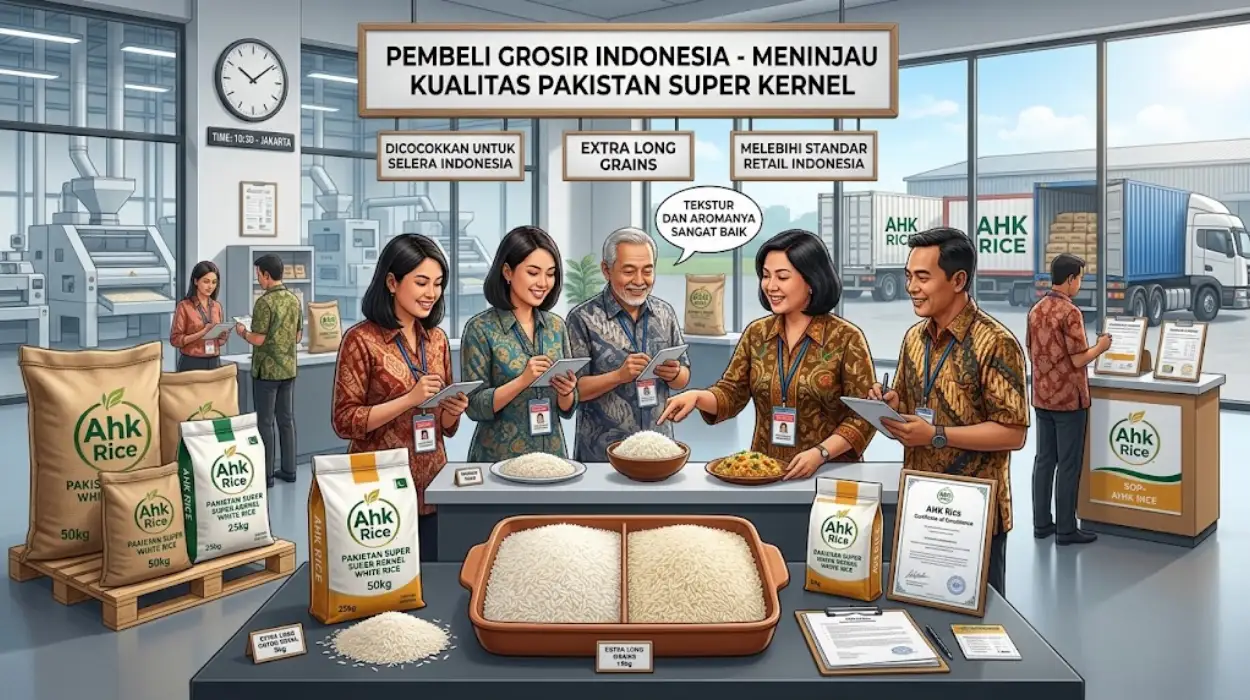
AHK Rice Pakistan Super Kernel White Rice Supply for Indonesian Retailers
AHK Rice is a practical supply option for Indonesian retailers seeking consistent Super Kernel White Rice, controlled specifications, export documentation, and retail-ready packing. Here is why: AHK Rice lists Super Kernel White Rice with 7.0–7.5 mm average grain length, ≤12.5% moisture, ≤2–3% broken grains, and double/silky polishing for Indonesia.
Indonesian retailers should confirm import eligibility before committing volume. Indonesia tightened rice-import controls in 2026, including approval requirements for restricted agricultural commodities. Pakistan and Indonesia are also discussing stronger trade cooperation, with rice identified as a priority sector. For product background, review what makes Pakistan Super Kernel White Rice different for Indonesian buyers.
What is the best solution for Indonesian retailers sourcing Super Kernel White Rice?
The best solution is a specification-led supply program covering grain quality, packing, samples, inspection, documents, and shipment planning before commercial loading.
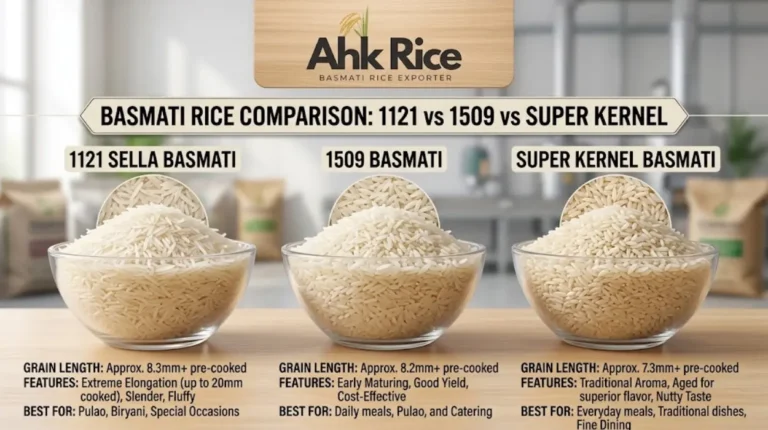
Super Kernel White Rice suits retailers seeking aromatic long-grain rice without moving directly into the highest-priced long-grain segment. AHK Rice positions Super Kernel for Indonesian applications including Nasi Goreng, Biryani, and daily meals.
The buying decision should start with a written specification. Define grain length, moisture, broken percentage, chalky grains, foreign matter, polishing level, crop year, packaging, and tolerance before requesting a commercial quotation.
AHK Rice lists bright-white colour, double/silky polishing, ≤12.5% moisture, and ≤3% chalky grains for its Indonesia Super Kernel specification. These values give retailers a measurable basis for sample approval.
Which specification should retailers approve?
A practical approval specification should use the following baseline.
| Attribute | AHK Rice Super Kernel White |
|---|---|
| Average grain length | 7.0–7.5 mm |
| Moisture | ≤12.5% |
| Broken grains | ≤2–3% |
| Chalky grains | ≤3% |
| Colour | Bright white |
| Polishing | Double / silky polished |
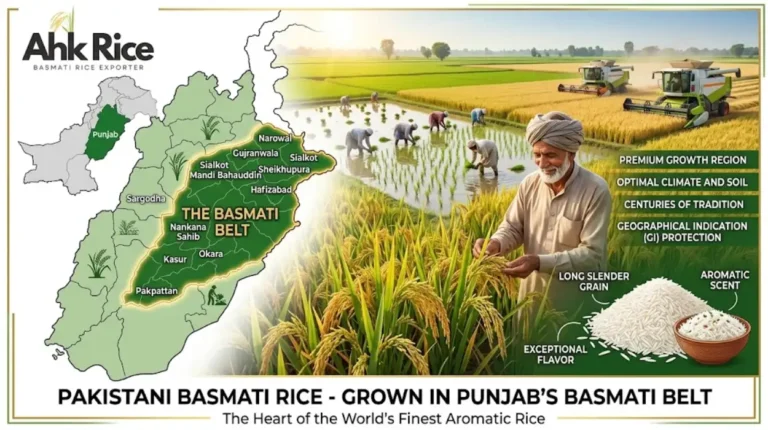
| Origin | Punjab, Pakistan |
S&P Global also publishes a Pakistan Super Kernel White Basmati assessment with a 2% broken specification, showing that tight broken-grain tolerances are commercially relevant in international trade specifications.
Retailers should approve the exact contract specification rather than relying only on the product name. A small difference in broken percentage can change the product’s appearance, retail positioning, and buying price.
With the target specification established, the next decision is selecting the exporter capable of controlling that specification.
Why choose AHK Rice for Super Kernel White Rice supply?
AHK Rice combines Pakistani origin, controlled milling, sorting, customizable packing, sample approval, and export logistics into one procurement workflow for Indonesian buyers.
AHK Rice sources Super Kernel from Punjab and mills the grain for uniformity. Its Indonesia product page states that the rice is cleaned, sorted, polished, and prepared for shipment to Jakarta or Surabaya.
The service is particularly useful for retailers requiring different pack formats. AHK Rice lists 1 kg, 2 kg, 5 kg, 10 kg, 20 kg, 29 kg, and 40 kg packaging options across PP, non-woven, cloth, jute, jar, and other formats.
Retailers can use AHK Rice to coordinate product selection, packaging, and export preparation instead of managing separate suppliers for each stage.
What does the supply process include?
A commercial supply workflow should follow these steps:
- Define the required grade, broken percentage, moisture, packing, crop, and quantity.
- Request the technical specification and current commercial offer.
- Review the specification against Indonesian retail requirements.
- Approve the physical sample before bulk production.
- Confirm packing artwork, bag material, markings, and shipment terms.
- Inspect the finished rice before loading.
- Load the approved quantity into export containers.
- Dispatch the shipment toward the nominated Indonesian port.
This process reduces specification disputes because the buyer approves the physical product before the commercial shipment.
Indonesian rice imports remain controlled, so the buyer should also confirm current eligibility, quota, and import documentation before shipment. Official Indonesian trade guidance lists import licensing mechanisms for business importers.
The service therefore has value beyond milling. The main benefit is connecting product approval with export execution.
What results can Indonesian retailers expect?
Retailers can expect a more predictable procurement process, consistent product specifications, flexible packaging, and shipment planning based on the approved sample and contract.
Product consistency is the primary commercial outcome. AHK Rice specifies Super Kernel White with a narrow grain-length range and controlled moisture. This helps retailers maintain a recognizable product presentation across replenishment orders.
Packaging flexibility creates another advantage. A retailer can select smaller consumer packs for supermarkets or larger packs for wholesale distribution. AHK Rice’s listed formats support both retail and bulk positioning.
How long does shipping to Indonesia take?
Shipping time depends on the selected port, vessel schedule, booking date, and transshipment conditions.
| Indonesian destination | Indicative sea transit | Suitable planning approach |
|---|---|---|
| Jakarta / Tanjung Priok | 18–28 days | Add booking and clearance buffer |
| Surabaya | 18–28 days | Confirm vessel schedule before loading |
| Other Indonesian ports | Quote-specific | Confirm route before contract |
The 18–28 day range is an indicative commercial transit estimate for Pakistan-to-Indonesia rice shipments and should not be treated as a guaranteed delivery period.
Retailers should separate production time from sea transit. A 20-day vessel journey does not mean the complete order arrives in 20 days. Sample approval, production, inspection, container booking, port handling, customs clearance, and inland delivery can extend the total procurement cycle.
Indonesia’s current import environment makes this planning more important. Rice imports are subject to policy controls, and requirements can change with domestic supply conditions.
With shipping expectations defined, the next commercial question is the total cost of securing an approved shipment.
What factors affect Super Kernel White Rice pricing?
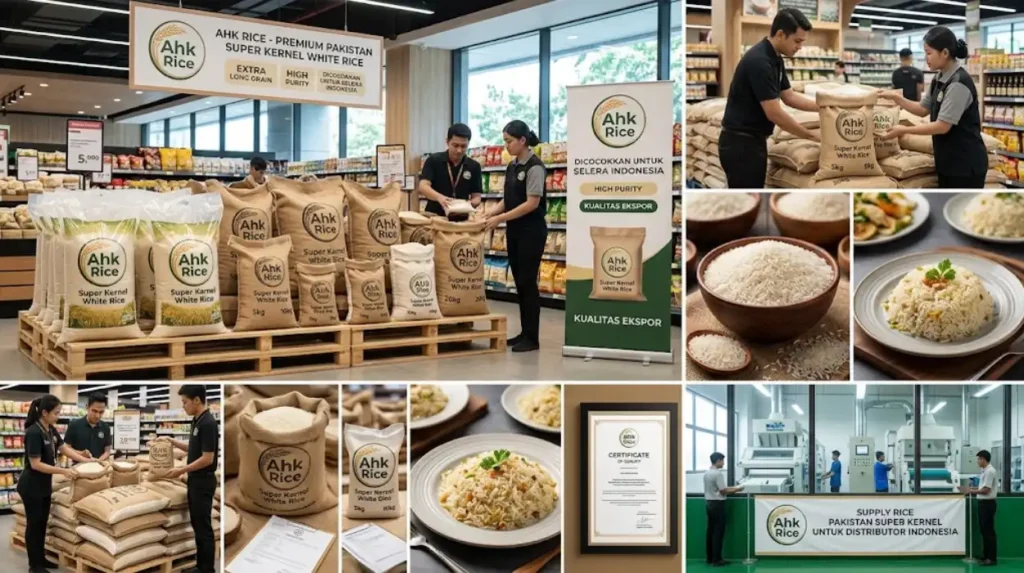
The final price depends on rice specification, crop, order quantity, packing, inspection, freight, destination, and current market conditions rather than one fixed per-ton figure.
FOB pricing changes with the selected specification. A lower broken tolerance can increase sorting requirements and product value. Retail packaging can also raise the landed cost compared with bulk PP bags.
Freight adds another variable. Ocean freight depends on the shipping line, container availability, route, season, and destination port. Retailers should therefore compare FOB and landed cost separately.
Packaging affects the quotation through bag material, printing, weight, inner liner, cartons, labels, and artwork. A 5 kg branded retail pack requires a different commercial calculation from a 40 kg bulk bag.
How much does the sample process cost?
AHK Rice’s Indonesia product page states that free samples up to 20 kg are available. Courier and destination charges should be confirmed separately because they depend on the delivery location and service selected.
A practical sample process looks like this:
| Stage | Buyer action | Cost position |
|---|---|---|
| Specification | Confirm required grade | No product cost |
| Sample request | Request up to 20 kg | Free sample stated by AHK Rice |
| Courier | Provide Indonesian delivery details | Quote separately |
| Testing | Compare physical and laboratory results | Buyer-specific |
| Approval | Confirm acceptable specification | No separate product charge |
| Commercial order | Confirm quantity and packing | Quoted per MT |
Retailers should avoid comparing sample prices alone. The correct comparison is landed cost against approved quality, packaging, inspection, and delivery reliability.
How should Indonesian retailers compare AHK Rice with another supplier?
Compare suppliers against the same specification, sample result, documentation, packing, shipment term, and landed-cost basis before selecting the lowest commercial offer.
A supplier offering a lower FOB price may not provide the same broken percentage, packaging quality, inspection arrangement, or documentation. A proper comparison therefore needs one standardized procurement sheet.
Retailers can use this framework:
| Decision factor | What to verify |
|---|---|
| Product | Super Kernel White specification |
| Quality | Moisture, broken, chalky, foreign matter |
| Sample | Physical approval before bulk order |
| Packing | Weight, material, printing, labeling |
| Logistics | Port, transit estimate, shipping term |
| Compliance | Current Indonesian import requirements |
| Commercial | FOB, freight, insurance, landed cost |
For a deeper specification comparison, retailers can also review how Indonesian retailers evaluate Pakistan Super Kernel White Rice specifications.
This approach turns supplier selection into a measurable decision rather than a brand-name comparison.
How can an Indonesian retailer get started?
Start with the required specification, target quantity, packaging format, destination port, and delivery timeline, then request a sample and commercial quotation.
Send the exporter the exact retail requirement first. Include the preferred grain specification, broken tolerance, moisture limit, packaging weight, private-label requirement, destination port, and expected order quantity.
AHK Rice can then align the product specification with the requested packaging and shipment structure. The physical sample should become the approval reference for the commercial order.
What information should the buyer provide?
Prepare these details before requesting a quotation:
- Grade: Super Kernel White Rice
- Quantity: Required metric tonnes
- Broken tolerance: Contractual percentage
- Moisture: Maximum acceptable level
- Packing: Retail or bulk format
- Branding: Private label or exporter packing
- Port: Jakarta, Surabaya, or another destination
- Trade term: FOB, CFR, or CIF
- Inspection: Required third-party or buyer inspection
Indonesian importers should independently verify current licensing and quota conditions before confirming shipment. Current regulations can restrict agricultural imports according to domestic supply and government approvals.
AHK Rice provides a commercially useful route for retailers that need Pakistani Super Kernel White Rice with defined specifications, sample approval, flexible packing, and export coordination. The correct decision is to approve the specification first, then compare the complete landed cost.
For a shipment-specific specification, sample, packing, and freight quotation, request a quote from AHK Rice.
Frequently Asked Questions
Is Super Kernel White Rice suitable for Indonesian retailers?
Yes, Super Kernel White Rice can serve premium and specialty retail positioning.
AHK Rice lists the product specifically for Indonesian buyers.
The listed specification includes 7.0–7.5 mm grain length.
Moisture is listed at ≤12.5%, with ≤2–3% broken grains.
Importers must confirm current Indonesian rice-import eligibility before ordering.
What is the minimum sample size available?
AHK Rice states that samples up to 20 kg are available free.
The sample should be reviewed before commercial production.
Buyers should compare grain length, broken percentage, colour, and moisture.
Courier or destination charges should be confirmed separately.
The approved sample should become the commercial quality reference.
How long does Pakistan rice take to reach Indonesia?
Indicative sea transit is around 18–28 days for Jakarta or Surabaya routes.
Actual transit depends on vessel schedules and routing.
Production and inspection time are separate from sea transit.
Port clearance and inland delivery add further time.
Retailers should confirm the shipment schedule before booking inventory.
What packaging can Indonesian retailers request?
AHK Rice lists multiple retail and bulk packaging formats.
Available weights include 1 kg, 2 kg, 5 kg, 10 kg, 20 kg, 29 kg, and 40 kg.
PP, non-woven, cloth, jute, and other formats are listed.
Private-label packaging can be discussed during order preparation.
Final packing depends on the confirmed commercial specification.
What should buyers confirm before placing an order?
Buyers should confirm specification, sample approval, quantity, packaging, price basis, port, documents, and import eligibility.
The product specification should be written into the purchase agreement.
The physical sample should be approved before bulk loading.
Current Indonesian import controls should be checked before shipment.
A complete landed-cost comparison should guide the final supplier decision.