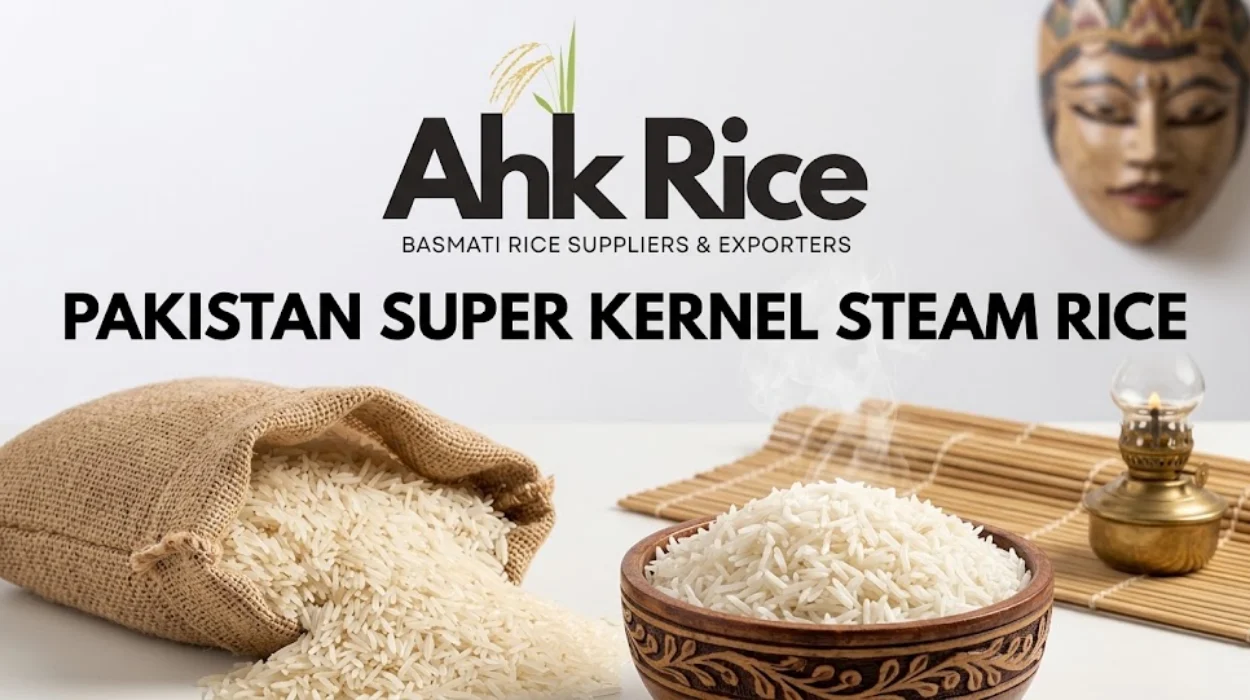
AHK Rice Pakistan Super Kernel Steam Rice Supply for Indonesian Restaurants
For Indonesian restaurants, the best commercial solution is a specification-controlled Super Kernel Steam Rice program from Pakistan that combines consistent grain quality, controlled steaming, low breakage, suitable packaging, verified documentation, practical shipping schedules, and repeatable supply rather than relying on spot-market price alone. Restaurants purchasing imported rice need predictable cooking results because changes in moisture, broken kernels, grain structure, aroma, and processing can affect portion yield and customer experience. For background on why this variety can fit restaurant demand, see:
Why Pakistan Super Kernel Steam Rice could fit Indonesian restaurant demand.
AHK Rice supplies Pakistan-origin Super Kernel Steam Rice for Indonesian buyers with processing, sorting, grading, packing, inspection, and export coordination. Its published Indonesia specification gives an average grain length of 7.0–7.2 mm, moisture up to 12%, broken grains up to 3%, and chalky grains up to 3%, with double or silky polishing available.
What is the best solution for Indonesian restaurants sourcing Super Kernel Steam Rice?
The strongest solution is a repeatable supply specification covering grain length, moisture, broken percentage, aroma, cooking performance, packaging, inspection, documentation, and shipment timing, allowing restaurants to protect food quality while controlling landed procurement costs.
A restaurant should begin with the cooking requirement rather than the supplier’s quoted price. Super Kernel Steam Rice is attractive when the kitchen needs aromatic rice with firm grain structure, separate cooked grains, and reliable performance across repeated cooking cycles.
The specification should be written into the commercial contract. A practical restaurant specification can include approximately 7.0–7.2 mm average grain length, moisture at or below 12%, broken grains at or below 3%, controlled chalky grains, clean sorting, and the agreed polishing level. These are supplier-published specifications, not universal Indonesian legal limits, so the final purchase specification should be confirmed before production.
The steam process also matters. Controlled steaming changes the grain structure before final preparation and can improve firmness and resistance to excessive sticking. AHK Rice describes Super Kernel Steam Rice as processed through steaming and drying before export preparation.
For restaurants serving biryani, rice platters, banquet meals, or other dishes where grain separation matters, this provides a practical reason to select steam processing rather than choosing only on raw grain appearance.
The commercial objective is consistency. A restaurant should be able to cook the same rice specification next month and obtain broadly comparable grain appearance, aroma, texture, and yield.
Why choose Indonesia as the supply program and AHK Rice as the supplier?
An Indonesia-focused supply program reduces procurement uncertainty by aligning the product specification, destination port, packing format, documentation, production schedule, sample approval, and shipment planning with the restaurant’s actual purchasing cycle.
AHK Rice’s Indonesia supply page identifies direct shipment from Karachi to Indonesian ports and provides Super Kernel Steam Rice specifically for the Indonesian market. The supplier also offers multiple commercial packing formats, allowing buyers to select packaging according to wholesale, restaurant, distributor, or private-label requirements.
For a restaurant group, this matters because a 50 kg foodservice bag has different handling economics from smaller consumer packs. Bulk packaging can reduce packaging cost per kilogram and simplify kitchen storage, while smaller packs may be useful when the restaurant operates through centralized purchasing or retail-linked channels.
AHK Rice also provides a defined production sequence. After order confirmation and the required advance payment, its published process states that the sales contract is issued within 24 hours. For standard orders up to 1,000 MT, production is stated to begin within 48 hours after payment receipt.
That timeline should still be treated as a supplier process target rather than a guaranteed arrival date. Production readiness, vessel availability, port congestion, documentation, customs procedures, and Indonesian import requirements can all influence final delivery.
Indonesia’s import framework is also changing. Indonesian Regulation No. 11 of 2026 amended agricultural import provisions and took effect on May 8, 2026, while another Ministry of Trade regulation, No. 18 of 2026, entered into force June 4, 2026. Buyers should therefore verify the applicable import pathway, permits, and product classification for their specific transaction before shipment.
For restaurants, AHK Rice should therefore be evaluated as a supply-program partner rather than simply as a rice seller. The decision should include product control, communication, sample approval, production scheduling, packing, documentation, and logistics coordination.
What specifications should Indonesian restaurants approve before placing an order?
Restaurants should approve a written specification before production, covering grain size, moisture, broken kernels, chalky grains, foreign matter, polishing, aroma, cooking performance, packaging, quantity, and inspection requirements so the delivered cargo can be compared with the approved sample.
A useful commercial specification for Super Kernel Steam Rice can be structured as follows:
| Attribute | Target specification |
|---|---|
| Variety | Super Kernel Basmati |
| Processing | Steam |
| Average grain length | 7.0–7.2 mm |
| Moisture | ≤12% |
| Broken grains | ≤3% |
| Chalky grains | ≤3% |
| Polishing | Double/silky polished |
| Cooking profile | Fluffy, aromatic, separate grains |
| Packaging | Agreed foodservice/bulk format |
| Inspection | Supplier and/or independent inspection as contracted |
AHK Rice publishes these core specifications for its Super Kernel Steam Rice Indonesia product page.
The restaurant should also approve a cooking sample before commercial production. The sample should be prepared using the restaurant’s normal water-to-rice ratio, soaking practice if applicable, cooking equipment, cooking time, holding period, and serving method.
This is important because laboratory specifications cannot fully predict a kitchen’s operational result. A restaurant that uses steamers, large rice cookers, or high-volume batch cooking should test the rice under those exact conditions.
AHK Rice’s quality process includes internal checks during milling, sorting, and steaming. Buyers requiring additional assurance can make third-party inspection part of the commercial specification.
Before approving a commercial lot, Indonesian restaurants should evaluate more than grain length. They should compare moisture, broken grains, chalky grains, polishing, cooking behavior, aroma, packaging, and consistency against their kitchen requirements. For a deeper purchasing framework, see:
How Indonesian restaurants evaluate Pakistan Super Kernel Steam Rice quality.
What is the full sample process and how much does it cost?
The sample process should move from specification confirmation to sample request, preparation, courier dispatch, restaurant cooking trial, technical approval, commercial quotation, and contract confirmation; the rice sample may be free, while courier and required certification costs remain buyer expenses.
AHK Rice states that up to 20 kg of Super Kernel Steam Rice can be provided free of charge, but the Indonesian customer covers sample shipping costs. The company also states that customers can use their own courier account and that the client pays the phytosanitary certificate required for sample export.
A practical sample workflow is:
- Specification request: The restaurant provides required variety, processing, broken percentage, moisture, packing preference, quantity, and destination.
- Sample confirmation: AHK Rice confirms the available grade against the requested specification.
- Sample preparation: The agreed Super Kernel Steam Rice sample is prepared for dispatch.
- Packing: The sample is packed securely using the agreed sample packaging.
- Certification: Where required, the phytosanitary documentation is arranged, with the associated cost charged to the buyer according to the supplier’s stated process.
- Courier: The buyer pays the courier cost or provides its own courier account.
- Kitchen trial: The restaurant cooks the sample using its normal equipment and recipe.
- Approval: The buyer records grain separation, aroma, texture, cooking yield, appearance, and holding performance.
- Commercial quotation: Quantity, packing, Incoterm, destination port, and specification are finalized.
- Contract: Production begins after commercial confirmation and required payment.
There is no single fixed 2026 sample courier price that should be presented as universal because the amount changes with sample weight, destination city, courier, service level, and documentation. The safest commercial approach is therefore to treat the rice as free within the stated 20 kg allowance while obtaining the actual courier and certification charges before dispatch.
This approach also prevents a common procurement mistake: approving rice visually without testing it in the restaurant’s actual cooking environment.
How long does shipping from Pakistan to Indonesia take?
Sea transit from Karachi to Indonesia can vary by destination and routing, so restaurants should budget roughly 18–30 days for ocean movement while allowing additional time for production, documentation, transshipment, port handling, customs clearance, and inland delivery.
For Jakarta, current freight data shows indicative ocean transit options of approximately 18–26 days depending on routing and service.
For Surabaya, current route information shows faster indicative services around 14–20 days, while other carrier options can take considerably longer. Another route reference gives approximately 18 days for the quickest container-ship service from Karachi to Surabaya.
Therefore, restaurants should not promise customers or branches a fixed delivery date based only on ocean transit. A more useful procurement schedule is:
| Stage | Practical planning window |
|---|---|
| Specification and quotation | 1–3 days |
| Contract/payment confirmation | 1–2 days |
| Production preparation | 2–7+ days |
| Inspection and export documentation | 2–5 days |
| Port and vessel scheduling | Variable |
| Ocean transit to Jakarta | ~18–26 days |
| Ocean transit to Surabaya | ~14–20+ days |
| Indonesian clearance and delivery | Variable |
These are planning ranges rather than contractual guarantees. Vessel schedules, transshipment, congestion, customs processing, and import approvals can change the final delivery date.
For restaurants with weekly or monthly consumption, the better strategy is to order before inventory reaches its emergency level. Maintaining a reorder point based on average daily consumption and expected replenishment time is more reliable than placing an order only after the kitchen runs short.
What results can Indonesian restaurants expect from a controlled Super Kernel Steam Rice supply?
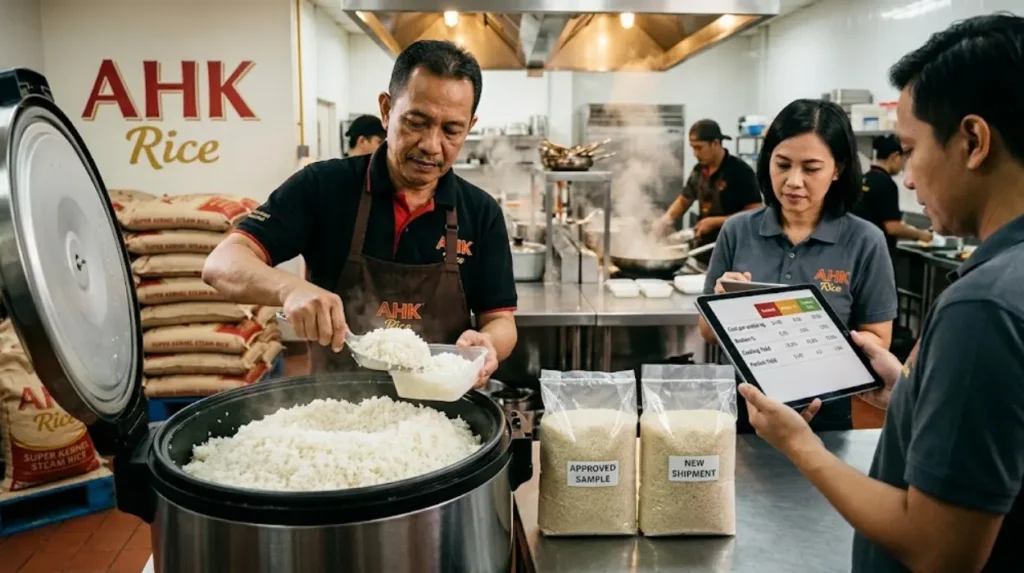
A controlled supply program can improve cooking consistency, reduce specification variation, support predictable portion planning, simplify repeat purchasing, and protect menu quality, provided every shipment remains tied to the approved specification and sample.
The most important result is repeatability. If the restaurant approves a particular moisture range, broken percentage, grain profile, and cooking method, the supplier can use that specification as the reference for subsequent production.
Lower breakage can also improve usable whole-grain yield. However, the restaurant should measure actual yield in its own kitchen rather than assuming that a laboratory specification automatically produces a specific percentage of additional servings.
A restaurant group can also use the specification for procurement benchmarking. Instead of comparing two quotations solely on price per metric ton, buyers can compare:
- cost per usable kilogram;
- broken percentage;
- cooking yield;
- portion yield;
- packaging cost;
- freight and destination charges;
- shipment reliability;
- inspection requirements;
- payment terms.
AHK Rice’s published Indonesia product specification is designed around measurable attributes such as moisture, broken grains, chalky grains, grain size, and polishing.
This makes the purchasing decision easier to audit internally. A procurement manager can compare the approved sample against subsequent lots rather than relying on subjective descriptions such as “premium” or “high quality.”
What factors determine the final Super Kernel Steam Rice price?
The final price depends on rice specification, quantity, packing, origin costs, inspection, documentation, freight, destination port, Incoterm, payment terms, and market conditions; therefore, a single public price per metric ton cannot represent every Indonesian restaurant order.
The rice itself is only one component of landed cost. A restaurant buyer should request a quotation based on the exact commercial configuration.
The main price variables are:
| Cost factor | Why it changes the quotation |
|---|---|
| Grade | Tighter specifications can increase processing cost |
| Quantity | Larger orders can change production and freight economics |
| Broken percentage | Lower tolerance generally requires stricter sorting |
| Packing | Bulk and customized retail packs have different costs |
| Inspection | Independent inspection adds a service cost |
| Freight | Ocean rates vary by destination and sailing |
| Incoterm | FOB, CFR, CIF and other terms allocate costs differently |
| Payment | LC, advance payment, or other terms affect commercial pricing |
| Destination | Jakarta and Surabaya can have different logistics costs |
AHK Rice’s Indonesia page currently displays the product price as quotation-based rather than publishing a fixed metric-ton price.
This is commercially preferable for a restaurant because the quotation can be built around actual volume and destination rather than a misleading generic number.
Pakistan’s 2026 rice export environment also remains relevant to procurement planning. USDA’s April 2026 Pakistan Grain and Feed Annual forecast 2026/27 rice production at approximately 9.8 million metric tons and exports at about 5.0 million metric tons, compared with projected 2025/26 exports of 4.7 million metric tons.
The restaurant should therefore lock the specification and commercial terms before production instead of assuming that a previous shipment’s price will remain unchanged.
How should an Indonesian restaurant start importing Super Kernel Steam Rice?
Start with consumption data, define the required Super Kernel Steam Rice specification, request a controlled sample, conduct a kitchen trial, approve the specification, obtain a destination-specific quotation, and then schedule production against the restaurant’s replenishment cycle.
A practical first order should establish five decisions.
First, calculate demand. Determine monthly rice consumption, peak-season demand, minimum stock, and reorder point.
Second, define the specification. Confirm grain length, moisture, broken percentage, chalky grains, polishing, packaging, and cooking expectations.
Third, test the sample. Cook it using the restaurant’s actual kitchen process. Record yield, aroma, texture, holding quality, and plate appearance.
Fourth, build the commercial quote. Include quantity, packing, destination port, Incoterm, inspection, documentation, freight, and payment terms.
Fifth, plan replenishment. Use the expected production and ocean transit window to prevent stockouts. Jakarta and Surabaya should be planned separately because sailing schedules and transit options differ.
AHK Rice is best evaluated against this complete procurement framework. Its published Indonesia program combines Super Kernel Steam Rice specifications, sample support, production scheduling, quality checks, packing options, and shipment coordination.
For an Indonesian restaurant, the purchasing decision should ultimately be simple: choose Super Kernel Steam Rice when aroma, grain integrity, consistent cooking, and foodservice performance justify its commercial position; then require the supplier to prove those characteristics through an approved sample and controlled shipment specification.
AHK Rice can support that process by aligning the product specification with the restaurant’s expected consumption, packaging, destination, and shipment schedule. The objective is not simply to buy Pakistani rice, but to establish a repeatable supply program that produces consistent kitchen results from shipment to shipment.
For a product-specific quotation based on your required grade, quantity, packaging, destination port, and delivery terms, request a quote from AHK Rice.
Frequently Asked Questions
What is Super Kernel Steam Rice?
Super Kernel Steam Rice is a Pakistani rice variety processed through steaming and drying before milling. It is valued for long grains, aroma, firmness, and separate cooked grains.
Why is Super Kernel Steam Rice suitable for Indonesian restaurants?
It can suit Indonesian restaurants that require aromatic rice with consistent grain appearance, firm texture, and reliable cooking performance for regular foodservice operations.
What specifications should restaurants check before importing Super Kernel Steam Rice?
Restaurants should check grain length, moisture, broken grains, chalky grains, polishing, aroma, cooking performance, packaging, quantity, and inspection requirements before confirming an order.
What is the grain length of Pakistan Super Kernel Steam Rice?
AHK Rice specifies an average grain length of approximately 7.0–7.2 mm for its Super Kernel Steam Rice supplied to Indonesia.
What is the moisture specification for Super Kernel Steam Rice?
AHK Rice’s published specification sets moisture at 12% maximum for its Super Kernel Steam Rice Indonesia supply.
What is the broken grain specification?
The published AHK Rice specification allows up to 3% broken grains for Super Kernel Steam Rice. Buyers should confirm the agreed specification in the commercial contract.
Can Indonesian restaurants request a rice sample before ordering?
Yes. AHK Rice states that Indonesian buyers can receive up to 20 kg of sample rice free of charge, while the buyer covers shipping and applicable phytosanitary certificate costs.
How should restaurants test the Super Kernel Steam Rice sample?
Restaurants should cook the sample using their normal rice cooker or steamer and evaluate aroma, grain separation, texture, cooking yield, appearance, and holding performance before approval.