How Do Indonesian Buyers Compare Pakistan Super Kernel Brown Rice Options?
Indonesian buyers comparing Pakistan Super Kernel Brown Rice options get the strongest result by evaluating grain specification, purity, moisture, packaging, landed cost, shelf life, and import readiness together, rather than selecting the lowest FOB price. In 2026, this comparison is especially important because Indonesian rice imports operate under regulated import procedures, while brown rice has tighter storage considerations than milled white rice.
For buyers new to the category, understanding:
Why Pakistani Super Kernel Brown Rice fits Indonesian specialty markets provides the right product context before supplier comparison. Super Kernel is a long-grain Basmati variety associated with Punjab, while brown rice retains the bran layer after dehusking. AHK Rice lists Super Kernel Brown Rice at approximately 7.0–7.4 mm, with moisture up to 12.5% and broken grains at 2–3%.
What are the available Super Kernel Brown Rice solutions for Indonesian buyers?
Indonesian buyers can compare three practical sourcing solutions: premium Super Kernel Brown Rice, alternative Pakistani Basmati brown grades, and customised private-label supply. Each solution targets a different balance of grain length, price, retail positioning, packaging, volume, and inventory requirements.
Premium Super Kernel Brown Rice
Super Kernel Brown Rice is the direct premium option. The bran remains intact, giving the product a brown appearance, firmer bite, and nutty flavour. AHK Rice processes this variety for export with specifications based on grain size, moisture, broken percentage, purity, and packing requirements.
For Indonesian specialty retailers, this option fits health-focused shelves, premium grocery stores, organic-oriented product ranges, and restaurants that require an aromatic whole-grain rice.
1121 Brown Basmati
1121 Brown Basmati provides a longer-grain alternative. It is useful when visual grain length receives more attention than the specific Super Kernel identity.
The commercial comparison is straightforward. 1121 normally occupies a premium positioning because of its extra-long grain characteristics. Super Kernel provides a strong balance between aromatic identity and grain appearance.
1509 Brown Basmati
1509 Brown Basmati is the cost-conscious alternative within Pakistan’s Basmati range. AHK Rice describes 1509 as a cost-competitive Basmati variety with strong export relevance across Southeast Asia and other markets.
For buyers testing Indonesian demand, 1509 can reduce the product-entry cost while preserving the Basmati category.
Private-label and customised packing
Packaging is a separate sourcing decision from rice grade. Indonesian buyers can request 1 kg, 5 kg, 10 kg, 20 kg, 40 kg, or bulk formats depending on the sales channel. AHK Rice lists PP, non-woven, plastic jar, box, jute, and cloth packaging options for Super Kernel Brown Rice.
This creates two distinct procurement models: bulk import for local repacking and finished private-label retail packaging.
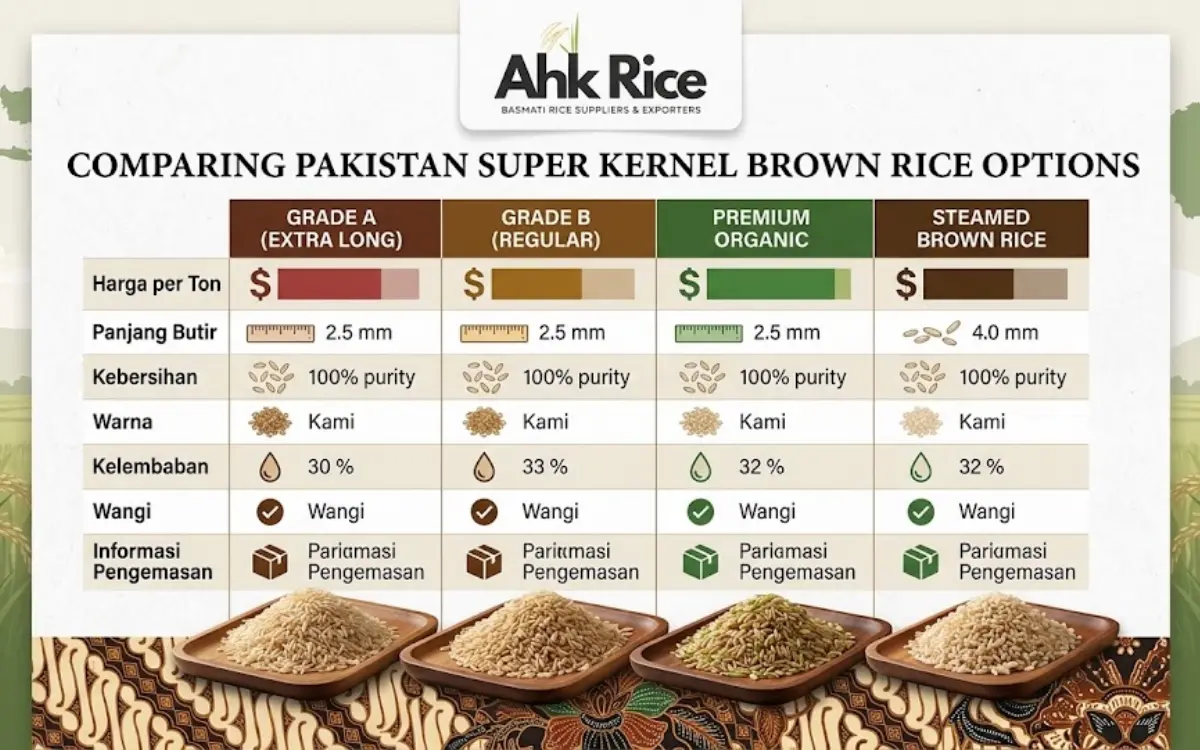
How do different Pakistan brown rice options compare?
Super Kernel Brown Rice provides the strongest middle position for Indonesian specialty retail because it combines premium Basmati identity, approximately 7.0–7.4 mm grains, whole-grain positioning, and flexible packaging without moving entirely into the highest-cost extra-long-grain segment.
| Attribute | Super Kernel Brown | 1121 Brown Basmati | 1509 Brown Basmati |
|---|---|---|---|
| Product position | Premium aromatic whole grain | Extra-long premium whole grain | Cost-conscious Basmati |
| Typical grain profile | 7.0–7.4 mm | Approximately 8 mm class | Approximately 7 mm class |
| Bran | Retained | Retained | Retained |
| Aroma | Distinct Basmati aroma | Strong Basmati aroma | Mild-to-moderate Basmati aroma |
| Broken target | 2–3% depending on specification | Usually low-broken premium grade | Usually low-broken commercial grade |
| Moisture target | ≤12.5% at AHK Rice Indonesia specification | Buyer specification | Buyer specification |
| Best application | Specialty retail and premium foodservice | Premium retail | Value-oriented specialty retail |
| Procurement priority | Balance of quality and price | Grain length and premium presentation | Price and market entry |
Specifications must remain contractual rather than inferred from variety names. A buyer should define moisture, broken grains, foreign matter, chalkiness, crop year, purity, packing, and inspection requirements in the purchase specification.
S&P Global’s rice specification methodology also demonstrates why objective parameters matter in international rice procurement. Its Pakistan Super Kernel specification uses measurable quality factors such as moisture, damaged kernels, broken grains, chalky grains, foreign grains, foreign matter, red rice, and milling degree.
What price per MT should Indonesian buyers compare in 2026?
Price comparison requires separating current FOB benchmarks from shipment-specific brown-rice quotations. Public August 2026 Pakistan pricing places Super Kernel Basmati White at approximately $1,165–$1,205 per MT FOB Karachi, while recent brown-rice trade records provide a useful market benchmark rather than a live Indonesian quote.
Current August 2026 public FOB data lists Super Kernel Basmati White at $1,165–$1,205 per MT. The same source lists 1121 Basmati White at $1,165–$1,205 per MT and D98 at $980–$1,020 per MT. These figures are indicative and shipment-dependent.
For brown rice, recent documented Pakistan export transactions provide a more relevant benchmark. A May 2025 shipment of 350 MT of Super Kernel Basmati Brown Rice was recorded at about $959/MT, while another 500 MT shipment was approximately $958/MT. These are historical transaction values, not August 2026 quotations.
| Comparison point | Indicative price position |
|---|---|
| Super Kernel Brown Rice | Recent public transaction benchmark: ~$958–$959/MT |
| Super Kernel White Rice | August 2026 FOB: $1,165–$1,205/MT |
| D98 Basmati White | August 2026 FOB: $980–$1,020/MT |
| 1121 Basmati White | August 2026 FOB: $1,165–$1,205/MT |
| Indonesian landed cost | Shipment-specific; add freight, duties, clearance and local costs |
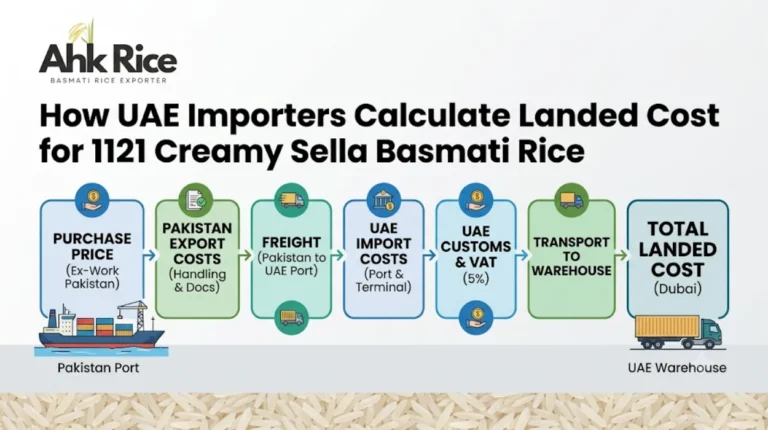
The correct Indonesian purchasing calculation is therefore FOB + ocean freight + insurance where applicable + Indonesian import costs + port and clearance charges + local distribution + packaging.
A brown-rice buyer should request a current FOB or CNF quotation for the exact specification instead of applying an old export transaction directly to a 2026 purchase.
Which grades fit different Indonesian market regions?
Greater Jakarta and Java favour premium specifications when buyers target specialty retail, modern grocery, health-focused consumers, and premium foodservice; Bali suits premium hospitality and wellness positioning, where packaging, consistency, freshness, and reliable replenishment become stronger decision factors.
Greater Jakarta and Java
Greater Jakarta is the stronger candidate for a premium packaged Super Kernel Brown Rice proposition. Buyers targeting modern retail can specify:
- 1 kg or 2 kg consumer packs
- 5 kg family packs
- 7.0–7.4 mm grain specification
- ≤12.5% moisture target
- 2–3% maximum broken target
- clear Indonesian labelling
- batch and expiry information
- private-label presentation
The product story focuses on whole-grain characteristics, Pakistani Basmati identity, aroma, and premium positioning.
Bali and premium hospitality
Bali provides a different procurement case. Hotels, resorts, restaurants, wellness businesses, and specialty food distributors require consistent cooking performance and dependable supply.
Bulk or foodservice packaging becomes more practical. Buyers can evaluate 20 kg or 40 kg packaging alongside smaller retail packs. The decision shifts from shelf presentation toward cooking consistency, delivered cost, inventory turnover, and documentation.
Indonesia’s food labelling framework requires important information such as product name, ingredients where applicable, net weight, producer or importer details, production information, expiry information, and required registration information for applicable processed foods.
How does shelf life affect the comparison?
Shelf life is a major disadvantage of brown rice compared with white rice because the retained bran contains oil that oxidises during storage. Buyers should therefore prioritise recent crop, controlled moisture, protective packaging, inventory rotation, and appropriate storage conditions.
Brown rice generally has a shorter practical quality life than milled white rice. USDA research identifies a typical brown-rice shelf life of approximately three to six months because bran oils undergo hydrolytic and oxidative deterioration.
Iowa State University gives a practical storage range of 3–6 months at room temperature, 6–12 months refrigerated, and 12–18 months frozen for uncooked brown rice.
Therefore, an Indonesian importer should not select a supplier based on a generic “18–24 month shelf life” claim without checking the contractual shelf-life specification, packaging, storage temperature, crop date, and supporting quality documentation.
| Market region | Preferred grade | Preferred pack | Shelf-life priority | Commercial use |
|---|---|---|---|---|
| Greater Jakarta & Java | Premium Super Kernel Brown | 1–5 kg retail | High | Specialty retail |
| Bali | Premium Super Kernel Brown | 5–20 kg / private label | Very high | Hotels, wellness, restaurants |
| Jakarta foodservice | Consistent commercial grade | 20–40 kg | High | Restaurants |
| Java distributors | Mixed retail grade | 5–20 kg | High | Wholesale distribution |
| Premium nationwide | High-purity specification | Custom | Very high | Specialty grocery |
The comparison shows why smaller, fresher purchasing cycles can outperform a low-price large shipment when brown rice is sold through premium channels.
Which method works best for different Indonesian buyers?
The best sourcing method depends on sales channel, expected turnover, price sensitivity, and packaging requirements. Specialty retailers benefit from premium Super Kernel specifications, while foodservice buyers prioritise consistent bulk supply and distributors prioritise landed cost, documentation, and scalable replenishment.
For specialty retailers
Premium Super Kernel Brown Rice is the strongest fit. Retailers can differentiate the product through grain appearance, Basmati identity, whole-grain positioning, and private-label packaging.
For hotels and restaurants
Bulk Super Kernel Brown Rice provides a more efficient format. Buyers can prioritise consistent cooking results, moisture, broken percentage, packaging strength, and repeat shipment specifications.
For price-sensitive distributors
1509 Brown Basmati becomes a stronger comparison point. It gives distributors a Basmati product with a different cost-positioning strategy.
For premium grain-focused retailers
1121 Brown Basmati deserves comparison. Its extra-long grain profile gives stronger visual differentiation, although the buyer must validate whether the additional grain-length premium improves retail sell-through.
What are the pros and cons of each approach?
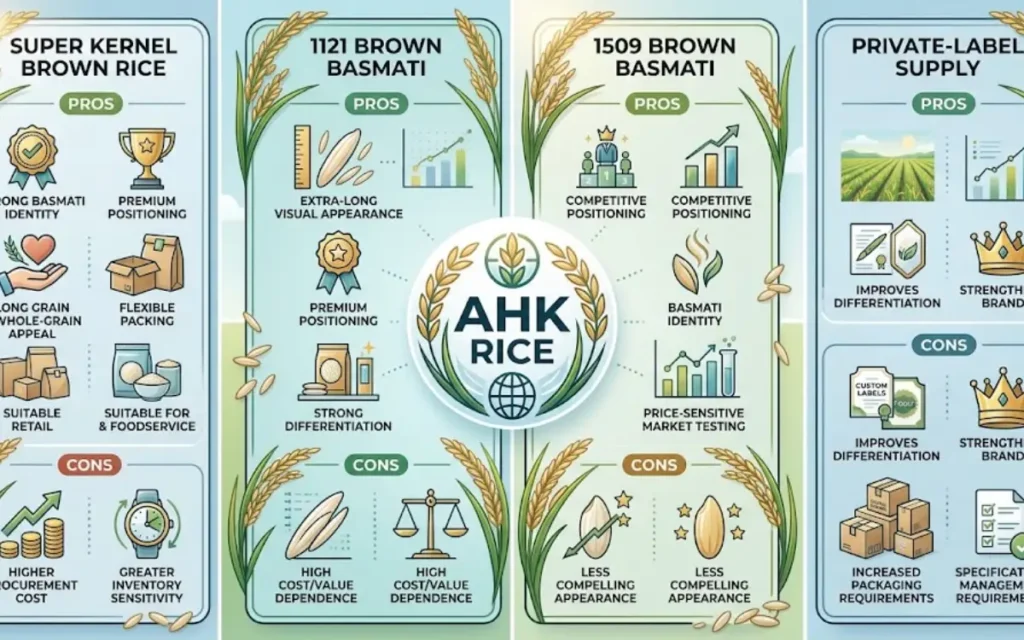
Premium Super Kernel offers the best balance of aromatic identity and specialty-market positioning, while 1121 maximises grain-length presentation and 1509 supports price-sensitive entry. Private-label supply improves differentiation but increases packaging and specification-management requirements.
Super Kernel Brown Rice
Pros: strong Basmati identity, premium positioning, long grain, whole-grain appeal, flexible packing, and suitability for retail and foodservice.
Cons: higher procurement positioning than lower-cost long-grain rice and greater inventory sensitivity because the bran remains intact.
1121 Brown Basmati
Pros: extra-long visual appearance, premium positioning, and strong differentiation on retail shelves.
Cons: the premium only makes commercial sense when customers value grain length enough to support the additional cost.
1509 Brown Basmati
Pros: competitive positioning, Basmati identity, and suitability for price-sensitive market testing.
Cons: less compelling when the retail proposition depends heavily on extra-long grain appearance.
Private-label packaging
Pros: stronger brand differentiation, controlled retail presentation, and flexible pack sizes.
Cons: higher packaging coordination requirements, artwork approval, minimum order considerations, and greater inventory complexity.
What five factors should Indonesian buyers use for the final decision?
Indonesian buyers should rank specification compliance first, then landed cost, shelf-life control, market fit, and supplier execution. This framework prevents FOB price from becoming the only selection criterion and connects product quality directly with retail turnover and import requirements.
| Decision factor | What to evaluate | Buyer question |
|---|---|---|
| 1. Specification | Grain, moisture, broken, purity | Does the sample match the contract? |
| 2. Landed cost | FOB, freight, duties, clearance | What is the actual cost per MT in Indonesia? |
| 3. Shelf life | Crop date, packaging, storage | How much saleable inventory life remains on arrival? |
| 4. Market fit | Retail, foodservice, premium segment | Does the grade match the customer willing to pay? |
| 5. Supplier execution | Processing, inspection, documents | Can the supplier reproduce the same specification every shipment? |
The fifth factor is particularly important for repeat procurement. A supplier that delivers a lower-priced first shipment but changes grain quality, moisture, packaging, or broken percentage between shipments creates a larger commercial problem than a slightly higher initial FOB price.
AHK Rice provides end-to-end processing, grading, colour sorting, customised packaging, and export documentation from its Punjab base. Its Indonesia-specific Super Kernel Brown Rice specification lists 7.0–7.4 mm grain length, ≤12.5% moisture, and ≤2–3% broken grains.
Indonesia’s import framework also requires buyers to check the applicable import approval route. Indonesia’s Ministry of Trade lists current agricultural import rules under Permendag No. 11/2026, while rice import requirements distinguish between purposes and importer categories.
For buyers ready to move from evaluation to supplier selection, the most relevant next step is to review:
AHK Rice Pakistan Super Kernel Brown Rice supply for Indonesian specialty retailers, where product specifications, packaging, sampling, and export execution become the focus.
Frequently Asked Questions
How do Indonesian buyers compare Pakistan Super Kernel Brown Rice?
Indonesian buyers compare Super Kernel Brown Rice based on grain length, moisture, broken percentage, purity, aroma, crop date, packaging, shelf life, FOB price, landed cost, and supplier export capability.
What is the typical grain length of Pakistan Super Kernel Brown Rice?
Pakistan Super Kernel Brown Rice commonly falls within the 7.0–7.4 mm grain-length range under AHK Rice’s Indonesia-specific specification. Buyers should confirm the contracted specification before shipment.
What moisture level is suitable for Super Kernel Brown Rice?
A suitable commercial specification is up to 12.5% moisture. Buyers should verify moisture through pre-shipment inspection and maintain appropriate storage conditions after arrival.
How does Super Kernel Brown Rice compare with 1121 Brown Basmati?
Super Kernel provides a strong balance between long-grain appearance, Basmati identity, and price positioning. 1121 Brown Basmati focuses more strongly on extra-long grain presentation and premium positioning.
Is 1509 Brown Basmati cheaper than Super Kernel Brown Rice?
1509 generally occupies a more cost-conscious position within Pakistani Basmati varieties. Actual pricing depends on crop year, quality specification, order volume, packaging, freight, and shipment terms.