Which Pakistan Basmati Quality Parameters Should Indonesian Buyers Compare Before Ordering?
Indonesian buyers should compare grain length, moisture, broken percentage, purity, cooking performance, processing grade, and packaging before ordering Pakistan Basmati rice. Here is why: these seven parameters determine product consistency, cooking results, storage performance, and commercial value.
Pakistan Basmati rice offers several quality profiles for Indonesian retail, wholesale, and foodservice operations. Understanding how packaging protects Pakistani Basmati rice during shipment to Indonesia helps buyers connect physical grain quality with transport performance. The correct comparison begins with the rice specification, not the supplier’s price.
Pakistan cultivates Basmati rice in Punjab, where climate, irrigation, soil, and harvesting practices influence grain development. Pakistani exporters supply 1121, Super Kernel, and 1509 varieties. Each variety serves different commercial requirements. Indonesian importers should compare these varieties against their intended retail or foodservice application.
What are the available Pakistan Basmati quality solutions?
The main solutions are 1121, Super Kernel, and 1509 Basmati rice, supplied as White, Steam, Golden Sella, or Creamy Sella. Here is why: each variety and processing method creates different grain characteristics, cooking behavior, and storage requirements.
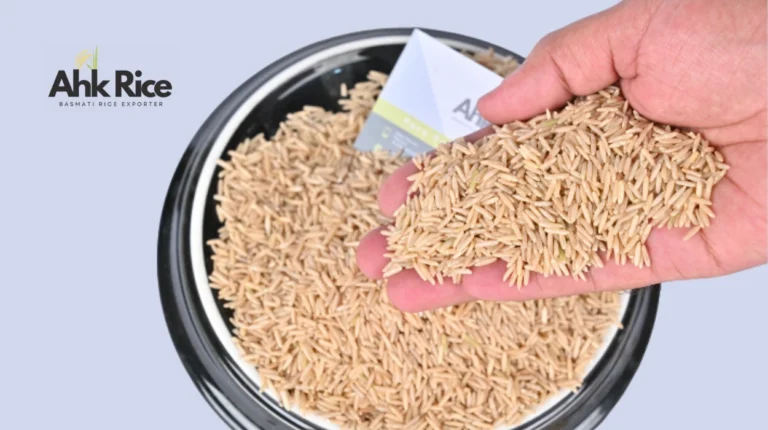
Pakistan Basmati rice quality begins with variety selection. The variety determines the natural grain shape, aroma, and cooking potential. Processing then influences moisture, appearance, texture, and storage stability. Buyers should compare both elements together.
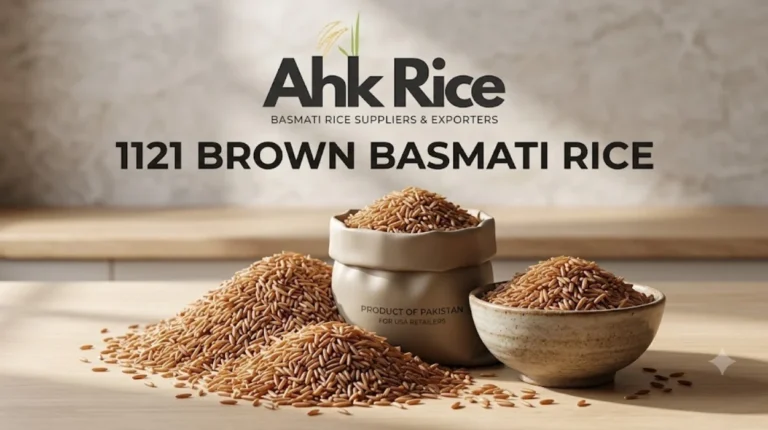
1121 Basmati rice
1121 Basmati is a long-grain variety recognized for its slender appearance and strong elongation during cooking. The variety suits premium retail, restaurants, catering, and institutional foodservice. Buyers compare 1121 against other varieties for grain length, aroma, and cooked presentation.
1121 Steam uses steam treatment during processing. The method improves grain firmness and reduces breakage during cooking. 1121 Golden Sella uses parboiling before drying and milling. This process produces a firmer grain with stronger storage performance.
Super Kernel Basmati rice
Super Kernel Basmati is a traditional Pakistani variety with a distinctive aroma and elongated cooked grain. It suits buyers seeking authentic Basmati character. Super Kernel Steam supports restaurant and catering applications that require attractive cooked grains and consistent texture.
Super Kernel Golden Sella supports wholesale and foodservice distribution. The processing method strengthens the grain and improves handling during storage and preparation.
1509 Basmati rice
1509 Basmati is a long-grain variety used in retail, foodservice, and institutional supply. Its commercial appeal comes from its elongated grain and competitive positioning. 1509 Steam suits buyers seeking a cost-conscious premium product with attractive cooked presentation.
1509 Golden Sella offers a firmer grain and practical storage performance. The choice depends on the buyer’s cooking process, target price, and distribution conditions.
Which processing types should Indonesian buyers compare?
White, Steam, Golden Sella, and Creamy Sella provide four main processing options for comparison. Here is why: processing changes grain firmness, moisture behavior, cooking texture, and storage performance.
| Processing type | Main characteristic | Suitable application |
|---|---|---|
| White | Natural polished grain with soft cooking texture | Retail and restaurants |
| Steam | Steam-treated grain with improved firmness | Foodservice and catering |
| Golden Sella | Parboiled grain with strong structure | Wholesale and institutional supply |
| Creamy Sella | Parboiled grain with lighter appearance | Retail and foodservice |
White rice provides a softer cooked texture. Steam rice provides a firmer texture and better grain separation. Golden Sella supports storage and distribution. Creamy Sella offers a balanced appearance and cooking profile.
The correct solution depends on the buyer’s required cooking result, warehouse conditions, and selling format. These differences lead directly to the seven quality parameters used in procurement.
How do different Pakistan Basmati quality parameters compare?
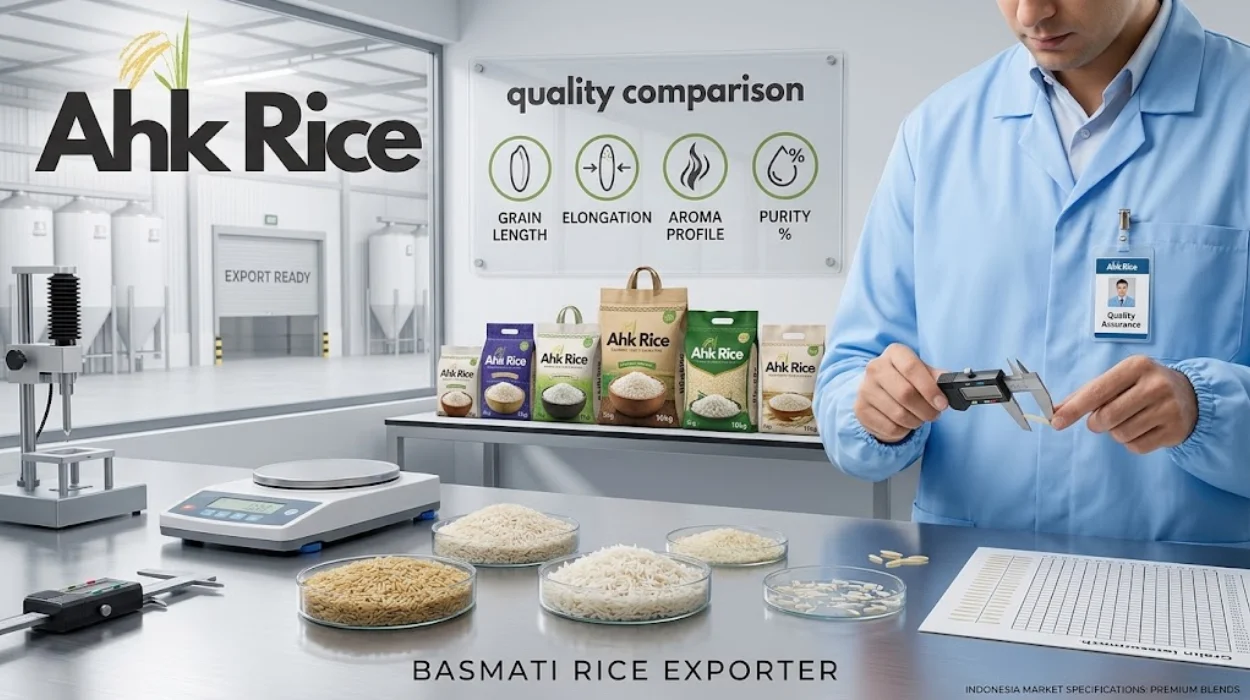
Grain length, moisture, broken percentage, purity, processing, cooking performance, and packaging provide the strongest comparison framework. Here is why: these parameters connect laboratory results with the final buyer experience.
What does grain length indicate?
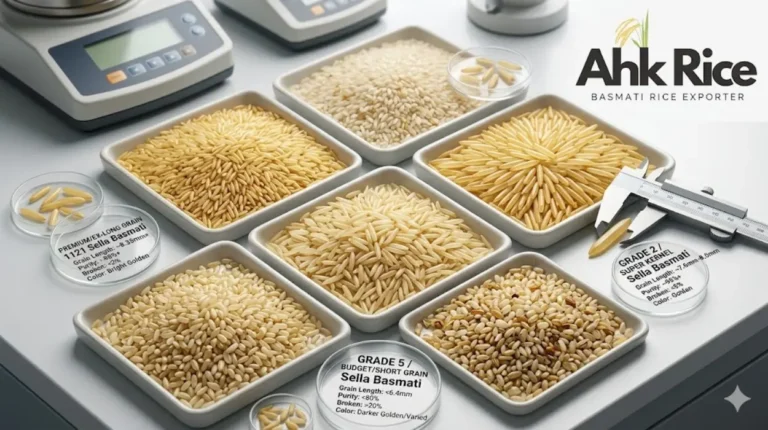
Grain length measures the physical size of the rice before and after cooking. Long-grain varieties create a more elongated cooked appearance. Indonesian premium retailers often use grain length as a visible quality indicator.
1121 Basmati commonly measures around 8.00 mm or more in raw grain specifications. Super Kernel and 1509 have different natural dimensions. Buyers should request the actual specification for each shipment.
Grain length alone does not determine quality. Uniformity, broken percentage, and cooking elongation also affect the final presentation. A longer grain with inconsistent size can produce an uneven cooked result.
Why does moisture matter?
Moisture should normally remain around 12–14% for properly stored milled rice. Here is why: moisture affects storage stability, microbial risk, grain strength, and cooking behavior.
Moisture testing measures the water content of the rice. A consistent moisture level supports predictable storage and reduces quality variation between batches. Buyers should request the moisture percentage on the inspection report.
Storage conditions also influence moisture behavior. Rice stored in a humid warehouse requires stronger moisture control. Indonesian importers should compare the moisture specification with the expected transit and warehouse environment.
How does broken percentage affect value?
Broken percentage measures the proportion of rice grains that break during milling, handling, or sorting. Here is why: broken grains change appearance, cooking texture, and the commercial value of the finished product.
Premium retail products generally require a low broken percentage. Restaurants and catering operations may accept a higher percentage when price and cooking performance remain suitable.
Buyers should compare broken percentage by grade. A 5% broken specification differs commercially from a 10% broken specification. The correct tolerance depends on the intended market segment and selling price.
What does purity measure?
Purity measures the proportion of acceptable rice grains compared with foreign matter, damaged grains, discolored grains, and other unwanted material. Here is why: purity supports food safety, appearance, and consistent cooking.
Purity testing includes foreign matter inspection, damaged grain assessment, and color sorting. Buyers should request the agreed tolerances before ordering.
Indonesian importers should also review the inspection procedure. A specification without a defined testing method creates disputes. The buyer and supplier should use the same inspection criteria.
How does processing affect cooking performance?
Processing determines grain firmness, cooking texture, appearance, and storage behavior. Here is why: White, Steam, Golden Sella, and Creamy Sella rice undergo different treatment before milling.
White rice provides a softer cooked texture. Steam rice provides stronger grain structure. Golden Sella produces firm, separate grains. Creamy Sella offers a lighter parboiled appearance.
The correct method depends on the final application. Restaurants often prioritize cooked appearance and texture. Wholesale buyers prioritize storage stability and handling. Retail buyers compare appearance, packaging, and consumer preferences.
What should buyers test for cooking performance?
Cooking performance includes elongation, grain separation, texture, aroma, and water absorption. Here is why: laboratory specifications cannot fully predict the final eating experience without a cooking test.
A representative sample should be cooked using the buyer’s intended method. The test should record raw grain weight, water ratio, cooking time, cooked yield, and grain appearance.
Indonesian buyers should compare samples from the same variety and processing grade. Comparing 1121 Steam with 1509 Golden Sella creates different cooking outcomes. A fair comparison uses equivalent processing types.
How does packaging influence quality?
Packaging protects rice from moisture, contamination, physical damage, and handling losses. Here is why: packaging maintains the quality achieved during milling and sorting.
Common export formats include PP bags, woven bags, and laminated retail packaging. Buyers should compare bag strength, liner quality, stitching, printing, and weight accuracy.
Retail packaging requires attractive presentation and accurate labeling. Wholesale packaging requires durability and efficient handling. Indonesian buyers should match the packaging specification with the distribution chain.
Which Pakistan Basmati quality method works best for different cases?

1121 Steam suits premium cooked presentation, 1509 Steam suits value-focused retail, and Golden Sella suits storage-intensive distribution. Here is why: each processing method balances grain appearance, firmness, cost, and storage performance differently.
Premium restaurants and hotels
1121 Steam provides long cooked grains and a firm texture. The variety suits restaurants that serve Basmati rice as a visible part of the dish. Buyers should prioritize grain length, elongation, aroma, and broken percentage.
Super Kernel Steam provides a traditional aromatic profile. It suits restaurants that prioritize fragrance and authentic Basmati character. The choice depends on the menu and target customer.
Retail and supermarket distribution
1509 Steam provides a practical option for mid-premium retail. The variety combines attractive grain length with a competitive cost structure. Retail buyers should compare raw grain appearance, cooking results, and packaging cost.
1121 Steam supports premium retail positioning. The longer grain creates a strong visual presentation. Buyers should compare consumer expectations with the required retail price.
Wholesale and institutional buyers
Golden Sella supports buyers who require firm grains and practical storage performance. The parboiling process strengthens the grain and supports handling during transport.
Golden Sella is suitable for institutional kitchens and wholesale distribution. Buyers should compare the processing method with the cooking equipment and storage environment.
What are the pros and cons of each quality approach?
A single quality parameter cannot determine the best rice. Here is why: grain length, processing, moisture, and price interact across the supply chain.
Grain-length comparison
Longer grain improves visual appeal and premium positioning. However, grain length does not guarantee aroma or cooking quality. Buyers should test elongation and grain separation alongside raw length.
Processing comparison
Steam rice provides a firm texture and attractive cooked appearance. Golden Sella provides stronger grain structure and practical storage performance. White rice provides a softer cooking texture.
The disadvantage of choosing only by processing type is that buyers may overlook variety-specific characteristics. A 1509 Golden Sella specification differs from a 1121 Golden Sella specification.
Price comparison
Lower-cost rice can improve retail margins. However, lower price often reflects differences in variety, processing, broken percentage, or packaging. Buyers should compare the complete specification before comparing offers.
Packaging comparison
Stronger packaging reduces damage during handling. However, premium packaging increases the landed cost. Buyers should compare packaging requirements with the final selling price.
Which two Indonesian market regions require different quality priorities?
Java and Sumatra require different procurement priorities because distribution conditions, buyer segments, and storage practices vary. Here is why: Indonesian importers should match the rice specification with the market’s commercial requirements.
Java market
Java includes major urban retail and foodservice markets. Premium restaurants and supermarkets often prioritize grain appearance, aroma, and cooking consistency.
1121 Steam suits premium retail and restaurant applications. Super Kernel Steam suits buyers seeking traditional aroma. 1509 Steam suits mid-premium retail.
Illustrative price comparison:
| Grade | Illustrative price per MT |
|---|---|
| 1121 Steam | USD 1,050–1,150 |
| Super Kernel Steam | USD 1,000–1,100 |
| 1509 Steam | USD 900–1,000 |
These figures are planning examples, not current supplier quotations. Actual prices depend on crop year, broken percentage, packaging, freight, and contract terms.
Sumatra market
Sumatra includes wholesale, catering, and institutional distribution. Buyers often prioritize grain firmness, storage stability, and handling performance.
1121 Golden Sella suits premium wholesale and catering. 1509 Golden Sella suits value-focused institutional supply. Super Kernel Golden Sella suits buyers seeking traditional aroma with firmer cooked texture.
Illustrative price comparison:
| Grade | Illustrative price per MT |
|---|---|
| 1121 Golden Sella | USD 1,050–1,150 |
| Super Kernel Golden Sella | USD 1,000–1,100 |
| 1509 Golden Sella | USD 900–1,000 |
How does shelf life compare?
Golden Sella generally provides stronger storage performance than White or Steam rice. Here is why: parboiling strengthens the grain and reduces breakage during handling.
Under suitable dry storage conditions, milled rice commonly retains commercial quality for 12–24 months. Actual shelf life depends on moisture, packaging, temperature, humidity, and pest control.
| Processing type | Planning shelf-life range |
|---|---|
| White | 12–18 months |
| Steam | 12–18 months |
| Golden Sella | 18–24 months |
| Creamy Sella | 18–24 months |
These are planning ranges, not guaranteed expiry periods. Buyers should confirm the supplier’s declared shelf life and storage instructions.
What five decision factors should Indonesian buyers use before ordering?
The best procurement decision combines quality, application, storage, landed cost, and verification. Here is why: a strong specification reduces disputes and improves commercial predictability.
| Decision factor | Buyer question | Recommended action |
|---|---|---|
| Grain specification | Does the raw grain meet the required length? | Request measured grain length |
| Cooking performance | Does the rice match the intended menu? | Conduct a representative cooking test |
| Processing | Does the processing method suit the application? | Compare White, Steam, and Sella |
| Storage | Can the product maintain quality during distribution? | Review moisture and packaging |
| Commercial value | Does the specification justify the landed cost? | Compare equivalent grades |
Indonesian buyers should use these factors before requesting final quotations. The comparison should cover the same variety, processing type, broken percentage, packaging, and shipment terms.
How should buyers verify the quality before ordering?
Buyers should request a representative sample, specification sheet, inspection report, and agreed shipment tolerance before placing a commercial order. Here is why: verification connects the promised specification with the delivered product.
A sample should represent the intended commercial grade. The buyer should inspect grain length, broken percentage, color, foreign matter, and cooking performance.
The specification sheet should define every measurable parameter. The inspection report should identify the testing method and results. The contract should define the acceptable tolerance for each parameter.
AHK Rice supplies Pakistani Basmati rice varieties including 1121, Super Kernel, and 1509. Its end-to-end processing and custom packaging support buyers seeking consistent export specifications.
Indonesian importers can review the AHK Rice Pakistan quality-verified Basmati supply for Indonesian importers to understand the decision process, specification verification, and export coordination.
The strongest order combines the correct variety, processing method, quality parameters, and packaging. Buyers should compare these elements together rather than choosing solely by grain length or price.
Frequently Asked Questions
What is the most important Pakistan Basmati quality parameter?
Grain length is a major quality parameter because it affects visual presentation and premium positioning. However, Indonesian buyers should also compare moisture, broken percentage, purity, and cooking performance.
Which Pakistan Basmati variety is best for Indonesian restaurants?
1121 Steam suits premium restaurants that require long cooked grains and firm texture. Super Kernel Steam suits restaurants that prioritize traditional Basmati aroma. The correct choice depends on the menu and customer expectations.
Is Golden Sella better than Steam rice?
Golden Sella provides stronger grain structure and practical storage performance. Steam rice provides attractive cooked presentation and firm texture. Buyers should compare both against their cooking process and distribution requirements.
What moisture percentage should Pakistani Basmati rice have?
A moisture level around 12–14% is commonly used for properly stored milled rice. Indonesian importers should confirm the exact specification, testing method, and storage instructions before ordering.
How should Indonesian buyers compare rice prices?
Compare prices using equivalent variety, processing type, broken percentage, packaging, and shipment terms. A lower price does not necessarily provide better commercial value.