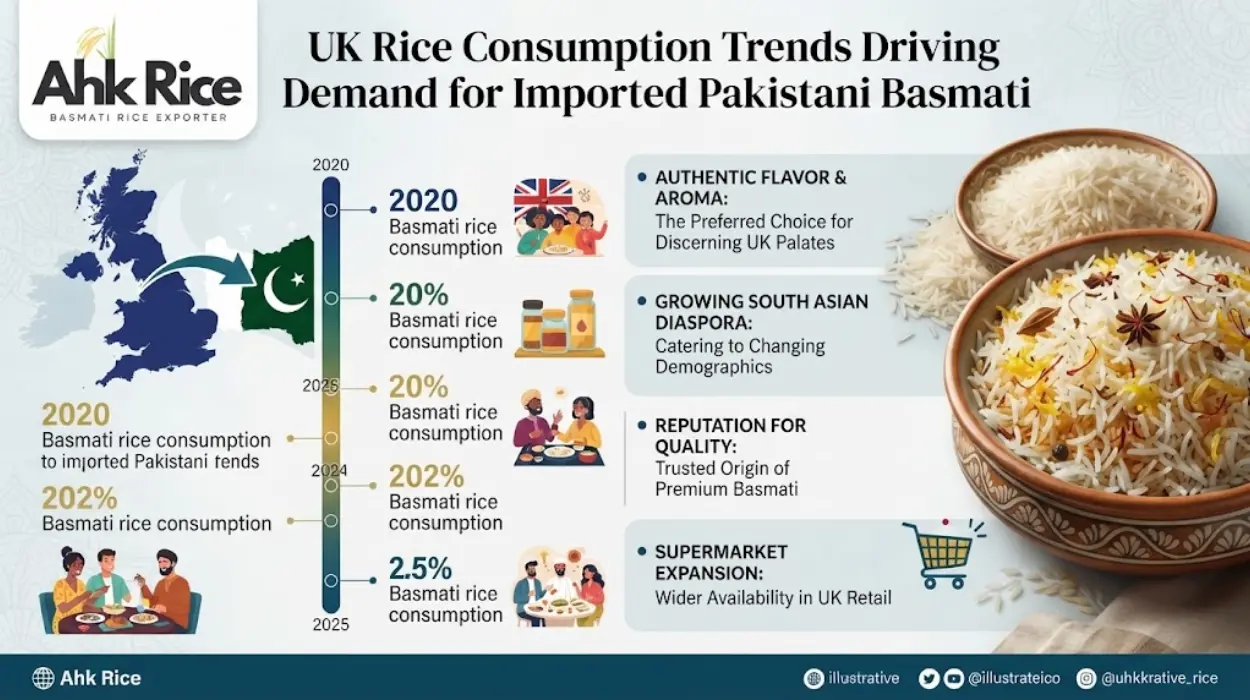
UK Rice Consumption Trends Driving Demand for Imported Pakistani Basmati in 2026
UK rice demand in 2026 is creating distinct opportunities for Pakistani Basmati across premium retail, ethnic wholesale, foodservice, and private-label distribution. Here is why: Pakistan supplied 37,395 MT of Basmati rice to the UK in FY2024, up 48.6% from 25,162 MT in FY2023. (source: Pakistan Bureau of Statistics, FY2023-24)
The UK market combines established South Asian consumption with wider retail demand for aromatic long-grain rice. The Pakistani Basmati rice export guide explains how Pakistani Basmati connects cultivation, grain characteristics, processing, and export markets. Pakistan’s wider Basmati exports reached 808,643 MT in FY2024-25, valued at US$830.57 million. (source: Rice Exporters Association of Pakistan)
What are the available solutions for UK rice buyers?
UK buyers can select White, Steam, Sella, Golden Sella, Creamy Sella, Brown, 1121, Super Kernel, or 1509 according to retail positioning, cooking use, price, and storage requirements. The correct solution starts with defining the buyer’s market segment and required specification.
Premium aromatic Basmati
Premium aromatic Basmati serves consumers who prioritize fragrance, long grains, cooking appearance, and traditional South Asian eating quality. 1121 and Super Kernel occupy this segment. UK retail packs commonly use these varieties for biryani, pulao, everyday meals, and premium private-label products.
Parboiled and Sella Basmati
Sella processing uses controlled parboiling before drying and milling. Golden Sella provides firm grains and strong cooking stability. This specification suits caterers, restaurants, wholesalers, and consumers seeking separate grains after bulk cooking.
Cost-focused long-grain supply
1509 provides a commercial alternative within long-grain Basmati purchasing. AHK Rice lists 1509 at approximately 8.2–8.5 mm raw grain length and offers White, Brown, Steam, Parboiled, Golden Sella, Creamy Sella, and Sella grades.
UK importers therefore have three broad approaches. Premium varieties target value per retail pack. Parboiled grades target cooking resilience. 1509 targets controlled procurement cost and volume distribution.
With the available solutions defined, the next comparison focuses on measurable specifications and commercial positioning.
How do 1121, Super Kernel, and 1509 compare for the UK market?
1121 emphasizes extra-long grain and premium presentation, Super Kernel emphasizes traditional aroma, and 1509 emphasizes cost efficiency with long-grain cooking performance. The specification determines the appropriate buyer segment rather than variety name alone.
| Attribute | 1121 Basmati | Super Kernel Basmati | 1509 Basmati |
|---|---|---|---|
| Primary position | Premium long grain | Traditional premium aroma | Cost-efficient long grain |
| Raw grain length | Approx. 8.2–8.5 mm | Approx. 7.0–7.5 mm | Approx. 8.2–8.5 mm |
| Aroma | High | Very high | Moderate to high |
| Cooking elongation | Very high | High | High |
| Main UK use | Premium retail, foodservice | Ethnic retail, premium foodservice | Wholesale, catering, private label |
| Indicative FOB benchmark | US$1,150–1,250/MT | US$1,135–1,205/MT | US$1,050–1,150/MT |
| Storage positioning | Dry, controlled storage | Dry, controlled storage | Dry, controlled storage |
The price ranges are indicative commercial benchmarks, not fixed quotations. A current market reference for Pakistan Basmati supplied to UK buyers lists indicative FOB Karachi pricing around US$1,135–1,205 per MT, with CNF Felixstowe calculated separately.
Pakistan’s average Basmati export realization was US$1,027.11 per MT across all Basmati exports in FY2024-25. The UK price for a specific grade can sit above this average because grade, packing, inspection, destination, and shipment terms change the final transaction value. (source: REAP export history)
Grain length also changes the commercial proposition. 1121 provides a strong visual advantage after cooking. Super Kernel emphasizes aroma and traditional Basmati identity. 1509 combines long grain with a more cost-focused procurement structure.
The specification table establishes the core differences, while market geography determines which differences matter most.
Which grades suit different UK and European market regions?
UK premium retail favors 1121 and Super Kernel, while broader European distribution also uses price-sensitive long-grain and parboiled specifications. Buyers should match grade, pack format, price, and shelf-life requirements with their specific distribution channel.
UK market
The UK has a large established market for Pakistani Basmati. Pakistan’s FY2024 Basmati exports to the UK reached US$45 million and 37,395 MT. The export quantity increased 48.6% year over year. (source: Pakistan Bureau of Statistics FY2023-24)
1121 suits premium retail packs and foodservice applications requiring prominent grain appearance. Super Kernel suits consumers who value traditional Pakistani Basmati aroma. Sella grades suit catering and wholesale channels requiring firm grains and consistent bulk cooking.
A current Pakistan-to-UK trade reference identifies 1121 White and Super Kernel as UK supply grades and gives an indicative FOB range of US$1,135–1,205 per MT. It also identifies Felixstowe as a destination port and a 24–40 day sailing window.
Wider European market
European demand combines ethnic retail with foodservice and specialist distribution. Pakistan’s Basmati exports to the European Union reached 137,694 MT across all rice categories during November 2024–April 2025. (source: Trade Data Monitor, USDA FAS)
Premium Basmati remains relevant for specialist retail. Super Kernel works for aroma-focused positioning. 1121 works for long-grain premium presentation. Sella and 1509 provide alternatives for institutional and price-sensitive channels.
Shelf life also affects regional purchasing decisions. Dry milled rice generally requires cool, dry, pest-controlled storage. Packaging, moisture level, processing type, warehouse temperature, and stock rotation determine practical storage performance.
For commercial planning, importers should specify a target shelf-life period rather than rely only on the variety name. A 12-month retail rotation requires different stock planning from an 18–24-month wholesale inventory cycle.
The UK and wider European markets therefore share premium Basmati demand but differ by channel, price sensitivity, and stock strategy.
How do the solutions compare on price and shelf life?
Premium 1121 and Super Kernel normally command higher prices than cost-focused 1509, while Sella processing supports stronger bulk-cooking stability and longer commercial storage planning. Actual shelf life depends on packaging, moisture, warehouse conditions, and stock rotation.
| Market region | Preferred grades | Indicative price position | Shelf-life planning | Main buyers |
|---|---|---|---|---|
| UK | 1121 White, Super Kernel, 1121 Sella | US$1,135–1,250/MT benchmark | 12–24 months under controlled storage | Retailers, wholesalers, foodservice |
| Wider Europe | 1121, Super Kernel, Sella, 1509 | US$1,050–1,250/MT benchmark | 12–24 months under controlled storage | Importers, ethnic retail, distributors |
The price comparison should use identical specifications. A 1121 White quote cannot be compared directly with 1509 Golden Sella without adjusting for processing, packing, grain length, broken percentage, moisture, and destination.
UK import controls also affect the buying specification. UK tariff classification recognizes milled, polished, parboiled, broken, and other rice categories under heading 1006. Basmati is classified as aromatic, slender, long-grain rice. (source: GOV.UK)
UK importers also operate within rice quota arrangements for relevant imports. The 2026 government notice requires eligible applicants to provide supporting trade evidence and meet application requirements. (source: GOV.UK, Notice to Traders 20/26)
Price therefore represents only one part of landed cost. Freight, quota access, customs treatment, inspection, packaging, certification, and warehouse handling can change the final cost per kilogram.
The regional comparison shows why the buyer’s next step should be a structured decision framework.
Which method works best for different UK buying cases?
1121 suits premium presentation, Super Kernel suits aroma-led positioning, and 1509 suits controlled-cost volume purchasing; Sella grades suit bulk cooking and storage-focused channels. Each method solves a different commercial requirement.
Five-row decision framework
| Decision factor | 1121 | Super Kernel | 1509 |
|---|---|---|---|
| Premium retail | Strong fit | Strong fit | Moderate fit |
| Aroma positioning | Strong | Very strong | Moderate |
| Cost control | Moderate | Moderate | Strong |
| Catering volume | Strong | Strong | Strong |
| Private-label flexibility | Strong | Strong | Strong |
Retail positioning should prioritize grain appearance, pack presentation, aroma, and consumer expectations. 1121 provides a clear premium proposition through extra-long grain.
Aroma-led distribution should prioritize Super Kernel. The variety is traditionally associated with strong natural fragrance and suits South Asian retail positioning.
Cost-sensitive distribution should evaluate 1509. The variety provides long grains and commercial cooking performance while offering a lower-cost alternative to premium 1121 specifications.
Catering purchasing should evaluate Steam and Sella processing alongside variety. Processing determines how the grain behaves during cooking, holding, and bulk service.
Private-label procurement should specify variety, processing grade, grain length, broken percentage, moisture, packaging, inspection, and destination before comparing quotations.
The decision framework converts market trends into specifications that buyers can use during procurement.
What are the pros and cons of each approach?
Premium varieties improve product positioning but increase procurement cost, while cost-focused varieties improve volume economics but provide less premium differentiation. Processing grades add another layer by changing cooking behavior, appearance, and commercial handling.
Premium 1121
Pros: Extra-long grain, strong visual presentation, broad premium positioning, strong suitability for retail and foodservice.
Cons: Higher procurement cost, stronger specification requirements, greater sensitivity to grade consistency.
Super Kernel
Pros: Strong natural aroma, traditional Basmati identity, strong fit for ethnic retail, premium foodservice positioning.
Cons: Higher price positioning than cost-focused varieties, aroma-focused buyers require consistent sensory quality.
1509
Pros: Long grain, competitive procurement structure, strong cooking performance, suitability for wholesale and private-label distribution.
Cons: Less premium positioning than 1121, weaker differentiation for aroma-led retail programs.
Sella processing
Pros: Firm grains, bulk cooking stability, useful for catering, strong holding performance.
Cons: Different color and texture profile from White or Steam rice, requiring appropriate consumer positioning.
The right comparison therefore depends on the buyer’s commercial objective rather than a single universal grade.
What should UK importers check before buying Pakistani Basmati?
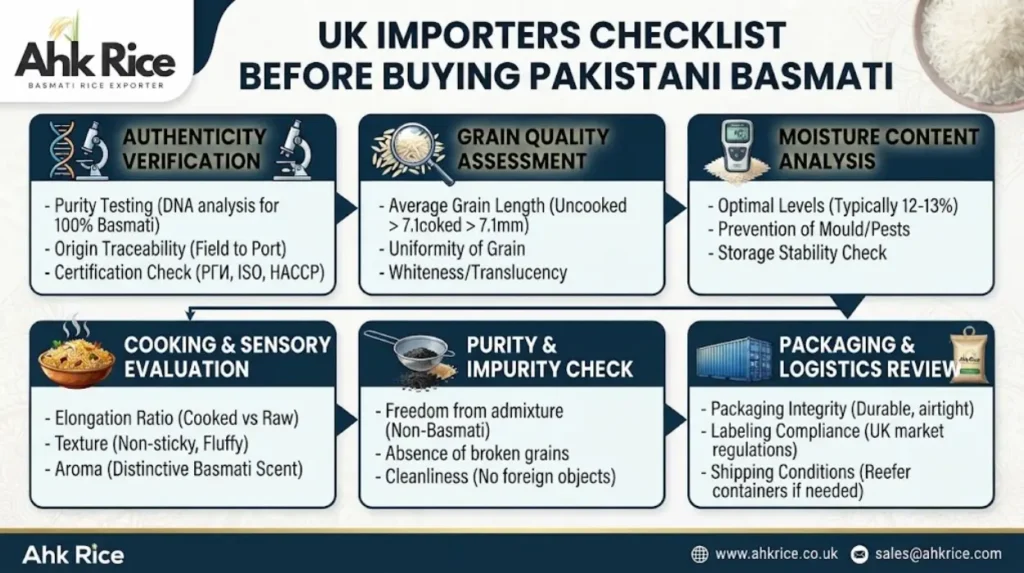
UK importers should verify variety, processing grade, grain length, broken percentage, moisture, packaging, inspection, documentation, landed cost, and shipment schedule before approving a supplier. These specifications create a comparable purchasing basis across suppliers.
Five core decision factors
Specification: Define variety, processing grade, grain length, broken percentage, moisture, and purity.
Compliance: Verify applicable UK import, food-safety, documentation, and inspection requirements.
Packaging: Match retail, wholesale, foodservice, or private-label packaging to the distribution channel.
Landed cost: Compare FOB or CIF pricing with freight, insurance, duties, handling, and local charges.
Supply consistency: Confirm sample approval, production controls, inspection, dispatch schedule, and repeat-order capability.
AHK Rice operates from Punjab and supplies 1121, Super Kernel, and 1509 Basmati rice varieties to international buyers. Its export process covers sourcing, milling, grading, sorting, packaging, documentation, and shipment coordination.
The supplier selection process should begin with a sample and specification sheet. The buyer can then approve the physical grain before commercial production and container loading.
UK demand in 2026 therefore reflects more than rising consumption. It reflects segmentation between premium retail, aroma-led Basmati, catering, wholesale, and private-label procurement.
Pakistan’s export data confirms the UK’s importance. The UK recorded 37,395 MT of Pakistani Basmati imports in FY2024, while Pakistan’s total Basmati exports reached 808,643 MT in FY2024-25.
The practical procurement solution is specification-led sourcing. Buyers can compare 1121, Super Kernel, 1509, White, Steam, and Sella grades against their target retail price, cooking application, storage model, and distribution channel.
For AHK Rice, this specification-led approach connects Punjab sourcing with milling, grading, custom packaging, inspection, and export logistics. The result is a purchasing process based on measurable attributes rather than variety names alone.
Frequently Asked Questions
Is Pakistani Basmati rice in demand in the UK in 2026?
Yes. Pakistan exported 37,395 MT of Basmati rice to the UK in FY2024, representing a 48.6% increase from FY2023. (source: Pakistan Bureau of Statistics)
Which Pakistani Basmati grade is popular in the UK?
1121 and Super Kernel are important premium grades for UK buyers. 1121 emphasizes long grain and presentation, while Super Kernel emphasizes traditional aroma.
Is 1509 Basmati suitable for UK importers?
Yes. 1509 suits wholesale, catering, and private-label programs seeking long grain with controlled procurement costs.
What is the indicative Pakistani Basmati price per MT for UK buyers?
Current indicative FOB references place Pakistani Basmati around US$1,135–1,205 per MT. Exact pricing depends on grade, specifications, packing, quantity, destination, and shipment terms.
How long does Pakistani Basmati rice last?
Commercial shelf-life planning commonly uses 12–24 months under controlled dry storage. Actual performance depends on moisture, packaging, temperature, pest control, and stock rotation.
What documents should UK rice importers check?
Importers should verify commercial documents, origin information, food-safety documentation, inspection records, phytosanitary requirements where applicable, and UK import requirements. Quota rules can also affect eligible rice imports.
Does AHK Rice supply Pakistani Basmati to the UK?
Yes. AHK Rice supplies Pakistani Basmati to UK buyers and lists Super Kernel, 1121 Sella, and other long-grain grades for the market.