Pakistan vs India Basmati Rice: Which Is Better for Importers?
Pakistan Basmati rice suits importers seeking distinctive aroma, long-grain varieties, and flexible processing options, while Indian Basmati suits buyers prioritizing specific grain profiles and established supply specifications. Here is why: procurement requirements, processing methods, and destination-market preferences determine the appropriate origin.
Basmati rice is an aromatic, long-grain rice traditionally cultivated in the Himalayan foothills of Pakistan and India. Importers compare both origins through grain length, aroma, cooking performance, price, and supplier consistency. This guide explains the differences and connects them to the Pakistan Basmati rice quality attributes importers should understand.
Pakistan and India both supply 1121, Super Kernel, and other Basmati grades. Their commercial specifications differ by variety, processing method, crop year, and supplier. A fair comparison therefore requires a defined specification rather than a general country preference.
What are the available solutions for Basmati rice importers?
Importers have four practical sourcing solutions: Pakistani Basmati, Indian Basmati, a dual-origin procurement strategy, or a specification-led supplier comparison. Each solution serves different quality, price, supply, and market requirements.
Pakistan Basmati rice
Pakistan Basmati rice includes traditional Basmati and newer long-grain varieties cultivated in Punjab. AHK Rice supplies 1121, Super Kernel, and 1509 Basmati rice varieties through end-to-end processing and export services.
1121 Basmati provides a long-grain profile for premium retail and foodservice. Super Kernel offers a traditional aromatic profile for buyers seeking recognizable Basmati characteristics. 1509 provides a long-grain alternative for value-conscious procurement.
Pakistan’s processing options include Steam, White, Golden Sella, and Creamy Sella. These methods change the grain’s colour, texture, cooking behaviour, and handling requirements.
Indian Basmati rice
Indian Basmati rice includes traditional and developed varieties such as 1121, Pusa Basmati 1509, and Pusa Basmati 1718. Indian suppliers offer White, Steam, and parboiled processing options.
Indian Basmati serves premium retail, foodservice, and wholesale channels. Buyers compare Indian varieties through grain length, aroma, elongation, cooking performance, and export documentation.
Dual-origin procurement
Dual-origin procurement means buying from both Pakistan and India under separate specifications. Importers use this strategy to compare landed costs, maintain supplier alternatives, and match different customer segments.
A distributor can source Pakistani 1121 Steam for one retail brand and Indian 1121 Steam for another. The distributor should maintain separate product specifications, certificates, and quality records.
Specification-led sourcing
Specification-led sourcing compares suppliers against one written purchase specification. The document defines variety, processing type, grain length, broken percentage, moisture, packaging, and inspection requirements.
This approach removes broad country assumptions from procurement. A buyer can compare two origins using the same measurable requirements.
These four sourcing solutions establish the available procurement routes. The next question is how their technical and commercial specifications compare.
How do Pakistan and India Basmati rice specifications compare?
Pakistan and India offer comparable Basmati categories, but grain length, aroma, processing, broken percentage, price, and shelf life vary by variety and supplier. Importers should compare matched specifications.
Specification comparison table
| Attribute | Pakistan Basmati rice | Indian Basmati rice |
|---|---|---|
| Main production region | Punjab and other designated Basmati-growing areas | Punjab, Haryana, Himachal Pradesh, and other designated growing areas |
| Common long-grain varieties | 1121, Super Kernel, 1509 | 1121, Pusa Basmati 1509, Pusa Basmati 1718 |
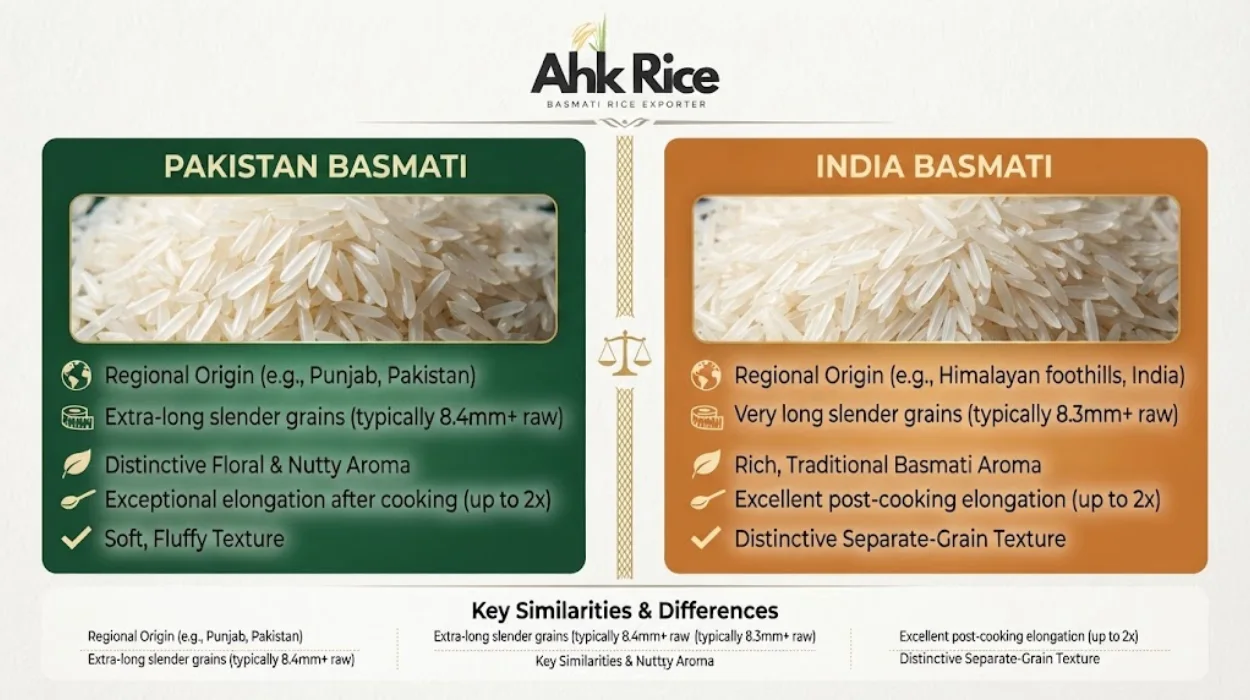
| Grain length | Long-grain varieties commonly reach 8 mm or more | Long-grain varieties commonly reach 8 mm or more |
| Processing options | White, Steam, Golden Sella, Creamy Sella | White, Steam, and parboiled options |
| Aroma | Distinctive aromatic profile | Distinctive aromatic profile |
| Cooking performance | Varies by variety, aging, and processing | Varies by variety, aging, and processing |
| Export packaging | PP, woven, vacuum, and custom retail packaging | PP, woven, vacuum, and custom retail packaging |
The table shows that both origins cover the main Basmati procurement requirements. The important difference appears within each category, not simply between countries.
Grain length and appearance
Grain length describes the measured length of a milled rice kernel. Importers use it to define product positioning and customer expectations.
Pakistan 1121 and Indian 1121 are both associated with extra-long grain specifications. A buyer should request actual laboratory measurements rather than relying on the variety name.
Grain appearance also includes whiteness, translucency, uniformity, and broken percentage. These attributes affect retail presentation and consumer perception.
Processing and cooking performance
Steam rice undergoes controlled steaming before drying and milling. The process improves grain firmness and reduces breakage during handling.
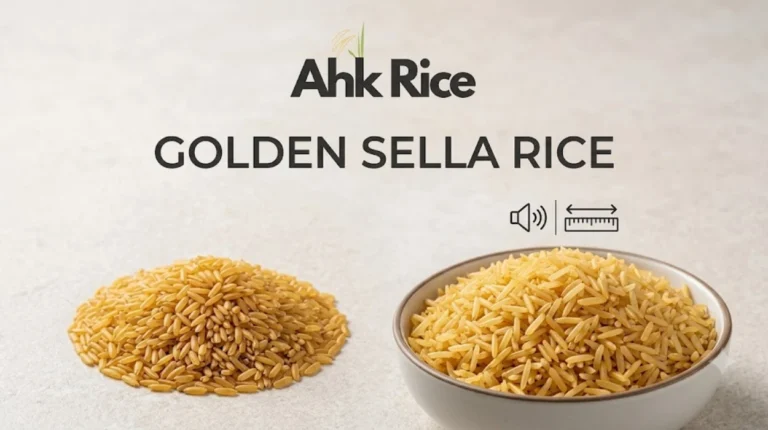
Golden Sella undergoes parboiling and drying. The process produces a golden appearance and supports firm cooking performance.
White rice undergoes milling without the same parboiling treatment. It retains a white appearance and serves buyers seeking conventional cooked-rice presentation.
Processing affects cooking results more directly than country of origin alone. Importers should compare the same processing type across both origins.
Aroma and aging
Aroma comes from naturally occurring compounds in aromatic rice. Aging changes moisture distribution and cooking behaviour.
Aged Basmati often provides firmer cooked grains and more consistent elongation. Freshly processed rice provides a different moisture and cooking profile.
Importers should define crop year, aging period, and storage conditions in the purchase specification. These details prevent inconsistent cooking results.
Quality control
Quality control measures physical, chemical, and visual characteristics. Common checks include moisture, broken percentage, foreign matter, grain length, and pesticide compliance.
A purchase specification should also define sampling procedures and acceptance limits. Independent inspection provides additional evidence before dispatch.
The technical comparison identifies the main variables. The next question is how these differences affect price and shelf life.
How do Pakistan and India Basmati rice prices compare per MT?
Pakistan and India Basmati rice prices depend on variety, processing, crop year, packaging, and freight. Importers should compare matched FOB or CIF quotations instead of country averages.
Price comparison by procurement category
| Product category | Pakistan price per MT | India price per MT | Main price drivers |
|---|---|---|---|
| 1121 White | Obtain supplier quotation | Obtain supplier quotation | Grain length, aging, broken percentage |
| 1121 Steam | Obtain supplier quotation | Obtain supplier quotation | Processing, crop year, packaging |
| 1121 Golden Sella | Obtain supplier quotation | Obtain supplier quotation | Parboiling, colour, moisture |
| Super Kernel | Obtain supplier quotation | Comparable variety quotation | Aroma, grain profile, processing |
| 1509 | Obtain supplier quotation | Pusa Basmati 1509 quotation | Grain length, yield, processing |
The table uses quotation fields rather than invented market prices. Export prices change with crop availability, exchange rates, freight, and buyer specifications.
FOB versus CIF pricing
FOB means Free on Board. The seller loads the goods onto the nominated vessel at the agreed port.
CIF means Cost, Insurance, and Freight. The seller includes ocean freight and insurance to the destination port.
A buyer comparing Pakistan and India should request the same Incoterm. A Pakistan FOB quote and an India CIF quote do not provide a valid price comparison.
Price per MT and landed cost
Landed cost includes the purchase price, freight, insurance, port charges, duties, clearance, and inland delivery.
For example, a buyer receiving a $1,000 per MT FOB quote should add destination expenses before comparing it with another supplier’s landed price.
A lower FOB price does not automatically produce a lower retail cost. Freight distance, port handling, and import duties change the final calculation.
Price and product positioning
Premium 1121 products generally require a different budget from standard long-grain products. Packaging and certification also add cost.
A restaurant distributor may prefer a consistent 1121 Steam specification. A wholesale buyer may prefer a lower-cost 1509 product.
The correct price comparison therefore starts with a product specification. The next question is how storage life affects procurement.
How does shelf life compare between Pakistani and Indian Basmati rice?
Both Pakistani and Indian Basmati rice can support long-term storage under controlled conditions. Shelf life depends on moisture, packaging, processing, warehouse temperature, and storage hygiene.
Shelf life by processing type
| Processing type | Storage characteristics | Importer requirement |
|---|---|---|
| White Basmati | Sensitive to moisture and storage conditions | Dry warehouse and sealed packaging |
| Steam Basmati | Firm grain structure and stable handling | Moisture control and pest prevention |
| Golden Sella | Parboiled grain structure supports storage | Dry storage and colour protection |
| Creamy Sella | Parboiled grain with cream appearance | Moisture and packaging control |
A fixed shelf-life number cannot apply to every supplier. Importers should use the manufacturer’s declared shelf life and validate it through product documentation.
Storage conditions
Warehouse temperature, humidity, pests, and packaging integrity directly affect rice quality. Rice should remain in a clean, dry warehouse away from direct sunlight.
Moisture migration can change grain texture and increase spoilage risk. Sealed packaging reduces exposure to humidity and handling contamination.
Crop year and aging
Crop year identifies the harvest period. Aging identifies the period between harvest or processing and sale.
Aged rice can develop different cooking characteristics from freshly processed rice. Buyers should define the required crop year and aging period.
Shelf life and market requirements
Gulf distributors often require stable storage performance during warm-weather logistics. European retailers often emphasize traceability, packaging integrity, and declared shelf life.
A buyer should match the processing method and packaging to the destination warehouse. The next section explains which approach fits different importer cases.
Which Basmati rice sourcing method works best for different cases?
Pakistan suits importers seeking flexible long-grain and parboiled specifications. India suits buyers seeking established Indian Basmati varieties. Dual-origin sourcing supports comparison and supply alternatives.
Premium retail
Premium retail buyers need consistent grain appearance, aroma, packaging, and cooking performance. Pakistan 1121 and Indian 1121 can both serve this segment.
The retailer should compare grain length, broken percentage, aging, and packaging. A branded retail product also requires consistent labelling and traceability.
Restaurant and foodservice
Foodservice buyers prioritize cooking yield, texture, and repeatability. Steam and parboiled rice often suit kitchens requiring firm grains.
A restaurant group can compare Pakistani 1121 Steam with Indian 1121 Steam. The decision should follow kitchen trials and cost per cooked serving.
Wholesale distribution
Wholesale buyers prioritize price, storage performance, and reliable dispatch. Pakistan 1509 and Indian 1509-related varieties provide comparison options.
A distributor should define minimum order quantity, packaging, and delivery schedule. These requirements help prevent inconsistent replenishment.
Private-label retail
Private-label buyers require packaging control, brand specifications, and documentation. Both origins support custom packaging through qualified suppliers.
The buyer should approve artwork, bag material, net weight, and packing format before production. A sample approval process reduces packaging errors.
Dual-origin procurement
Dual-origin procurement suits buyers with multiple customer segments or supply-continuity requirements. It requires separate specifications for each origin.
A buyer can maintain two approved suppliers while keeping product quality consistent. The same inspection and documentation process should apply to both.
The sourcing cases show that product requirements determine suitability. The next section examines the advantages and limitations of each approach.
What are the pros and cons of Pakistan and India Basmati rice?
Pakistan offers diverse long-grain and parboiled options, while India offers established Basmati varieties and broad processing choices. Both require supplier-level quality verification.
Pakistan Basmati rice
Pakistan’s product range includes 1121, Super Kernel, and 1509. These varieties serve premium retail, foodservice, and wholesale channels.
Pakistan also offers White, Steam, Golden Sella, and Creamy Sella processing. This range helps buyers match texture, colour, and storage requirements.
The main limitation is specification variation between suppliers. A buyer must verify grain length, broken percentage, moisture, and crop year.
Indian Basmati rice
Indian Basmati includes traditional and developed varieties. Buyers can source long-grain, aromatic, and parboiled products.
Indian suppliers also offer different packaging and export arrangements. These options support retail and foodservice procurement.
The main limitation is that variety names do not establish complete quality. Buyers must verify actual specifications and supplier performance.
Dual-origin sourcing
Dual-origin sourcing provides an additional supplier route. It supports comparative testing and supply planning.
The limitation is administrative complexity. Buyers must manage separate contracts, certificates, inspections, and shipment schedules.
Specification-led sourcing
Specification-led sourcing creates a measurable procurement standard. It reduces ambiguity and supports consistent purchasing.
The limitation is the time required to define and verify each parameter. The buyer must maintain the specification throughout repeat orders.
The advantages and limitations point toward a structured decision process. The next section provides a practical framework.
What decision factors should Basmati rice importers compare?
Importers should compare product specification, landed cost, storage requirements, documentation, and supplier reliability. A weighted decision framework creates a consistent basis for selecting an origin.
Five-row decision framework
| Decision factor | Questions to ask | Evidence required |
|---|---|---|
| Product quality | Does the rice meet grain length and broken limits? | Laboratory report and approved sample |
| Price | Does the quotation include comparable Incoterms? | FOB or CIF quotation |
| Shelf life | Does the product suit the warehouse conditions? | Product specification and storage guidance |
| Compliance | Does the shipment meet destination requirements? | Certificates and export documents |
| Supply continuity | Can the supplier repeat the specification? | Production capacity and shipment records |
Product quality
Product quality should be measured through a written specification. The document should define variety, processing, grain length, broken percentage, moisture, and foreign matter.
An approved sample establishes the physical and cooking reference. A laboratory report provides measurable evidence.
Price
Price comparison should use the same quantity, packaging, and Incoterm. The buyer should also calculate destination charges.
A lower quotation becomes meaningful only after landed cost calculation. The comparison should include freight, insurance, duties, and clearance.
Shelf life
Shelf life should match the warehouse and distribution period. Buyers should confirm packaging integrity and storage conditions.
A distributor with long storage periods may require a different processing specification from a restaurant buying frequent shipments.
Compliance
Compliance includes food safety, labelling, inspection, and import documentation. Requirements vary by destination market.
The buyer should confirm applicable regulations before approving the supplier. The exporter should provide the required documents before shipment.
Supply continuity
Supply continuity depends on production capacity, raw material availability, processing controls, and logistics planning. The buyer should assess the supplier’s ability to repeat the specification.
A contract should define quality requirements, shipment schedule, packaging, and acceptance procedures. These terms support consistent procurement.
The framework converts the comparison into measurable purchasing criteria. The next section explains how importers can validate the decision through samples.
How should importers evaluate Pakistani and Indian Basmati rice samples?
Importers should evaluate matched samples through documentation, physical inspection, cooking trials, and commercial quotation. Sample approval should precede contract confirmation and bulk dispatch.
Sample evaluation process
- Define the specification. Set the variety, processing type, grain length, broken percentage, moisture, and packaging.
- Request the samples. Obtain matched Pakistani and Indian products from qualified suppliers.
- Inspect the grain. Check appearance, uniformity, foreign matter, and broken percentage.
- Conduct cooking trials. Measure water absorption, elongation, texture, aroma, and cooked yield.
- Compare quotations. Request matched FOB or CIF prices and confirm the shipment terms.
- Approve the sample. Record the accepted specification and retain the reference sample.
- Confirm the contract. Define quality, packaging, inspection, documentation, and dispatch requirements.
Sample approval example
A restaurant importer compares Pakistan 1121 Steam with Indian 1121 Steam. Both samples meet the required grain length.
The importer then tests cooking yield and texture. The approved sample becomes the reference for bulk procurement.
A retail buyer may also compare bag appearance and packaging integrity. These checks support a complete commercial decision.
Supplier verification
Supplier verification includes company identity, processing capacity, quality systems, and export documentation. The buyer should confirm the supplier’s ability to repeat the approved specification.
AHK Rice supplies Pakistani Basmati rice through end-to-end processing and export services. Its product range includes 1121, Super Kernel, and 1509 varieties.
The sample process creates a measurable basis for procurement. The final section summarizes the comparison and next steps.
What should importers conclude from the Pakistan versus India comparison?
Pakistan and India both provide viable Basmati sourcing options. The appropriate origin depends on the buyer’s specification, landed cost, storage needs, destination requirements, and supplier verification process.
Pakistan suits buyers comparing long-grain and parboiled options across 1121, Super Kernel, and 1509. India suits buyers comparing established Indian Basmati varieties and processing categories.
Neither origin should be selected through country reputation alone. The buyer should compare matched samples, laboratory reports, quotations, and documentation.
A specification-led process supports repeatable procurement. It also creates a clear basis for supplier discussions and contract terms.
AHK Rice provides Pakistani Basmati rice sourcing through processing, packaging, and export coordination. Its product range supports different retail, foodservice, and wholesale requirements.
Frequently Asked Questions
Is Pakistani Basmati rice better than Indian Basmati rice?
Pakistani Basmati rice suits importers seeking specific long-grain and parboiled specifications. Indian Basmati rice suits buyers seeking established Indian varieties. The correct choice depends on matched quality and cost requirements.
What is the main difference between Pakistani and Indian Basmati rice?
The main difference lies in variety, processing, aroma, grain characteristics, and supplier specifications. Both origins produce aromatic long-grain rice. Importers should compare actual product data.
Which Basmati rice is best for restaurants?
Restaurants should choose the rice that delivers consistent cooking yield, texture, aroma, and cost per serving. Pakistani 1121 Steam and Indian 1121 Steam provide suitable comparison categories.
Which Basmati rice has a longer shelf life?
Shelf life depends on moisture, processing, packaging, and storage conditions. Golden Sella and other parboiled products support storage-focused procurement. Importers should confirm the declared shelf life.
How can importers compare Basmati rice prices?
Importers should request comparable FOB or CIF quotations. They should include freight, insurance, duties, clearance, and inland delivery in the landed-cost calculation.