Vietnam Rice Trade 2026: Why Pakistani Basmati Fits the Premium Segment
What is Vietnam rice trade 2026?
Vietnam rice trade 2026 is the movement of rice into and out of Vietnam during 2026, including exports, imports, domestic re-processing, and premium retail demand. Pakistani basmati fits the premium segment because it supplies aroma, length, texture, and traceable origin.
Vietnam rice trade 2026 covers 2 connected flows. Vietnam exports large volumes of white rice, jasmine rice, fragrant rice, and broken rice. Vietnam also imports rice for border trade, animal feed, food processing, blending, hospitality, and premium retail categories.
Rice trade means the commercial movement of rice between countries. It includes contracts, grades, packing, inspection, certification, customs clearance, shipping, and distribution. In Vietnam, rice trade has 2 sides. The first side is Vietnam as a major exporter. The second side is Vietnam as an importer for selected rice types.
Vietnam’s export identity is built on Mekong Delta rice. The Mekong Delta cultivates high-yield rice for regional food security and price-sensitive export buyers. Typical export markets include the Philippines, Indonesia, China, Malaysia, and African buyers.
Vietnam’s import identity is different. Vietnam imports rice when domestic demand needs specific qualities, origins, or uses. Examples include Cambodian paddy for milling, Indian rice for commodity channels, and Pakistani basmati for aromatic premium uses.
Pakistani basmati belongs to the premium segment because it is not purchased only for calories. Buyers source it for grain length, cooked elongation, aroma, low stickiness, and serving presentation. These features matter in hotels, restaurants, ethnic retail, modern supermarkets, and premium online grocery.
The primary keyword “Vietnam rice trade 2026” connects to a larger trade reality. Vietnam is both a producer and a strategic rice trader. The secondary keyword “Pakistani basmati premium segment” explains where Pakistan fits. Pakistan does not compete with Vietnamese white rice on the same use case. Pakistan competes in aromatic, long-grain, higher-value consumption.
With Vietnam rice trade 2026 defined, the next question is how this trade system works from farm to shipment.
How does Vietnam rice trade 2026 work?
Vietnam rice trade works through cultivation, milling, grading, certification, contracting, shipping, and retail distribution. Commodity rice moves by volume, while premium basmati moves by specification. Pakistani basmati enters the system when importers need aroma, long grains, and stable cooking performance.
Vietnam cultivates most of its rice in the Mekong Delta. Farmers grow paddy, harvest it, and sell it into collection networks. Millers dry the paddy, dehusk the grain, polish the kernels, sort defects, and grade the rice for export or domestic sale.
Export rice from Vietnam follows a volume-led system. Buyers often select 5% broken white rice, fragrant rice, jasmine rice, glutinous rice, or broken rice. These products serve staple consumption, food service, and government procurement.
Import rice follows a more selective logic. Importers procure rice when a domestic channel needs a grade that Vietnam does not produce at the same quality, origin, or price position. Pakistani basmati fits this logic because basmati is a geographical and varietal category linked to Pakistan and northern India.
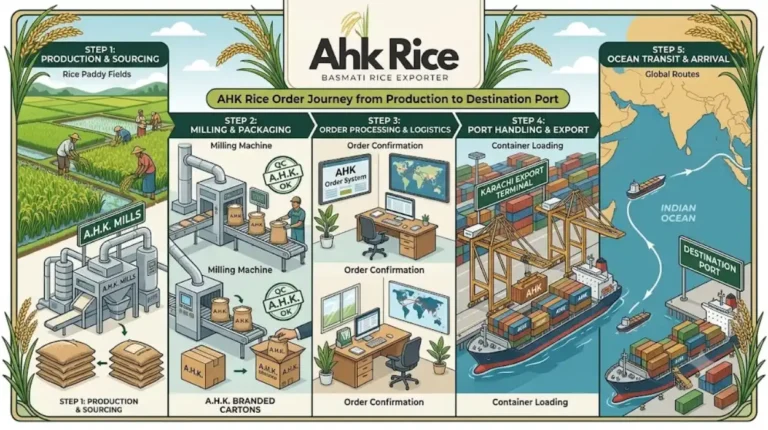
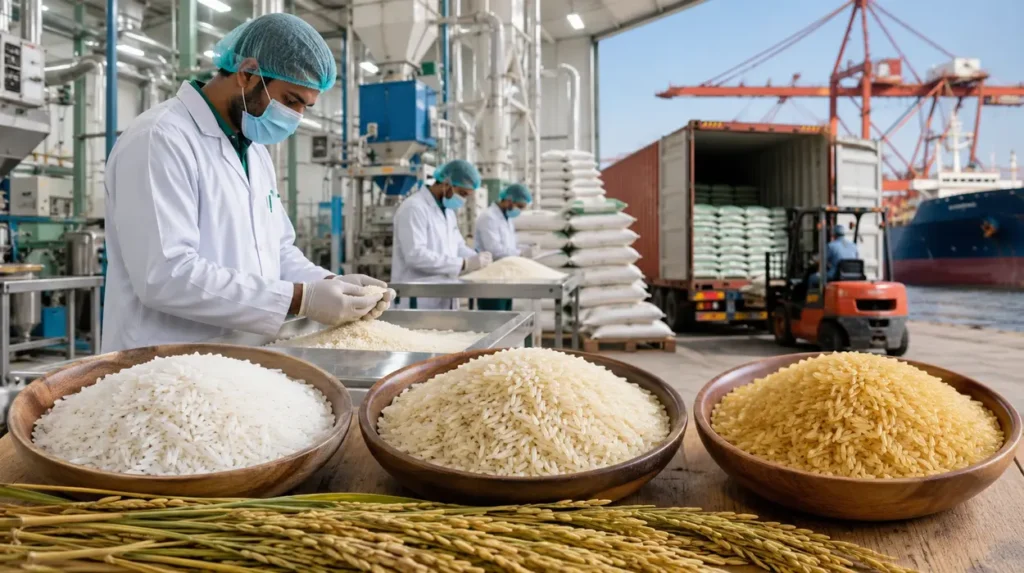
The Pakistani basmati supply chain starts in Punjab. Farmers cultivate basmati varieties in rice-growing districts with suitable soil, irrigation, climate, and harvesting cycles. After harvest, processors dry paddy to safe moisture levels, dehusk it into brown rice, polish it into white rice, sort it by length and colour, and pack it for shipment.
How is Pakistani basmati processed step by step?
Clean the paddy to remove dust, straw, stones, and field impurities.
Dry the paddy to control moisture before storage and milling.
Dehusk the paddy to remove the outer husk and produce brown rice.
Polish the brown rice to produce white rice with a clean surface.
Grade the kernels by length, width, broken percentage, and visual quality.
Sort the rice by colour to remove yellow, chalky, black, or damaged grains.
Steam or parboil selected grades to improve firmness and storage performance.
Age premium basmati to improve aroma, cooking separation, and elongation.
Pack the rice in buyer-selected formats, such as 5 kg, 10 kg, 25 kg, and 40 kg bags.
Inspect, certify, load, dispatch, ship, clear, and deliver the consignment through the export chain.
This step-by-step process explains why premium basmati is a specification-led product. Vietnamese distributors do not only ask for rice. They ask for a variety, processing style, grain length, broken percentage, moisture level, packing format, certification set, and cooking result.
With the trade process explained, the next section identifies the key components that shape basmati’s premium fit.
Explore Our Expert Guides:
Indonesia Rice Import Volume 2026: Why Pakistan Is Gaining Market Share
1509 Basmati vs Long Grain Non-Basmati: Which Rice for Indonesia Bulk Buyers?
What are the key components of the Pakistani basmati premium segment?
The key components are variety, origin, grain length, processing grade, aroma, broken percentage, moisture, aging, certifications, and packaging. Vietnamese importers assess these components because premium rice must satisfy chefs, retailers, inspectors, distributors, and final consumers at the same time.
A rice variety is the genetic type of rice. In Pakistani basmati, common export varieties include 1121 Basmati, 1509 Basmati, and Super Kernel Basmati. Each variety has a different grain length, elongation pattern, price point, and cooking use.
1121 Basmati is known for extra-long grains and strong elongation after cooking. It suits premium restaurants, wedding caterers, biryani kitchens, and retail buyers who want visual length on the plate.
1509 Basmati is an early-maturing basmati variety with strong commercial value. It offers long grains, good cooking results, and a more accessible price position than 1121 in many export cycles. Vietnamese distributors compare it with 1121 when they need premium basmati at a controlled cost. For a deeper distributor-level comparison, read 1509 vs 1121 Basmati.
Super Kernel Basmati is a traditional premium variety from Pakistan. It is known for aroma, taste, and classic basmati identity. It suits ethnic retail, premium household cooking, and South Asian restaurants.
Processing grade means the form in which rice is milled and finished. Pakistani basmati is commonly supplied as white rice, steam rice, sella rice, golden sella rice, brown rice, parboiled rice, and broken rice. Each grade serves a different buyer need.
White basmati gives a soft texture and classic appearance. Steam basmati gives better grain firmness and separation. Sella basmati gives stronger cooking stability after parboiling. Golden sella basmati gives a yellow-gold colour and longer shelf stability. Brown basmati keeps bran layers for health-positioned retail. Broken basmati supports food processing, ready meals, and lower-cost aromatic blends.
Broken percentage measures the share of broken kernels. Premium buyers often prefer 5% broken or lower. Food service buyers can accept different limits when cooking performance and price remain consistent.
Moisture is a quality control value. Rice with controlled moisture stores better during shipping and warehousing. Premium basmati commonly targets safe export moisture levels to reduce mould risk, insect risk, and quality loss during container movement.
Packaging is also part of the premium segment. Retail channels use 1 kg, 2 kg, 5 kg, and 10 kg packs. Food service channels use 20 kg, 25 kg, and 40 kg bags. Vietnamese importers select packaging based on supermarkets, restaurants, hotels, wholesalers, and e-commerce sellers.
These components turn basmati from a commodity into a controlled premium product, and the next section explains the practical benefits for Vietnam’s market.
What benefits does Pakistani basmati bring to Vietnam’s premium rice segment?
Pakistani basmati brings aroma, long-grain presentation, menu differentiation, stable cooking, premium packaging potential, and origin-based positioning. These benefits help Vietnamese retailers, hotels, restaurants, and specialty importers serve buyers who want more than standard white rice or local fragrant rice.
Pakistani basmati improves plate presentation because the grains remain long and separate after cooking. This matters for biryani, pulao, mandi, kabsa, fried rice, and premium buffet service. A chef can serve basmati without a sticky texture when the rice is washed, soaked, and cooked correctly.
Pakistani basmati supports premium retail because consumers can see the difference. Long grains, aroma, and origin labels create a stronger shelf story than generic white rice. A 5 kg basmati bag can sit in the premium rice aisle beside jasmine, japonica, and imported specialty rice.
Pakistani basmati gives Vietnamese distributors a broader portfolio. A distributor can sell local fragrant rice for daily household use, Thai jasmine for regional premium demand, Japanese-style rice for sticky texture, and Pakistani basmati for long-grain aromatic meals. Each rice type has a separate use case.
Pakistani basmati also supports restaurants that serve international menus. Indian, Pakistani, Middle Eastern, Turkish, Malaysian, and fusion restaurants need rice that performs with spices, meat, broth, and long holding times. Steam and sella basmati perform well in commercial kitchens because they maintain structure.
Vietnam’s rice market is not only a low-price market. Premium urban demand exists in Ho Chi Minh City, Hanoi, Da Nang, and tourist zones. Imported rice earns attention when it solves a menu, retail, or gifting need.
Trade data supports the larger opportunity. USDA reporting stated that Vietnam imported about 2.97 million metric tons of milled rice equivalent during the first 8 months of 2025. USDA also projected Vietnam rice imports at about 4.1 million tons for 2025/26. These figures show that Vietnam’s import role has become important inside Asian rice trade (source: USDA FAS Grain and Feed Quarterly, Vietnam, 2025).
Pakistan’s supply capacity also supports premium positioning. REAP export history recorded Pakistan’s total rice exports at 5.817 million metric tons in 2024–25, including 808,643 metric tons of basmati rice. This confirms that Pakistan has export capacity across basmati and non-basmati categories (source: Rice Exporters Association of Pakistan, 2025).
With the benefits clear, the next section explains where Vietnamese importers and distributors use Pakistani basmati.
Get More Insights:
AHK Rice Indonesia: 1509 Basmati Wholesale — Competitive CIF Jakarta Pricing
Which use cases fit Pakistani basmati in Vietnam?
Pakistani basmati fits premium restaurants, hotels, caterers, ethnic grocery stores, supermarkets, online grocery platforms, food manufacturers, and gifting packs. Each use case values a different specification, such as 1121 length, 1509 price balance, or Super Kernel aroma.
Premium restaurants use basmati for biryani, pulao, kebabs with rice, mandi, kabsa, and South Asian rice plates. Restaurants need grains that stay separate during service. Steam and sella grades suit this use because they tolerate batch cooking and holding.
Hotels use basmati in buffets, banquet menus, and international cuisine corners. Hotels need consistency because one banquet can serve hundreds of guests. Golden sella and steam basmati suit hotel service when the menu requires long-grain appearance.
Caterers use basmati for wedding events, corporate meals, and large group dining. Caterers need rice that expands well, resists clumping, and delivers a premium look. 1121 sella and 1121 golden sella are common choices for this type of demand.
Ethnic grocery stores use basmati for South Asian, Middle Eastern, and Muslim consumer groups. These buyers understand basmati by name. They compare origin, grain length, aroma, cooking result, and bag size before purchase.
Supermarkets use basmati to build premium rice shelves. A premium shelf can include Vietnamese fragrant rice, Thai jasmine rice, Japanese-style short grain rice, organic rice, brown rice, and Pakistani basmati. This mix gives consumers clear choice by cuisine and cooking style.
Online grocery platforms use basmati for search-led demand. Consumers search for biryani rice, basmati rice, long grain rice, imported rice, and aromatic rice. Product titles, images, cooking instructions, and certifications influence conversion.
Food manufacturers use broken basmati or lower-broken grades in ready meals, spice rice packs, frozen meals, and meal kits. Broken basmati can still deliver aroma while controlling cost. This use case needs strict grading and predictable supply.
Gifting packs use premium basmati when packaging design and origin story matter. Rice is a daily staple, but premium imported rice can also work as a festive or hospitality gift. Small packs with strong visual identity suit this channel.
These use cases show why basmati does not replace Vietnam’s local rice; it fills specific premium gaps that standard rice cannot fill.
Which markets import Pakistani basmati and what does that teach Vietnam?
Pakistani basmati is imported by Gulf, European, North American, African, and Asian markets. These markets teach Vietnam that premium basmati demand grows where buyers value aroma, halal suitability, long grains, ethnic cuisine, and reliable export documentation.
The Gulf region is a major basmati destination because rice dishes are central to daily meals and hospitality. Saudi Arabia, the UAE, Qatar, Oman, Kuwait, and Bahrain use basmati for mandi, kabsa, biryani, and catering. These markets value long grains, aroma, and cooking strength.
European markets import basmati for ethnic retail, mainstream supermarkets, restaurants, and private-label packs. The United Kingdom, Germany, Netherlands, France, Italy, and Spain all have demand linked to South Asian and Middle Eastern cuisines. These markets also place strong attention on food safety, residue limits, traceability, and packaging compliance.
North American markets import basmati for household cooking, ethnic grocery chains, restaurants, and bulk retail. The United States and Canada have strong demand from South Asian, Middle Eastern, and health-aware consumers.
African markets import rice across commodity and premium segments. Some markets buy Pakistani non-basmati for affordability. Others buy basmati for premium channels, hospitality, and urban retail.
Asian markets import basmati when cuisine diversity and premium retail demand support it. Malaysia, Singapore, Hong Kong, China, and Vietnam all have premium rice buyers. These buyers understand that rice is not one product. Rice changes by origin, grain, aroma, texture, and cooking use.
Vietnam can learn 3 lessons from these markets. First, basmati sells best when the use case is clear. Second, premium rice needs correct cooking education. Third, importers need documents that satisfy customs, food safety, and buyer audits.
This market view leads directly to certification, because premium trade depends on verified quality and legal entry.
What certifications apply to Pakistani basmati for Vietnam rice trade?
Pakistani basmati for Vietnam trade needs export documents, food safety controls, plant health certification, quality testing, and buyer-specific certifications. Common documents include commercial invoice, packing list, certificate of origin, phytosanitary certificate, fumigation certificate, health certificate, and laboratory analysis.
A phytosanitary certificate confirms that a plant product meets plant health requirements. Vietnam requires phytosanitary certification for imported plant products, and rice falls under plant quarantine controls. This certificate helps customs verify pest control and plant safety (source: USDA FAS Vietnam Export Certificate Report, 2022).
A certificate of origin confirms the country where the rice was produced or processed. Vietnamese importers use this document for customs, tariff treatment, and buyer verification.
A fumigation certificate confirms that the shipment was treated against insects and storage pests. Rice shipments often require fumigation before loading or during export handling.
A health certificate or food safety certificate supports the claim that the rice is fit for human consumption. It helps the importer satisfy food safety requirements and buyer standards.
A certificate of analysis gives laboratory values. It can include moisture, broken percentage, foreign matter, damaged kernels, aflatoxin, pesticide residues, heavy metals, and microbiological checks. Premium buyers request these values because they reduce risk before shipment.
ISO 22000 is a food safety management certification. HACCP is a hazard control system used in food processing. FSSC 22000 is a food safety certification scheme used by larger food supply chains. These certifications do not replace Vietnam’s import checks, but they support buyer confidence.
Halal certification matters for Muslim consumers, restaurants, Gulf-linked buyers, and halal retail shelves. Rice is plant-based, but halal certification still helps when buyers need verified handling and packaging controls.
Vietnamese importers must match 2 compliance layers. The first layer is government entry compliance. The second layer is buyer compliance. Government compliance clears the product. Buyer compliance places the product in restaurants, hotels, supermarkets, and food service channels.
With certification requirements defined, the final section addresses the problems and misconceptions that cause weak buying decisions.
What common problems and misconceptions affect Vietnam rice trade 2026?
The main problems are grade confusion, moisture mismatch, weak documentation, wrong cooking method, poor packaging selection, and treating all aromatic rice as equal. These mistakes reduce value because premium basmati needs specification control from contract to final cooking.
The first misconception is that basmati and jasmine rice are the same. Jasmine rice is fragrant, soft, and slightly sticky. Basmati rice is aromatic, long, and separate after cooking. Vietnamese buyers need both products for different meals.
The second misconception is that 1121 is always the best choice. 1121 gives strong length and presentation. 1509 gives a useful balance between premium appearance and price control. Super Kernel gives classic aroma and traditional basmati identity. The best grade depends on channel, recipe, and buyer budget.
The third misconception is that sella and steam rice are identical. Steam rice is treated with steam to improve firmness and cooking performance. Sella rice is parboiled before milling, which changes texture, colour, and cooking strength. Golden sella has a yellow-gold appearance and strong holding ability.
The fourth problem is moisture mismatch. Rice with poor moisture control loses quality in storage. A container moving through humid routes needs strong moisture management, clean packing, and correct loading practices.
The fifth problem is documentation delay. Missing phytosanitary certificates, unclear origin documents, incomplete packing lists, or weak laboratory reports delay customs clearance. Premium rice trade depends on paperwork as much as product quality.
The sixth problem is wrong packaging. A 40 kg PP bag suits wholesalers and food service. A 5 kg printed bag suits supermarkets and online retail. A vacuum pack suits premium household buyers. Packaging must match the channel before shipment.
The seventh problem is weak cooking education. Basmati needs washing, soaking, correct water ratio, and controlled heat. A poor cooking method makes premium rice look average. Importers should provide cooking instructions on retail packs and chef sheets for food service buyers.
Vietnam rice trade 2026 is a volume market and a premium market at the same time. Pakistani basmati fits the premium segment because it offers a defined origin, long-grain cooking, aromatic value, and multiple grades for restaurants, retail, catering, and food manufacturing.
The correct buying decision starts with the use case. Choose 1121 when length and presentation matter most. Choose 1509 when premium quality needs stronger price balance. Choose Super Kernel when traditional aroma matters most. Choose steam, sella, or golden sella when the kitchen needs reliable cooking performance.
Vietnam’s rice trade will remain competitive because local rice, Thai rice, Cambodian rice, Indian rice, and Pakistani rice all serve different needs. Pakistani basmati earns its place when the buyer needs premium aroma, long-grain identity, and specification-led supply.