What Is Pakistani Basmati Rice?
Pakistani Basmati rice is a naturally aromatic, long-grain rice cultivated mainly in Punjab, Pakistan, and recognized for its fragrance, elongation, and cooking texture. Traditional Basmati develops a distinctive aroma during cultivation and maturation. Modern processing protects these qualities for domestic consumption and export.
Basmati belongs to the rice species Oryza sativa. The name describes a group of aromatic rice varieties rather than one single grain. Pakistan produces traditional Basmati alongside modern long-grain varieties, including 1121, Super Kernel, and 1509.
Pakistan’s Basmati cultivation centers on Punjab. The region contains fertile agricultural land, irrigation systems, and growing conditions suited to aromatic rice. Major production areas include Gujranwala, Hafizabad, Narowal, Sialkot, and Sheikhupura.
How Does Pakistani Basmati Differ From Other Rice?
Pakistani Basmati combines aroma, grain elongation, texture, and regional cultivation with processing methods designed to preserve these characteristics. These attributes distinguish Basmati from ordinary long-grain rice and shorter-grain varieties.
Aroma is one of the defining characteristics. Pakistani Basmati contains naturally occurring aromatic compounds that produce its recognizable fragrance during cooking. The scent becomes more noticeable after boiling or steaming.
Grain elongation is another important feature. Basmati rice expands lengthwise during cooking. The grain retains its shape when properly prepared, producing separate rice grains rather than a sticky mass.
Texture depends on the variety and processing method. Steam rice, Sella rice, and traditional white rice produce different cooking results. These differences affect restaurant preparation, household meals, and commercial food production.
Where Is Pakistani Basmati Rice Grown?
Pakistani Basmati rice is cultivated primarily in Punjab, where fertile soil, irrigation, seasonal temperatures, and traditional farming support aromatic grain development. Punjab supplies the agricultural foundation for Pakistan’s Basmati production and rice export industry.
Punjab contains the main Basmati-growing districts. Farmers cultivate rice during the summer growing season and harvest the crop after the grains mature. Irrigation supports crop development during periods without sufficient rainfall.
Soil conditions influence rice cultivation. Farmers manage fields through land preparation, water control, seed selection, and fertilizer application. These practices support consistent crop growth and grain development.
Climate also affects grain quality. Temperature, humidity, and rainfall influence flowering, grain filling, and harvest timing. Proper crop maturity supports the aroma and physical characteristics associated with Basmati.
Why Does Punjab Matter to Basmati Quality?
Punjab provides the agricultural environment that supports Basmati aroma, grain development, and crop maturity. Its farming districts supply traditional Basmati and newer long-grain varieties for domestic and international markets.
Traditional Basmati varieties depend on suitable cultivation conditions. Farmers select seeds according to variety characteristics, planting requirements, and expected harvest performance.
Harvest timing affects rice quality. Mature paddy contains developed grains that require drying and milling before consumption. Premature harvesting produces inconsistent grain development and processing results.
Punjab’s rice-growing districts also support an established agricultural supply chain. Farmers, rice mills, storage facilities, transporters, and exporters connect cultivation with international buyers.
How Is Pakistani Basmati Rice Processed?
Pakistani Basmati rice passes through nine main processing steps: paddy cleaning, drying, dehusking, whitening, polishing, grading, sorting, inspection, and packaging. Each step removes impurities, improves appearance, or prepares the grain for storage and shipment.
What Are the Main Processing Steps?
Paddy processing converts harvested rice into clean, edible grain through controlled milling, drying, grading, and sorting. The process protects grain quality and prepares different varieties for commercial distribution.
- Clean the paddy: Remove stones, straw, dust, and other foreign material from harvested rice.
- Dry the paddy: Reduce moisture to a suitable level for storage and milling.
- De-husk the grain: Remove the outer husk to produce brown rice.
- Mill the rice: Remove the bran layer to produce white rice.
- Polish the grain: Improve surface appearance and remove remaining bran particles.
- Grade the rice: Separate grains according to length, broken percentage, and physical quality.
- Sort the rice: Remove discoloured grains, foreign matter, and defective kernels.
- Inspect the rice: Check moisture, appearance, cleanliness, and other agreed specifications.
- Package the rice: Pack the finished product into suitable bags for storage and shipment.
Milling determines the final rice form. White rice receives bran removal and polishing. Sella rice receives parboiling before drying and milling. Steam rice receives steam treatment before drying and processing.
Sorting supports uniformity. Modern colour sorters remove discoloured kernels and foreign material. Length graders separate whole grains from broken rice. These operations create consistent commercial grades.
Which Pakistani Basmati Rice Grades Are Available?
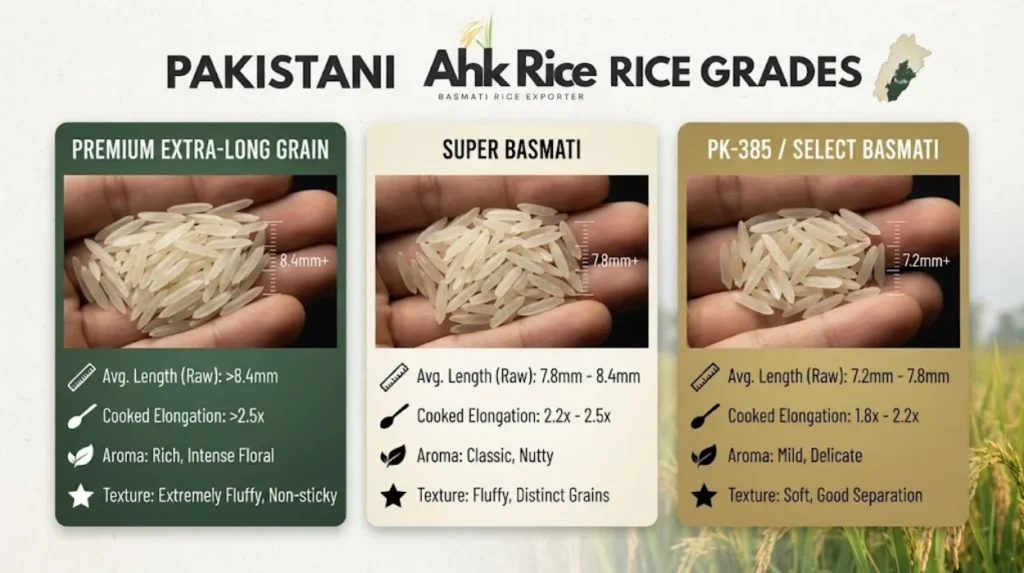
Pakistan produces traditional Basmati, 1121, Super Kernel, and 1509 Basmati rice varieties, with white, Steam, Sella, and Golden Sella processing forms. Each variety offers different grain characteristics, cooking performance, and commercial applications.
What Is 1121 Basmati Rice?
1121 Basmati is a long-grain variety recognized for its elongated kernels, aromatic profile, and cooking expansion. It is widely used for rice dishes requiring long, separate grains and a refined appearance.
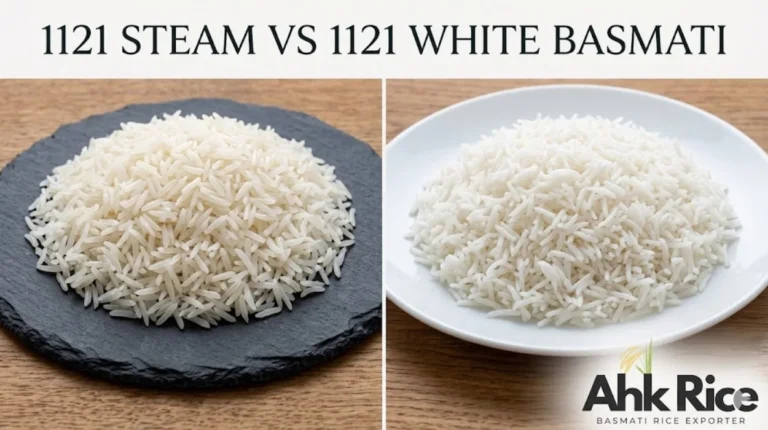
1121 rice is available in White, Steam, and Sella forms. Each processing type produces different texture and cooking performance.
1121 Steam receives steam treatment before drying and milling. The process improves grain strength and supports consistent cooking.
1121 Sella receives parboiling before drying. Golden Sella receives additional processing that produces its characteristic golden colour.
What Is Super Kernel Basmati Rice?
Super Kernel Basmati is a traditional Pakistani Basmati variety with aromatic grain, elongated appearance, and firm cooking texture. It is used in rice dishes that require fragrance, separation, and a traditional Basmati profile.
Super Kernel is available in White, Steam, and Sella forms. Its grain size and aroma suit household consumption, restaurants, and commercial rice preparation.
What Is 1509 Basmati Rice?
1509 Basmati is a long-grain variety that offers aromatic rice characteristics, efficient cooking performance, and commercial versatility. It is used across retail, foodservice, and wholesale rice markets.
1509 is available in White, Steam, and Sella forms. Its processing options support different cooking requirements and buyer specifications.
How Do White, Steam, and Sella Rice Differ?
White rice receives conventional milling, Steam rice receives steam treatment, and Sella rice receives parboiling before milling. These processing methods influence grain strength, colour, cooking texture, and preparation requirements.
White rice retains a natural white appearance. Its processing removes the husk and bran layers before polishing and grading.
Steam rice receives controlled steam treatment. The process strengthens the grain and reduces breakage during handling and cooking.
Sella rice receives parboiling. The process partially cooks the grain inside its husk before drying and milling. Golden Sella develops a golden colour through its processing method.
Which Processing Type Suits Different Uses?
White rice suits traditional cooking, Steam rice suits firmer grain preparation, and Sella rice suits commercial cooking that requires grain strength and separation. The correct processing type depends on the recipe, storage conditions, and buyer specification.
White Basmati suits pulao, biryani, and everyday rice meals. Steam Basmati suits catering operations requiring consistent grain structure. Sella Basmati suits large-volume preparation and foodservice applications.
Which Countries Import Pakistani Basmati Rice?
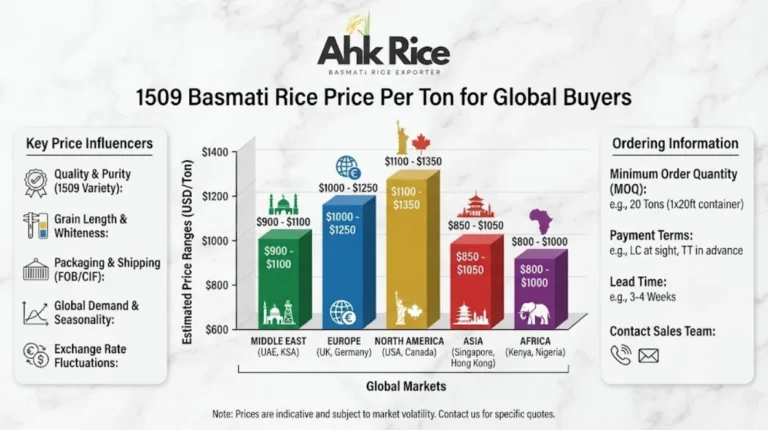
Pakistani Basmati rice reaches markets across the Middle East, Asia, Europe, Africa, and North America. Importers purchase different varieties and processing types according to local food preferences, cooking methods, and commercial requirements.
The Middle East imports Basmati for households, restaurants, catering companies, and wholesale distribution. Saudi Arabia, the United Arab Emirates, Qatar, and Iraq represent important rice-consuming markets.
European markets purchase Basmati for retail, foodservice, and ethnic grocery channels. The United Kingdom, France, Germany, and Italy contain established rice-importing businesses.
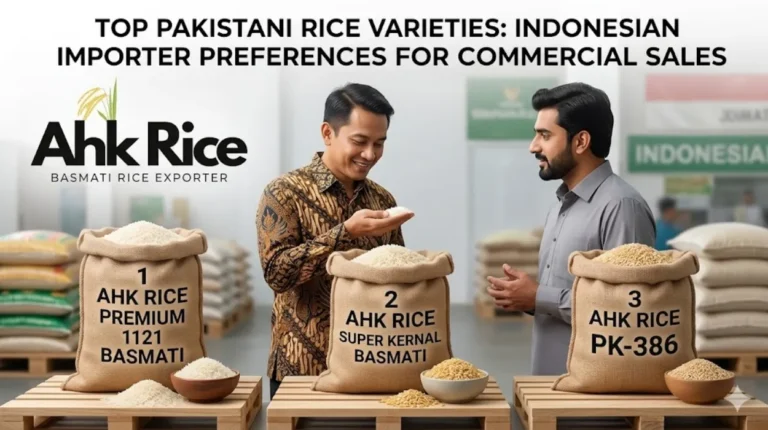
Asian markets also source Pakistani rice. Indonesia, Malaysia, and the Philippines use imported rice in commercial food preparation and retail distribution.
African markets purchase rice for household consumption and wholesale trade. Importers select grades according to local demand, price requirements, and cooking preferences.
Why Do Importers Choose Different Grades?
Importers select Basmati grades according to grain length, aroma, processing type, cooking performance, and customer segment. Retail buyers often prioritize appearance and packaging, while restaurants prioritize consistent cooking results.
Premium restaurants require aromatic rice with long, separate grains. Wholesale buyers require stable specifications and consistent supply. Retail buyers require suitable packaging, clear labeling, and dependable quality.
Which Certifications Apply to Pakistani Basmati Rice?
Pakistani Basmati rice exports require product documentation, quality verification, and destination-specific compliance. Certification requirements depend on the importing country, shipment type, food regulations, and buyer specifications.
What Documents Support Rice Export?
Rice export documentation includes commercial invoices, packing lists, certificates of origin, phytosanitary certificates, and applicable inspection documents. These records support customs clearance, traceability, and product verification.
Commercial invoices identify the product, quantity, price, and trading parties. Packing lists describe bag counts, weights, and shipment details.
Certificates of origin identify the country where the rice was produced. Phytosanitary certificates confirm compliance with plant-health requirements where applicable.
Food safety documentation supports destination requirements. Importers also request laboratory reports covering moisture, foreign matter, pesticide residues, and other agreed parameters.
What Common Misconceptions Exist About Pakistani Basmati Rice?
Pakistani Basmati is not one uniform product, and grain length alone does not determine quality. Variety, cultivation, processing, storage, and cooking method all influence the final result.
One misconception is that all long-grain rice is Basmati. Basmati is a specific aromatic rice group with recognized characteristics.
Another misconception is that Sella and Steam rice are identical. Both receive heat treatment, but their processing methods and cooking characteristics differ.
A third misconception is that the longest grain always provides the best cooking result. Grain length matters, but aroma, texture, broken percentage, and preparation method also affect quality.
Frequently Asked Questions
What makes Pakistani Basmati rice different from Indian Basmati rice?
Pakistani Basmati rice has a distinct aroma, grain structure, and cultivation history. Both countries produce aromatic Basmati varieties, but their agricultural regions, processing practices, and commercial grades differ.
Which Pakistani Basmati rice is best for biryani?
1121 Basmati and Super Kernel Basmati are commonly used for biryani. Their long grains, aroma, and cooking separation suit traditional biryani preparation.
What is the difference between 1121 and 1509 Basmati rice?
1121 Basmati is recognized for its elongated grain and aromatic cooking profile. 1509 Basmati offers long-grain characteristics and commercial versatility. Both are available in White, Steam, and Sella forms.
Is Pakistani Basmati rice naturally aromatic?
Yes. Pakistani Basmati rice contains naturally occurring aromatic compounds. These compounds produce the characteristic fragrance associated with Basmati rice during cooking.
Which countries import Pakistani Basmati rice?
Pakistan exports Basmati rice to markets in the Middle East, Europe, Asia, Africa, and North America. Importers select grades according to cooking requirements, customer demand, and commercial specifications.