FOB vs CIF Pricing: Which Option Is Best for Rice Buyers?
FOB works best for buyers with established freight arrangements, while CIF suits importers seeking a more coordinated shipping process. Here is why: FOB separates rice procurement from ocean freight, while CIF combines product cost, freight, and marine insurance into one supplier quotation. The right choice depends on destination, shipment size, freight control, and import experience.
Rice importers comparing Pakistani Basmati rice prices need more than a per-metric-ton quotation. A lower FOB price does not automatically produce a lower landed cost. A CIF quotation does not automatically provide better freight value. Buyers must compare the same grade, packaging, shipment quantity, destination port, and delivery period. This guide explains the differences between FOB and CIF rice pricing, with practical examples for commercial procurement.
What Do FOB and CIF Mean for Rice Buyers?
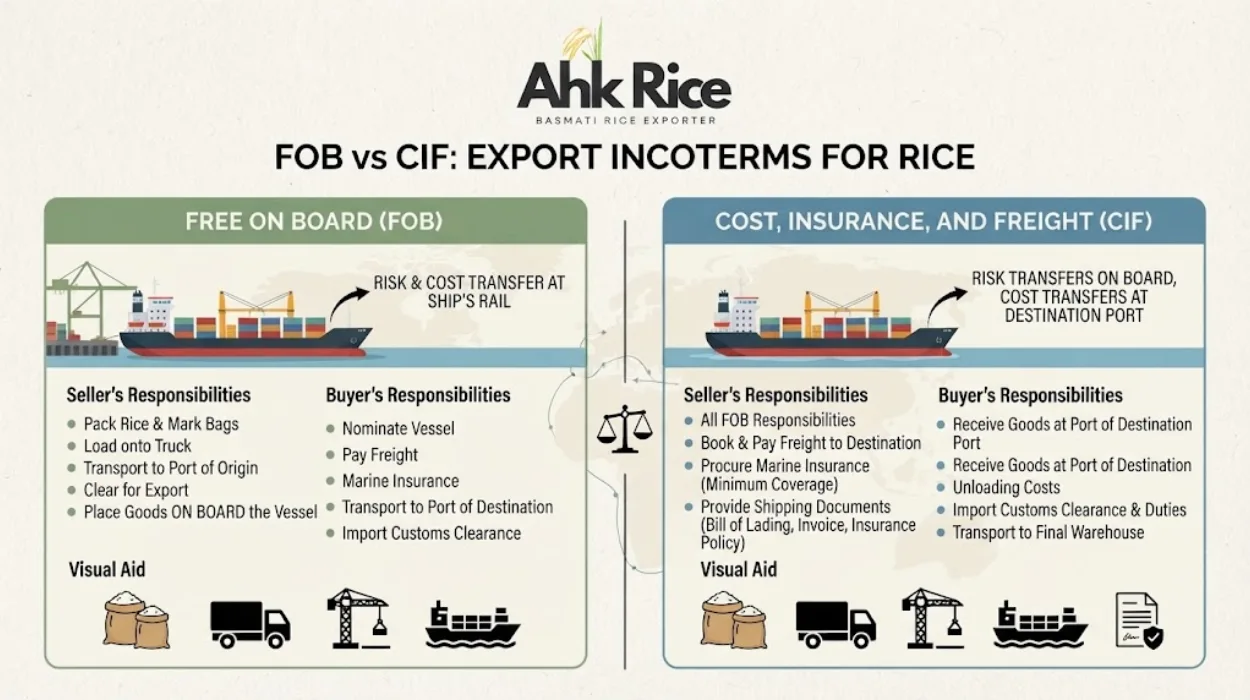
FOB means the seller delivers rice aboard the nominated vessel, while CIF includes ocean freight and marine insurance to the named destination port. These Incoterms define the division of costs, responsibilities, and risk between the exporter and importer.
FOB stands for Free On Board. Under FOB, the seller prepares the rice, completes export clearance, and loads the cargo onto the vessel selected by the buyer. The buyer arranges the main ocean freight and insurance.
CIF stands for Cost, Insurance and Freight. Under CIF, the seller arranges the ocean freight and minimum marine insurance to the named destination port. The buyer still handles import clearance, duties, taxes, and inland delivery.
How does FOB pricing work?
FOB rice pricing includes the product cost and export-side charges up to vessel loading. A Pakistani exporter quotes a 1121 Basmati shipment at $1,000 per MT FOB Karachi. The buyer pays the agreed product price and arranges the ocean freight separately.
FOB gives the importer control over freight selection. A buyer with a contracted shipping line can compare vessel schedules and negotiate freight directly. A new importer without freight contacts must obtain additional shipping quotations before calculating the landed cost.
How does CIF pricing work?
CIF rice pricing combines the product cost, ocean freight, and required marine insurance. A supplier quotes 1121 Basmati at $1,120 per MT CIF Jakarta. The quotation includes the agreed rice value, freight, and insurance to Jakarta port.
CIF simplifies the initial purchasing calculation. The buyer compares one product-and-shipping quotation against another. Import duties, destination handling, customs clearance, and inland transport remain separate costs.
The distinction between FOB and CIF establishes the cost boundary. The next question is how those boundaries affect the total import price.
How Do FOB and CIF Rice Prices Compare?
FOB separates freight from rice procurement, while CIF combines product, freight, and insurance into one quotation. The lower quotation depends on freight rates, shipment size, insurance, destination, and the buyer’s existing logistics arrangements.
Consider a hypothetical 25 MT shipment of Pakistani 1121 Steam Basmati rice from Karachi to Jakarta. The following figures illustrate the calculation method, not live market quotations.
| Cost component | FOB quotation | CIF quotation |
|---|---|---|
| Rice product value | $25,000 | $25,000 |
| Export clearance and loading | Included | Included |
| Ocean freight | Buyer arranges | $2,000 |
| Marine insurance | Buyer arranges | $50 |
| Total before destination charges | $25,000 | $27,050 |
| Price per MT | $1,000 | $1,082 |
The example shows a $82 per MT difference before destination charges. The buyer using FOB must arrange freight and insurance independently. The CIF buyer pays the supplier for those services.
What changes the FOB price per MT?
FOB rice prices reflect the selected grade, processing specification, packaging, quantity, and export-side costs. A 1121 Steam quotation differs from a 1509 Steam quotation because grain characteristics and market positioning differ.
A 25 MT shipment may also carry a different per-MT cost from a 100 MT shipment. Fixed documentation, inspection, and handling costs spread across a larger quantity. The buyer must compare quotations using identical shipment quantities.
What changes the CIF price per MT?
CIF rice prices reflect the same product factors plus freight, insurance, and destination port selection. A quotation for Jakarta differs from one for Jeddah because shipping routes and freight conditions differ.
Freight quotations also change with container availability, vessel schedules, seasonal demand, and fuel-related charges. A CIF price remains valid only for the quotation’s stated validity period and shipment conditions.
How should buyers compare quotations?
Use the same grade, broken percentage, moisture specification, bag weight, shipment quantity, and destination port. Then separate the costs included in each quotation.
A supplier quoting 1121 White Basmati at $980 FOB cannot be compared directly with a 1121 Steam quotation at $1,080 CIF. The processing type and freight inclusion create different commercial values.
With the quotation structure established, the next step is comparing the approaches across procurement and logistics attributes.
What Are the Available Rice Pricing Solutions?
Rice buyers can choose FOB, CIF, or a supplier-supported freight arrangement based on their logistics capability and purchasing requirements. Each approach assigns freight control, cost responsibility, and operational work differently.
FOB procurement
FOB procurement suits importers with established shipping arrangements. The buyer selects the freight forwarder, negotiates ocean freight, and manages the shipping schedule.
A distributor importing several containers each month may already have contracted freight rates. FOB allows that distributor to use existing arrangements while sourcing rice from Pakistan.
CIF procurement
CIF procurement suits buyers who prefer supplier-arranged ocean freight. The exporter coordinates the main carriage and includes the freight cost in the quotation.
A new Indonesian importer purchasing its first 25 MT shipment may prefer CIF. The buyer receives a combined quotation and avoids arranging the initial ocean freight independently.
Freight-supported procurement
Some suppliers provide freight estimates or coordinate shipping while quoting FOB. This arrangement gives the buyer visibility into logistics costs without changing the agreed Incoterm.
The buyer must confirm which services are included. A freight estimate does not automatically transfer responsibility for freight booking or risk.
Which approach works for recurring shipments?
Recurring buyers should compare FOB and CIF using their actual shipping history. A buyer with reliable freight rates can evaluate FOB against supplier-arranged CIF quotations.
A buyer without regular shipping arrangements should evaluate CIF alongside destination handling and inland delivery. The best comparison measures the complete landed cost, not the supplier’s product quotation alone.
The available solutions address different operational needs. The next comparison shows how each method performs against seven procurement attributes.
How Do FOB and CIF Compare Across Seven Attributes?
FOB provides greater freight control, while CIF provides a more consolidated shipping quotation. The comparison below shows the practical differences buyers should evaluate before approving a rice import contract.
| Attribute | FOB | CIF |
|---|---|---|
| Product quotation | Rice and export-side costs | Rice, freight, and insurance |
| Freight arrangement | Buyer | Seller |
| Main ocean freight cost | Buyer pays separately | Seller pays initially |
| Marine insurance | Buyer arranges | Seller arranges minimum cover |
| Freight control | Higher | Lower |
| Quotation simplicity | Requires separate freight quote | Combined quotation |
| Best operational fit | Experienced importers | Buyers seeking simpler coordination |
FOB provides more control over shipping selection and freight negotiation. CIF provides a consolidated quotation that supports faster initial cost comparison.
Neither method removes the buyer’s responsibility for import clearance, duties, taxes, or inland delivery. Those charges must remain in the landed-cost calculation.
Which Pricing Method Works Best for Different Rice Buyers?
FOB suits established importers with freight contracts, while CIF suits buyers prioritising supplier-coordinated shipping. The correct choice changes with destination, shipment volume, logistics expertise, and procurement objectives.
Which method suits Indonesian distributors?
Indonesian distributors importing regular container shipments should compare FOB with their existing freight contracts. FOB becomes useful when the distributor has reliable shipping partners and can negotiate competitive freight.
CIF provides a simpler starting point for distributors developing their import process. The buyer can compare supplier quotations while separately confirming destination handling and customs costs.
Which method suits GCC importers?
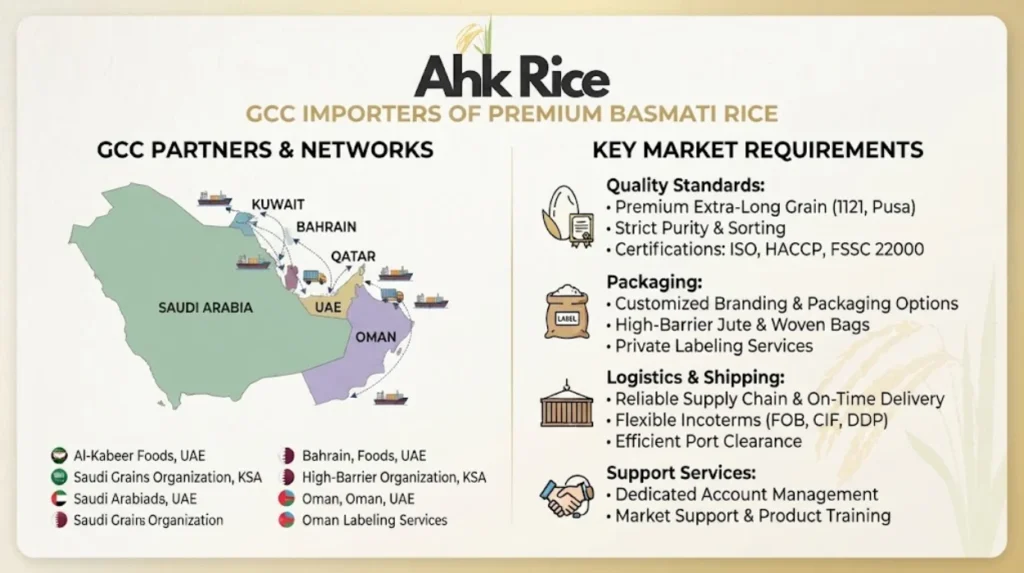
GCC importers should compare FOB and CIF for Karachi-to-Gulf routes using the same grade and shipment size. Buyers with established shipping arrangements can assess FOB against their contracted freight rates.
CIF suits buyers seeking supplier-coordinated ocean freight. Destination port selection remains important because handling and inland transport costs differ between Gulf markets.
Which method suits new importers?
New importers often need a clear quotation structure before managing independent freight arrangements. CIF provides a combined product, freight, and insurance quotation.
FOB remains useful for buyers building long-term logistics capability. The importer must obtain freight quotations and confirm insurance arrangements before approving the purchase.
The best method depends on operational circumstances. The next section explains the advantages and limitations through practical examples.
What Are the Pros and Cons of FOB and CIF Pricing?
FOB improves freight control but increases logistics responsibility, while CIF simplifies shipping coordination but reduces buyer control over freight selection. The trade-off affects cost transparency, scheduling, and operational workload.
What are the advantages of FOB?
FOB gives buyers direct control over the main ocean freight arrangement. The importer can compare shipping lines, vessel schedules, and freight quotations.
FOB also supports procurement from suppliers in different exporting regions. A buyer with an established freight contract can compare rice quotations using the same freight arrangement.
The limitation is additional coordination. The buyer must arrange the main carriage and insurance, then confirm the shipping schedule with the exporter.
What are the advantages of CIF?
CIF provides a combined quotation for rice, ocean freight, and marine insurance. The buyer can compare supplier offers without arranging the main freight independently.
CIF also supports simpler first-time procurement. A new importer can focus on product specifications, documentation, destination charges, and customs requirements.
The limitation is reduced freight control. The buyer must confirm the shipping line, transit schedule, freight validity, and insurance coverage included in the quotation.
What are the disadvantages of FOB?
FOB requires the buyer to manage additional logistics tasks. A new importer without shipping contacts may face delays while arranging freight.
FOB quotations also require careful cost calculation. The buyer must add freight, insurance, and related charges before comparing the landed price.
What are the disadvantages of CIF?
CIF may include freight charges that differ from the buyer’s available shipping rates. The importer must compare the supplier’s freight cost with independent market quotations.
CIF also includes minimum marine insurance coverage under the Incoterm. Buyers requiring broader protection must confirm the policy terms and arrange additional coverage when necessary.
The advantages and limitations clarify the operational trade-off. The next section provides a decision framework for selecting the appropriate pricing method.
How Should Rice Buyers Choose Between FOB and CIF?
Buyers should select FOB or CIF by comparing freight control, shipment volume, logistics experience, destination requirements, and total landed cost. A structured decision framework prevents product price from becoming the only selection criterion.
| Decision factor | FOB consideration | CIF consideration |
|---|---|---|
| Freight experience | Existing freight contracts support independent booking | Supplier coordinates main freight |
| Shipment volume | Larger recurring shipments support freight negotiation | Smaller or irregular shipments simplify coordination |
| Cost control | Buyer compares freight rates directly | Buyer compares the supplier’s freight component |
| Shipping schedule | Buyer selects the vessel schedule | Buyer confirms supplier-arranged schedule |
| Import complexity | Buyer manages additional logistics tasks | Buyer receives a consolidated quotation |
How does shipment volume affect the decision?
Shipment volume affects freight negotiation and fixed logistics costs. A distributor importing 100 MT monthly may obtain better freight terms through regular booking arrangements.
A buyer importing one container quarterly may prefer CIF for simpler coordination. The decision should use actual freight quotations rather than assumptions about volume discounts.
How does destination affect the decision?
Destination affects freight cost, transit time, port charges, and inland delivery. Buyers must compare FOB and CIF using the same destination port.
A CIF quotation for Jakarta cannot be compared directly with an FOB quotation for Karachi. The destination port and included services must match.
How does product specification affect the decision?
Product specification affects the rice price before freight is considered. A buyer comparing 1121 Steam, 1121 Sella, and 1509 Steam must confirm the same grade, broken percentage, moisture, packaging, and quantity.
AHK Rice supplies 1121, Super Kernel, and 1509 varieties through end-to-end processing and custom packaging. Buyers can use the same product specification to compare FOB and CIF quotations.
How should buyers compare shelf life?
Shelf life depends on rice moisture, processing, packaging, storage conditions, and production quality. FOB and CIF do not change the product’s inherent shelf life.
Buyers should request the production date, packaging specification, storage requirements, and recommended consumption period. These details support inventory planning after arrival.
The decision framework identifies the main procurement variables. The next comparison examines two market regions and their typical grade preferences.
Which Pricing Method Suits Different Market Regions?
GCC and Southeast Asian buyers should compare FOB and CIF using regional grade preferences, freight routes, and storage requirements. Market needs influence the product specification, while the Incoterm determines shipping responsibilities.
GCC market: Saudi Arabia and the UAE
GCC buyers commonly evaluate 1121 Basmati, Super Kernel, and 1509 varieties for retail, catering, and wholesale channels. Product selection depends on grain length, processing type, appearance, and cooking requirements.
A buyer sourcing 1121 Golden Sella for catering should compare the same grade under FOB and CIF. The importer must also evaluate storage conditions, destination charges, and delivery requirements.
Southeast Asian market: Indonesia
Indonesian buyers evaluate Pakistani Basmati rice for retail, foodservice, and distribution channels. 1121 Steam and 1509 Steam provide examples of grades that require specification-based comparison.
A distributor comparing 1121 Steam FOB with 1121 Steam CIF should use the same shipment size and destination port. The buyer must also confirm packaging, documentation, and import requirements.
How do prices and shelf life compare?
Regional price comparisons require current supplier quotations and freight data. The following example illustrates the method using hypothetical figures.
| Market region | Example grade | Illustrative FOB price per MT | Illustrative CIF price per MT |
|---|---|---|---|
| GCC | 1121 Golden Sella | $1,000 | $1,080 |
| Southeast Asia | 1121 Steam | $1,000 | $1,085 |
The example shows a $80 per MT CIF difference for the GCC shipment and an $85 per MT difference for Southeast Asia. Actual freight costs depend on the route, vessel schedule, shipment quantity, and quotation validity.
Shelf life must be compared using the same grade and storage conditions. A 1121 Golden Sella shipment stored in a dry warehouse should be evaluated against another 1121 Golden Sella shipment under equivalent conditions.
CIF does not extend shelf life. FOB does not reduce shelf life. Product quality, packaging, and storage management determine the usable inventory period.
The regional comparison shows why buyers need destination-specific quotations. The next section explains the documents and checks required before approving either method.
What Should Buyers Check Before Approving FOB or CIF?
Buyers should verify the rice specification, quotation validity, Incoterm, freight details, insurance, and export documentation before approving a shipment. These checks establish the commercial and operational responsibilities.
What product documents matter?
Product specifications should identify the rice variety, processing type, grain length, broken percentage, moisture, packaging, and shipment quantity. The specification must match the quotation and purchase contract.
Quality documents should include the agreed inspection and testing requirements. Buyers should confirm the applicable standards before approving the shipment.
What shipping documents matter?
Shipping documents should identify the exporter, importer, shipment quantity, destination port, and agreed Incoterm. Buyers should confirm the bill of lading requirements and freight arrangements.
CIF buyers should review the marine insurance certificate and coverage terms. FOB buyers should arrange their own insurance and confirm the policy before shipment.
What cost documents matter?
Cost documents should separate product value, freight, insurance, destination handling, duties, taxes, and inland delivery. The buyer should calculate the complete landed cost.
The same calculation should apply to every supplier quotation. This creates a consistent basis for comparing FOB and CIF offers.
The verification process reduces quotation ambiguity. The final section connects pricing decisions with the wider export process.
How Does FOB or CIF Connect to the Rice Export Process?
FOB and CIF pricing form one part of the export process, which also includes milling, quality control, packaging, documentation, and shipment dispatch. Buyers should understand the complete process before approving a commercial order.
AHK Rice manages end-to-end processing, custom packaging, and export coordination for Pakistani Basmati rice. Its product range includes 1121, Super Kernel, and 1509 varieties.
The export process begins with paddy procurement and milling. Processing includes dehusking, polishing, grading, sorting, and packaging according to the agreed specification.
Quality control includes inspection, testing, and verification of the required product attributes. Documentation supports customs clearance and shipment dispatch.
The buyer should connect the pricing quotation with the product specification and shipping arrangement. A clear specification reduces the risk of comparing different products under similar prices.
For the next stage, buyers can review the complete AHK Rice export process from mill to destination port to understand how procurement, processing, documentation, and shipping fit together.
Conclusion
FOB and CIF serve different rice procurement requirements. FOB provides freight control for experienced importers with established shipping arrangements. CIF provides a consolidated quotation for buyers seeking supplier-coordinated ocean freight.
The correct choice depends on the complete landed cost, not the rice price alone. Buyers should compare the same grade, shipment quantity, destination port, packaging, and delivery requirements.
A structured comparison supports better procurement decisions. It also creates clearer communication between the importer, exporter, freight provider, and destination customs authorities.
Frequently Asked Questions
Is FOB cheaper than CIF for rice imports?
FOB can produce a lower landed cost when the buyer has competitive freight arrangements. CIF can provide better value when the supplier secures favourable shipping rates. Compare both quotations using the same grade, shipment quantity, destination, and included charges.
Does CIF include import duties and taxes?
CIF does not include import duties, taxes, customs clearance, or inland delivery. The seller arranges the main ocean freight and minimum marine insurance to the named destination port. The buyer remains responsible for destination import procedures and charges.
Which Incoterm gives buyers more control over freight?
FOB gives buyers greater control over the main ocean freight arrangement. The buyer selects the shipping line, negotiates freight, and manages the booking. CIF places the main freight arrangement with the seller.
Can buyers negotiate FOB and CIF prices?
Buyers can negotiate both FOB and CIF quotations. Negotiation should focus on the rice specification, shipment quantity, freight validity, packaging, and included costs. The buyer should compare the resulting landed cost rather than the product price alone.
Does CIF guarantee faster rice delivery?
CIF does not guarantee faster delivery. Transit time depends on the shipping route, vessel schedule, port operations, and customs clearance. Buyers should confirm the estimated dispatch date, transit time, and destination requirements before approving the shipment.
What should buyers request from a Pakistani rice exporter?
Buyers should request a detailed product specification, quotation validity, Incoterm, shipment quantity, packaging details, export documentation, and quality requirements. A complete quotation supports accurate comparison between FOB and CIF procurement.