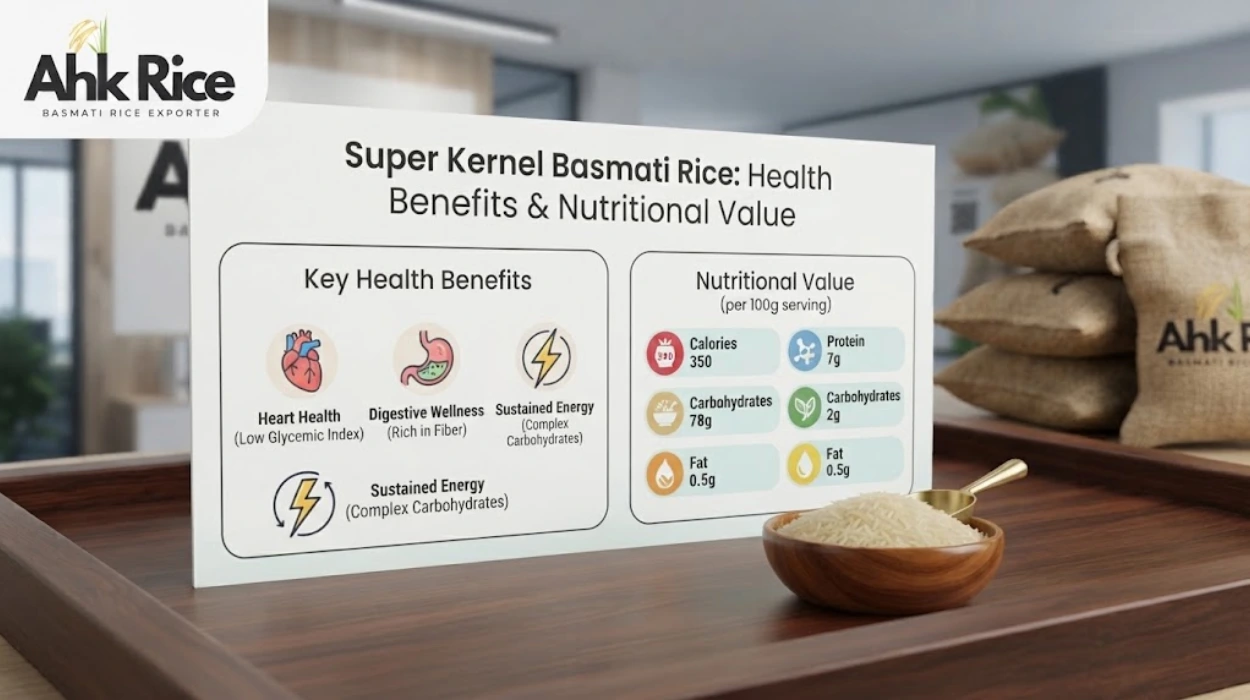
Super Kernel Rice Health Benefits and Nutritional Value
Super Kernel rice provides mainly carbohydrates for energy, about 2.7 g protein and 0.3 g fat per 100 g cooked white rice, while its health profile depends on milling and preparation. Here is why: white Super Kernel is a polished long-grain rice, so it supplies energy but less fiber than whole-grain rice. USDA data for comparable cooked white long-grain rice reports 130 kcal, 28.2 g carbohydrate, 2.7 g protein, 0.3 g fat, and 0.4 g fiber per 100 g.
What Is Super Kernel Rice?
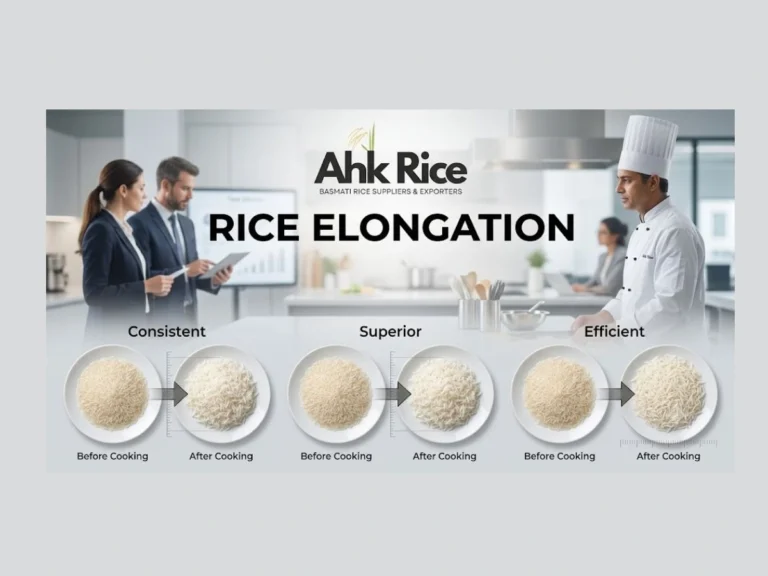
Super Kernel rice is a traditional Pakistani Basmati rice type with aromatic long grains, commonly measured around 7.2 mm before cooking and 16 mm or more after cooking. Its identity combines grain length, aroma, cooking behavior, milling quality, and Basmati characteristics.
Super Kernel Basmati is cultivated mainly in Pakistan’s Punjab rice-growing areas. Punjab has a major role in Pakistan’s Basmati production, with the provincial agriculture department identifying Basmati as a premium rice category.
Super Kernel has a shorter raw grain than 1121 Basmati. A commonly published specification places Super Kernel at 7.2 mm raw grain length, with cooked grain reaching 16 mm or more.
The grain carries the characteristic Basmati aroma that supports traditional dishes such as biryani, pulao, pilaf, and rice-based foodservice meals. Its cooked structure also supports applications where separated grains and recognizable Basmati character matter.
Super Kernel should not be confused with brown rice. Super Kernel describes a rice variety or commercial grain type, while brown and white describe processing states. White rice has the bran and germ removed during milling, leaving mainly the starchy endosperm.
With the product definition established, its processing determines much of its final nutritional profile.
How Is Super Kernel Rice Processed?
Super Kernel rice passes through cleaning, dehusking, milling, polishing, grading, sorting, inspection, and packing before reaching consumers. Each stage removes impurities, separates grain fractions, controls appearance, and prepares the rice for consistent cooking and distribution.
Which processing steps does Super Kernel rice follow?
- Clean the paddy to remove stones, dust, straw, and other field impurities.
- De-husk the grain to remove the outer rice husk.
- Separate the kernels from remaining husk and immature material.
- Mill the rice to remove bran layers and produce edible white kernels.
- Polish the grain to create a smoother and cleaner surface.
- Grade the rice according to grain size, broken percentage, and commercial specification.
- Sort the kernels with mechanical and optical systems to remove discolored or unsuitable grains.
- Inspect the rice for moisture, foreign matter, appearance, and other quality parameters.
- Pack the rice into food-grade retail or bulk packaging according to market requirements.
Processing directly affects nutrition. White milling removes bran and germ, which reduces fiber and some micronutrients compared with whole-grain rice. Harvard Health notes that white rice retains mainly the starchy endosperm after this refining process.
Super Kernel therefore delivers a different nutritional profile from brown rice made from the same general grain category. Processing level matters as much as variety when evaluating nutritional value.
With processing understood, the next step is to examine the nutrients present in cooked rice.
What Is the Nutritional Value of Super Kernel Rice?
A 100 g serving of comparable cooked white long-grain rice provides about 130 kcal, 28.2 g carbohydrates, 2.7 g protein, 0.3 g fat, and 0.4 g fiber. These values provide a useful reference for cooked white Super Kernel.
Super Kernel does not have a universally standardized nutrition label that applies to every crop, mill, processing method, and cooking method. Nutritional values change with milling degree, enrichment, cooking water, and serving size.
| Nutrient | Typical amount per 100 g cooked white long-grain rice |
|---|---|
| Energy | 130 kcal |
| Carbohydrate | 28.2 g |
| Protein | 2.7 g |
| Total fat | 0.3 g |
| Dietary fiber | 0.4 g |
| Calcium | 10 mg |
| Iron | 1.2 mg |
| Potassium | 35 mg |
| Sodium | 1 mg |
These reference values come from USDA FoodData Central data for cooked white long-grain rice.
Carbohydrates form the largest nutritional component. The 28.2 g carbohydrate value per 100 g cooked rice means Super Kernel functions primarily as an energy-providing staple rather than a high-protein food.
Protein contributes about 2.7 g per 100 g in the comparable USDA reference. Rice protein therefore complements meals containing legumes, meat, dairy, eggs, fish, or other protein-rich foods.
Fat remains low at about 0.3 g per 100 g. This value applies to plain cooked rice before adding cooking oil, butter, ghee, sauces, meat, or other ingredients.
Fiber is also low in polished white rice. The comparable USDA reference contains 0.4 g fiber per 100 g. Brown rice contains substantially more fiber because the bran and germ remain intact.
With these nutrients established, the main health benefits become easier to understand.
What Are the Main Super Kernel Rice Health Benefits?
Super Kernel supports daily energy needs through carbohydrates, provides modest plant protein, contains little fat, and supplies small amounts of minerals. Its nutritional role depends on portion size, processing level, and the foods served with it.
Does Super Kernel provide energy?
Super Kernel provides substantial carbohydrate energy in a relatively low-fat food. A 100 g cooked reference portion supplies 130 kcal and 28.2 g carbohydrates.
This makes rice useful in meals requiring a carbohydrate-rich staple. Examples include biryani, pulao, rice bowls, curries, and foodservice meals.
Does Super Kernel provide protein?
Super Kernel provides protein, but it should not serve as the primary protein source. A comparable cooked white rice reference supplies 2.7 g protein per 100 g.
Combining rice with lentils, chickpeas, beans, meat, fish, eggs, or yogurt creates a more protein-rich meal.
Is Super Kernel low in fat?
Plain cooked Super Kernel contains very little fat. The comparable USDA reference contains 0.3 g total fat per 100 g.
The final fat content of a rice dish depends heavily on preparation. Fried rice, biryani cooked with oil, and rice served with creamy sauces contain more fat than plain steamed rice.
Does Super Kernel contain minerals?
Super Kernel contains minerals in smaller quantities than its carbohydrate content. Comparable cooked white long-grain rice provides calcium, iron, potassium, magnesium, phosphorus, zinc, and other micronutrients.
The exact mineral profile changes with variety, soil, processing, enrichment, and preparation.
These benefits define Super Kernel’s nutritional role, while its applications explain why consumers and food businesses select the grain.
Where Is Super Kernel Rice Commonly Used?
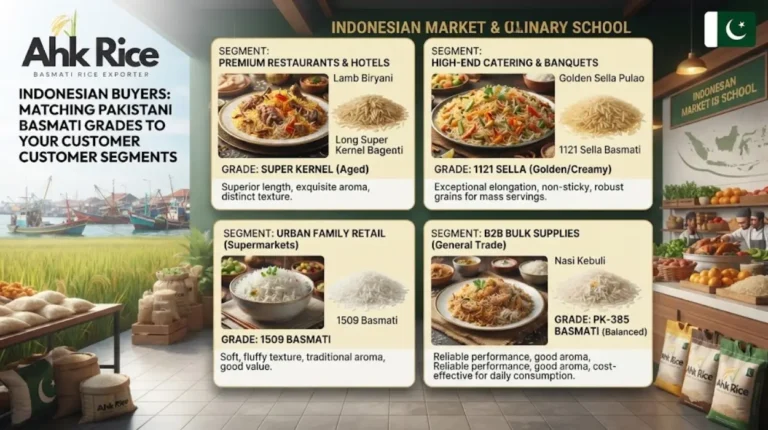
Super Kernel is used in household meals, restaurants, catering, foodservice, retail rice packs, biryani, pulao, pilaf, and other dishes requiring aromatic long-grain rice. Its grain appearance and traditional Basmati aroma support both everyday and commercial cooking.
Which foods use Super Kernel?
Biryani uses Super Kernel for separated aromatic grains and a recognizable Basmati character. Pulao uses the grain for its long cooked appearance and aroma.
Rice bowls use Super Kernel as a carbohydrate base for vegetables, meat, seafood, legumes, and sauces. Catering kitchens also use it for large-volume rice preparation.
Retail consumers purchase Super Kernel as a household staple. Commercial buyers procure it for restaurants, wholesalers, distributors, private-label products, and foodservice operations.
Pakistan’s rice industry supplies Basmati to international markets, while Super Kernel specifications vary by exporter, processor, crop, and destination requirements. Pakistan’s agriculture authorities identify Basmati as a premium export-oriented rice category.
The next consideration is understanding the grades and processing forms that determine how Super Kernel behaves in cooking.
What Grades and Forms of Super Kernel Rice Are Available?
Super Kernel is commonly sold as white or raw rice, with commercial specifications differentiated by grain length, broken percentage, moisture, milling degree, and sorting quality. Processing form determines appearance, cooking behavior, shelf characteristics, and buyer specifications.
What defines Super Kernel quality?
| Quality attribute | Common commercial reference |
|---|---|
| Raw grain length | About 7.2 mm |
| Cooked grain length | 16 mm or more |
| Broken grains | 0–2% in one published specification |
| Moisture | Up to 13.5% in one published specification |
| HS classification | 1006.30 |
Published commercial specifications identify Super Kernel at approximately 7.2 mm raw length and 16 mm or more cooked length.
Buyers should distinguish product variety from processing grade. White rice is milled and polished without parboiling. Sella is parboiled before drying and milling. Steam rice receives steam treatment before further processing.
Commercial specifications also differ between suppliers. A buyer therefore needs a written specification covering grain length, broken percentage, moisture, milling degree, foreign matter, crop year, packaging, and inspection requirements.
This specification approach becomes important when nutritional characteristics are evaluated alongside commercial quality.
What Are Common Misconceptions About Super Kernel Rice?
Super Kernel is not a high-protein food, does not automatically provide high fiber, and does not become nutritionally superior simply because it is Basmati. Variety, milling, preparation, serving size, and the complete meal determine its nutritional role.
One misconception treats Basmati rice as automatically low glycemic. White rice can have a relatively high glycemic index, and Harvard notes that processing influences the glycemic response of rice.
Another misconception assumes longer grains contain more nutrients. Grain length primarily describes physical structure. It does not establish protein, fiber, vitamin, or mineral superiority.
A third misconception treats rice as a major protein source. Cooked white rice provides useful protein, but its primary macronutrient is carbohydrate.
A fourth misconception assumes every Super Kernel product has identical nutrition. Milling, enrichment, processing, cooking water, and serving size change the final nutritional values.
Super Kernel is best understood as an aromatic Basmati rice variety with a carbohydrate-focused nutritional profile, not as a specialized health food.
Which Certifications Apply to Super Kernel Rice Exports?
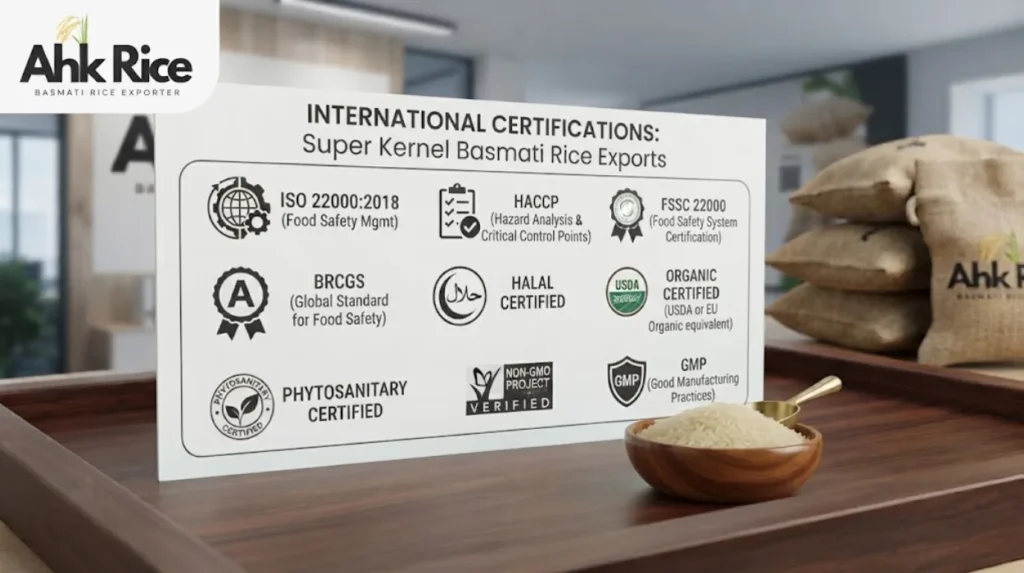
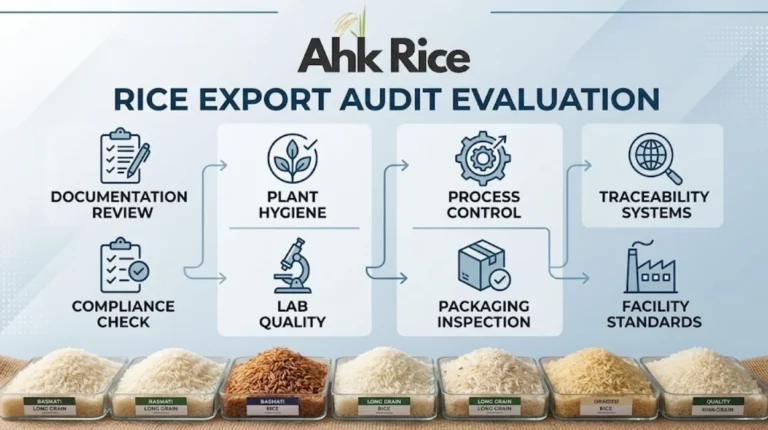
Exported Super Kernel rice requires food-safety, quality, phytosanitary, traceability, and destination-specific documentation according to the importing market and shipment specification. Certification requirements differ by destination, product form, packaging, and buyer contract.
Common export documentation can include certificates of analysis, phytosanitary certificates, certificates of origin, fumigation documents, inspection reports, packing lists, invoices, and shipping documents.
Food-safety systems can include HACCP-based controls and internationally recognized management standards such as ISO 22000. Specific markets can also impose residue, labeling, contaminant, traceability, and packaging requirements.
Certification should therefore be matched to the destination rather than presented as one universal certificate for every Super Kernel shipment.
With nutrition, processing, applications, grades, misconceptions, and export controls covered, the next stage is evaluating Super Kernel through commercial quality and price.
For the next consideration-stage article, place the internal link after the nutritional and specification discussion, where readers naturally move from product understanding to purchasing evaluation: [Insert Link to MOFU Article] using contextual anchor text such as “Super Kernel rice price and quality factors for buyers”.
Frequently Asked Questions About Super Kernel Rice
Is Super Kernel rice healthy?
Super Kernel can form part of a balanced diet. Its main nutritional contribution is carbohydrate energy, with modest protein and low fat. Portion size and the foods served with rice affect the overall nutritional quality of the meal.
How many calories does Super Kernel rice contain?
Comparable cooked white long-grain rice contains about 130 kcal per 100 g, with 28.2 g carbohydrate, 2.7 g protein, 0.3 g fat, and 0.4 g fiber.
Does Super Kernel rice contain fiber?
Polished white Super Kernel contains relatively little fiber. A comparable USDA reference provides 0.4 g fiber per 100 g cooked rice. Brown rice retains more fiber because its bran remains intact.
Is Super Kernel rice good for daily meals?
Super Kernel works as a daily carbohydrate staple when portions and the complete meal are balanced. Pairing rice with vegetables, legumes, dairy, eggs, fish, or meat increases the meal’s nutrient diversity.
Is Super Kernel the same as 1121 Basmati?
No. Super Kernel and 1121 are different Basmati rice types. A published commercial comparison places Super Kernel near 7.2 mm raw grain length, while 1121 is listed around 8.3 mm.
Does cooking change Super Kernel’s nutritional value?
Cooking changes nutrient concentration per 100 g because rice absorbs water. The cooked weight increases, so nutrients become distributed across a larger mass. Added oil, salt, meat, and sauces also change the final nutrition profile.