Why Should New York Buyers Evaluate Rice Production Capacity?
New York buyers should evaluate rice production capacity because a supplier’s factory capacity determines whether ordered volume can be processed, graded, packed, documented, and shipped consistently across multiple purchase cycles. Production capacity is not simply the size of a rice mill. It includes raw paddy access, milling lines, drying and parboiling systems, grading equipment, storage, packaging, quality control, labor, and export logistics. For a buyer sourcing Pakistani Basmati rice, these factors directly affect supply continuity.
Pakistan remains a major rice-exporting country. USDA data places Pakistan’s 2025/26 rice production at about 9.4 million metric tons and its 2025/26 exports at roughly 4.7 million metric tons in the latest Pakistan Grain and Feed Annual. Through the first four months of 2025/26, Pakistan exported about 1.80 million metric tons of rice, including 326,591 metric tons of Basmati rice.
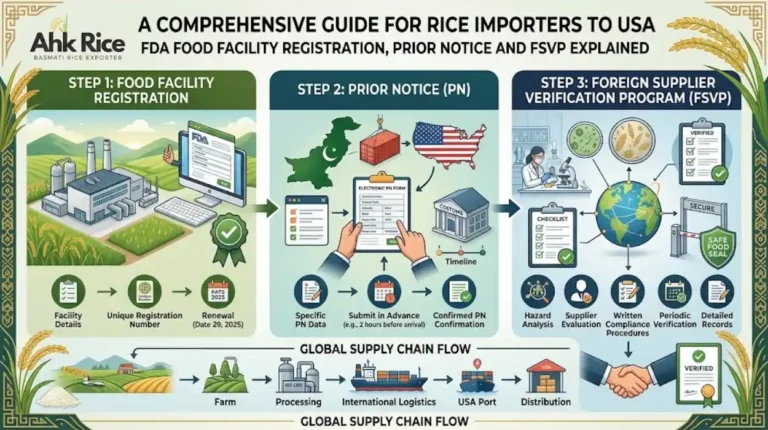
For New York importers, production capacity matters because the U.S. market requires reliable product specifications, food-safety documentation, labeling compliance, and supplier verification. FDA rules require covered U.S. food importers to operate a Foreign Supplier Verification Program, while most foreign facilities that manufacture, process, pack, or hold food for U.S. consumption must maintain FDA registration.
What is rice production capacity?
Rice production capacity is the maximum quantity of rice a supplier can process into finished commercial product within a defined period while maintaining specified quality, packaging, food-safety, and documentation requirements. It includes both physical processing capacity and the supplier’s ability to convert available paddy into consistent export-ready rice.
A rice mill’s installed capacity describes what its equipment can process under stated operating conditions. Actual production capacity is different. It depends on raw paddy availability, operating hours, maintenance schedules, drying capacity, milling efficiency, labor, storage space, and packaging throughput.
For example, a mill with a nominal processing capacity of 10 metric tons per hour does not automatically guarantee 240 metric tons of finished rice every day. Downtime, cleaning, grade changes, maintenance, raw-material preparation, and packing operations reduce practical output.
New York buyers should therefore evaluate production capacity as a complete supply system.
For Pakistani Basmati rice, this system starts with paddy procurement and ends with finished bags or bulk-packed containers. A supplier such as AHK Rice operates within Punjab’s rice-processing environment, where Basmati production is concentrated in important rice-growing areas.
The main commercial varieties relevant to Pakistani Basmati sourcing include 1121 Basmati, Super Kernel Basmati, and 1509 Basmati. Each variety requires controlled processing because grain length, moisture, broken percentage, purity, milling degree, and cooking characteristics differ.
Where is Pakistani Basmati rice produced?
Pakistani Basmati rice is primarily associated with the irrigated rice-growing areas of Punjab, where suitable soil, water availability, climate, and traditional cultivation support aromatic long-grain varieties. Paddy from these areas enters mills for drying, cleaning, milling, grading, and export preparation.
Punjab is central to Pakistan’s Basmati supply chain. Rice cultivation also occurs in Sindh and other provinces, but production systems vary by ecological zone and rice type.
The crop follows an agricultural cycle rather than a continuous factory-production cycle. Farmers plant paddy during the rice-growing season. Harvested paddy then moves through procurement and post-harvest handling before reaching processing facilities.
This distinction matters to New York buyers. A mill does not manufacture rice from nothing. It converts harvested paddy into a standardized finished product.
A capacity assessment should therefore examine both the factory and its access to suitable paddy.
For example, a supplier selling 1121 Basmati needs reliable access to 1121 paddy that matches the contracted specifications. A factory with large milling equipment but inadequate access to the required variety cannot provide dependable supply.
How does rice production work from paddy to export-ready rice?
Rice production moves through procurement, receiving, cleaning, drying, dehusking, separation, whitening, polishing, grading, sorting, quality inspection, packaging, storage, container loading, and export documentation. Each stage controls a different quality or supply variable before the rice reaches the buyer.
1. Paddy procurement
The process begins with paddy procurement. Paddy is harvested rice with its outer husk still attached.
The processor identifies the required variety and assesses incoming lots for moisture, foreign material, damaged kernels, immature grains, and varietal purity.
2. Receiving and sampling
The factory receives paddy and takes representative samples. Sampling establishes whether the raw material matches the required processing parameters.
Measurements can include moisture content, impurity levels, grain dimensions, damaged kernels, and varietal characteristics.
3. Cleaning
Cleaning removes materials such as stones, dust, straw, metal particles, and other foreign matter.
Mechanical cleaning protects downstream equipment and improves finished-product quality.
4. Drying
Freshly harvested paddy requires controlled moisture management before storage and milling.
Drying reduces moisture to an appropriate level for safe storage and efficient milling. Poor drying increases the risk of grain damage, while excessive drying can increase breakage during milling.
5. Dehusking
Dehusking removes the outer rice husk and produces brown rice.
The husk is separated from the edible kernel through mechanical equipment.
6. Paddy separation
Unhusked paddy can remain mixed with brown rice after dehusking. Paddy separators recover remaining unhusked grains for another processing cycle.
This step improves milling recovery and reduces unwanted paddy in the finished product.
7. Whitening and polishing
Whitening removes bran layers from brown rice.
Polishing produces the appearance and surface finish required for the selected commercial grade.
Processing intensity affects appearance, yield, and the quantity of broken kernels generated.
8. Grading
Grading separates rice according to physical characteristics.
Long-grain Basmati products require controlled separation of head rice and broken rice. Buyers can specify parameters such as broken percentage, grain length, moisture, foreign matter, and damaged kernels.
9. Optical sorting
Optical sorters identify and remove kernels that differ in color or appearance.
Examples include discolored grains, yellow kernels, chalky grains, and other visually defective kernels.
10. Final inspection
Quality-control personnel verify the finished product against the commercial specification.
Inspection can cover moisture, broken percentage, grain length, purity, foreign material, milling degree, packaging weight, and other contractual parameters.
11. Packaging
Rice is packed into the required commercial format.
Examples include 5 kg retail bags, 10 kg bags, 20 kg bags, 25 kg bags, and larger commercial sacks.
Packaging capacity matters because milling capacity alone does not determine how quickly an order becomes shipment-ready.
12. Storage and container loading
Finished rice requires controlled storage before shipment.
The factory then prepares cartons, sacks, pallets where applicable, container loading records, shipping documents, and other export paperwork.
This final stage connects production capacity with logistics capacity.
What are the key components of rice production capacity?
The key components are raw-paddy availability, milling throughput, drying capacity, grading and sorting capability, finished-goods storage, packaging throughput, quality-control resources, labor, maintenance capacity, and export logistics. A capacity evaluation must examine these components together rather than factory size alone.
Raw-material access establishes whether production can continue.
Processing throughput establishes how quickly paddy becomes finished rice.
Drying capacity controls post-harvest handling.
Grading and optical sorting determine whether the factory can consistently produce the contracted specification.
Storage capacity determines how much finished rice can remain available before shipment.
Packaging capacity determines whether finished rice can be converted into the buyer’s required retail or commercial format.
Quality-control capacity determines whether the supplier can test and document each production lot.
Export logistics determine whether completed orders can move from the factory to the port and onward to New York.
This is why production capacity should be assessed as a chain. A bottleneck at one stage can restrict the entire operation.
For example, a mill can have high milling throughput but limited packaging lines. The result is a lower effective shipment capacity.
How does production capacity benefit New York rice buyers?
Production capacity gives New York buyers a measurable basis for evaluating supply continuity, order scalability, specification consistency, production scheduling, and shipment planning. It also helps buyers distinguish installed machinery from practical output that a supplier can sustain under real commercial operating conditions.
The first benefit is supply continuity.
A buyer supplying restaurants, grocery stores, wholesalers, or food-service operators needs rice at predictable intervals. A supplier that cannot maintain production creates inventory pressure downstream.
The second benefit is specification consistency.
Repeated orders require the same variety and defined quality parameters. Consistent production systems support repeatable grading and packaging.
The third benefit is scalability.
A buyer that starts with 1 container and later needs 5 containers needs a supplier whose processing and packing system can accommodate increased volume.
The fourth benefit is inventory planning.
When buyers understand production schedules, they can coordinate purchase orders, inland transportation, customs clearance, warehouse capacity, and distribution.
The fifth benefit is supplier verification.
FDA’s FSVP framework requires covered importers to evaluate foreign suppliers and verify that imported food is produced in compliance with applicable U.S. food-safety requirements. Supplier records, hazard analysis, verification activities, corrective actions, and recordkeeping form part of that framework.
Production capacity does not replace food-safety verification. It provides another operational dimension for evaluating whether a supplier can support the commercial relationship.
Which rice grades should New York buyers evaluate against production capacity?
New York buyers should evaluate production capacity against the exact rice specification they intend to purchase, including Basmati variety, grain length, broken percentage, moisture, purity, milling degree, packaging format, and private-label requirements. Capacity without specification control does not establish reliable supply.
1121 Basmati
1121 Basmati is an extra-long-grain Pakistani Basmati variety widely traded in international markets.
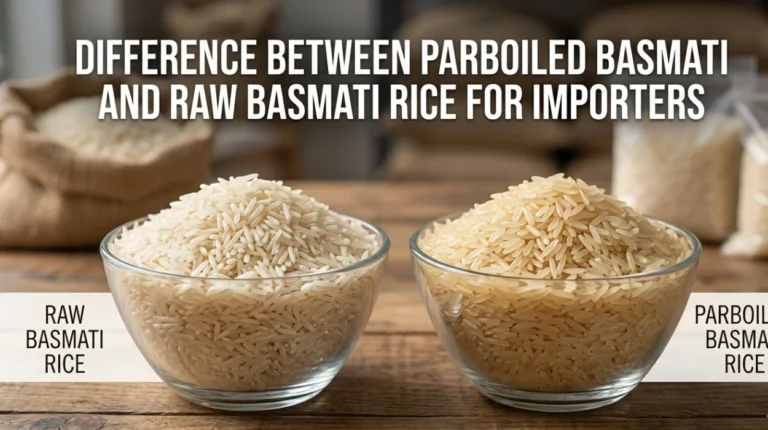
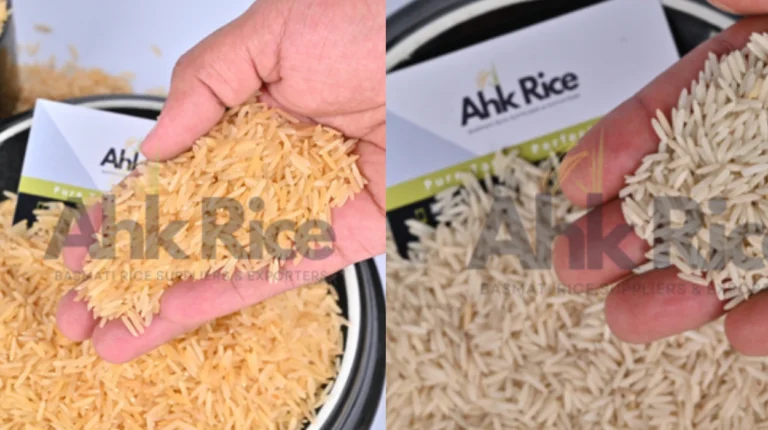
Buyers commonly distinguish between white and parboiled forms, including 1121 White and 1121 Steam or Sella products.
Capacity evaluation should consider whether the factory can process the required form while maintaining grain integrity and the contracted grade.
Super Kernel Basmati
Super Kernel is a premium Pakistani Basmati variety associated with long, slender grains and aromatic cooking characteristics.
The buyer should assess whether the supplier has sufficient raw-material access and grading capability to maintain varietal purity.
1509 Basmati
1509 is another long-grain Basmati variety used in export markets.
It is available in processing forms such as white and parboiled products.
A buyer should evaluate whether the factory can keep 1509 production separated from other varieties and maintain the agreed specification.
Retail and food-service grades
The same rice variety can be prepared for different channels.
Retail buyers require packaging, labeling, branding, and presentation controls.
Food-service buyers often focus on larger pack sizes, cooking yield, consistency, and commercial pricing.
Examples include 5 kg retail packs, 10 kg packs, and 25 kg food-service sacks.
Which markets import Pakistani rice?
Pakistani rice is exported across Africa, the Middle East, Central Asia, Europe, and North America, with Basmati serving specialized consumer and food-service markets. Export destinations differ by variety, price segment, packaging format, and consumer preference.
USDA reports that Pakistan’s rice exports are concentrated in Africa, the Middle East, and increasingly Central Asian markets.
The United States is another important destination for Pakistani rice products, including Basmati varieties sold through distributors, ethnic grocery channels, restaurants, food-service businesses, and specialty retailers.
For New York buyers, the relevant question is not simply whether Pakistan exports rice to the United States. The stronger question is whether the supplier’s production system can support the specific New York sales channel.
A distributor supplying multiple stores has different volume requirements from a restaurant group purchasing rice for several kitchens.
What certifications and documents should New York buyers examine?
New York buyers should examine FDA facility registration where applicable, FSVP-related supplier documentation, food-safety records, product specifications, certificates of analysis, traceability records, packaging information, and shipment documents. Certification should support the buyer’s verification process rather than replace it.
FDA states that most facilities manufacturing, processing, packing, receiving, or holding food for U.S. consumption must register with the agency, subject to applicable exemptions. FDA also states that imported food is subject to U.S. requirements and inspection at ports of entry.
FSVP is particularly important for U.S. importers. The importer is responsible for conducting supplier-verification activities covered by the regulation. The program includes supplier evaluation, hazard analysis, verification activities, corrective actions, and recordkeeping.
A buyer should also review documents relevant to the contracted rice specification.
Examples include certificates of analysis, laboratory test results, fumigation documentation where applicable, certificate of origin, commercial invoice, packing list, bill of lading, and traceability records.
The exact documentation package depends on the product, transaction, importer, and U.S. regulatory requirements.
What are the common misconceptions about rice production capacity?
The biggest misconception is that installed milling capacity equals guaranteed export supply. Actual supply depends on raw-material availability, operating efficiency, product changeovers, quality controls, packaging throughput, storage, labor, maintenance, and logistics. Capacity must therefore be evaluated as practical sustained output.
A second misconception is that a large factory automatically produces better rice.
Factory size does not establish grain quality. Quality depends on raw material, process controls, grading accuracy, sorting, storage, and inspection.
A third misconception is that production capacity only matters for large buyers.
A buyer ordering 1 container still needs reliable fulfillment. The commercial risk becomes larger when the buyer expands to repeated monthly orders.
A fourth misconception is that production capacity is only a quantity issue.
Capacity also affects consistency. Frequent production changes can increase the risk of specification variation if segregation and quality-control systems are weak.
A fifth misconception is that Pakistan’s total rice production represents one supplier’s available stock.
USDA estimates Pakistan’s total 2025/26 rice production at about 9.4 million metric tons, but that national figure does not represent the exportable inventory of any individual mill.
How should New York buyers evaluate production capacity before selecting a supplier?
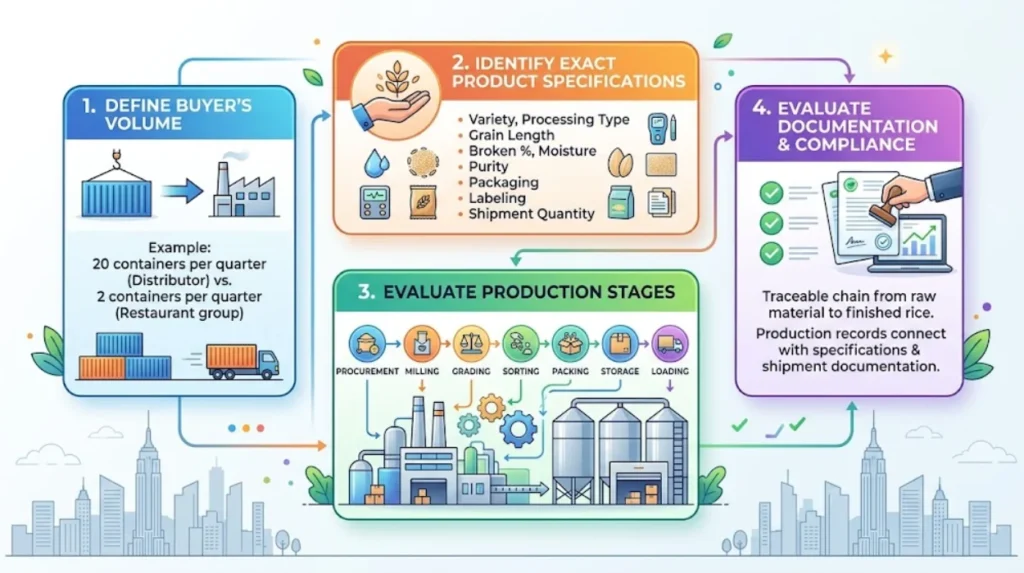
New York buyers should compare required monthly volume with practical processing throughput, raw-paddy access, storage, packaging capacity, quality controls, export history, documentation systems, and shipment scheduling. The objective is to measure sustainable supply against the buyer’s actual purchasing cycle.
Start with the buyer’s expected volume.
For example, a distributor requiring 20 containers per quarter needs a different capacity assessment from a restaurant group requiring 2 containers per quarter.
Next, identify the exact product specification.
The assessment should cover variety, processing type, grain length, broken percentage, moisture, purity, packaging, labeling, and shipment quantity.
Then evaluate production stages.
The buyer should determine whether procurement, milling, grading, sorting, packing, storage, and loading can support the required volume without creating bottlenecks.
Finally, evaluate documentation and compliance.
The supplier’s production records should connect with product specifications and shipment documentation. This creates a traceable chain from raw material through finished rice.
Production capacity becomes most useful when it is measured against actual purchase requirements. Read:
How production capacity affects long-term rice supply contracts. That approach gives New York buyers a practical framework for understanding supply reliability before moving into discussions about long-term contracts, delivery commitments, and commercial terms.
Frequently Asked Questions
Why should New York rice buyers evaluate production capacity?
New York buyers should evaluate production capacity to determine whether a Pakistani rice supplier can consistently process, pack, and ship the required quantity without disrupting future orders.
What does rice production capacity mean?
Rice production capacity is the quantity of rice a supplier can process into finished, specification-compliant product within a defined period while maintaining quality and food-safety controls.
Why is production capacity important for long-term rice supply?
Production capacity indicates whether a supplier can support repeated orders as purchasing volumes increase. It helps buyers assess supply continuity before entering long-term commercial arrangements.
What factors determine rice production capacity?
Key factors include paddy availability, milling throughput, drying capacity, grading equipment, optical sorting, storage space, packaging capacity, labor, maintenance, quality control, and export logistics.
Does a large rice mill guarantee reliable supply?
No. Factory size alone does not guarantee reliable supply. Raw-material availability, equipment efficiency, quality controls, packaging capacity, storage, and logistics also determine practical production capacity.
Which Pakistani Basmati varieties should New York buyers evaluate?
New York buyers can evaluate 1121 Basmati, Super Kernel Basmati, and 1509 Basmati according to their required grain length, processing type, broken percentage, moisture, purity, packaging, and cooking characteristics.
Where is Pakistani Basmati rice mainly grown?
Pakistani Basmati rice is primarily associated with Punjab, where climate, irrigation, soil conditions, and established cultivation practices support aromatic long-grain Basmati varieties.
How is Pakistani Basmati rice processed?
Processing typically includes paddy receiving, sampling, cleaning, drying, dehusking, paddy separation, whitening, polishing, grading, optical sorting, quality inspection, packaging, storage, and container loading.
What certifications and documents should New York rice buyers check?
Buyers should review applicable FDA registration information, FSVP-related supplier documentation, certificates of analysis, product specifications, traceability records, certificate of origin, commercial invoice, packing list, and other shipment documents.
Does production capacity affect rice quality?
Production capacity itself does not determine quality. However, adequate processing, grading, sorting, storage, and quality-control capacity helps suppliers maintain consistent product specifications across repeated production lots.
How can New York buyers compare rice suppliers?
Buyers should compare practical processing capacity, raw-paddy access, product specifications, quality controls, storage, packaging capability, export experience, documentation systems, and the supplier’s ability to meet the buyer’s required purchasing schedule.
Which markets import Pakistani rice?
Pakistani rice is exported to markets across North America, the Middle East, Africa, Europe, and Central Asia. Demand varies according to rice variety, grade, packaging format, price, and consumer preferences.