1509 Basmati Rice Explained: Fast Cooking Export Variety
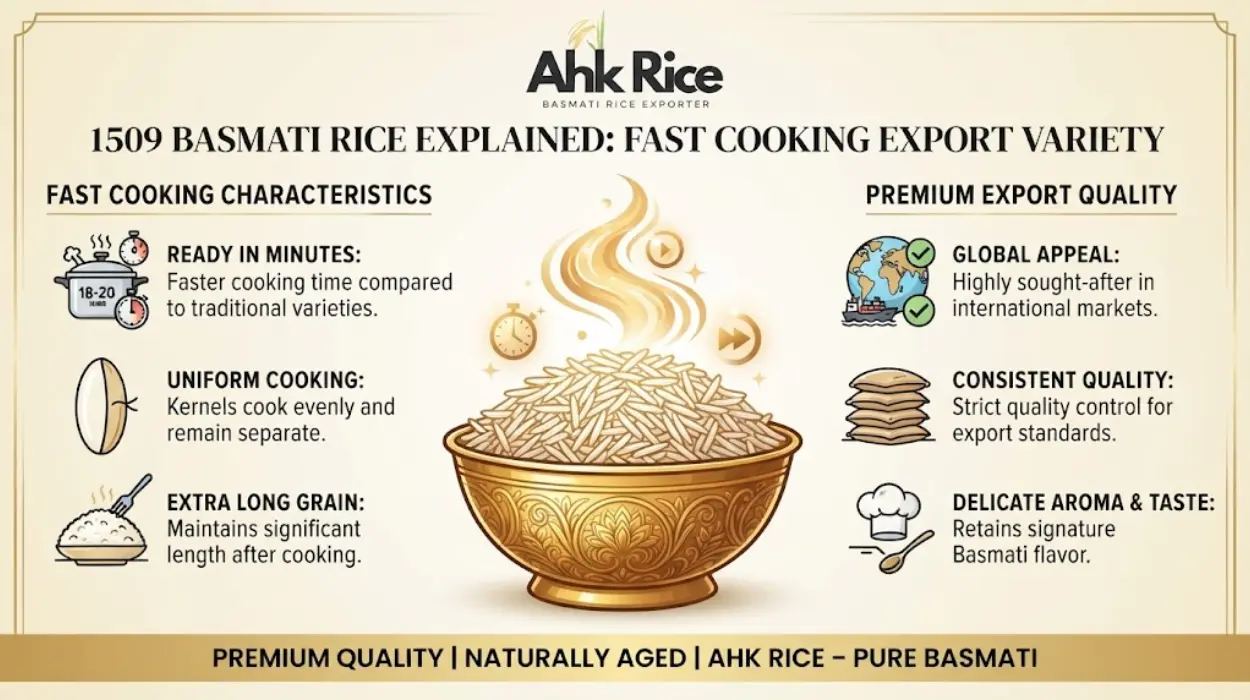
1509 Basmati rice is an early-maturing, long-grain aromatic variety known for fast cooking, good elongation, and flexible export forms. Here is why: 1509 combines an approximately 8.3 mm raw grain length with raw, steam, White Sella, Creamy Sella, and Golden Sella processing options.
1509 Basmati originated as an early-maturing basmati variety. Pusa Basmati 1509 was released in 2013 for major northern Indian basmati-growing regions. The variety reaches maturity in about 115–120 days under suitable conditions. Pakistan also cultivates and exports 1509 Basmati for international buyers.
1509 Basmati has become important in export markets because its grain length, cooking performance, and processing flexibility suit different buyer specifications. Common commercial forms include Raw, Steam, White Sella, Creamy Sella, and Golden Sella.
What Is 1509 Basmati Rice?
1509 Basmati is an early-maturing, long-grain aromatic rice variety with approximately 8.3–8.5 mm raw grain length and strong cooking elongation. Here is why: the variety combines a short agricultural cycle with long slender grains and several processing formats for retail, wholesale, foodservice, and export applications.
1509 Basmati belongs to the basmati rice category. Basmati rice is recognized for long slender grains, characteristic aroma, and elongation after cooking. 1509 differs from longer premium varieties through its early maturity and commercial positioning.
The agricultural cycle is a major characteristic. Pusa Basmati 1509 reaches maturity in approximately 115–120 days. Its early maturity supports earlier harvesting and helps create a different supply profile from longer-duration basmati varieties.
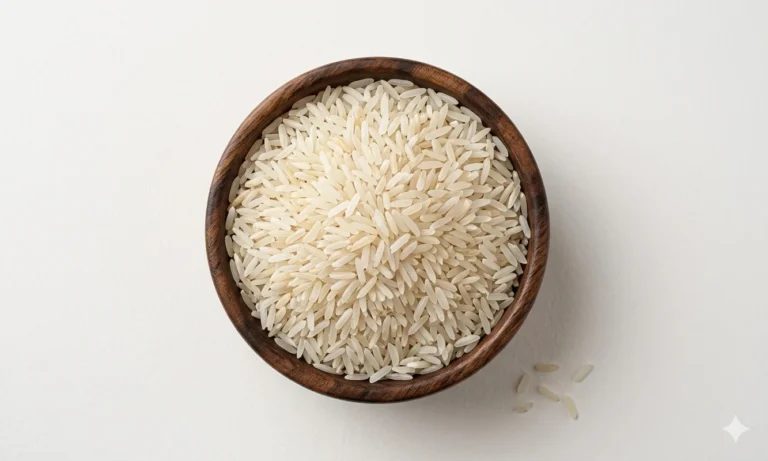
The grain is also defined by measurable physical characteristics. Published specifications place average raw grain length around 8.30 mm, with some export specifications reaching approximately 8.40–8.50 mm. Cooked length depends on processing, aging, cooking method, and lot specifications.
1509 Basmati therefore represents more than a grain-size designation. The variety connects cultivation period, milling method, grain appearance, cooking behavior, quality specifications, and export requirements.
With the variety defined, the next question is where 1509 Basmati is cultivated and produced.
Where Is 1509 Basmati Rice Grown?
1509 Basmati is cultivated across northern South Asian basmati-producing regions, including Pakistan and India, with Punjab forming an important production area. Here is why: the variety requires suitable irrigated conditions and performs within established basmati-growing agricultural zones.
Punjab is a major rice-producing region for Pakistan. Pakistani exporters source basmati from established rice-growing areas and process the harvested paddy through rice mills before export.
India also produces Pusa Basmati 1509. The notified growing areas include Punjab, Haryana, Delhi, western Uttar Pradesh, Uttarakhand, and Jammu and Kashmir. The official variety description identifies 1509 as an early-maturing basmati with a 115–120 day seed-to-seed period.
Growing conditions affect grain quality. Irrigation, harvesting maturity, drying, storage, and paddy handling influence moisture, grain integrity, and milling recovery.
Pakistan’s export industry also demonstrates the commercial importance of basmati. REAP recorded 808,643 metric tons of Pakistani basmati exports in FY2024–25, valued at approximately US$830.57 million. This figure covers Pakistani basmati exports rather than 1509 specifically.
With cultivation established, the next step is understanding how harvested 1509 paddy becomes export rice.
How Is 1509 Basmati Rice Processed?
1509 Basmati follows a controlled chain of cleaning, dehusking, polishing, grading, sorting, and packing, while Steam and Sella forms receive additional heat processing. Here is why: each processing route changes appearance, texture, cooking behavior, and handling characteristics.
How Is Raw 1509 Basmati Processed?
Raw 1509 begins with harvested paddy. The mill removes impurities before separating the husk from the edible grain.
- Clean the paddy to remove stones, dust, straw, and other foreign material.
- Dry the paddy to reach the required moisture specification.
- De-husk the grain to remove the outer rice husk.
- Polish the grain to achieve the required surface appearance.
- Grade the rice according to grain size and quality parameters.
- Sort the grain to remove discolored, immature, chalky, or defective kernels.
- Inspect the rice for broken grains, moisture, foreign matter, and other contractual specifications.
- Pack the rice according to the buyer’s required bag size and packaging material.
Raw rice receives no parboiling or steam treatment before conventional milling.
How Is 1509 Steam Processed?
1509 Steam receives controlled steaming before final milling. The treatment changes grain structure and creates a firmer cooked texture.
Steam processing can improve grain integrity during cooking. Published product specifications describe 1509 Steam as long-grain rice that cooks into separate, non-sticky grains.
How Is 1509 Sella Processed?
Sella refers to parboiled rice. Paddy receives controlled soaking, steaming, and drying before milling. This process produces a stronger grain and changes its appearance.
White Sella retains a creamy or white appearance. Golden Sella develops a golden appearance through its parboiling and drying process. Both forms are used for dishes requiring firm, separate grains.
The processing route determines the final product form, so grade selection starts with the required cooking and appearance characteristics.
What Are the Main 1509 Basmati Rice Grades?
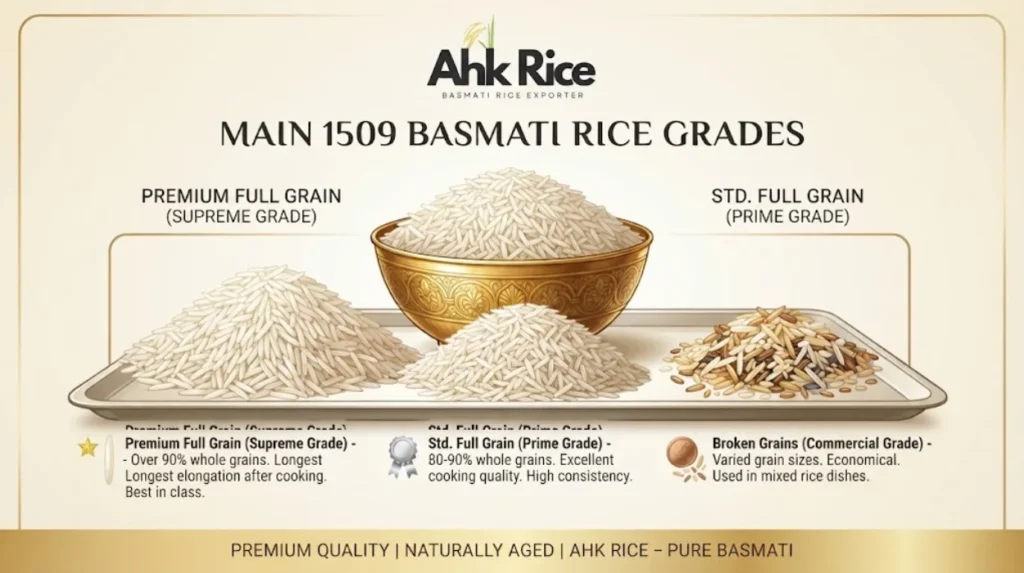
The main commercial forms are Raw, Steam, White Sella or Creamy Sella, and Golden Sella, with each form using a different processing route. Here is why: processing determines color, grain firmness, cooking response, and the final application.
1509 Raw Basmati
1509 Raw uses conventional milling without parboiling. The grain has a white appearance and develops a soft, fluffy texture after cooking.
1509 Steam Basmati
1509 Steam receives controlled steam treatment before milling. Published specifications place raw grain length around 8.3–8.5 mm and describe good elongation after cooking.
1509 White Sella Basmati
1509 White Sella is parboiled while retaining a creamy-white appearance. The process creates firm grains that remain separate after cooking.
1509 Golden Sella Basmati
1509 Golden Sella is parboiled and dried to produce a golden-colored grain. Its firm structure suits biryani, pulao, catering, and other high-volume cooking applications.
These grades demonstrate why the same 1509 variety can serve different cooking and distribution requirements.
What Are the Key Specifications of 1509 Basmati Rice?
Typical specifications include approximately 8.3 mm grain length, up to 13% moisture, low broken percentage, and multiple processing forms. Here is why: exporters grade each lot against agreed physical and food-safety requirements before shipment.
| Specification | Typical commercial range |
|---|---|
| Raw grain length | 7.8–8.5 mm |
| Moisture | Up to 13% |
| Broken grains | 1–5%, depending on contract |
| Processing forms | Raw, Steam, White Sella, Golden Sella |
| Texture | Separate and non-sticky |
| Cooking elongation | Approximately 18–21 mm in published examples |
| Packaging | Retail and bulk formats |
These values are reference ranges rather than universal specifications. Export contracts define the exact grain length, broken percentage, moisture, purity, foreign matter, and sorting requirements.
With specifications established, the next question is where buyers use each form.
What Are the Main Uses of 1509 Basmati Rice?
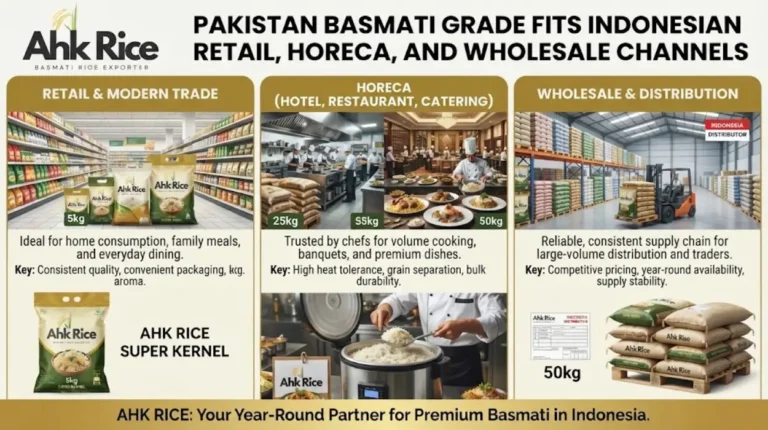
1509 Basmati serves retail, wholesale, restaurants, catering, foodservice, biryani, pulao, and everyday rice applications where long grains and fast cooking matter. Here is why: the variety combines visual grain length with processing options suited to different preparation methods.
Retail buyers use Raw and Steam forms for household cooking. The long slender grain provides a recognizable basmati appearance.
Restaurants use Steam and Sella forms for rice dishes. Sella products provide firmer grains that retain separation during cooking.
Catering operations commonly use parboiled forms. Golden Sella provides strong grain integrity for large-batch biryani and pulao preparation.
Wholesale buyers can select different processing forms according to customer requirements. A distributor serving restaurants requires a different specification from a retailer selling small consumer packs.
This flexibility connects directly with commercial sourcing decisions. Buyers comparing 1509 with 1121 need to evaluate grain length, processing, cooking performance, price, and market positioning together.
Which Markets Import 1509 Basmati Rice?
1509 Basmati is traded across Middle Eastern, Asian, African, European, and other international markets, with demand varying by processing form and buyer segment. Here is why: importers select grades according to local cooking preferences, retail positioning, foodservice requirements, and price specifications.
Published exporter information identifies markets including Saudi Arabia, Kuwait, the UAE, Oman, Bahrain, Jordan, Iraq, Egypt, Turkey, the United States, and Australia. Market coverage differs between exporters and individual contracts.
Gulf buyers commonly purchase long-grain basmati for household consumption, restaurants, catering, and wholesale distribution. Sella forms suit applications requiring stronger cooked grain structure.
European buyers often focus on documented food safety, traceability, contaminant controls, packaging compliance, and consistent specifications. Pakistani rice exporters have specifically addressed compliance requirements for EU basmati shipments through industry and government discussions.
The appropriate market therefore depends on more than the name “1509.” The processing grade and destination requirements determine the relevant export specification.
What Certifications and Export Documents Apply to 1509 Basmati Rice?
Export documentation depends on the destination, but phytosanitary certification, commercial documentation, inspection records, and destination-specific food requirements form the core compliance framework. Here is why: importing countries establish their own plant-health, food-safety, labeling, and residue requirements.
Phytosanitary Certificate
Pakistan’s Department of Plant Protection issues phytosanitary certificates after the required inspection, sampling, treatment, and certification procedures. The importing country’s requirements determine the applicable phytosanitary conditions.
Commercial Documents
Commercial invoices, packing lists, container information, and other prescribed documents support export clearance. Pakistan’s Department of Plant Protection lists these documents within its export procedure.
Quality and Food-Safety Records
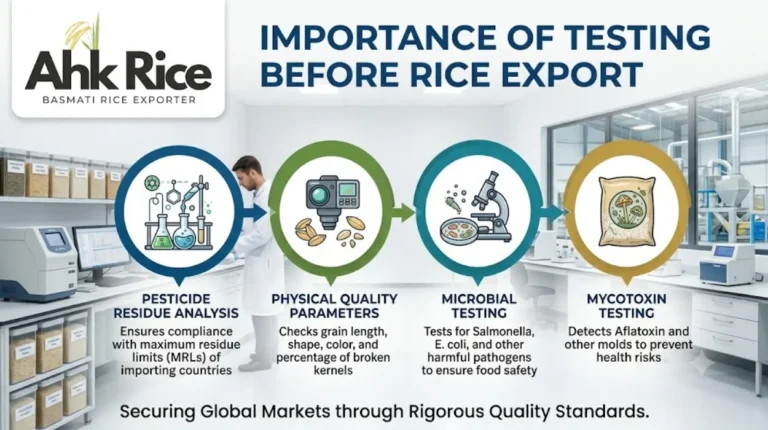
Quality records can include laboratory analysis, grading reports, inspection documentation, and certificates required by the destination. REAP training materials specifically reference Pakistan rice standards, ISO 7301, food safety audits, and rice analysis.
Certification therefore depends on destination requirements rather than one universal certificate for every 1509 shipment.
What Are the Common Problems and Misconceptions About 1509 Basmati?
1509 is not simply a cheaper version of every other basmati variety; its early maturity, grain profile, processing options, and cooking behavior define its commercial identity. Here is why: buyers must compare specifications rather than judging varieties from names alone.
One misconception concerns grain length. A 1509 grain can reach approximately 8.3–8.5 mm before cooking, but exact measurements depend on the lot and grading specification.
Another misconception concerns processing. Raw, Steam, White Sella, and Golden Sella are not interchangeable products. Each uses a different processing route and produces different cooking characteristics.
A third misconception concerns fast cooking. Processing, aging, moisture, soaking, cooking equipment, and recipe conditions influence actual cooking time. A product description alone does not establish one universal cooking duration.
A fourth misconception concerns export quality. A long grain does not automatically mean premium export quality. Broken percentage, moisture, purity, foreign matter, sorting, aroma, and destination compliance also matter.
The comparison becomes clearer after understanding these specifications, which leads naturally to evaluating 1509 against 1121.
How Does 1509 Compare With Other Basmati Varieties?
1509 emphasizes early maturity, fast cooking, long grain, and cost-focused positioning, while varieties such as 1121 emphasize exceptional grain length and premium visual presentation. Here is why: the two varieties serve overlapping markets but have different agricultural and physical characteristics.
1509 provides a strong balance between grain appearance and cooking performance. 1121 generally commands attention for its exceptionally long grain and cooked elongation.
The comparison should include raw grain length, cooked length, aroma, processing form, broken percentage, crop cycle, price, demand, and target market.
For importers, profitability also depends on procurement cost, selling price, freight, packaging, customs costs, and market demand. The variety alone does not determine commercial return.
A detailed comparison of these factors belongs in the consideration stage: 1509 vs 1121 Basmati Rice: Which Is More Profitable?
Where Should the MOFU Article Link Be Inserted?
Insert the MOFU article link in the second paragraph of the “How Does 1509 Compare With Other Basmati Varieties?” section. Use a natural anchor such as “compare 1509 and 1121 Basmati for export profitability” rather than forcing the exact title as anchor text.
[Insert Link to MOFU Article]
That placement follows the information flow from product education into commercial comparison without interrupting the main definition, processing, grade, market, or certification sections.
Frequently Asked Questions
Is 1509 Basmati rice fast cooking?
Yes. 1509 Basmati is recognized for fast cooking compared with many longer-duration basmati varieties. Processing method, moisture, aging, soaking, and cooking technique affect the actual cooking time.
What is the grain length of 1509 Basmati rice?
Published commercial specifications commonly place 1509 grain length around 8.3–8.5 mm before cooking. Contract specifications establish the final accepted range.
What are the grades of 1509 Basmati rice?
The main commercial forms are Raw, Steam, White Sella or Creamy Sella, and Golden Sella. Each form uses a different processing method and produces different cooking characteristics.
Is 1509 Basmati grown in Pakistan?
Yes. 1509 Basmati is commercially available from Pakistani exporters and is listed by Pakistani suppliers as an early-maturing basmati variety.
What is 1509 Golden Sella?
1509 Golden Sella is a parboiled form of 1509 Basmati. Controlled steaming and drying create its characteristic golden color and firm grain structure.
What is 1509 White Sella?
1509 White Sella is a parboiled 1509 variety that retains a creamy-white appearance. Its firm grain structure supports separate cooked grains and foodservice applications.
Is 1509 Basmati suitable for export?
Yes. 1509 Basmati is exported in multiple processing forms and packaging specifications. Export suitability depends on the destination’s food-safety, phytosanitary, labeling, residue, documentation, and quality requirements.