1509 vs Super Kernel Basmati: Market and Aroma Comparison
1509 Basmati suits buyers seeking lower-cost long-grain rice with a lighter aroma, while Super Kernel Basmati suits markets that value stronger traditional fragrance, longer aroma retention, and premium positioning. The commercial choice depends on grain specification, processing grade, price, storage period, and target market.
For buyers who need the fundamentals before comparing these two varieties, the [guide to 1509 Basmati, its specifications, and export positioning] provides the necessary background. The comparison then becomes more useful because 1509 and Super Kernel are not interchangeable products despite both belonging to Pakistan’s Basmati rice export category.
AHK Rice supplies [1509 Basmati through its Basmati rice export service] from Punjab, where sourcing, milling, grading, sorting, packaging, and export coordination can be combined around a defined buyer specification. The purpose of this comparison is not to identify one universal winner. It is to show where each variety creates a stronger commercial fit.
What are the available solutions between 1509 and Super Kernel Basmati?
The two main solutions are 1509 Basmati for cost-efficient long-grain positioning and Super Kernel Basmati for stronger traditional aroma; White, Steam, and Sella processing grades create additional options for retail, foodservice, wholesale, and premium markets.
1509 Basmati is an early-maturing Pakistani Basmati variety cultivated mainly in Punjab. Its commercial appeal comes from long grain, efficient cultivation, competitive pricing, and a lighter aromatic profile.
Super Kernel Basmati is a traditional Pakistani Basmati variety associated with stronger aroma, recognizable grain quality, and premium South Asian culinary use. Its commercial value comes from aroma, cooking performance, and traditional market recognition.
Both varieties can be processed into different formats. White rice provides the conventional milled appearance. Steam rice receives controlled steaming before milling and provides stronger grain integrity. Sella rice is parboiled before milling and provides firmer cooked grains and stronger storage performance.
The buyer therefore chooses two things at the same time: the variety and the processing grade. A 1509 Steam shipment serves a different commercial purpose from 1509 White. The same principle applies to Super Kernel White and Super Kernel Sella.
How do 1509 and Super Kernel compare by specification?
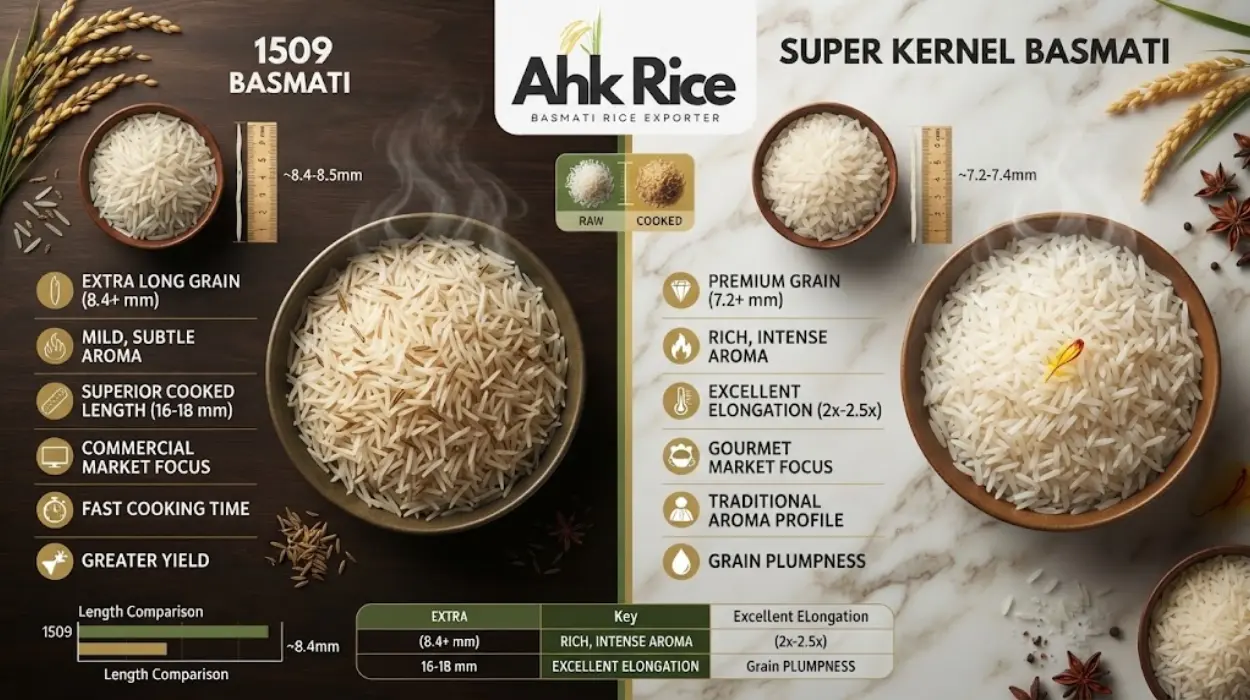
1509 provides longer raw grain and a lighter aroma at a more competitive price, while Super Kernel provides shorter grain, deeper traditional fragrance, stronger aroma retention, and a higher premium position in aroma-led markets.
| Attribute | 1509 Basmati | Super Kernel Basmati |
|---|---|---|
| Typical raw grain length | 8.10–8.40 mm | 7.40–7.70 mm |
| Aroma profile | Light, fresh | Deep, traditional |
| Aroma retention | Moderate | High |
| Cooked elongation | Approximately 1.8–2.0× | Approximately 1.6–1.8× |
| Typical moisture target | 12–13% | 12–13% |
| Indicative FOB range | US$850–1,050/MT | US$900–1,200/MT |
| Main commercial position | Value-premium | Traditional premium |
These figures establish a comparison framework rather than a fixed quotation. Actual specifications depend on crop year, milling yield, broken percentage, processing method, packaging, order volume, destination, and Incoterm.
The grain-length difference is commercially important. 1509 creates a stronger visual impression through its longer kernel. Super Kernel creates differentiation through aroma and traditional Basmati identity.
A buyer focused mainly on grain appearance therefore evaluates the products differently from a buyer whose customers judge rice primarily by fragrance and cooked taste.
How does aroma differ between 1509 and Super Kernel?
Super Kernel generally provides deeper and longer-lasting aroma, while 1509 produces a lighter and fresher fragrance; the difference becomes most noticeable after cooking and influences the suitability of each variety for different cuisines.
Aroma is an important quality attribute in Basmati rice because consumers experience it before tasting the cooked grain. The aromatic compound 2-acetyl-1-pyrroline contributes significantly to the characteristic fragrance associated with Basmati.
1509 commonly presents a lighter aromatic profile. Its commercial advantage is that the fragrance does not dominate dishes where rice is served with sauces, vegetables, seafood, or heavily seasoned foods.
Super Kernel provides a deeper traditional fragrance. This profile fits dishes where rice itself contributes strongly to the sensory experience, including biryani, pulao, pilaf, and other aromatic preparations.
Processing also affects aroma. Excessive polishing, uncontrolled drying, moisture variation, and unsuitable storage conditions can reduce the final sensory performance of either variety.
For this reason, aroma should be evaluated from a physical sample rather than inferred only from the variety name. Buyers should cook the sample using the intended commercial preparation method and compare fragrance before cooking, during cooking, and after serving.
Which markets prefer 1509 and Super Kernel?
East and Southeast Asian markets commonly provide stronger opportunities for 1509 because of price sensitivity and lighter aroma preferences, while South Asian and Gulf markets commonly provide stronger demand for Super Kernel because aroma and traditional Basmati identity influence purchasing decisions.
East and Southeast Asia
Markets such as Malaysia, Indonesia, and other Southeast Asian destinations can suit 1509 when buyers require a long-grain product with controlled procurement costs.
1509 Steam is particularly suitable for distributors supplying retail and foodservice channels where cooking consistency and grain appearance matter.
A practical planning range for 1509 is approximately US$850–1,050 per MT FOB Pakistan, based on the specification framework above. Fast-moving distribution also reduces the importance of extended aroma retention because inventory turns more frequently.
Super Kernel can still serve these markets, particularly through specialty retailers and South Asian food channels. Its stronger aroma becomes an advantage when the customer base specifically seeks traditional Pakistani Basmati characteristics.
South Asia and Gulf markets
Markets across South Asia and the Gulf place stronger commercial emphasis on aroma-led rice products. Biryani, pulao, catering, restaurants, and premium retail channels create demand for rice with recognizable fragrance.
Super Kernel therefore fits these channels well. A planning range of approximately US$900–1,200 per MT FOB Pakistan reflects its traditional premium position, although the final quotation depends on grade and specification.
1509 also has a role in these markets. Buyers operating large foodservice networks can select 1509 when procurement economics and long-grain appearance are more important than maximum aroma intensity.
The regional comparison is therefore not absolute. A Dubai foodservice distributor and a Dubai premium supermarket can require completely different specifications.
How do price per MT and shelf life compare?
1509 generally offers a lower FOB price per MT, while Super Kernel commands a higher aroma-led position; properly processed Sella grades provide longer storage performance than standard White or Steam grades under suitable warehouse conditions.
| Commercial factor | 1509 Basmati | Super Kernel Basmati |
|---|---|---|
| Indicative FOB Pakistan | US$850–1,050/MT | US$900–1,200/MT |
| Price driver | Long grain and cost efficiency | Aroma and traditional premium |
| Typical fast-moving use | Retail and foodservice | Premium retail and traditional cuisine |
| White/Steam storage planning | Around 12–18 months | Around 12–18 months |
| Sella storage planning | Around 18–24 months | Around 18–24 months |
Shelf life is controlled by more than variety. Moisture, packaging, warehouse temperature, humidity, pest protection, processing quality, and storage hygiene directly affect product stability.
Sella rice normally provides stronger storage performance because parboiling changes the grain structure and improves resistance during handling and storage.
For a buyer with rapid inventory turnover, 1509 Steam can provide sufficient commercial performance without paying for a stronger aroma profile that the target consumer does not prioritize.
For a buyer holding inventory for longer periods, Super Kernel Sella can combine aroma-led positioning with the storage advantages of parboiled rice.
Which method works best for different buyer cases?
1509 works best for value-premium retail, high-volume distribution, and cost-sensitive foodservice, while Super Kernel works best for aroma-led retail, traditional cuisine, premium catering, and buyers seeking stronger product differentiation.
A retailer selling a 5 kg value-premium pack can use 1509 because long grain provides visible quality while keeping the procurement position controlled.
A specialist South Asian retailer can use Super Kernel because aroma creates a stronger connection with traditional Basmati expectations.
A foodservice distributor supplying hundreds of restaurants may prioritize 1509 Steam because purchase economics and cooking consistency influence repeat orders.
A premium caterer serving biryani may prioritize Super Kernel Sella because fragrance and grain separation have greater commercial importance.
A private-label importer can use either variety, but the product specification must be locked before packaging artwork and recurring procurement are finalized.
The correct method is therefore based on the commercial purpose of the rice, not simply its variety name.
What are the pros and cons of 1509 and Super Kernel?
1509 combines long grain, competitive pricing, and efficient high-volume distribution, while Super Kernel combines stronger aroma, traditional recognition, and premium differentiation; each has limitations when its core strength does not match the buyer’s target market.
1509 Basmati advantages
1509 provides a long-grain appearance at a competitive purchase position. This supports value-premium retail where customers expect an imported Basmati product without the highest price.
Its early-maturing agricultural profile also supports supply efficiency. Higher yield potential makes the variety useful for large-volume procurement programs.
1509 also works well in fast-moving markets. Buyers can purchase Steam or White grades according to cooking and packaging requirements.
1509 Basmati limitations
Its aroma is generally lighter than Super Kernel. Buyers targeting traditional biryani and aroma-focused consumers therefore need to evaluate whether the fragrance meets their specification.
Its premium differentiation also depends more heavily on grain length and packaging because aroma is not its strongest commercial attribute.
Super Kernel advantages
Super Kernel provides a stronger traditional Basmati aroma. This creates differentiation for retailers, restaurants, caterers, and specialty food distributors.
Its aroma profile also fits South Asian and Gulf cuisines where fragrance forms an important part of the rice experience.
Sella processing adds stronger grain integrity and storage performance, making Super Kernel suitable for commercial inventory programs.
Super Kernel limitations
The higher price position can reduce competitiveness in highly price-sensitive channels.
Its shorter raw grain compared with 1509 also makes it less suitable when extra-long visual presentation is the primary premium signal.
What five factors should buyers use before choosing?
Buyers should compare target consumer, aroma requirement, price per MT, storage period, and end use before selecting the variety; these five factors connect product specifications with actual commercial performance and prevent purchasing decisions based only on variety names.
| Decision factor | Choose 1509 when… | Choose Super Kernel when… |
|---|---|---|
| Target consumer | Price and long grain matter most | Traditional aroma matters most |
| Aroma requirement | Light to moderate aroma is sufficient | Strong fragrance is essential |
| Budget | Procurement cost needs tighter control | Premium pricing is acceptable |
| Storage period | Inventory moves quickly | Longer storage is required |
| End use | Retail, wholesale, foodservice | Biryani, premium retail, catering |
This framework creates a practical procurement sequence.
First, define the consumer. A value-oriented supermarket buyer has a different requirement from a premium restaurant.
Second, define aroma expectations. This determines whether 1509 or Super Kernel creates the stronger product fit.
Third, establish the maximum purchase cost per MT. The buyer should compare equivalent grades rather than mixing White, Steam, and Sella quotations.
Fourth, establish inventory duration. Storage conditions should be included in the specification.
Finally, test the product through a physical sample. Grain length, aroma, cooked elongation, texture, broken percentage, and appearance should all be assessed before bulk production.
What should buyers check before placing a bulk order?
Buyers should approve a defined sample and specification covering grain length, broken percentage, moisture, aroma, processing grade, packaging, crop year, inspection, quantity, and Incoterm before committing to commercial container volume.
A supplier quotation should state exactly what is included in the price.
The buyer should compare FOB with FOB, or CIF with CIF. Mixing commercial terms can make a lower quotation appear more competitive when freight, insurance, or destination costs are excluded.
The specification should also identify the permitted broken percentage. A product with the same variety name can have a different commercial value when its broken percentage changes.
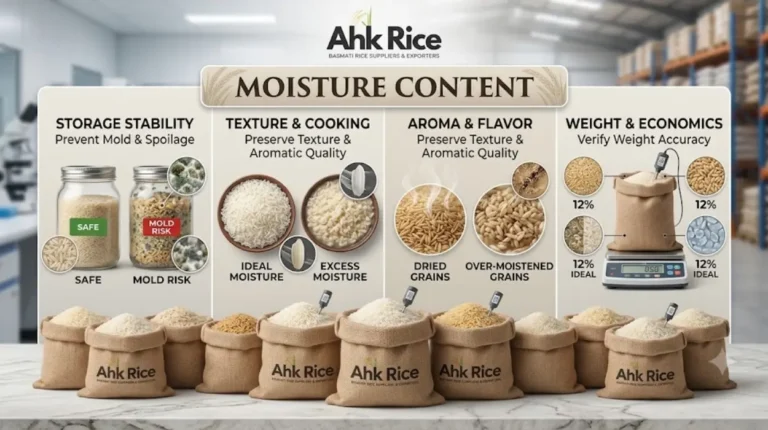
Moisture should be controlled because excessive moisture creates storage and quality risks. Foreign matter and color uniformity should also be specified for retail products.
Packaging is another important factor. Retail bags, foodservice packs, and bulk bags create different unit economics.
AHK Rice’s integrated model covers sourcing, processing, custom packaging, quality control, and export coordination. This allows the buyer to define the specification before production instead of relying on a generic variety label.
What is the final market and aroma comparison?
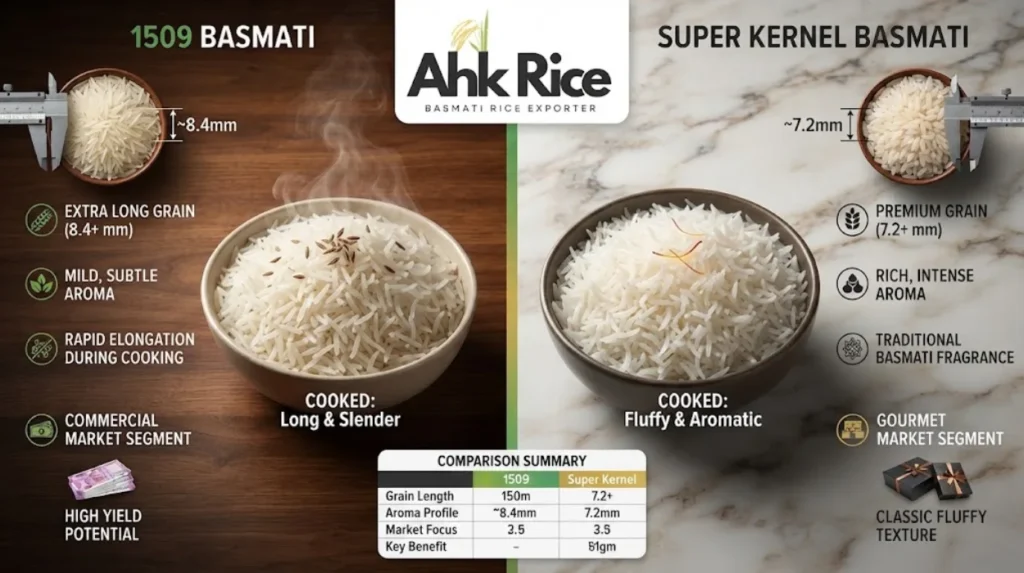
1509 is the stronger commercial fit where long grain, price efficiency, and rapid turnover drive purchasing, while Super Kernel is stronger where deep aroma, traditional Basmati identity, and premium culinary positioning create greater value for the buyer.
The distinction is clear.
1509 competes through efficiency. Its longer grain and competitive price support high-volume distribution, value-premium retail, and cost-sensitive foodservice.
Super Kernel competes through sensory differentiation. Its stronger aroma and traditional identity support premium retail, South Asian cuisine, catering, and Gulf markets.
Neither variety should be purchased from the name alone. The final decision should combine variety, processing grade, measurable quality specifications, storage conditions, market positioning, and landed cost.
For buyers moving from comparison to commercial procurement, the next step is to calculate the required 1509 Basmati price per ton against the exact grade, quantity, packaging, destination, and Incoterm.
Frequently Asked Questions
Is 1509 Basmati more aromatic than Super Kernel?
Super Kernel generally provides stronger and longer-lasting aroma. 1509 produces a lighter, fresher fragrance. The difference becomes most noticeable after cooking and is particularly relevant in aroma-focused cuisines.
Which is cheaper, 1509 or Super Kernel?
1509 generally has the lower FOB price position. A planning range of US$850–1,050 per MT is commonly used for comparison, while Super Kernel can occupy approximately US$900–1,200 per MT depending on specifications.
Which variety is better for premium retail?
Super Kernel suits premium retail when aroma and traditional Basmati identity are central to the product proposition. 1509 suits premium-value retail where long grain and controlled procurement cost are more important.
Which is better for restaurants?
The answer depends on the menu. 1509 suits high-volume restaurants that prioritize cost and consistent long-grain cooking. Super Kernel suits restaurants where aroma and traditional Basmati character are central to dishes such as biryani and pulao.
Does Sella have a longer shelf life than Steam rice?
Sella generally provides stronger storage performance than Steam or White rice when properly processed, packed, and stored. A practical planning range is around 18–24 months for Sella, while White and Steam commonly require a shorter inventory cycle.
What should buyers test in a 1509 or Super Kernel sample?
Buyers should test raw grain length, broken percentage, aroma, cooking expansion, texture, color uniformity, moisture, foreign matter, and overall cooking performance using the same preparation method intended for commercial use.
Which market is more suitable for 1509 Basmati?
1509 is particularly suitable for price-sensitive and high-volume markets where long-grain appearance matters but the buyer does not require the strongest traditional aroma. Southeast Asian retail, wholesale, and foodservice programs can fit this profile.
Which market is more suitable for Super Kernel?
Super Kernel is particularly suitable for South Asian and Gulf markets where traditional Basmati aroma, biryani performance, and premium culinary positioning influence purchasing decisions.
Should buyers compare FOB or CIF prices?
Buyers should compare the same Incoterm across suppliers. FOB compares origin-side product economics, while CIF incorporates freight and insurance to the destination port. Final landed cost also includes destination charges, duties, taxes, clearance, and inland transport where applicable.