1509 Basmati Rice Price Per Ton for Global Buyers
1509 Basmati rice is generally positioned as a cost-efficient export Basmati for bulk foodservice, wholesale, and retail programs. Here is why: its 8.10–8.40 mm raw grain range, short crop cycle, and strong cooking elongation support competitive procurement. For background, see why 1509 Basmati rice is popular in the food service industry.
What is the best solution for buying 1509 Basmati Rice?
The best solution is a specification-based export purchase covering grain length, broken percentage, moisture, processing grade, packing, quantity, destination, and Incoterm. This approach prevents a low headline price from becoming an expensive shipment after quality and logistics adjustments.
1509 Basmati Rice gives commercial buyers a balance between Basmati identity and procurement efficiency. AHK Rice sources and processes 1509 for export specifications rather than treating every shipment as the same commodity.
The variety is cultivated in Punjab and reaches maturity faster than traditional Basmati types. AHK Rice’s product information places its crop cycle around 95–105 days, compared with 135–145 days for traditional Basmati types.
The grain provides a raw length of approximately 8.10–8.40 mm and cooked elongation of up to 2.5 times. These specifications make 1509 suitable for catering operations that need visual grain length without moving directly into the highest-priced Basmati grades.
Pakistan remains a major Basmati export origin. REAP records 808,643 MT of Basmati exports worth US$830.57 million during FY2024-25. The reported average Basmati export value was US$1,027.11 per MT. (source: Rice Exporters Association of Pakistan, FY2024-25)
That average covers multiple Basmati varieties and specifications. It should not be treated as a fixed 1509 price. A buyer needs the exact grade and delivery basis before comparing supplier quotations.
The purchasing decision therefore starts with specification control. The price per ton becomes meaningful only after the product, packing, quantity, and delivery terms are fixed.
With the procurement problem defined, the next step is selecting the exporter and service structure that can execute the specification.
Why choose AHK Rice for 1509 Basmati Rice?
AHK Rice connects sourcing, milling, grading, packing, quality verification, and export logistics into one procurement workflow. This gives buyers one specification to approve and one commercial process to manage from sample evaluation through container dispatch.
AHK Rice supplies Pakistani Basmati varieties from Punjab and works with export buyers requiring defined commercial specifications. Its service structure covers product sourcing, processing, grading, packaging, and shipment preparation.
1509 Basmati Rice can be processed into different commercial forms according to the buyer’s requirement. Common export specifications include white or steam-processed rice, while parboiled requirements can be quoted separately.
AHK Rice can also align packaging with the buyer’s distribution model. Retail programs can require smaller consumer bags, while wholesalers and foodservice buyers often require larger commercial packs.
The main benefit is specification continuity. The buyer approves the sample first. The exporter then prepares the bulk shipment against the agreed specification.
Quality verification should cover grain appearance, average grain length, moisture, broken grains, foreign matter, damaged grains, and cooking performance. A commercial certificate of analysis can define the shipment before loading.
AHK Rice also supports export documentation and logistics coordination. The buyer should confirm the required certificates, destination regulations, packaging information, and inspection requirements before dispatch.
The wider Pakistani export market demonstrates the importance of specification control. During July-May FY2024-25, Pakistan exported 761,702 MT of Basmati worth US$781.934 million according to reported Pakistan Bureau of Statistics data. (source: Pakistan Bureau of Statistics, FY2024-25)
AHK Rice therefore positions 1509 as a commercial procurement product rather than simply a low-price rice option. The correct specification determines whether the shipment meets the buyer’s retail, wholesale, or foodservice requirements.
With the supplier workflow established, the next question is what a buyer should expect from sampling, quality approval, and shipment execution.
What results can buyers expect from an AHK Rice order?
Buyers can expect a controlled progression from sample approval to specification confirmation, production, inspection, packing, loading, and shipment. Typical planning ranges vary by destination, vessel schedule, port congestion, customs clearance, and agreed Incoterm.
The first result is specification clarity. AHK Rice confirms the required grain length, processing grade, broken percentage, moisture, packaging, quantity, destination, and delivery term before commercial execution.
The second result is physical product verification. Buyers can request a sample before committing to container volume. AHK Rice can provide up to 20 kg of Super Kernel sample rice free, while the buyer covers courier and applicable phytosanitary charges.
The same sampling principle can be applied to 1509 specifications through a buyer-approved sample process. Courier charges depend on destination, parcel weight, service level, and carrier. Phytosanitary charges depend on the applicable shipment requirements.
A practical sample workflow is:
- Define the specification — confirm variety, processing grade, grain length, broken percentage, moisture, packing, and quantity.
- Request the sample — provide the delivery address and preferred courier method.
- Ship the sample — AHK Rice prepares the agreed sample and export documentation.
- Test the sample — evaluate appearance, aroma, cooking performance, elongation, and broken percentage.
- Approve the specification — confirm the commercial specification before bulk production.
- Confirm the order — agree quantity, packing, Incoterm, payment terms, and shipment schedule.
- Prepare the shipment — AHK Rice mills, grades, sorts, packs, and loads the approved product.
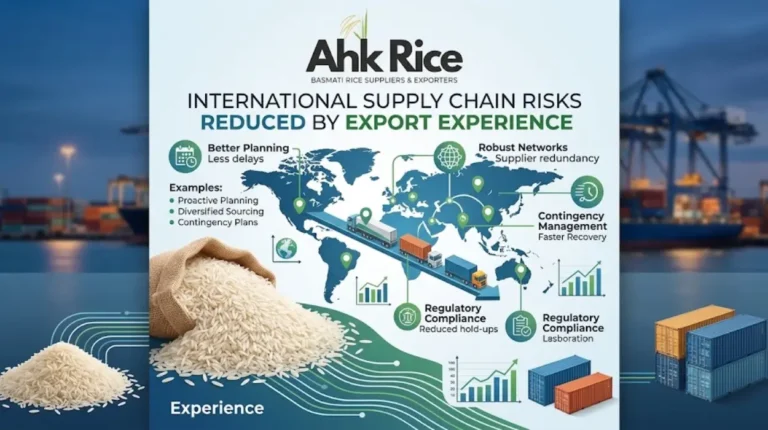
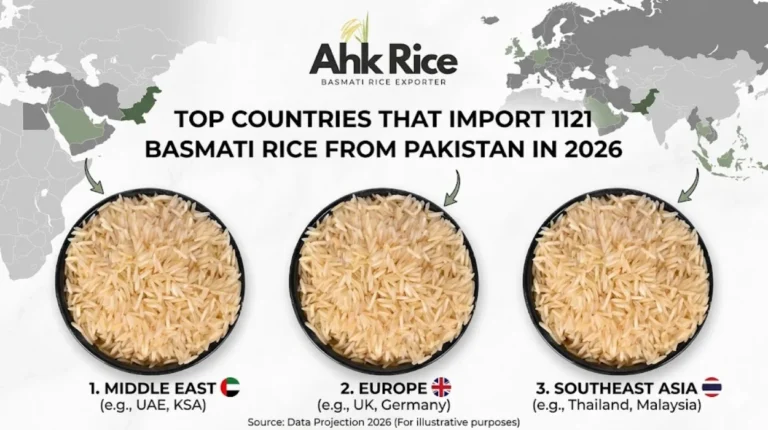
Shipping time should be treated as a planning range rather than a guaranteed number of days. Gulf destinations commonly require around 10–18 days of ocean transit from Karachi. Southeast Asian routes often require around 18–28 days. European routes commonly require around 25–35 days, while North American routes can require around 30–40 days.
These ranges exclude possible port delays, transshipment, customs clearance, inspection, and destination delivery. The final schedule depends on the selected vessel and destination port.
For buyers comparing aroma, commercial positioning, and grade differences, the 1509 versus Super Kernel market and aroma comparison provides a useful consideration-stage reference.
AHK Rice’s role continues through shipment preparation. The buyer receives a specification-led order rather than relying only on a supplier’s general product name.
With sampling and logistics defined, the final commercial question is how much 1509 Basmati Rice should cost per metric ton.
What factors affect the 1509 Basmati Rice price per ton?
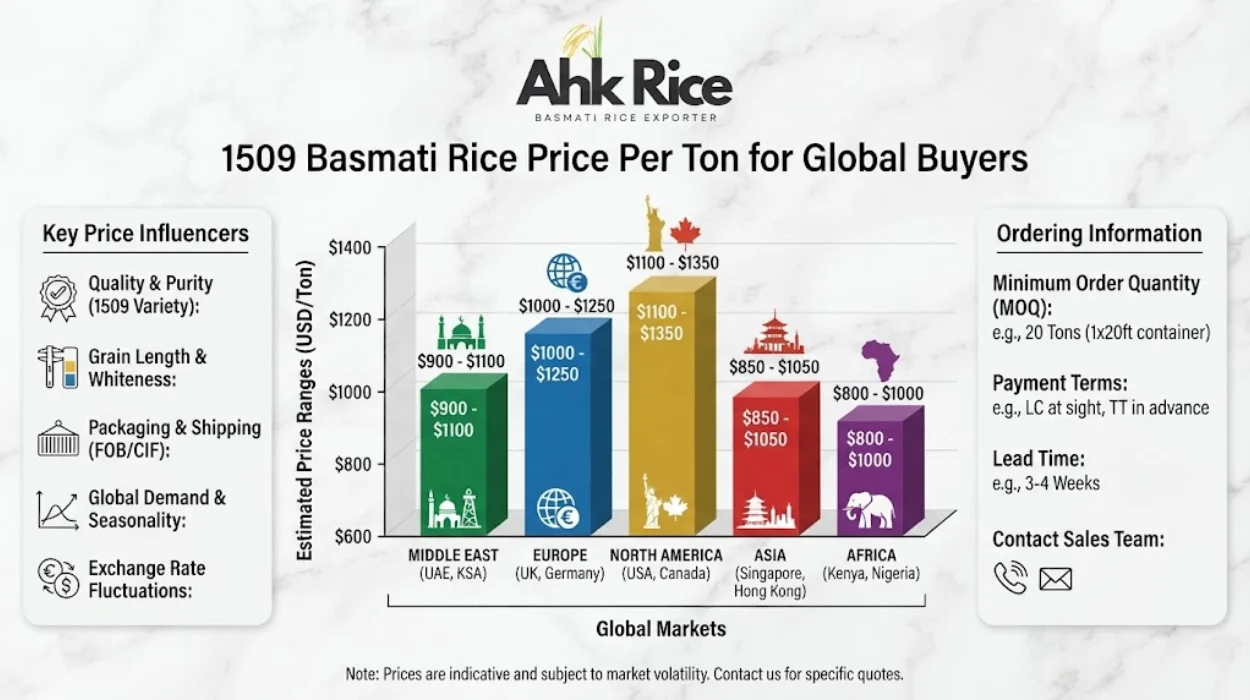
The price per ton depends on processing grade, grain specification, broken percentage, moisture, packing, order quantity, destination, freight, and Incoterm. A 1509 quote without these variables is only an indication and cannot represent the final landed procurement cost.
Pakistan’s overall Basmati export average provides useful market context. REAP reported US$1,027.11 per MT as the average Basmati export value for FY2024-25. (source: Rice Exporters Association of Pakistan, FY2024-25)
That figure includes different varieties and grades. A 1509 buyer should therefore request a shipment-specific quotation instead of applying the national average directly.
| Price factor | Effect on quotation |
|---|---|
| Grain length | Longer and more uniform grains can increase value |
| Broken percentage | Lower broken content generally supports a higher specification |
| Moisture | Controlled moisture supports storage and quality requirements |
| Processing grade | Steam, white, and parboiled specifications carry different costs |
| Packaging | Retail and custom packaging increase preparation costs |
| Quantity | Larger orders can change production and packing economics |
| Destination | Freight and destination requirements change delivered cost |
| Incoterm | FOB, CFR, and CIF allocate different logistics costs |
FOB pricing separates the rice value from the buyer’s ocean freight and destination charges. CIF pricing includes the agreed ocean freight and insurance to the named destination port.
For example, a buyer importing 1509 into Saudi Arabia may compare an FOB quotation with a CIF Jeddah quotation. The FOB figure may look lower, but the buyer must separately calculate freight, insurance, destination charges, clearance, and inland transport.
A European buyer should also account for destination compliance and inspection requirements. A shipment with the correct product specification but incomplete documentation can create additional clearance costs.
AHK Rice can therefore quote against the actual commercial requirement. The buyer should submit destination, quantity, packing, processing grade, and preferred Incoterm before comparing offers.
Price should also be evaluated against expected selling use. A foodservice distributor may prioritize cooking performance and consistent grain appearance. A retail importer may prioritize packaging, branding, and consumer positioning.
The correct decision is not necessarily the lowest quoted number. It is the quotation that provides the required specification at a workable landed cost.
With the pricing variables understood, the buyer can move from market research to a controlled purchasing process.
How can global buyers get started with 1509 Basmati Rice?
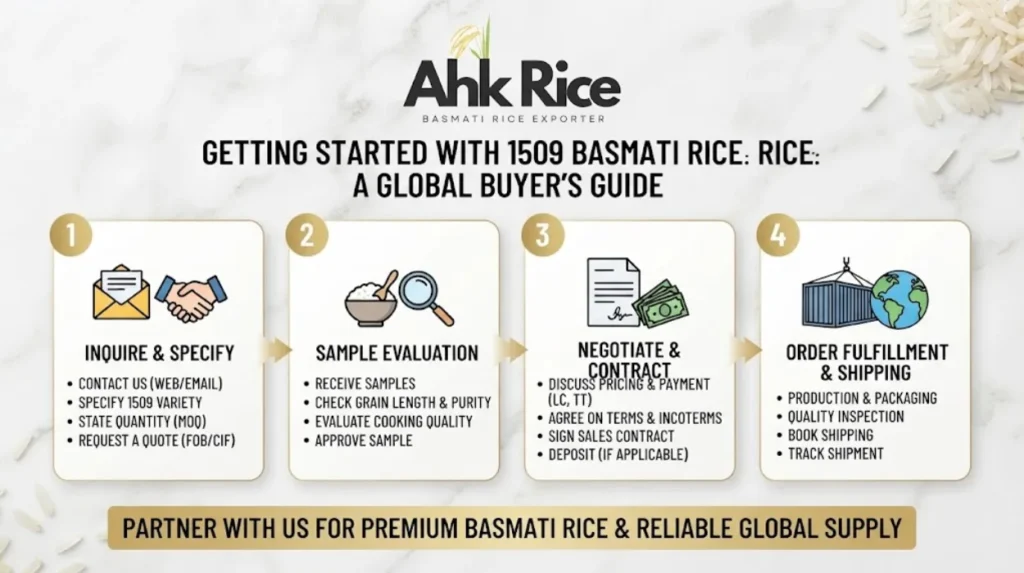
Start with a complete product specification, request a representative sample, approve the quality, confirm the commercial quotation, and then authorize bulk production and shipment. This sequence reduces specification disputes and gives both parties a clear commercial reference.
AHK Rice can begin the process with the buyer’s basic requirements. The essential information includes destination country, destination port, required quantity, processing grade, grain specification, broken percentage, moisture, packaging, and Incoterm.
Sample evaluation should focus on measurable characteristics. Buyers should inspect grain uniformity, aroma, appearance, cooking elongation, texture, broken grains, and moisture.
The commercial quotation should then identify the agreed product specification. It should also state packing, quantity, price basis, payment terms, shipment schedule, and applicable documentation.
Bulk production follows sample approval. AHK Rice mills, grades, sorts, packs, and prepares the rice according to the agreed specification.
Final inspection should verify the shipment before loading. The buyer can use the approved specification as the reference for quality verification and documentation.
Shipment execution then moves through loading, port handling, customs procedures, vessel dispatch, and destination clearance. The exact transit period depends on the destination and shipping schedule.
A buyer purchasing for Gulf foodservice may prioritize 1509 Steam for consistent cooking performance. A wholesale importer may prioritize competitive FOB economics. A private-label retailer may require customized bags and tighter visual specifications.
AHK Rice can structure the quotation around each scenario. This makes the purchasing decision more precise than comparing generic “1509 rice price per ton” listings.
The final step is to submit the complete specification and request a shipment-specific commercial offer. For buyers ready to move from comparison to procurement, request an export quotation from AHK Rice.
FAQs About 1509 Basmati Rice Price Per Ton
What is the average 1509 Basmati Rice price per ton?
1509 pricing varies by grade, specification, quantity, and destination.
Pakistan’s FY2024-25 Basmati average was US$1,027.11/MT.
This figure covers multiple Basmati varieties and grades.
It should not be treated as a fixed 1509 quotation.
A shipment-specific quote provides the relevant commercial price.
Why does 1509 Basmati Rice cost less than some premium grades?
1509 combines Basmati characteristics with efficient commercial production.
Its shorter crop cycle supports production efficiency.
Its raw grain commonly measures around 8.10–8.40 mm.
Cooked elongation can reach 2.5 times.
Buyers can therefore target Basmati performance with controlled procurement costs.
How much does an AHK Rice sample cost?
AHK Rice can provide eligible samples without charging for the rice itself.
The buyer covers courier shipping and applicable phytosanitary charges.
Courier cost depends on destination and shipment weight.
The buyer should approve the physical sample before bulk production.
The final commercial order follows the approved specification.
How long does shipping take from Pakistan?
Gulf routes commonly require around 10–18 days of ocean transit.
Southeast Asian routes commonly require around 18–28 days.
European routes can require around 25–35 days.
North American routes can require around 30–40 days.
Port, vessel, transshipment, and customs conditions can change the schedule.
What information is needed for a 1509 export quote?
Buyers should provide destination and required quantity first.
They should then specify processing grade and grain requirements.
Packing size, broken percentage, moisture, and branding should follow.
The buyer should also state the preferred Incoterm.
AHK Rice can then prepare a specification-based commercial quotation.