Which Pakistani Basmati Rice Varieties Dominate Saudi Import Demand in 2026?
1121 Basmati leads premium Saudi demand, while Super Kernel serves aroma-focused buyers and 1509 targets value-led volume procurement. Here is why: Saudi buyers compare grain length, aroma, cooking performance, shelf life, processing grade, price, and end-use before selecting Pakistani Basmati.
Saudi Arabia imports Pakistani Basmati across retail, wholesale, hospitality, catering, and foodservice channels. The three core varieties are 1121, Super Kernel, and 1509. Recent Saudi-focused trade data also shows repeated shipments of 1121 Steam, Golden Sella, Creamy Sella, and other Sella specifications from Pakistan.
Buyers seeking a complete explanation of cultivation, processing, grades, and export standards can review the guide to popular Pakistani Basmati grades in Saudi Arabia before comparing commercial specifications.
What are the available Pakistani Basmati solutions for Saudi importers?
Saudi importers have three principal Pakistani Basmati solutions: 1121 for premium presentation, Super Kernel for traditional aroma, and 1509 for cost-efficient volume supply across retail, wholesale, hospitality, and catering channels. These varieties also offer different processing grades, storage profiles, and procurement economics.
1121 Basmati
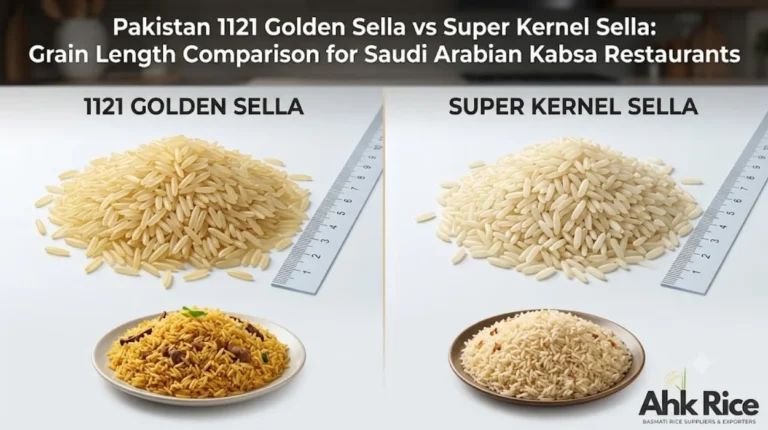
1121 Basmati occupies the premium long-grain segment. Its raw grain commonly measures around 8.30–8.40 mm in Saudi-oriented specifications. Cooking expansion creates a long, separate grain that suits premium retail and foodservice applications.
Saudi import records show substantial commercial shipments of 1121 Steam, Golden Sella, and Creamy Sella. One May 2025 shipment contained 125,000 kg of 1121 Steam, while another contained 250,000 kg of 1121 Golden Sella.
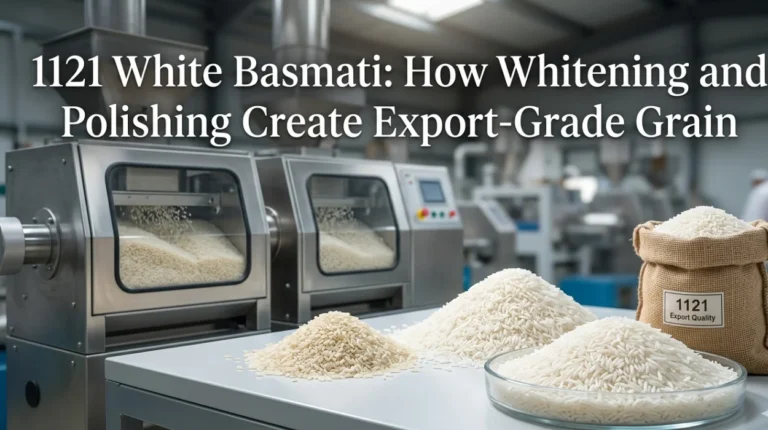
1121 Steam suits supermarkets seeking bright white presentation. 1121 Golden Sella suits catering operations requiring stronger grain structure and longer storage. Creamy Sella provides a lighter parboiled appearance with similar long-grain characteristics.
Super Kernel Basmati
Super Kernel represents the traditional aromatic Pakistani Basmati segment. Its commercial grain length commonly falls around 7.20–7.40 mm. Its strongest differentiator is aroma rather than maximum grain length.
Saudi consumers and traditional retailers use Super Kernel for familiar Basmati characteristics. The variety supports household consumption, premium ethnic retail, and selected foodservice applications.
1509 Basmati
1509 Basmati provides a cost-oriented long-grain solution. Its raw grain specification commonly reaches approximately 8.20–8.40 mm. The variety combines long grain appearance with commercial pricing and strong cooking performance.
1509 suits wholesalers, institutional kitchens, and value-oriented retail programs. Its shorter crop cycle also supports commercial supply efficiency compared with traditional Basmati varieties.
AHK Rice supplies these Pakistani varieties through its Saudi Arabia Basmati rice export service, with processing, grading, inspection, packaging, and export coordination available according to buyer specifications.
These three varieties define the principal solution set, so the next step is a measurable specification comparison.
How do 1121, Super Kernel, and 1509 compare?
1121 provides the longest grain and strongest premium positioning, Super Kernel provides the strongest traditional aroma, and 1509 provides a lower-cost long-grain option for high-volume Saudi distribution. Each specification fits a different procurement objective.
| Attribute | 1121 Basmati | Super Kernel | 1509 Basmati |
|---|---|---|---|
| Raw grain length | 8.30–8.40 mm | 7.20–7.40 mm | 8.20–8.40 mm |
| Aroma | High | Very high | Medium to high |
| Cooking expansion | 2.2–2.5× | Around 2× | Around 2.3× |
| Main processing grades | White, Steam, Golden Sella, Creamy Sella | White, Steam, Sella | White, Steam, Golden Sella |
| Typical shelf life | 12–24 months by grade | 12–18 months | 12–18 months |
| Commercial position | Premium | Traditional premium | Value-oriented premium |
| Main Saudi application | Retail, hotels, catering | Traditional retail | Wholesale, catering, institutions |
The comparison shows why variety selection cannot depend on grain length alone. 1121 has the strongest long-grain specification, but Super Kernel competes through aroma. 1509 competes through the relationship between grain performance and procurement cost.
Saudi-focused market data identifies 1121 Steam, 1121 Golden Sella, Super Kernel, and 1509 as important commercial grades.
The next consideration is regional demand because Saudi procurement requirements vary across distribution channels and operating environments.
Which Saudi market regions prefer different Pakistani Basmati grades?
Western Saudi Arabia emphasizes foodservice and pilgrimage-related volume, while Central and Eastern markets combine retail, wholesale, and institutional demand; 1121 Sella, 1121 Steam, Super Kernel, and 1509 therefore serve different regional purchasing requirements. Channel requirements remain more important than geography alone.
Western Saudi Arabia
Western Saudi Arabia includes major commercial centers such as Jeddah and foodservice networks serving Makkah and Madinah. Large catering operations prioritize cooking consistency, grain separation, and holding performance.
1121 Golden Sella fits extended foodservice holding. Its parboiled structure supports separate grains during large-scale cooking. Its 18–24 month commercial shelf-life range also supports longer inventory cycles under proper storage conditions.
1121 Steam suits premium restaurants and retailers requiring a white appearance. Steam processing provides strong grain integrity while retaining a bright presentation.
Central and Eastern Saudi Arabia
Central and Eastern Saudi markets include Riyadh, Dammam, and surrounding wholesale and retail networks. These channels require both premium consumer products and cost-controlled bulk supply.
Super Kernel fits traditional retail buyers who prioritize aroma and recognizable Basmati characteristics. Its grain length remains shorter than 1121, but its aromatic profile supports premium ethnic positioning.
1509 fits wholesalers and institutional buyers controlling landed cost. Its 8.20–8.40 mm grain profile gives buyers a long-grain presentation without positioning the product at the highest premium level.
Saudi food imports must also meet SFDA requirements. The Saudi Food and Drug Authority states that importers must register food items and comply with applicable Saudi regulations, technical requirements, and standards.
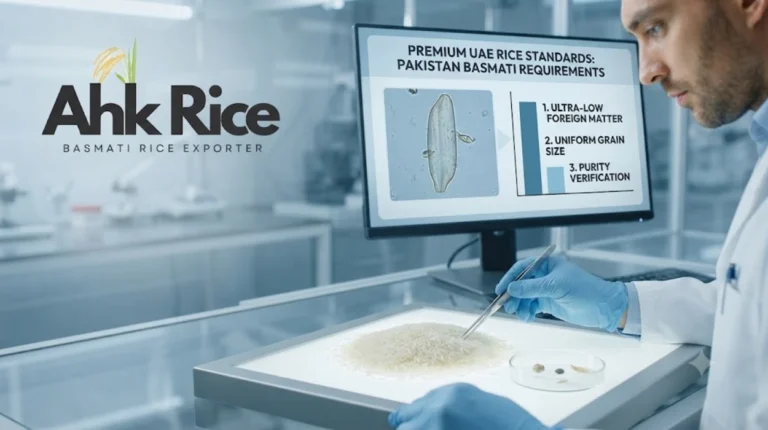
Saudi rice controls also cover physical and laboratory characteristics. SFDA identifies rice testing areas that include purity, grain appearance, grain length, cooking characteristics, contaminants, pesticide residues, microbial safety, and fungal toxins.
The regional comparison establishes different demand patterns, while price and shelf life explain the commercial trade-offs.
How do prices and shelf life compare between Saudi-market grades?
1509 generally occupies the lower price position, Super Kernel occupies the traditional premium range, and 1121 commands premium pricing; Golden Sella provides the longest stated shelf life at 18–24 months under suitable storage conditions. Actual contracts depend on specifications and freight.
Indicative export pricing varies by grade, crop, processing specification, packing, order quantity, and delivery term. A September 2026 Pakistani exporter price schedule lists 1121 Sella at US$1,135–1,175/MT FOB Karachi, 1121 Steam at US$1,160–1,200/MT, and Super Kernel at US$1,165–1,205/MT.
A Saudi-focused AHK market comparison places 1121 Steam around US$1,150–1,300/MT, 1121 Golden Sella around US$1,200–1,350/MT, Super Kernel around US$1,050–1,180/MT, and 1509 around US$900–1,050/MT. These figures should be treated as indicative market comparisons rather than shipment quotations.
| Grade | Indicative price position | Shelf-life range | Commercial implication |
|---|---|---|---|
| 1121 Steam | Premium | 12 months | Premium retail turnover |
| 1121 Golden Sella | Highest premium | 18–24 months | Catering and extended storage |
| Super Kernel | Premium | 12–18 months | Aroma-led retail |
| 1509 | Value premium | 12–18 months | Bulk and institutional supply |
Shelf life depends on moisture, packaging, warehouse conditions, and storage practices. Saudi buyers therefore need a defined moisture specification rather than relying only on the variety name.
The pricing and storage comparison now makes the decision framework clearer for different Saudi purchasing cases.
Which Pakistani Basmati method works best for different Saudi cases?

Premium supermarkets generally suit 1121 Steam, catering operations suit 1121 Golden Sella, traditional aromatic retail suits Super Kernel, and cost-controlled wholesale programs suit 1509. The correct selection follows application, price target, storage cycle, and cooking requirements.
| Decision factor | Recommended solution | Reason |
|---|---|---|
| Premium supermarket appearance | 1121 Steam | Bright presentation and long cooked grain |
| Long storage and catering | 1121 Golden Sella | Strong grain structure and 18–24 month shelf life |
| Traditional aroma | Super Kernel | Strong aromatic identity |
| Cost-controlled bulk supply | 1509 | Long grain with competitive positioning |
| Mixed premium distribution | 1121 + 1509 | Covers premium and value segments |
The framework supports segmented procurement rather than one-grade purchasing. A Saudi distributor serving supermarkets and institutional buyers can maintain separate specifications for each channel.
This approach also reduces the risk of forcing one variety into every commercial application. Premium retail requires appearance. Catering requires grain resilience. Traditional retail requires aroma. Wholesale requires procurement efficiency.
With the decision framework established, the next question is how each approach performs in practical commercial use.
What are the pros and cons of each Pakistani Basmati approach?
1121 maximizes grain length and premium presentation, Super Kernel maximizes traditional aroma, and 1509 balances long-grain performance with cost; each approach creates trade-offs in price, storage, positioning, and target customer. Buyers should evaluate those trade-offs against their sales channel.
1121 Basmati
Advantages: Extra-long grain, strong visual presentation, broad processing options, premium positioning, and strong suitability for Kabsa, Mandi, Biryani, hotels, and retail.
Limitations: Premium specifications generally require higher procurement budgets. Golden Sella also creates a different appearance from white or steam rice.
Super Kernel Basmati
Advantages: Strong aroma, traditional Basmati identity, soft cooking texture, and established appeal among consumers seeking classic Pakistani Basmati characteristics.
Limitations: Its raw grain is shorter than 1121 and 1509. Buyers focused primarily on maximum grain length may therefore prefer 1121.
1509 Basmati
Advantages: Long grain, competitive procurement position, good cooking expansion, and suitability for high-volume distribution.
Limitations: Aroma and premium positioning do not match Super Kernel or top-tier 1121 specifications. Buyers targeting luxury retail can therefore require a higher premium grade.
The practical solution is specification-based procurement. A buyer should define grain length, broken percentage, moisture, processing grade, packing, crop year, purity, and testing requirements before comparing quotations.
What decision factors should Saudi importers use before purchasing?
Saudi importers should prioritize end use, grain specification, processing grade, price per MT, shelf life, compliance, packaging, and supplier consistency before selecting a Pakistani Basmati variety. These factors convert a broad product choice into a measurable procurement specification.
End use
Retail buyers should prioritize appearance and consumer recognition. Catering buyers should prioritize grain strength and holding performance. Wholesale buyers should prioritize cost, consistency, and repeat availability.
Grain specification
Specify raw grain length rather than using only the variety name. A contract can define 8.30–8.40 mm for 1121 or 8.20–8.40 mm for 1509.
Processing grade
Specify White, Steam, Golden Sella, or Creamy Sella. Processing changes grain strength, appearance, cooking behavior, and storage characteristics.
Moisture and broken percentage
Define maximum moisture and broken-grain limits in the purchase specification. Controlled moisture protects storage performance, while low broken percentage supports retail appearance and cooking consistency.
Compliance
Saudi importers must ensure the shipment satisfies SFDA requirements. Imported food must meet applicable Saudi regulations and technical standards, while import documentation includes items such as commercial invoices and certificates according to the product and regulatory requirements.
Packaging
Retail programs require consumer-sized packaging and Arabic-compliant labeling. Wholesale and foodservice programs commonly use larger formats. Packaging must also protect rice during international transportation and Saudi warehouse storage.
Supplier consistency
A supplier should reproduce the agreed specification across shipments. A sample that passes evaluation but differs from the commercial shipment creates quality and brand risks.
These factors provide the commercial basis for selecting 1121, Super Kernel, or 1509 rather than choosing purely by variety popularity.
How should Saudi importers structure the final comparison?
Saudi importers should compare approved samples against one written specification covering variety, grain length, processing, broken percentage, moisture, packaging, testing, price, and delivery terms before confirming bulk procurement. This creates a direct comparison between competing export offers.
Sample approval should begin with physical inspection. Buyers can verify grain length, color, purity, broken percentage, aroma, and processing grade against the agreed specification.
Laboratory testing should then verify relevant safety and quality parameters. SFDA requirements make regulatory compliance important for food clearance, while rice controls can include contaminants, pesticide residues, and microbiological parameters.
Commercial comparison should use the same Incoterm. FOB Karachi and CIF Jeddah produce different cost structures. A Saudi buyer should therefore compare the landed cost rather than treating an FOB figure as the final procurement cost.
Packaging should also remain identical during comparison. A 5 kg private-label retail product cannot be compared directly with a 40 kg wholesale bag without adjusting packaging and handling costs.
For procurement planning, the next-stage article should explain how these specifications become commercial contracts, payment terms, shipment schedules, inspection requirements, and bulk purchase structures.
Saudi Basmati demand in 2026 is segmented rather than controlled by one variety. 1121 dominates premium long-grain positioning, Super Kernel supports traditional aroma demand, and 1509 provides cost-efficient long-grain supply. Processing grades further divide demand between Steam, Golden Sella, Creamy Sella, and White rice.
The strongest procurement strategy is specification-based. Buyers should match variety, processing grade, shelf life, price, packaging, and compliance requirements with the final sales channel. This approach creates a clearer comparison between suppliers and reduces specification disputes after shipment.
Frequently Asked Questions
Which Pakistani Basmati rice is most popular in Saudi Arabia?
1121 Basmati, Super Kernel, and 1509 Basmati are the principal Pakistani varieties used across Saudi retail, wholesale, hospitality, and catering channels. 1121 emphasizes long grain, Super Kernel emphasizes aroma, and 1509 emphasizes value-oriented volume supply.
Is 1121 better than 1509 for Saudi importers?
1121 and 1509 serve different commercial objectives. 1121 provides longer grain and stronger premium positioning. 1509 provides a competitive long-grain specification for wholesale and institutional buyers. The correct choice depends on the sales channel and procurement budget.
Which Pakistani Basmati rice has the longest shelf life?
1121 Golden Sella has the longest stated shelf-life range at approximately 18–24 months under suitable storage conditions. Its parboiling process strengthens the grain and supports longer storage compared with standard Steam specifications.
Is Super Kernel popular in Saudi Arabia?
Super Kernel remains relevant among traditional and aroma-focused Saudi buyers. Its strongest commercial attribute is its distinctive natural fragrance rather than maximum grain length. This makes it suitable for traditional retail and premium ethnic consumer segments.
Why do Saudi caterers use Golden Sella?
Golden Sella provides strong grain structure, high cooking yield, and extended storage stability. These characteristics support large-scale preparation for hotels, restaurants, catering companies, and institutional kitchens where rice can remain in service for extended periods.
What documents are important for Pakistani rice entering Saudi Arabia?
Common documents include commercial invoices, packing lists, certificates of origin, phytosanitary documentation, health or laboratory documentation, and other certificates required by the product and Saudi authorities. SFDA requirements also require food importers to register products and meet applicable regulations.
What should a Saudi importer specify in a rice quotation?
The quotation should define variety, processing grade, grain length, broken percentage, moisture, packing, quantity, origin, inspection requirements, Incoterm, destination, and freight. These fields make competing offers commercially comparable.
Which variety suits Saudi wholesale distribution?
1509 Basmati suits cost-controlled wholesale distribution because it combines long grain with a value-oriented procurement position. 1121 remains suitable for wholesalers serving premium retail, while Super Kernel suits aroma-focused traditional distribution.