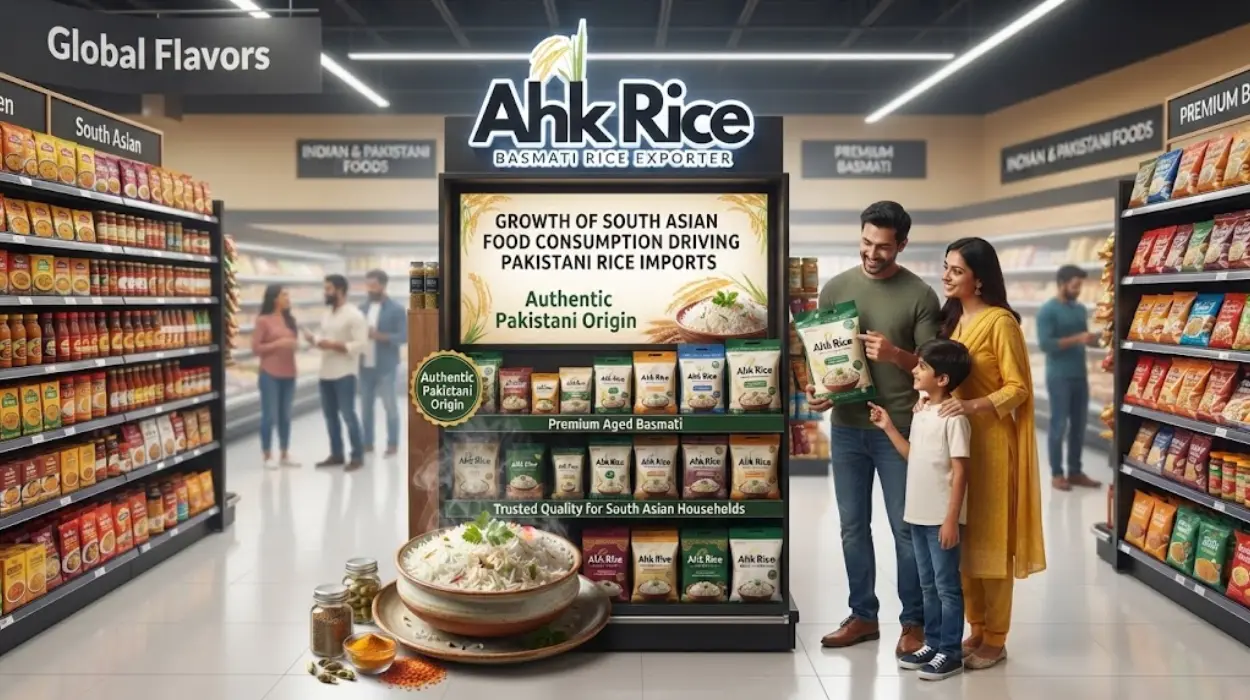
Growth of South Asian Food Consumption Driving Pakistani Rice Imports in the United States in 2026
Pakistani rice imports are gaining commercial importance in the United States because South Asian food consumption supports demand for aromatic Basmati across retail, foodservice, ethnic grocery, and private-label channels. Here is why: the United States imports around 1.3 million tons of rice annually, with Asian aromatic rice forming a major part of imports, while Pakistani rice exports to the United States reached about US$35.53 million in 2025. (source: USDA Economic Research Service; UN Comtrade)
The demand connects directly with Pakistani Basmati varieties, processing grades, packaging, and distribution models. Buyers comparing supply options can first review [why Pakistani Basmati rice is growing in premium USA grocery stores] as the educational foundation for this market. South Asian food consumption creates the demand base, while U.S. import requirements determine which products can scale through commercial channels.
What are the available solutions for meeting U.S. rice demand?
1121, Super Kernel, and 1509 provide three distinct solutions: premium grain presentation, traditional aroma, and value-focused long-grain supply. Here is why: each variety targets different consumer expectations, price positions, processing formats, and retail or foodservice applications.
Pakistani Basmati rice is cultivated mainly in Punjab. Farmers grow aromatic varieties under irrigated agricultural conditions. Harvested paddy then moves through cleaning, drying, dehusking, milling, polishing, grading, sorting, inspection, packing, and export preparation.
AHK Rice supplies 1121, Super Kernel, and 1509 Basmati from Punjab. The supply model covers processing, grading, packaging, inspection coordination, and export logistics.
1121 Basmati
1121 Basmati represents the premium grain-length solution. Raw grain commonly reaches about 8.2–8.5 mm under commercial specifications. Cooked grain expansion creates strong visual differentiation for premium retail, restaurants, catering, and private-label products.
1121 fits buyers who want a highly visible premium product. White, Steam, Sella, and Golden Sella formats create additional options for different cooking and storage requirements.
Super Kernel Basmati
Super Kernel provides an aroma-led solution. The grain is shorter than 1121 but delivers a strong traditional Pakistani Basmati aroma. Commercial specifications commonly place raw grain around 7.2–7.5 mm.
Super Kernel fits ethnic grocery stores, traditional South Asian cuisine, restaurants, and premium-value retail. The variety works especially well where aroma and authenticity matter more than maximum grain length.
1509 Basmati
1509 provides a cost-efficiency solution. The variety combines long-grain appearance with a more competitive procurement position than 1121 in many export specifications.
1509 fits value-focused retail, foodservice, restaurants, and distributors managing high-volume inventory. Steam and Sella processing provide additional options for cooking consistency and storage planning.
The three varieties therefore solve different commercial problems rather than competing only on price.
How do different Pakistani rice approaches compare?
1121 leads on premium visual presentation, Super Kernel leads on traditional aroma, and 1509 leads on procurement efficiency. Here is why: U.S. buyers serve different consumer groups, so variety selection must match retail positioning, cooking expectations, inventory strategy, and landed cost.
| Attribute | 1121 Basmati | Super Kernel Basmati | 1509 Basmati |
|---|---|---|---|
| Raw grain length | About 8.2–8.5 mm | About 7.2–7.5 mm | About 8.1–8.4 mm |
| Aroma | Strong | Very strong traditional aroma | Moderate to strong |
| Cooked appearance | Extra-long premium | Long and separate | Long and separate |
| Processing options | White, Steam, Sella, Golden Sella | White and selected processed forms | White, Steam, Sella |
| Price position | Premium | Premium-value | Value-premium |
| Main U.S. use | Premium retail, HORECA, private label | Ethnic retail, restaurants | Foodservice, value retail |
| Storage position | Strong under controlled storage | Strong under controlled storage | Strong under controlled storage |
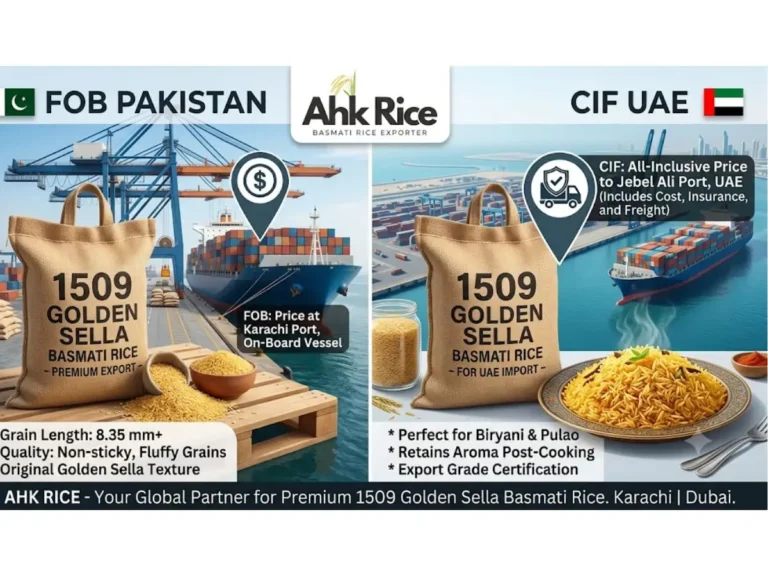
Current Pakistan export references place 1121 Basmati around US$1,135–US$1,205 per MT FOB Karachi. Super Kernel is also positioned around US$1,165–US$1,205 per MT in current market references. 1509 generally occupies a lower price position, with AHK Rice market comparisons placing it around US$780–US$1,050 per MT depending on processing and specification. (source: Pakistan rice export market references, 2026)
These prices are planning benchmarks rather than fixed U.S. landed prices. Freight, customs charges, packaging, inspection, insurance, duties, and inland delivery change the final cost per metric ton.
Processing also changes the commercial comparison. Sella generally provides stronger storage performance than standard White or Steam rice. Proper moisture control and packaging remain essential for every grade.
Which method works best for different U.S. market cases?
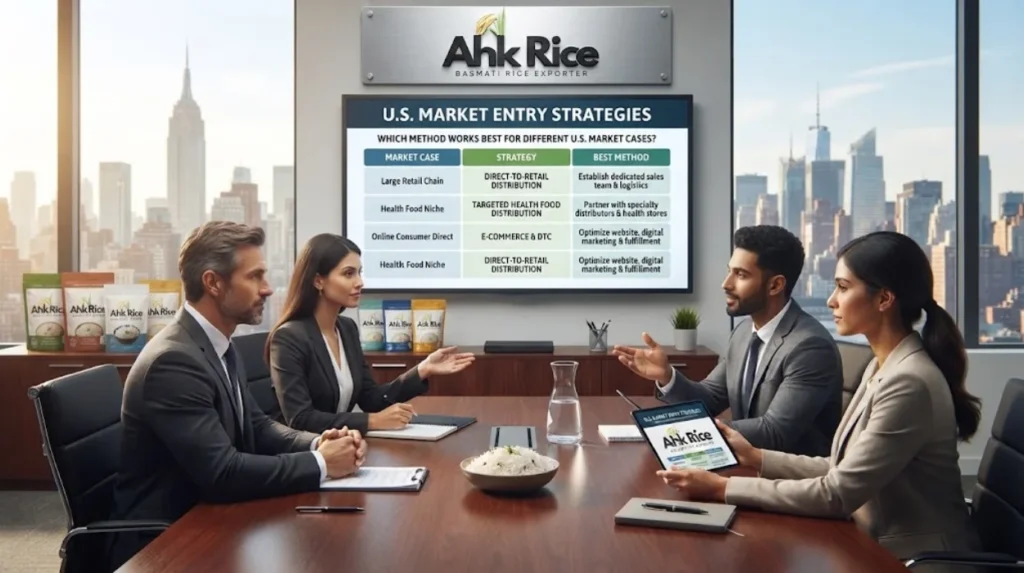
1121 works best for premium retail, Super Kernel works best for aroma-led ethnic channels, and 1509 works best for cost-controlled high-volume distribution. Here is why: each segment assigns different value to grain length, aroma, price, cooking performance, and inventory duration.
Northeast and Mid-Atlantic markets
New York and New Jersey form important South Asian consumer and food distribution centres. Pakistani, Indian, Bangladeshi, Middle Eastern, and broader Asian food channels create demand for imported aromatic rice.
1121 suits premium supermarket shelves where long grain and visual presentation support higher retail positioning. Super Kernel suits ethnic stores serving consumers seeking traditional Pakistani Basmati aroma.
1509 suits wholesalers and foodservice operators seeking long-grain performance at a lower procurement position. The same distributor can carry multiple grades to serve different customer groups.
The U.S. Pakistani population alone was estimated at about 680,000 people in 2023, while the Indian population reached about 5.2 million. These communities form part of the broader South Asian food-consumption base. (source: Pew Research Center, 2025)
Texas, California, and other Western and Southern markets
Texas and California support large multicultural food markets with South Asian grocery, restaurant, catering, and private-label demand. Distributor networks also connect ethnic products with wider specialty-food channels.
1121 suits premium retail and restaurant programs requiring strong cooked-grain presentation. Super Kernel suits Pakistani and South Asian stores where aroma supports repeat purchasing.
1509 suits large foodservice accounts where procurement efficiency and consistent cooking performance carry greater weight than maximum grain length.
The commercial lesson is important. Geographic demand does not determine one universal grade. Retail positioning, customer profile, packaging, and inventory turnover determine the correct product.
How do price and shelf life compare across markets?
1509 normally provides the strongest cost-efficiency position, while 1121 and Super Kernel support higher-value premium positioning; Sella formats provide stronger storage planning. Here is why: U.S. buyers must compare purchase cost with storage duration, product positioning, and expected retail turnover.
| Market region | Preferred grades | Indicative price position | Shelf-life planning | Best commercial use |
|---|---|---|---|---|
| Northeast & Mid-Atlantic | 1121, Super Kernel | Premium | White/Steam: 12–18 months; Sella: 18–24 months | Ethnic retail, premium grocery |
| Texas & West/South | 1121, 1509, Super Kernel | Premium to value-premium | White/Steam: 12–18 months; Sella: 18–24 months | Retail, foodservice, private label |
Shelf life is not determined by variety alone. Moisture, packaging material, warehouse temperature, humidity, pest control, processing quality, and stock rotation directly affect rice stability.
Sella processing strengthens grain structure through controlled parboiling. This makes Sella useful for buyers managing longer inventory cycles. Steam provides a different appearance and cooking profile while maintaining strong commercial stability under suitable storage.
A retailer with rapid inventory turnover can prioritise 1509 Steam. A retailer holding premium inventory for longer periods can select 1121 or Super Kernel Sella.
What are the pros and cons of each solution?
1121 provides the strongest premium appearance, Super Kernel provides the strongest traditional aroma, and 1509 provides the strongest cost-efficiency advantage. Here is why: each benefit also creates a commercial trade-off that buyers must evaluate before final procurement.
1121 Basmati
Pros: Extra-long grain, premium appearance, strong cooked elongation, broad retail appeal, and strong restaurant presentation.
Cons: Higher procurement cost and greater dependence on premium retail positioning.
A premium supermarket can justify the higher cost through stronger shelf positioning. A price-sensitive foodservice distributor may achieve better margins with 1509.
Super Kernel Basmati
Pros: Strong aroma, traditional Pakistani Basmati identity, premium ethnic positioning, and suitability for biryani and pulao.
Cons: Shorter grain than 1121 and less emphasis on maximum visual elongation.
A Pakistani grocery chain can use Super Kernel to target aroma-focused consumers. A premium mainstream shelf may prefer 1121 because grain length communicates value quickly.
1509 Basmati
Pros: Long grain, competitive procurement cost, strong cooking performance, and suitability for high-volume distribution.
Cons: Lower premium perception than 1121 and less intense aroma than Super Kernel.
A foodservice distributor can use 1509 to control cost across recurring restaurant orders. A premium private-label program can instead use 1121 to support higher retail positioning.
These trade-offs lead directly to the factors that should control the final purchasing decision.
What decision factors should U.S. buyers evaluate?
U.S. buyers should evaluate variety, processing, specification, price, compliance, packaging, and supply reliability before selecting Pakistani rice. Here is why: a low FOB quotation does not represent the true commercial value without equivalent specifications and destination costs.
| Decision factor | Buyer question | Best-fit approach |
|---|---|---|
| Grain profile | Does the customer value maximum length? | 1121 |
| Aroma | Does traditional fragrance drive repeat purchases? | Super Kernel |
| Cost | Does procurement efficiency dominate? | 1509 |
| Storage | Will inventory remain for extended periods? | Sella |
| Retail format | Does the product need premium shelf presentation? | 1121 or Super Kernel |
| Compliance | Can the shipment meet U.S. food requirements? | Verified documentation |
| Supply | Can the supplier reproduce the approved specification? | Specification-controlled sourcing |
U.S. food importers must ensure imported food is safe, sanitary, and properly labelled. FDA also requires applicable facility registration and prior notice procedures. FSVP requires covered importers to verify that foreign suppliers meet applicable food-safety requirements. (source: U.S. Food and Drug Administration)
The compliance process therefore belongs inside procurement planning. Buyers should verify product specifications, supplier documentation, testing, labeling, shipment records, and importer responsibilities before dispatch.
What is the best overall sourcing strategy for 2026?
A segmented portfolio using 1121 for premium demand, Super Kernel for aroma-led ethnic demand, and 1509 for value-focused volume provides the strongest market coverage. Here is why: U.S. South Asian food consumption is diverse, so one rice grade cannot efficiently serve every retail and foodservice application.
A multi-grade strategy allows distributors to separate premium and value segments. 1121 can serve high-value retail and restaurant accounts. Super Kernel can serve aroma-focused Pakistani and South Asian customers. 1509 can serve high-volume foodservice and price-sensitive retail.
The United States also maintains a structurally large import requirement. USDA projects 49.8 million hundredweight of rice imports for the 2026/27 marketing year. Total U.S. rice supply remains comparatively tight, with ending stocks projected at 40.4 million hundredweight. (source: USDA Economic Research Service, September 2026)
This market structure strengthens the importance of reliable imported supply. Buyers need consistent specifications, compliant documentation, suitable packaging, and repeatable shipment schedules.
AHK Rice operates within this supply model by sourcing and processing Pakistani Basmati varieties in Punjab and supporting custom packaging and export logistics. The commercial decision remains specification-led rather than brand-led.
The comparison establishes the role of each grade. The next stage is choosing the exact grade and branding format for U.S. retail and grocery distribution.
Frequently Asked Questions
Why are Pakistani rice imports growing in the United States in 2026?
Pakistani rice imports are supported by South Asian food consumption, ethnic grocery expansion, restaurant demand, premium Basmati consumption, and private-label sourcing. Pakistan supplied about US$35.53 million of rice to the United States in 2025. (source: UN Comtrade)
Which Pakistani rice variety is best for U.S. premium retail?
1121 Basmati is the strongest premium retail option when extra-long grain appearance, cooked elongation, and premium presentation drive consumer value. Super Kernel suits premium ethnic retail where traditional aroma receives greater emphasis.
Is Super Kernel cheaper than 1121 Basmati?
Super Kernel can occupy a similar premium price range to 1121. Current indicative references place both around US$1,165–US$1,205 per MT for selected specifications. Final prices depend on processing, quantity, packaging, quality, and Incoterm.
Is 1509 Basmati suitable for U.S. grocery stores?
1509 Basmati suits U.S. grocery stores that target value-premium consumers. Its long grain and competitive procurement position support private-label, foodservice, and price-sensitive retail programs.
Which Pakistani rice grade has better storage performance?
Sella grades generally provide stronger storage performance than standard White or Steam formats. A practical planning range is around 18–24 months for suitable Sella storage and around 12–18 months for White or Steam under controlled conditions.
What U.S. compliance requirements apply to Pakistani rice?
U.S. importers must meet applicable FDA food-safety and labeling requirements. Covered importers must also maintain an FSVP for foreign suppliers. Facility registration, prior notice, documentation, and applicable inspection requirements form part of the import process. (source: U.S. FDA)
Which U.S. regions have strong South Asian rice demand?
New York, New Jersey, Texas, California, Illinois, and Georgia contain established South Asian grocery, restaurant, and food distribution networks. These markets support retail, foodservice, catering, and private-label demand for imported Basmati.
What should buyers compare before selecting Pakistani rice?
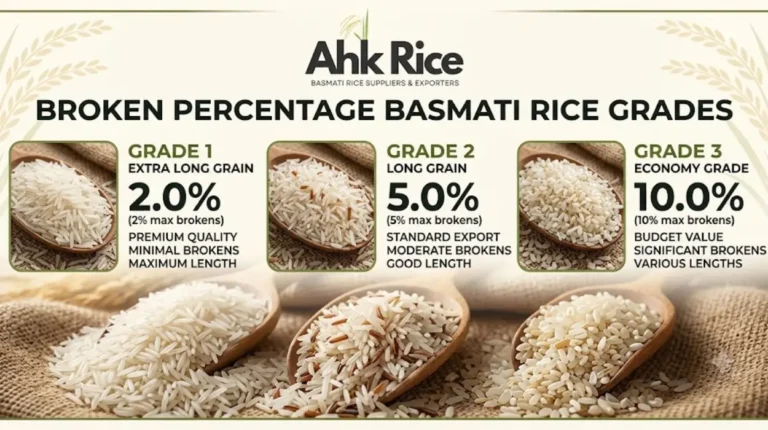
Buyers should compare grain length, aroma, processing type, broken percentage, moisture, price per MT, packaging, shelf-life requirements, compliance documents, freight, and supplier consistency. Comparing only FOB price creates an incomplete procurement decision.