How US Importers and Distributors Negotiate Certification, Packaging, and Compliance for Pakistani Rice Imports
U.S. importers and distributors negotiate Pakistani rice purchases by aligning FDA requirements, FSVP verification, phytosanitary controls, food testing, packaging specifications, labeling, documentation, and shipment terms before dispatch. Here is why: imported food must meet U.S. safety, sanitation, and truthful labeling requirements.
Pakistani Basmati rice enters the U.S. market through importers, distributors, Asian grocery chains, foodservice companies, private-label brands, and wholesalers. Common commercial varieties include 1121, Super Kernel, and 1509.
The negotiation process connects the rice specification with regulatory documentation. Buyers therefore discuss grain length, broken percentage, moisture, packaging weight, laboratory testing, certificates, labeling, and shipment documents in one purchasing specification.
What is certification and compliance negotiation for Pakistani rice imports?
Certification and compliance negotiation is the process of matching Pakistani rice specifications with U.S. food-safety, labeling, import, plant-health, and buyer documentation requirements before shipment and customs entry.
U.S. food importers remain responsible for ensuring imported food meets applicable U.S. requirements. FDA states that imported food must be safe, sanitary, and properly labeled. FDA also verifies food facility registration and other requirements during importation.
Certification therefore does not mean obtaining one universal “U.S. rice certificate.” Different documents address different risks.
FDA requirements focus on food safety and labeling. FSVP focuses on importer verification of foreign suppliers. APHIS requirements address plant-health risks for regulated agricultural commodities. Certificates from Pakistan support shipment verification and buyer specifications.
For example, a U.S. importer purchasing 1121 Basmati can specify grain length, broken grains, moisture, foreign matter, pesticide residues, microbiological parameters, packaging material, label information, and certificate requirements.
This specification becomes the reference point for sampling, testing, production, inspection, loading, and customs documentation.
With the compliance definition established, the next step is understanding how importers execute this negotiation.
How does the Pakistani rice import process work in the United States?
The process starts with product specification and supplier verification, then moves through sampling, testing, labeling approval, documentation, shipment inspection, customs entry, and post-import supplier verification.
How do buyers establish the rice specification?
Define the variety, processing grade, grain length, broken percentage, moisture, color, crop year, packing format, net weight, and destination before commercial negotiation.
Pakistani Basmati includes varieties such as 1121, Super Kernel, and 1509. Processing formats include white rice, steam rice, Sella rice, and Golden Sella rice.
A buyer purchasing premium 1121 can specify long grain appearance and aroma. A bulk distributor purchasing 1509 can prioritize yield, price positioning, and consistent cooking performance.
How do buyers approve samples?
Request representative samples before confirming production. Test the sample against the agreed specification.
Sample approval commonly covers appearance, aroma, grain dimensions, broken percentage, moisture, cooking performance, foreign matter, and laboratory parameters.
A commercial sample should represent the production specification. The approved sample then becomes a reference for quality inspection before loading.
How do buyers verify suppliers?
Review supplier identity, facility information, food-safety systems, laboratory reports, certificates, previous shipment documentation, and production controls.
FDA’s FSVP framework requires covered U.S. importers to verify that foreign suppliers produce food under applicable safety controls and that imported food is not adulterated or misbranded.
The commercial negotiation therefore connects supplier verification with the exact rice product being purchased.
With the import workflow established, certification becomes the next decision point.
Which certifications and documents matter for Pakistani rice imports?
Key documents include FDA facility registration information, FSVP records, prior notice, phytosanitary documentation where required, certificates of origin, health certificates, inspection reports, laboratory results, and commercial shipping documents.
What does FDA require?
FDA requires applicable foreign food facilities to register with FDA. Imported food also requires prior notice before arrival in the United States. FDA examines imported foods for compliance with safety and labeling requirements.
FDA does not operate as a pre-import approval agency for every food shipment. Instead, imported food remains subject to U.S. legal requirements and inspection at entry.
What does FSVP require?
FSVP requires covered U.S. importers to verify foreign suppliers and maintain procedures supporting food-safety compliance.
The importer of record and FSVP importer have defined responsibilities. The FSVP framework identifies the U.S. owner or consignee as the importer under specified conditions.
What does APHIS control?
APHIS regulates plant products that present plant-pest risks. Requirements depend on the commodity and country of origin. Importers use the Agricultural Commodity Import Requirements database to identify applicable conditions.
Rice is a processed plant product, so importers should verify the current commodity-specific requirements before shipment. APHIS specifically identifies rice among dried or processed plant products that can face import restrictions.
Which commercial documents support shipment clearance?
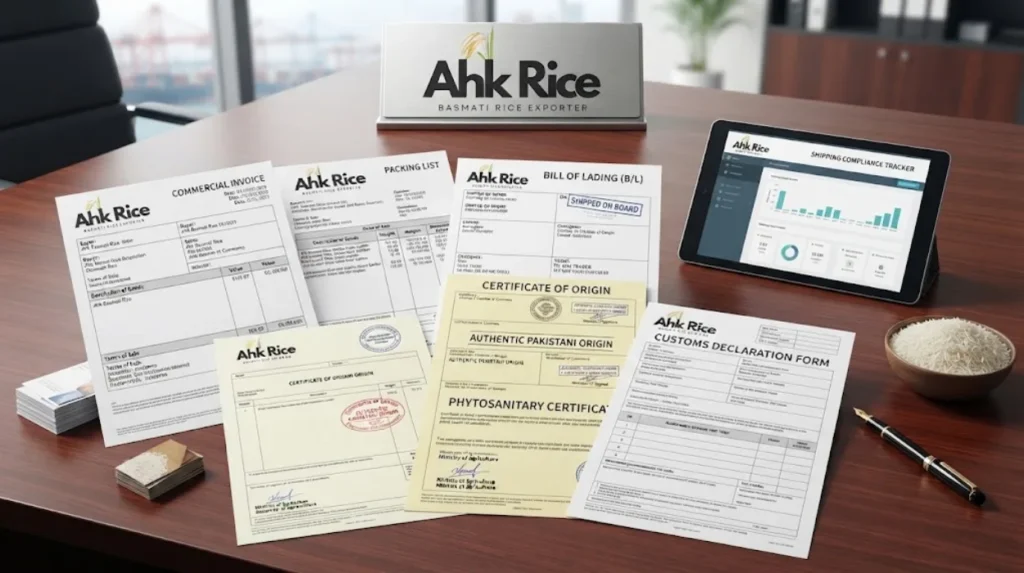
Common documents include:
- Commercial invoice
- Packing list
- Bill of lading
- Certificate of origin
- Phytosanitary certificate where required
- Health certificate where required
- Inspection certificate
- Laboratory analysis
- Fumigation or treatment documentation where required
- Product specification sheet
Document requirements vary according to product, shipment structure, buyer specification, and applicable U.S. regulations.
With certification requirements separated by function, packaging becomes the next major negotiation area.
How do U.S. buyers negotiate Pakistani rice packaging and labeling?
U.S. buyers negotiate packaging around retail weight, material, durability, barcode placement, nutrition information, country-of-origin statements, product identity, importer details, and truthful English labeling.
What packaging formats are used?
Common rice packaging includes polypropylene bags, woven bags, laminated bags, paper-based packs, and consumer retail pouches.
Commercial weights include 5 kg, 10 kg, 20 kg, and larger bulk formats. U.S. retailers often require pound-based consumer labeling, while importers can specify packaging formats for wholesale distribution.
Private-label buyers also negotiate artwork, brand names, UPC or barcode placement, package dimensions, pallet configuration, and carton specifications.
What labeling rules apply?
FDA requires imported food labeling to be informative and truthful. Food labels must comply with applicable FDA requirements and generally provide required information in English.
Country-of-origin statements must not be false or misleading. FDA specifically applies this principle to geographical-origin food labeling.
A Pakistani rice package therefore needs accurate product identity and origin information. Buyers should approve final artwork before commercial production.
Why does packaging affect logistics?
Packaging determines container utilization, pallet configuration, warehouse handling, product protection, and retail presentation.
A 20 kg wholesale bag serves a different distribution model from a consumer retail pouch. Private-label retail programs require additional coordination between packaging artwork and regulatory labeling.
With packaging aligned, importers then evaluate the rice itself against commercial specifications.
What key rice specifications do U.S. importers negotiate?
U.S. buyers commonly negotiate variety, grain length, broken percentage, moisture, foreign matter, milling quality, color, aroma, cooking performance, packaging, quantity, inspection, and laboratory testing requirements.
What specifications matter for 1121 Basmati?
1121 Basmati is positioned around long grain appearance, natural aroma, cooking elongation, and premium retail presentation.
Buyers commonly define grain length, broken percentage, moisture, whiteness, purity, and cooking characteristics within the purchase specification.
What specifications matter for Super Kernel?
Super Kernel is a traditional Pakistani Basmati type associated with natural aroma and premium South Asian consumption.
Commercial specifications can target approximately 7.0–7.5 mm raw grain, 12–13% maximum moisture, and 2–3% broken grains, subject to the agreed grade and contract.
What specifications matter for 1509?
1509 is associated with high yield, shorter cultivation duration, long grain appearance, and cost-sensitive distribution.
Commercial specifications commonly target approximately 8.10–8.40 mm raw grain, with moisture controlled around 13% maximum according to the agreed specification.
These specifications give buyers measurable quality controls rather than relying on generic descriptions such as premium or high quality.
With the product specification defined, the commercial benefits become clearer.
What are the benefits of negotiating certification, packaging, and compliance together?
Integrated negotiation reduces documentation gaps, prevents packaging conflicts, improves supplier verification, strengthens shipment consistency, and gives U.S. buyers one controlled specification for procurement, inspection, and import entry.
What is the procurement benefit?
A single specification reduces disputes between the buyer, exporter, inspector, laboratory, customs broker, and distributor.
The purchase contract can identify the exact rice variety, grade, packaging, tolerance, certificates, inspection process, and documentation requirements.
What is the quality benefit?
Pre-shipment inspection compares the loaded rice with the agreed specification.
Laboratory testing provides measurable evidence for parameters such as moisture, contaminants, residues, and microbiological quality where required by the buyer.
What is the logistics benefit?
Complete documentation supports smoother coordination between exporter, freight forwarder, customs broker, importer, and warehouse.
Prior notice must reach FDA before applicable food shipments enter the United States.
The combined approach therefore links commercial purchasing with regulatory execution.
Which U.S. markets use Pakistani rice?
Pakistani rice serves South Asian grocery retail, wholesale distribution, foodservice, private-label retail, restaurant supply, catering, and ethnic-food channels across major U.S. metropolitan markets.
Which retail channels use Pakistani Basmati?
South Asian grocery stores commonly stock 1121, Super Kernel, and other Basmati grades.
Retailers negotiate smaller consumer packs, private-label artwork, barcodes, shelf presentation, and consistent cooking quality.
Which foodservice channels use Pakistani rice?
Restaurants, caterers, banquet operators, and institutional kitchens purchase rice according to cooking performance, volume, price, and packaging.
Steam and Sella formats serve different operational requirements. Golden Sella provides a parboiled format suited to large-scale cooking and catering applications.
Which wholesale channels import Pakistani rice?
Wholesale distributors purchase container quantities for resale to retailers, restaurants, catering companies, and regional distributors.
Their specifications emphasize consistent quality, competitive landed cost, shipment reliability, and repeat availability.
The market applications explain why U.S. buyers negotiate more than price alone.
What common compliance problems occur with Pakistani rice imports?
Common problems include incomplete documentation, incorrect labels, mismatched specifications, insufficient supplier verification, inconsistent samples, missing shipment information, and failure to confirm current APHIS requirements.
What causes documentation problems?
Document discrepancies arise when commercial invoices, packing lists, certificates, labels, and product specifications show inconsistent information.
A buyer should compare product name, variety, quantity, origin, packaging, lot details, and shipment information across documents before loading.
What causes labeling problems?
Label problems occur when artwork does not match applicable FDA requirements or the approved product specification.
Buyers should approve final artwork before printing large packaging quantities.
What causes quality disputes?
Quality disputes arise when the commercial contract lacks measurable tolerances.
A purchase specification should identify grain length, broken percentage, moisture, foreign matter, packaging weight, inspection method, and testing requirements.
What causes plant-health problems?
Plant-health problems arise when importers rely on assumptions instead of checking current APHIS requirements.
APHIS states that requirements vary by commodity and country of origin. Its ACIR database provides the applicable requirements for covered agricultural commodities.
These problems show why compliance negotiation must begin before production rather than after shipment dispatch.
How should U.S. importers approach Pakistani rice procurement?
U.S. importers should approve the product specification, verify the supplier, confirm FDA and FSVP responsibilities, approve packaging, define testing, verify APHIS requirements, and complete shipment documents before dispatch.
A practical procurement sequence is:
- Define the variety — Specify 1121, Super Kernel, 1509, or another agreed grade.
- Define the quality — Specify grain length, broken percentage, moisture, purity, and cooking requirements.
- Verify the supplier — Review facility information, food-safety controls, testing records, and commercial documents.
- Approve the sample — Compare representative samples against the written specification.
- Approve the packaging — Confirm material, weight, artwork, barcode, labeling, and pallet requirements.
- Confirm testing — Define laboratory parameters and acceptable limits.
- Confirm certificates — Identify required origin, phytosanitary, health, inspection, and treatment documents.
- Verify import rules — Check current FDA and APHIS requirements before shipment.
- Inspect the shipment — Compare loaded goods with the approved specification.
- Complete documentation — Coordinate commercial and regulatory documents before dispatch.
U.S. buyers researching the market context can connect this compliance process with the broader demand picture in growth of South Asian food consumption driving Pakistani rice imports in the United States in 2026.
This completes the compliance framework and connects supplier negotiation with the broader U.S. Pakistani rice market.
What questions do U.S. rice importers ask most often?
Does Pakistani rice require FDA compliance in the United States?
Yes. Imported food must comply with applicable FDA safety, sanitation, registration, prior-notice, and labeling requirements. FDA also subjects imported food to inspection at U.S. ports of entry.
What is FSVP for Pakistani rice?
FSVP is the Foreign Supplier Verification Program. Covered U.S. importers use FSVP procedures to verify that foreign suppliers meet applicable U.S. food-safety requirements.
Does Pakistani rice need a phytosanitary certificate?
The requirement depends on the commodity, processing status, origin, and current APHIS conditions. Importers should verify the current requirement through APHIS’s ACIR system before shipment.
What Pakistani rice varieties do U.S. buyers purchase?
U.S. buyers purchase Pakistani varieties including 1121, Super Kernel, and 1509. Selection depends on retail positioning, foodservice use, cooking characteristics, packaging, and target price.
What packaging sizes are suitable for U.S. rice distribution?
Packaging depends on the channel. Retail programs commonly use consumer-size packs, while wholesalers and foodservice distributors use larger bags. Final weights should match the buyer’s labeling and distribution requirements.
What should a rice import contract specify?
A contract should identify variety, grade, grain length, broken percentage, moisture, packaging, quantity, inspection method, testing requirements, certificates, Incoterm, shipment schedule, and documentation requirements.