How Pakistan’s Basmati GI Registration Protects UAE Importers from Mislabeled Rice
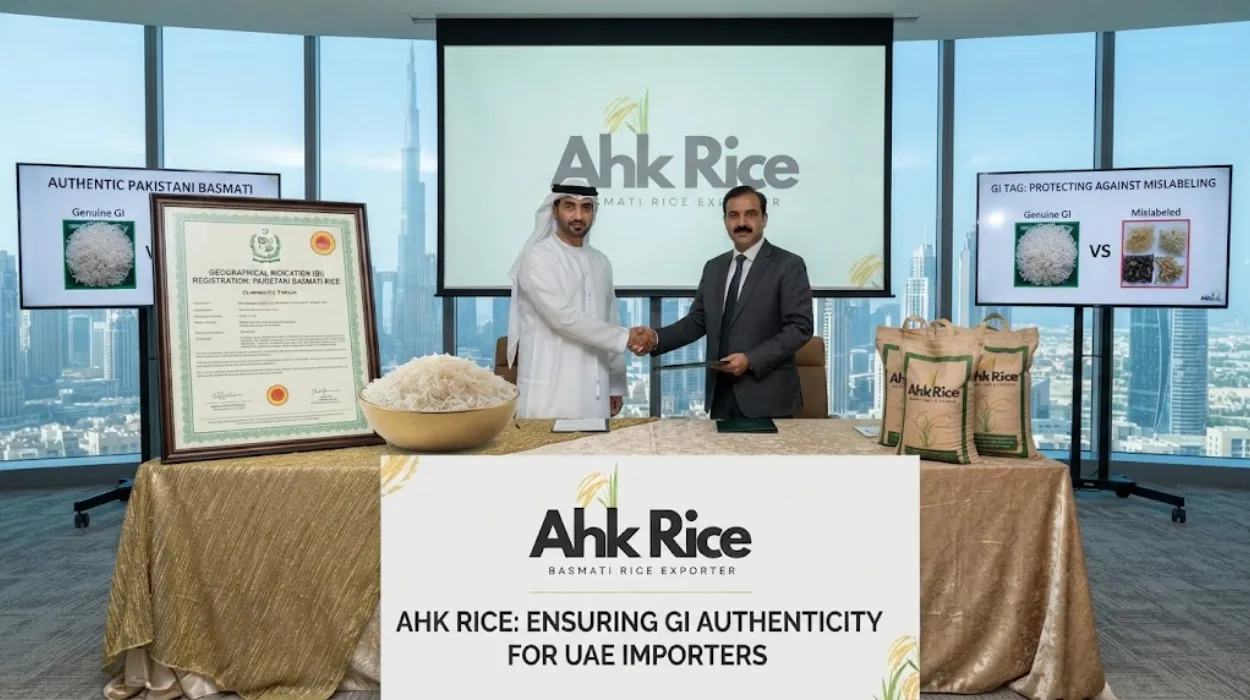
Pakistan’s Basmati GI registration gives UAE importers a stronger origin-verification framework against mislabeled rice. Here is why: Pakistan’s GI system links Basmati to a defined geographical area, product specifications, authorized users, and conformity verification. Trading Corporation of Pakistan verifies export consignments against the Basmati specifications.
UAE importers also need accurate country-of-origin information on imported food packaging. UAE food regulations require origin information to be clear and non-misleading. Labels must also provide required food information in Arabic. For broader context, importers can review the Pakistan rice export documentation requirements for UAE before evaluating suppliers.
What does Pakistan’s Basmati GI registration mean for UAE importers?
Pakistan’s Basmati GI registration connects geographical origin, product specifications, authorized users, and conformity verification. This structure helps UAE importers distinguish documented Pakistani Basmati from rice using the Basmati name without sufficient origin evidence.
A Geographical Indication identifies goods whose quality, reputation, or characteristics are essentially attributable to geographical origin. Pakistan’s Geographical Indications Act 2020 establishes this legal framework. The Act also defines authorized users and a book of specifications.
The Basmati Book of Specifications defines the geographical area and product requirements. It covers Basmati cultivated across designated areas in Punjab, Sindh, Khyber Pakhtunkhwa, Balochistan, and Azad Jammu and Kashmir.
The framework therefore creates several connected entities. These include IPO Pakistan, TDAP, Trading Corporation of Pakistan, authorized users, the geographical area, and the Basmati specifications.
For an importer, this matters because a product name alone does not provide complete traceability. The importer needs evidence connecting the product to its declared origin and specification.
Pakistan’s GI system also provides a regulatory mechanism for inspection and monitoring. Authorized users must comply with the book of specifications. The designated certification body reports compliance and non-compliance information to the relevant authority.
This makes GI verification different from ordinary brand verification. A private brand can identify a seller. A GI framework identifies a protected geographical product and its defined production conditions.
With the GI framework established, the next question is which sourcing solutions provide the strongest protection against mislabeled rice.
What are the available solutions for verifying Pakistani Basmati?
Four controls work together: GI conformity, authorized-user verification, Certificate of Origin, and independent shipment testing. Combining these controls gives UAE importers stronger protection than relying on packaging claims or supplier declarations alone.
GI conformity verification
GI conformity verification checks whether the Basmati shipment follows the registered product specifications and originates from the defined geographical area. Trading Corporation of Pakistan has been appointed to verify Basmati export compliance under Pakistan’s GI framework.
The Basmati specification document states that authenticity certificates are issued by Trading Corporation of Pakistan for export consignments. This creates an official verification layer beyond commercial invoices and packing lists.
Authorized-user verification
Authorized-user verification checks whether a producer or operator has registered to use the geographical indication. Pakistan’s GI Act allows compliant producers and operators to apply for authorized-user registration after the required assent and registration process.
This control is useful during supplier onboarding. The importer can request evidence supporting the supplier’s right to market the product as GI-compliant Basmati.
Certificate of Origin
A Certificate of Origin establishes the declared country of origin for the exported shipment. TDAP states that Certificates of Origin for non-preferential trade are issued by relevant chambers, while TDAP issues electronic certificates for applicable preferential arrangements.
The Certificate of Origin and GI documentation serve different purposes. The COO establishes origin for trade documentation. GI conformity establishes compliance with the protected geographical product framework.
Independent inspection
Independent inspection adds a commercial verification layer before dispatch. Buyers can specify checks for grain length, moisture, broken grains, purity, packaging, weight, and lot identification.
This approach is especially useful for larger UAE consignments. A pre-shipment inspection creates evidence that the loaded shipment matches the approved commercial specification.
With four verification controls available, a specification comparison shows which combination fits each UAE procurement model.
How do different approaches compare for UAE rice imports?
GI verification provides origin protection, while Certificates of Origin establish trade origin and laboratory inspection confirms physical product characteristics. The strongest procurement system combines all three with accurate UAE labeling.
| Attribute | GI Verification | Certificate of Origin | Laboratory Inspection | Supplier Declaration |
|---|---|---|---|---|
| Main purpose | Geographical authenticity | Trade origin | Physical quality | Commercial assurance |
| Origin evidence | Strong | Strong | Limited | Supplier-dependent |
| Product specification | Defined GI specifications | Not primary purpose | Buyer-defined | Contract-defined |
| Mislabelling protection | High | Medium | Medium | Low |
| Physical quality verification | Specification-based | No | Yes | Limited |
| UAE customs usefulness | Supporting evidence | Direct origin document | Compliance support | Limited |
| Best use | Authentic Pakistani Basmati | Customs and trade files | Pre-shipment control | Initial supplier screening |
The comparison shows why one document cannot replace another. GI documentation answers whether the product qualifies under the protected Basmati framework. The Certificate of Origin answers the shipment’s declared country of origin. Inspection answers whether the physical cargo matches the agreed specification.
UAE legislation also requires imported food origin information to be clear and non-misleading. This makes accurate origin documentation important for both customs and downstream food distribution.
Dubai Municipality also states that imported food products are checked to ensure safety and suitability for human consumption. Its food-safety department specifically includes rice products within its monitoring activities.
The practical conclusion is clear. A UAE importer should treat GI evidence, origin documentation, labeling, and physical inspection as separate controls.
With the approaches compared, regional purchasing patterns show how the same verification strategy changes across GCC and European markets.
Which method works best for GCC and European buyers?
GCC buyers should prioritize origin verification, Arabic-compliant labeling, and pre-shipment controls, while European buyers add stronger traceability and residue-control requirements. The product remains Pakistani Basmati, but compliance priorities change by destination.
GCC market: UAE and neighbouring markets
The GCC market strongly values 1121, Super Kernel, and Sella processing formats. UAE importers commonly source rice for retail, wholesale, restaurants, catering, and re-export channels.
Published 2026 market references place premium Pakistani Basmati around $1,135–$1,205 per MT FOB Karachi. Exact pricing depends on variety, processing, packaging, quantity, and specification.
1121 White generally sits around $1,165–$1,205/MT FOB Karachi in current published indications. 1121 Sella sits around $1,135–$1,175/MT. These figures represent origin benchmarks rather than UAE landed prices.
GCC buyers should also compare shelf-life planning. Properly packed Basmati is shelf-stable, but heat, moisture, pests, packaging damage, and poor ventilation reduce commercial quality. AHK Rice market guidance places commercial planning around 12–24 months, depending on grade and storage conditions.
Golden Sella provides stronger grain structure for foodservice and high-volume cooking. Steam provides a different cooked texture and appearance. White Basmati provides the cleanest visual profile for premium retail.
European market: UK and EU channels
European buyers place greater emphasis on traceability, food-safety testing, residue compliance, and documented product identity. Pakistani Basmati therefore requires stronger evidence throughout the supply chain.
Current published Pakistan-origin references place premium 1121 grades around $1,135–$1,205/MT FOB Karachi. European landed costs then add freight, insurance, port charges, customs, clearance, and inland transport.
European buyers also need longer supply-chain planning. Ocean transit, destination clearance, laboratory checks, and distribution create additional time between dispatch and final sale.
A UAE importer mainly needs to prevent origin and labeling errors within a fast-moving Gulf distribution environment. A European importer generally adds more extensive traceability and contaminant controls.
| Market region | Preferred grades | Indicative FOB price | Shelf-life planning | Main verification priority |
|---|---|---|---|---|
| UAE / GCC | 1121 White, 1121 Sella, Super Kernel, 1509 | $1,135–$1,205/MT | 12–24 months | GI, COO, label, inspection |
| UK / EU | 1121 White, 1121 Steam, Super Kernel | $1,135–$1,205/MT | 12–24 months | GI, traceability, testing |
These figures are origin benchmarks, not fixed quotations. Destination charges must be added before comparing landed procurement cost.
The regional comparison shows that GI verification remains useful in both markets, but the surrounding compliance system changes.
What are the pros and cons of GI-compliant sourcing?
GI-compliant sourcing improves origin confidence and traceability, but it does not replace product testing, UAE labeling checks, or commercial inspection. Importers gain stronger evidence when each document performs a defined verification role.
Advantages
- Origin protection: GI controls connect Basmati with a defined geographical area.
- Specification control: The book of specifications defines product requirements.
- Traceability: Authorized-user and certification processes create additional records.
- Mislabelling control: Origin evidence reduces reliance on unsupported packaging claims.
- Buyer confidence: Documented conformity supports procurement and quality review.
Limitations
- Document dependency: GI evidence does not replace physical inspection.
- Label dependency: UAE labeling requirements remain separate from Pakistan’s GI registration.
- Commercial variation: GI compliance does not create one fixed export price.
- Storage risk: GI status does not prevent quality deterioration during poor storage.
- Destination controls: UAE authorities still apply their own import and food regulations.
A simple example explains the distinction. A shipment can have correct Pakistani origin documents but still fail a buyer’s agreed moisture or broken-grain specification. The importer therefore needs both documentary and physical controls.
Another example involves labeling. A package can accurately state Pakistan as the country of origin while still requiring other UAE food-label information. UAE regulations require food information to be clear, true, and available in Arabic.
The correct strategy is therefore layered verification rather than one-document compliance.
What should UAE importers check before buying Pakistani Basmati?

UAE importers should verify GI conformity, authorized-user status, Certificate of Origin, product specifications, labeling, inspection results, and shipment traceability before approving bulk cargo. These factors directly reduce origin and quality disputes.
| Decision factor | What to verify | Buyer outcome |
|---|---|---|
| GI status | Basmati conformity and authorization | Origin confidence |
| Origin document | Certificate of Origin | Customs evidence |
| Product specification | Grain, moisture, broken percentage | Quality consistency |
| Packaging | Origin and required UAE information | Label compliance |
| Inspection | Pre-shipment testing and inspection | Physical verification |
The first factor is GI status. Request evidence showing that the product follows the applicable Basmati specifications and verification process.
The second factor is origin documentation. Request the applicable Certificate of Origin and match its shipment details with the commercial invoice, packing list, and bill of lading.
The third factor is physical specification. Define grain length, moisture, broken percentage, processing type, packing weight, and allowable foreign matter before approving the contract.
The fourth factor is packaging. UAE food rules require country-of-origin information to be clear and non-misleading. Packaging must also meet applicable labeling requirements.
The fifth factor is inspection. Use a pre-shipment inspection process for larger orders and retain the inspection report with the shipment file.
AHK Rice applies this procurement logic across its Pakistani Basmati supply chain. The company supplies 1121, Super Kernel, and 1509 Basmati rice from Punjab and supports processing, custom packaging, documentation, and export logistics.
AHK Rice’s UAE export workflow includes sourcing, milling, sorting, packaging, documentation, final quality checks, loading, and shipment coordination. Its UAE service information identifies the Certificate of Origin, Phytosanitary Certificate, Fumigation Certificate, and Bill of Lading within the export documentation process.
The final decision should therefore focus on evidence rather than the Basmati label alone.
What is the best sourcing strategy for UAE importers?
The strongest UAE sourcing strategy combines GI-compliant Pakistani Basmati, verified origin documentation, approved specifications, compliant labeling, and pre-shipment inspection. This approach separates geographical authenticity from physical quality and customs documentation.
A UAE importer should begin with the exact commercial specification. Define the variety, processing type, grain length, moisture, broken percentage, packaging, quantity, and Incoterm.
The importer should then request supporting origin and GI documentation. Match supplier information, product information, and shipment information across all documents.
Sample approval should follow documentation review. Test the sample for cooking performance, aroma, grain elongation, appearance, and the agreed physical specifications.
Pre-shipment inspection should follow sample approval for larger commercial consignments. The inspection should confirm that the loaded cargo matches the approved sample and contract specification.
Container documentation should then be checked before dispatch. The Certificate of Origin, invoice, packing list, bill of lading, phytosanitary certificate, fumigation documentation, inspection report, and applicable GI evidence should align.
This workflow gives UAE importers a defensible procurement record. It also reduces the risk of buying rice that carries an attractive product description without sufficient origin or specification evidence.
Pakistan exported 808,643 MT of Basmati rice worth US$830.57 million in FY2024–25, showing the scale of the product category and the importance of reliable origin controls. (source: Rice Exporters Association of Pakistan)
For UAE buyers, the key distinction is simple. GI registration protects the geographical identity of Pakistani Basmati. A Certificate of Origin supports the declared country of origin. Inspection verifies the physical cargo. UAE labeling rules govern how the product is presented in the market.
Together, these controls provide a stronger sourcing system than any single certificate.
With the verification framework established, the next procurement step is selecting a supplier that can align GI evidence, product specifications, packaging, inspection, and export documentation in one shipment process.
Frequently Asked Questions
Does Pakistan have GI protection for Basmati rice?
Yes. Pakistan’s Geographical Indications Act 2020 provides the legal framework for GI registration and protection. Basmati has a Book of Specifications defining its geographical area and product requirements.
Who verifies Pakistani Basmati GI compliance?
Trading Corporation of Pakistan is the designated authority responsible for verifying Basmati conformity with the applicable specifications. It also issues authenticity certificates for export consignments.
Does a Certificate of Origin prove GI compliance?
No. A Certificate of Origin establishes declared country of origin for trade purposes. GI conformity establishes compliance with the protected Basmati geographical and product framework. Importers should use both documents where applicable.
Can GI registration prevent mislabeled Basmati in the UAE?
GI registration strengthens origin protection and provides a verification framework. UAE importers should still check packaging, origin documents, product specifications, and applicable UAE food-labeling requirements. UAE rules require origin information to be clear and non-misleading.
What Pakistani Basmati grades suit UAE importers?
1121 White, 1121 Sella, Super Kernel, and 1509 are relevant commercial options. Grade selection depends on retail positioning, foodservice requirements, cooking performance, price target, and storage conditions.
What is the current Pakistani Basmati price per MT?
Published 2026 market references place premium Pakistani Basmati around $1,135–$1,205 per MT FOB Karachi. Exact pricing depends on variety, processing, specification, packaging, quantity, and Incoterm.
How long can Pakistani Basmati be stored?
Commercial shelf life depends on moisture, packaging, warehouse temperature, ventilation, pest control, and stock rotation. Current AHK Rice market guidance uses 12–24 months for commercial planning across suitable Basmati grades and controlled storage.
What documents should UAE importers request?
Importers should request a commercial invoice, packing list, bill of lading, Certificate of Origin, phytosanitary certificate, fumigation certificate, applicable laboratory reports, inspection documentation, and relevant GI authenticity or conformity evidence.
Is GI documentation enough for a UAE rice shipment?
No. GI documentation addresses geographical and product authenticity. UAE importers still need to satisfy applicable food, labeling, customs, phytosanitary, and commercial requirements. UAE legislation specifically addresses truthful origin labeling for imported food.