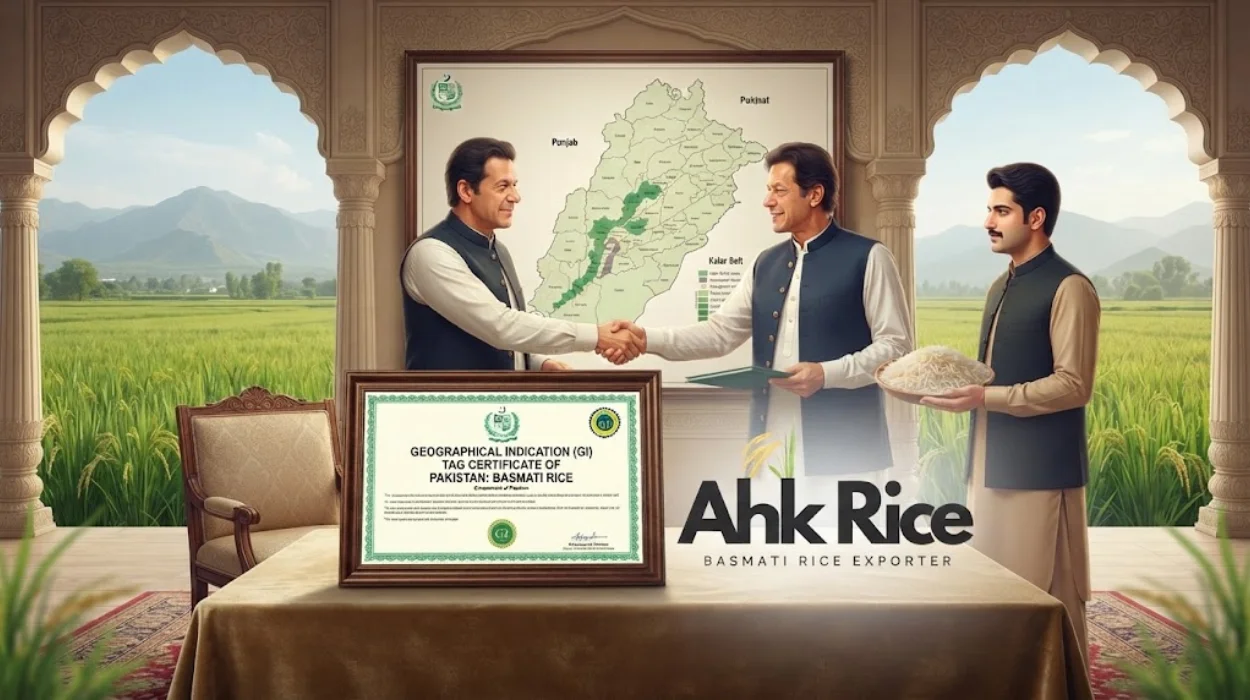
What Is the Basmati Geographical Indication (GI) Tag of Pakistan?
Pakistan registered Basmati rice as a Geographical Indication on January 26, 2021, under its Geographical Indications (Registration and Protection) Act, 2020. Here is why: the GI connects the Basmati name with defined production areas, product characteristics, specifications, verification, and authorized use.
Pakistan’s GI framework gives geographical products legal protection against misleading use. The law defines a GI through geographical origin, quality, reputation, or characteristics linked to that origin. Basmati therefore represents more than a rice name. It identifies qualifying rice connected with Pakistan’s defined geographical production area.
The Basmati registration also establishes a formal system involving the Trade Development Authority of Pakistan (TDAP), the Intellectual Property Organization of Pakistan (IPO-Pakistan), authorized users, certification, and product specifications. This system creates traceability between cultivation, processing, certification, and export.
What is the Basmati GI tag of Pakistan?
The Basmati GI tag is legal protection for qualifying Pakistani Basmati rice produced within the defined geographical area and meeting registered specifications. The registration protects the product name and its connection with Pakistani origin.
A Geographical Indication identifies goods whose quality, reputation, or characteristics relate essentially to a geographical origin. Pakistan’s GI Act applies this principle to agricultural, natural, manufactured, and food products.
Pakistan registered “Basmati” as a GI through its national GI system in January 2021. The registration created a formal legal framework for protecting Basmati against misuse or imitation in Pakistan.
The GI does not mean every rice grain sold as Basmati automatically qualifies. The product must satisfy the applicable Book of Specifications. The specification document defines the geographical area, characteristics, varieties, verification process, and other requirements.
The registered Basmati specification describes the product as long-grain aromatic rice grown and produced in defined parts of the Indo-Gangetic Plains. Its characteristics include slender kernels, aroma, sweet taste, soft texture, and cooking elongation.
With the legal definition established, the next question is how the GI system connects production with authorized commercial use.
How does Pakistan’s Basmati GI registration work?
Pakistan’s Basmati GI system connects geographical production, product specifications, authorized users, inspection, certification, and registration through designated government institutions. Each component establishes a separate control over authenticity and lawful use.
How is Basmati registered?
The Geographical Indications Registry operates under IPO-Pakistan. The GI Act establishes a register containing registered geographical indications, registrants, and authorized users.
TDAP serves as the registrant for Basmati rice. Pakistan designated TDAP for this role under Section 11(2) of the GI Act. TDAP represents the institutional side of Basmati GI registration.
The registration process also uses a Book of Specifications. This document defines the geographical area, product standards, specifications, and qualification process for Basmati.
How does authorization work?
An authorized user must comply with the applicable Basmati specifications. The GI Act gives compliant producers and operators a route to authorized use of a registered GI.
The Basmati specification states that applicants seeking authorized-user status submit their application after formal assent from TDAP. The GI Registrar at IPO-Pakistan then issues the relevant registration certificate to qualifying applicants.
This creates a distinction between owning the GI and using the GI. The registration protects the geographical indication, while authorized users demonstrate compliance with its requirements.
With registration and authorization defined, the next issue is the product specification behind the Basmati name.
What are the key components of Pakistan’s Basmati GI?
Pakistan’s Basmati GI uses geographical area, grain characteristics, aroma, cooking performance, approved varieties, verification, and certification as core specification components. These requirements connect the Basmati name with measurable product attributes.
What grain characteristics define Basmati?
The registered specification sets a minimum pre-cooked milled grain length of 6.50 mm. It sets average grain breadth at 1.90 mm or less. The minimum length-to-breadth ratio is 3.50.
Cooking characteristics also form part of the specification. The minimum average cooked rice length is 12.00 mm. The minimum cooked-to-precooked length ratio is 1.70. The average volume expansion ratio is 3.50.
The specification also identifies 19–26% amylose content, an alkali spreading value of 4–7, soft gel consistency, and non-sticky cooked texture.
What gives Basmati its characteristic aroma?
Basmati aroma comes from a combination of volatile compounds. 2-acetyl-1-pyrroline, commonly called 2AP, is the predominant compound associated with its characteristic fragrance. The specification identifies aroma as a principal Basmati characteristic.
Aroma therefore forms part of product identity rather than serving only as a marketing description. The GI specification connects sensory characteristics with the defined Basmati product.
With the core specifications established, the next question is how the system verifies compliance before export.
How is Pakistani Basmati verified under the GI system?
Trading Corporation of Pakistan verifies Basmati compliance through inspections, traceability documents, product analysis, and authenticity certification for applicable export consignments. This process checks origin and conformity with registered specifications.
Who verifies Basmati?
Trading Corporation of Pakistan (TCP) is the designated authority for verifying Basmati compliance under the registered specification. Its responsibilities include inspection, traceability verification, and authenticity certification.
TCP’s rice inspection process checks documentation showing that the rice originates within the defined geographical area. Trained rice analysts also examine physical characteristics associated with Basmati.
Additional verification uses laboratory testing for specific export requirements. The Basmati specification identifies DNA-based verification through the National Institute of Biotechnology and Genetic Engineering (NIBGE), Faisalabad, for cases requiring additional origin verification.
The Department of Plant Protection handles phytosanitary certification. That certificate addresses plant-health requirements imposed by the importing country. It serves a different function from GI authenticity certification.
With verification explained, the next question is what practical protection the GI provides to producers, buyers, and consumers.
What benefits does Pakistan’s Basmati GI provide?
Pakistan’s Basmati GI protects geographical identity, reduces misleading use of the Basmati name, supports traceability, and strengthens the legal basis for authentic Pakistani Basmati. The framework also supports clearer product differentiation in international trade.
How does the GI protect producers?
GI protection gives compliant producers and operators a legal framework for using the protected geographical indication. The system also creates mechanisms against misleading presentation and unfair competition.
The GI Act specifically provides legal means to prevent uses that indicate or suggest an incorrect geographical origin. It also addresses unfair competition involving geographical indications.
How does the GI help buyers?
Importers gain a stronger origin-verification framework when purchasing qualifying Pakistani Basmati. The GI does not replace laboratory testing, contractual specifications, or import controls. It adds an origin-linked legal and verification layer.
For UAE importers, this distinction matters. A commercial specification can require grain length, broken percentage, moisture, packaging, and other parameters. GI verification addresses the separate question of whether the product qualifies as Pakistani Basmati under the registered framework.
This relationship explains why GI registration has relevance beyond intellectual property. It connects product identity with sourcing and verification.
Where is Pakistani Basmati grown under the GI?

Pakistan’s Basmati GI covers defined production areas connected with the Indo-Gangetic Plains and the product’s established environmental and agricultural characteristics. The specification identifies the geographical area rather than treating all Pakistani farmland as Basmati territory.
The registered specification links Basmati characteristics with natural and human factors. These include soil, water, temperature, humidity, solar radiation, day length, cultivation practices, harvesting, and processing.
The defined area includes districts across Pakistan. The specification lists locations such as Sialkot, Gujranwala, Hafizabad, Lahore, Sheikhupura, Faisalabad, Okara, Sahiwal, Multan, Bahawalpur, and other areas.
Punjab remains central to Pakistani Basmati production. However, the GI specification itself defines the qualifying geographical area through its registered criteria rather than through a simple province-wide label.
With geographical origin established, the next question is how GI protection relates to Basmati processing and export.
How does the GI apply to Basmati processing and export?
GI compliance follows Basmati from qualifying agricultural origin through processing, verification, packaging, and export documentation. Processing does not remove the need to demonstrate geographical origin and specification compliance.
What happens after harvest?
Basmati paddy enters controlled processing after harvest. Processors clean the paddy, dehusk the grain, polish the rice, grade the kernels, and sort foreign material and unwanted fractions.
Different commercial forms include white rice, steam rice, and parboiled forms such as Sella. These processing descriptions identify treatment methods. They do not independently create separate GI rights.
Export consignments also require documentation based on destination requirements. Authenticity certification supports the Basmati origin claim. Phytosanitary certification addresses plant-health requirements.
The GI therefore works alongside normal export controls. It does not replace food-safety certificates, customs documents, contractual specifications, or destination-specific import requirements.
With processing and export separated from GI ownership, the next issue is the common misunderstanding surrounding the term “GI tag.”
What does the Basmati GI tag not mean?
A Basmati GI registration does not mean every Basmati product worldwide receives automatic Pakistani GI protection. GI rights are territorial, so protection depends on the legal system of each destination market.
A GI is not the same as a trademark. A trademark identifies a commercial source or brand. A GI identifies qualifying goods connected with a geographical origin.
A GI is also not a plant-variety registration. Basmati refers to a protected product name under the GI framework. Individual rice varieties have separate agricultural approval and varietal identity systems.
International protection requires another legal step. WIPO explains that GI rights are territorial and do not create one automatic worldwide GI right. Protection abroad therefore depends on national, regional, bilateral, or international mechanisms.
Pakistan’s Basmati GI also does not eliminate the need for buyer-side quality checks. Importers still need commercial specifications, laboratory testing, inspection, packaging compliance, and destination-country documentation.
This distinction is important for international sourcing because GI protection establishes identity, while commercial contracts establish shipment requirements.
Which markets use Pakistani Basmati GI protection?
Pakistani Basmati serves international retail, wholesale, foodservice, and institutional markets, while GI protection strengthens origin recognition within applicable legal systems. Importers still apply their own food, labeling, customs, and quality requirements.
The UAE is a significant market for Pakistani rice. UAE importers source Basmati for retail packs, wholesale distribution, catering, restaurants, and re-export channels.
The United Kingdom also represents an important market for Pakistani Basmati. Importers and retailers commonly differentiate products by variety, processing, grain length, packaging, and origin.
European markets apply additional regulatory controls. The EU has separately examined Pakistan’s Basmati name under its geographical indication framework. The European Commission published the Pakistani Basmati PGI application with defined product characteristics and geographical production criteria.
This international context shows why the Pakistani GI matters. National registration establishes domestic protection, while foreign protection requires the relevant jurisdiction’s legal framework.
What are the common misconceptions about Pakistan’s Basmati GI?
The main misconceptions concern automatic global protection, unrestricted Basmati labeling, and the difference between GI status and commercial quality certification. Each issue has a specific legal or technical distinction.
Does the GI protect Basmati worldwide?
No. GI rights are territorial. Pakistani registration establishes protection under Pakistan’s legal framework. Separate protection applies in foreign jurisdictions under their applicable systems.
Can any Pakistani rice be sold as Basmati?
No. The registered specification defines characteristics, geographical origin, and compliance requirements. Traders using Basmati for rice that fails applicable specifications can face legal consequences under Pakistan’s GI framework.
Does GI certification replace quality inspection?
No. GI verification focuses on geographical origin and compliance with GI specifications. Importers still need food-safety testing, commercial inspection, phytosanitary documents, packaging compliance, and other destination requirements.
Does GI registration guarantee a premium price?
No. A GI establishes protected geographical identity. Market price still depends on grain length, processing type, broken percentage, moisture, packaging, supply conditions, freight, and buyer specifications.
Understanding these distinctions makes the GI system easier to apply during international Basmati sourcing.
Why does Pakistan’s Basmati GI matter to rice importers?
Pakistan’s Basmati GI gives importers an origin-linked legal framework that supports authenticity, traceability, and clearer differentiation between qualifying Pakistani Basmati and mislabeled rice. It strengthens one part of a wider import-control system.
For an importer, GI verification starts with origin. The buyer then evaluates specifications such as grain length, moisture, broken percentage, processing type, packaging, and laboratory results.
For a UAE importer, this distinction is especially useful. A shipment can satisfy commercial specifications while still requiring origin verification for the Basmati designation.
Pakistan’s Basmati GI therefore functions as an identity and protection mechanism. It does not replace commercial due diligence. It strengthens the evidence supporting the product’s geographical identity.
The next stage is understanding how this registration affects a buyer evaluating Pakistani Basmati suppliers and mislabeled rice in the UAE market.
Frequently Asked Questions
What year did Pakistan register Basmati as a GI?
Pakistan registered Basmati rice as a geographical indication in January 2021 under the Geographical Indications (Registration and Protection) Act, 2020. The registration established formal protection through Pakistan’s GI Registry.
Who is the registrant for Pakistani Basmati?
The Trade Development Authority of Pakistan (TDAP) is the registrant designated for Basmati rice under Pakistan’s GI framework. IPO-Pakistan administers the GI Registry.
Who verifies Pakistani Basmati?
Trading Corporation of Pakistan (TCP) is the designated authority for verifying compliance with the Basmati product specifications and issuing applicable authenticity certificates.
What is the minimum Basmati grain length under the specification?
The registered specification sets a minimum pre-cooked milled grain length of 6.50 mm. It also specifies a minimum length-to-breadth ratio of 3.50.
Does Pakistan’s GI tag protect Basmati in the UAE automatically?
No. GI protection is territorial. Pakistani registration does not automatically create worldwide protection. UAE protection depends on the applicable UAE legal framework and any relevant international arrangements.
Does the GI guarantee Basmati quality for every shipment?
No. The GI provides an origin and specification framework. Importers still need shipment-level inspection, laboratory testing, food-safety documentation, packaging checks, and commercial specification verification.
What is the relationship between GI and Basmati authenticity?
The GI links the Basmati name with defined geographical origin and product specifications. Authenticity procedures then verify whether qualifying rice satisfies those requirements before applicable export certification.
Why is the Basmati GI important for UAE importers?
The GI provides an origin-linked framework for distinguishing qualifying Pakistani Basmati from rice that is incorrectly represented as Pakistani Basmati. Importers can combine this framework with inspection, testing, documentation, and contractual specifications.