How Are Rice Processing Facilities Evaluated During Export Audits?
Rice processing facilities are evaluated through a risk-based combination of document review, on-site inspection, food-safety system verification, product testing, traceability checks, corrective-action review, and supplier history. The strongest approach connects physical conditions with records and shipment-specific evidence for export approval.
For Illinois distributors, a factory audit is more useful when it verifies the complete path from paddy intake to container loading rather than reviewing certificates alone. Buyers evaluating a Pakistani Basmati supplier should understand how audit depth affects product consistency, regulatory confidence, and supply continuity. The earlier guide on:
Why Illinois distributors request factory audit documentation should be read first because it explains the buyer-side reasons for requesting this evidence.
In the United States, supplier verification can include on-site audits, sampling and testing, and review of relevant food-safety records under the Foreign Supplier Verification Program (FSVP). FDA states that the appropriate verification activity depends on food risk and supplier performance.
What are the available solutions for evaluating a rice processing facility?
Export audit solutions include customer audits, independent third-party inspections, certification audits, regulatory verification, remote document reviews, and supplier questionnaires. Each method answers a risk question, but an effective program combines documentary evidence with physical verification and product-specific testing before approval.
A customer audit is performed by the importer or its appointed technical team. It evaluates the factory against the buyer’s own specification. This approach works well when an Illinois distributor has strict private-label requirements.
An independent third-party audit uses an external auditor or inspection company. It adds separation between the supplier and verification process. Typical evidence includes photographs, inspection findings, sampling records, corrective actions, and loading observations.
A certification audit evaluates a formal food-safety management system. Relevant frameworks can include HACCP-based systems, ISO 22000, FSSC 22000, BRCGS, or another buyer-accepted scheme. Certification demonstrates system implementation, but the certificate alone does not prove that every shipment meets the buyer’s commercial specification.
A regulatory verification review focuses on destination-market obligations. For U.S. food imports, FSVP places responsibility on the U.S. importer to verify that the foreign supplier produces food in a manner that provides the required level of public-health protection. FDA recognizes audits, testing, and record review as possible verification activities.
A document review examines HACCP plans, sanitation records, pest-control reports, calibration certificates, laboratory results, traceability records, corrective-action reports, and previous audit findings. It is fast but cannot replace physical observation.
How are rice factories inspected during an export audit?
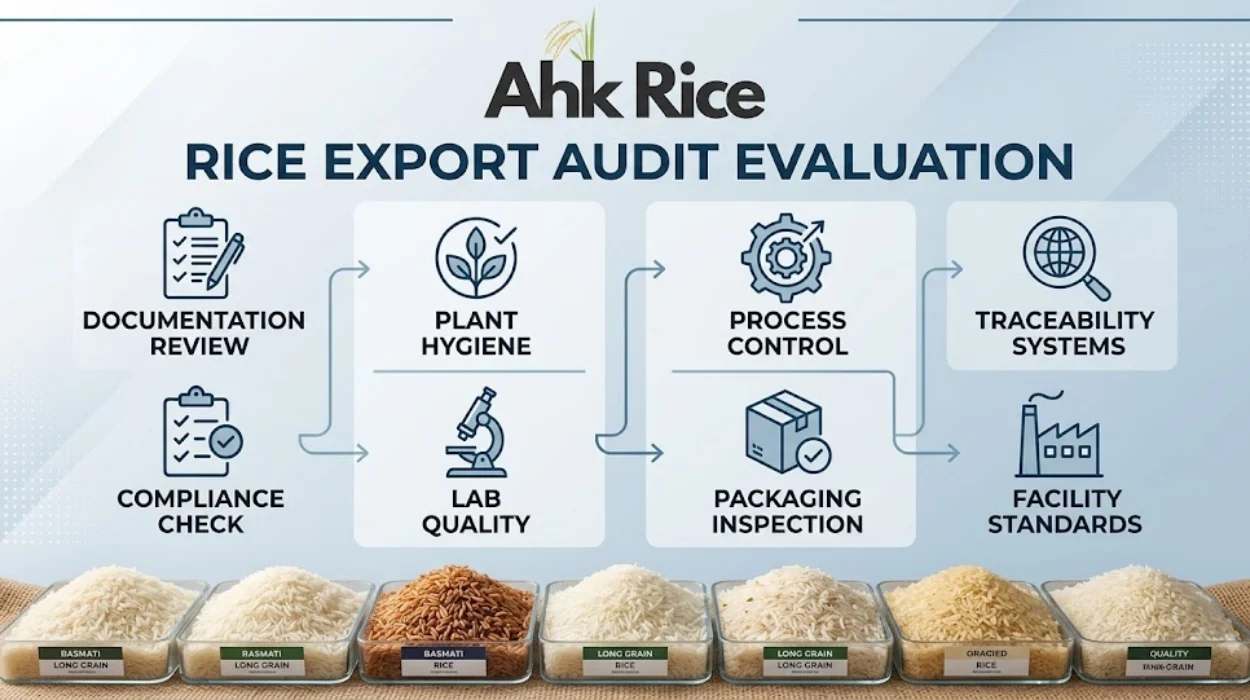
A rice factory audit follows the physical flow of the product and tests whether documented procedures match actual operations. Auditors normally examine raw-material receiving, cleaning, dehusking, whitening, grading, optical sorting, storage, packaging, finished-goods control, and container loading.
Raw paddy receiving and traceability
The auditor verifies supplier identification, intake records, lot coding, moisture controls, and storage conditions. Traceability should connect the incoming paddy to a processed rice batch and ultimately to the exported container.
Cleaning and dehusking
Cleaning equipment should remove stones, dust, straw, and foreign material. Dehusking separates the outer husk from the grain. Auditors examine equipment condition, cleaning schedules, maintenance records, and contamination controls.
Whitening and polishing
For white Basmati, the milling system must remove bran consistently without creating excessive breakage. Auditors compare operating procedures with actual product results. Excessive broken grains can indicate equipment settings, raw-material problems, or inadequate process control.
Grading and length sorting
Grading determines whether the rice meets contracted specifications. For Basmati, auditors may review grain length, broken percentage, foreign matter, chalky grains, damaged grains, and other physical parameters. Optical sorting equipment receives particular attention because it removes discolored or defective grains.
Packaging and finished-product storage
Packaging areas should protect finished rice from moisture, pests, foreign material, and mix-ups. Auditors verify bag specifications, label accuracy, lot identification, sealing, warehouse conditions, and stock rotation.
Container loading
Loading supervision connects factory controls with export execution. Inspectors check container cleanliness, dryness, structural condition, pallet or bag arrangement where applicable, seal numbers, loading records, and product identification.
GFSI benchmarking requirements also distinguish between remote and on-site audit activities. Physical verification of Good Manufacturing Practices and the food-safety management system remains an on-site activity where applicable.
How do different audit approaches compare?
| Audit approach | Physical verification | Documentation depth | Independence | Best use case | Main limitation | Typical evidence |
|---|---|---|---|---|---|---|
| Customer audit | High | High | Medium | Private-label supplier approval | Higher buyer cost | Audit report, photos, CAPA |
| Third-party inspection | High | High | High | High-risk or new supplier | Inspection fee | Inspection report, sampling |
| Certification audit | High | Very high | High | Food-safety system validation | May not match buyer specs | Certificate, audit findings |
| Remote document audit | None | High | Variable | Preliminary screening | Cannot verify factory condition | Records, certificates |
| Product testing | None/limited | Medium | High if independent | Lot quality confirmation | Does not assess factory systems | Lab report |
| Loading inspection | High at shipment | Medium | High if external | Container-risk control | Limited process visibility | Seal, loading report |
| Combined audit program | High | Very high | High | Long-term supplier approval | Highest coordination need | Integrated evidence |
The table shows why one audit method rarely answers every procurement question. A certification audit can verify a management system. A laboratory report can verify a product parameter. A loading inspection can verify shipment condition. None of these alone provides the same evidence as a combined supplier-verification program.
Which market regions require different audit priorities?
U.S. Midwest buyers generally prioritize documented food-safety controls, traceability, contaminant management, consistent 1121 or Super Kernel specifications, and private-label reliability. Middle Eastern buyers place commercial emphasis on 1121 Sella, 1121 Steam, aroma, grain appearance, packing durability, and consistent container loading.
For Illinois and the wider U.S. Midwest, the audit should connect factory controls with U.S. importer requirements. FSVP records can include supplier evaluations, audit results, testing results, corrective-action evidence, and other verification records. FDA also requires covered importers to maintain FSVP documentation and make records available when requested.
For Middle Eastern markets, commercial specifications often place greater attention on parboiled or steam-treated grades, grain appearance, aroma, cooking performance, packaging, and shipment consistency. A supplier audit therefore needs to verify both food-safety controls and the processing parameters behind the contracted grade.
The regional difference does not mean that one market has lower quality expectations. It means buyers weight evidence differently according to regulatory responsibilities, consumer demand, product positioning, and distribution channels.
How do grade preferences affect audit requirements and price?
The audit should match the product grade because processing requirements, buyer expectations, and commercial value change between rice varieties and processing styles. In July 2026, indicative FOB Karachi prices placed 1121 White around $1,165–$1,205/MT and 1121 Steam around $1,160–$1,200/MT.
| Market region | Common Basmati preference | Indicative FOB price reference | Audit priority | Typical commercial shelf-life target* |
| Illinois / U.S. Midwest | 1121 White, 1121 Steam, Super Kernel | $1,160–$1,205/MT for 1121 | FSVP evidence, traceability, testing, labeling | 18–24 months |
| Middle East / Gulf | 1121 Sella, 1121 Steam, Super Kernel | $1,135–$1,200/MT for 1121 | Grade consistency, cooking quality, packing, loading | 18–24 months |
*Shelf life depends on moisture, packaging, storage temperature, humidity, pest protection, processing type, and the manufacturer’s validated specification. It should be confirmed on the product specification and packaging rather than assumed from the rice variety.
The price difference between 1121 grades is not large enough to justify weakening audit controls. A $20–$40/MT price advantage can disappear through rejected cargo, relabeling, claims, demurrage, replacement shipments, or disrupted retail inventory.
Which method works best for different buyer cases?
A facility should be selected according to buyer risk, order frequency, product sensitivity, destination rules, and required evidence. A first-time Illinois distributor needs deeper verification than a repeat buyer with an established supplier history, current certification, and consistent shipment records.
For a first shipment, use a combined audit. Review certificates and food-safety records, conduct an on-site inspection, test representative samples, verify traceability, and supervise loading. This creates a baseline before the first commercial container.
For recurring shipments, use risk-based surveillance. Review updated certificates, corrective actions, laboratory reports, production records, and shipment results. Schedule periodic physical inspections rather than repeating the same complete audit for every container.
For private-label rice, place additional emphasis on packaging control, label accuracy, artwork approval, batch coding, weight verification, and segregation. A factory can produce good rice while still creating commercial risk through incorrect packaging.
For premium 1121 Basmati, verify grain length, broken percentage, purity, moisture, discoloration, and cooking performance. Independent laboratory testing strengthens the physical factory audit.
For a new exporter, do not rely only on a certificate. Review the certificate scope, issuing body, validity, site covered, audit date, non-conformities, and corrective actions. The certificate must correspond to the facility producing the contracted product.
What are the pros and cons of each audit strategy?
The main advantage of a combined audit is evidence coverage. It tests the factory, records, product, and shipment process together. Its main disadvantage is higher time and inspection cost compared with a document-only review.
A customer audit gives the buyer direct control over acceptance criteria. Its disadvantage is travel, technical staffing, and scheduling.
A third-party audit provides greater independence. Its disadvantage is that the auditor must understand both food-safety requirements and the commercial rice specification.
A certification audit provides structured system evidence. Its disadvantage is scope. A certification can confirm that a food-safety management system exists without confirming that every shipment contains the exact contracted grain grade.
A remote document audit is efficient for initial supplier screening. Its disadvantage is obvious: documents cannot prove whether a sanitation procedure is actually followed on the production floor.
Product testing provides objective lot-level evidence. Its limitation is that a compliant sample cannot prove that the entire factory operates consistently.
Loading inspection protects the final shipment stage. It cannot replace process auditing because it occurs after most manufacturing decisions have already been made.
What five decision factors should buyers use when approving a facility?
The most useful audit combines facility inspection, HACCP and preventive-control review, traceability testing, product sampling, calibration checks, sanitation verification, pest-control records, corrective-action evidence, and loading supervision. It converts a factory claim into measurable evidence tied to the contracted rice specification.
| Decision factor | What to verify | Strong evidence |
| Food safety | HACCP, sanitation, pest control, preventive controls | Current audit report and records |
| Traceability | Paddy-to-batch-to-container identification | Tested traceability exercise |
| Product consistency | Grain length, broken percentage, moisture, purity | Independent laboratory report |
| Corrective action | Previous non-conformities and closure | CAPA records with verification |
| Export execution | Packaging, loading, sealing, documentation | Loading report and shipment records |
A sixth practical consideration is audit freshness. A report from several years ago provides less assurance than a current audit supported by recent production and laboratory records.
Another is scope alignment. The audited facility, product category, processing activities, and certification scope should correspond to the rice being purchased.
The final consideration is evidence accessibility. U.S. importers need records that can be retrieved when required. FDA states that FSVP records must be maintained and can be requested for review.
Why is combined factory verification stronger than certificate-only approval?
Combined verification is stronger because certificates demonstrate system conformity while inspections, laboratory tests, traceability exercises, and loading checks demonstrate current operational performance. Buyers therefore evaluate both the management system and the actual rice shipment instead of relying on one document.
For an Illinois distributor, this distinction matters. A Basmati supplier can hold a valid certification and still produce an incorrect grade, use the wrong packaging, experience a traceability failure, or load a container with damaged or contaminated packaging.
The strongest supplier file therefore contains several layers of evidence. These include the facility certificate, latest audit report, corrective-action status, HACCP documentation, laboratory results, product specification, traceability records, packaging approval, and shipment inspection records.
AHK Rice operates an integrated rice processing and export facility in Punjab covering paddy procurement, cleaning, dehusking, whitening, grading, sorting, packaging, documentation, and container loading. Its published product range includes 1121, Super Kernel, and 1509 Basmati grades.
For buyers evaluating:
Audited Basmati rice supply for Illinois distribution, the decision should therefore focus on evidence rather than supplier claims. The practical question is not whether a factory says it is compliant. The question is whether its processes, records, laboratory results, traceability system, and shipment controls prove compliance with the contracted specification.
What should an Illinois distributor request before approving a rice factory?

Buyers should score facilities on food-safety controls, traceability, product consistency, certification status, audit independence, corrective-action performance, documentation quality, and export execution. The decision should favor evidence that is current, lot-specific, independently verifiable, and directly relevant to destination market specific requirements.
A practical supplier-audit package should contain:
- Current food-safety certification and certificate scope.
- Latest external audit report.
- Corrective-action and non-conformity records.
- HACCP or preventive-control documentation.
- Recent laboratory analysis for contracted rice.
- Product specification sheet.
- Traceability procedure and test record.
- Pest-control and sanitation documentation.
- Calibration records for critical measuring equipment.
- Packaging and labeling specifications.
- Pre-shipment inspection evidence.
- Container loading and seal records.
- Export documentation relevant to the shipment.
- Evidence of previous corrective-action closure.
- Contact information for responsible quality personnel.
The goal is not to collect documents for their own sake. The goal is to establish a chain of evidence from facility condition to finished rice to export container.
For Illinois distributors, this approach reduces supplier-approval uncertainty and makes factory evaluation measurable. It also creates a repeatable framework for comparing Pakistani Basmati suppliers across 1121, Super Kernel, and 1509 grades.
Frequently Asked Questions
What is a rice processing facility audit?
A rice processing facility audit evaluates food safety, sanitation, processing controls, traceability, quality management, storage, packaging, and export procedures to determine whether a factory can consistently meet buyer and destination-market requirements.
What documents are checked during a rice factory audit?
Auditors typically review food-safety certificates, HACCP records, sanitation logs, pest-control records, laboratory reports, calibration records, traceability documents, corrective-action reports, product specifications, packaging records, and previous audit reports.
Why is traceability important in rice export audits?
Traceability connects raw paddy to processing batches, finished rice, packaging, and export containers. It allows buyers to identify affected lots quickly when a quality, safety, or documentation issue occurs.
What quality parameters are checked in Basmati rice?
Common parameters include grain length, broken percentage, moisture, purity, foreign matter, chalky grains, damaged grains, discoloration, aroma, and cooking performance. Contract specifications determine the exact acceptance limits.
Are food-safety certifications enough to approve a rice supplier?
No. Certification provides evidence of a formal food-safety management system, but buyers should also review current audit findings, product laboratory results, traceability records, corrective actions, and shipment controls.
What is the difference between a customer audit and a third-party audit?
A customer audit evaluates the factory against the buyer’s specific requirements. A third-party audit is conducted by an independent inspection or certification organization and provides greater separation between supplier and evaluator.
How often should rice processing facilities be audited?
Audit frequency should reflect supplier risk, product risk, shipment history, previous non-conformities, certification status, and destination-market requirements. New or higher-risk suppliers generally require more extensive initial verification.
What does a rice factory audit check before container loading?
Inspectors can verify container cleanliness, dryness, structural condition, packaging integrity, product identification, loading arrangement, seal numbers, quantity records, and documentation before the container leaves the facility.
What should Illinois rice distributors request from Pakistani exporters?
Illinois distributors should request current certifications, audit reports, HACCP or preventive-control documentation, laboratory results, product specifications, traceability evidence, corrective-action records, packaging details, and shipment inspection documentation.