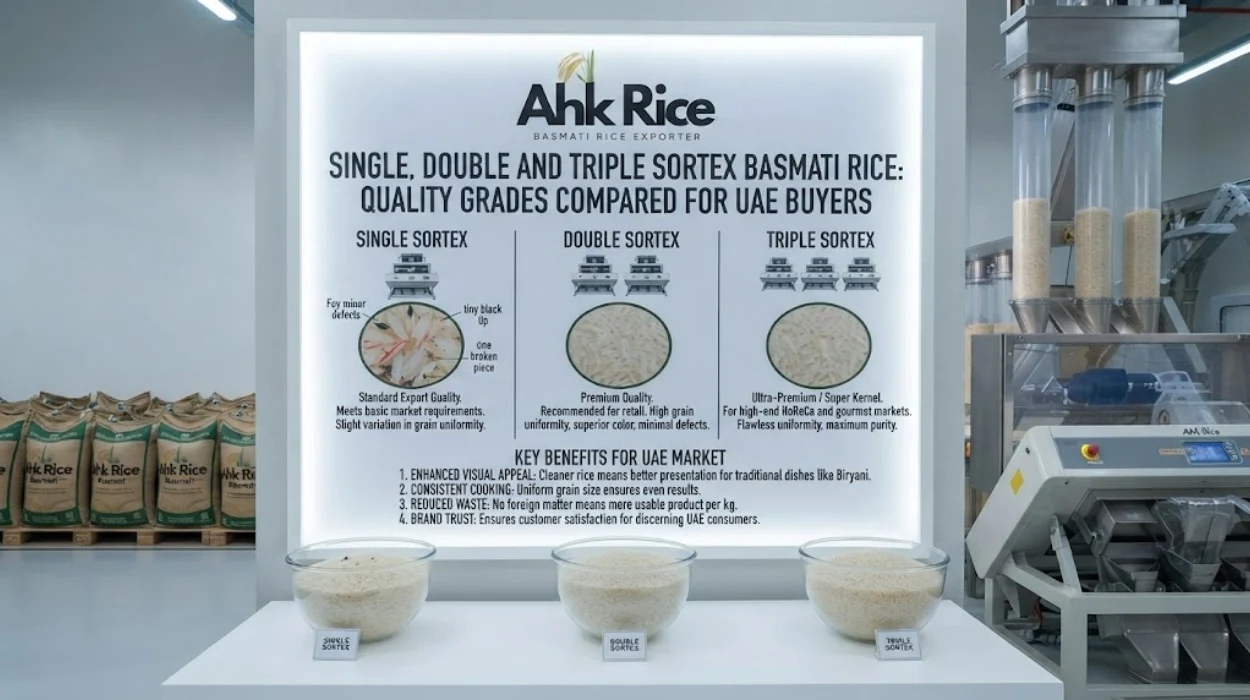
Single, Double and Triple Sortex Basmati Rice: Quality Grades Compared for UAE Buyers
Double Sortex Basmati rice offers a practical balance between visual consistency, processing cost and premium retail presentation, while single Sortex suits value-led distribution and triple Sortex suits stricter appearance requirements. Here is why: each additional sorting pass provides another opportunity to remove discoloured grains and visible impurities. However, buyers must evaluate the finished rice specification rather than relying on the number of passes alone.
UAE importers need to compare colour uniformity, broken-grain percentage, moisture, foreign matter, packaging and landed cost before approving a supplier. This guide to the UAE Pakistani Basmati rice import market explains the wider demand context. The following comparison focuses on processing grades, commercial value and practical purchasing decisions.
What are single, double and triple Sortex Basmati rice grades?
Single Sortex means one optical sorting pass, double Sortex means two passes, and triple Sortex means three passes. These terms describe processing frequency, not separate rice varieties or universally standardised quality grades. The final result depends on machine settings, incoming grain quality and the buyer’s agreed specification.
Sortex is a common trade term for optical colour sorting. The machine uses cameras or sensors to identify grains that differ from acceptable colour or appearance. Air ejectors then remove selected grains from the product stream. Modern optical sorting equipment can also identify certain foreign materials, depending on the system and configuration.
Pakistani Basmati varieties such as 1121, Super Kernel, and 1509 Basmati rice can undergo optical sorting. Their aroma, grain length and cooking characteristics come primarily from the variety and processing method. Sortex passes mainly improve visual uniformity and remove targeted defects.
What does each sorting level provide?
- Single Sortex: One optical pass removes detected off-colour grains and selected visible contaminants. It suits price-sensitive wholesale and foodservice orders with appropriate incoming grain quality.
- Double Sortex: Two passes provide an additional opportunity to remove remaining detectable defects. It suits branded retail packs and distributors seeking consistent appearance.
- Triple Sortex: Three passes allow further inspection and rejection of detectable defects. It suits premium presentation requirements when the extra processing produces a measurable improvement.
A higher pass count does not automatically guarantee lower broken content, better aroma or regulatory compliance. Buyers should approve a representative sample and specify measurable acceptance limits before moving to the cost comparison.
How do single, double and triple Sortex compare?
Double Sortex is the most balanced starting point for premium UAE retail, while single and triple passes suit different cost and appearance targets. Buyers should compare actual defect rates, rejected-grain losses and final inspection results. The table summarises typical commercial differences, not guaranteed performance.
| Attribute | Single Sortex | Double Sortex | Triple Sortex |
|---|---|---|---|
| Optical passes | 1 | 2 | 3 |
| Visual uniformity | Standard, specification-dependent | Higher consistency target | Highest target when additional defects remain detectable |
| Discoloured grains | Removed in one pass | Further removal opportunity | Further refinement opportunity |
| Foreign-material control | Depends on equipment and settings | Additional detection opportunity | Additional detection opportunity |
| Processing cost | Usually lowest | Usually moderate | Usually highest |
| Best-fit channel | Value wholesale and foodservice | Mainstream and premium retail | Appearance-sensitive premium retail |
| Main limitation | More residual defects may remain | Extra pass adds cost | Diminishing returns and additional product loss |
These comparisons assume similar starting material and correctly configured equipment. A clean incoming batch can achieve excellent results with fewer passes. A poor incoming batch can still fail its specification after three passes.
Which quality measurements matter beyond Sortex?
Buyers should specify the following parameters independently:
- Broken grains: Set the maximum broken percentage, such as 2%, according to the product and contract.
- Moisture: Agree on a maximum, commonly around 12–13% for export-oriented Basmati specifications.
- Foreign matter: Define acceptable limits for stones, husk and other extraneous material.
- Discoloured grains: Establish a measurable tolerance for yellow, black or otherwise off-colour kernels.
- Grain length: Specify the variety and agreed average grain length using a consistent measurement method.
- Food safety: Require applicable pesticide-residue, contaminant and import-compliance documentation.
A Sortex pass count cannot replace laboratory testing or an agreed inspection protocol. With the processing differences defined, the next decision is which UAE sales channel benefits from each grade.
Which Sortex method works best for UAE retail, wholesale and foodservice?
Double Sortex generally suits branded UAE retail, single Sortex suits cost-controlled bulk distribution, and triple Sortex suits premium products with demanding appearance specifications. The best choice depends on shelf positioning, buyer expectations, margin and verified sample performance.
UAE premium retail
Double Sortex is a sensible starting specification for 1 kg, 2 kg and 5 kg Basmati packs. Consumers can readily notice uneven colour, visible defects and inconsistent grains through transparent packaging. Retailers also need repeatable quality across replenishment orders.
Triple Sortex is worth evaluating for premium private-label products. It becomes commercially justified when the extra pass measurably improves the approved sample and supports a higher selling price or stricter retail acceptance criteria. A premium label alone does not prove that three passes are necessary.
UAE wholesale and foodservice
Single Sortex can suit restaurants, caterers and wholesalers purchasing larger quantities. These buyers often prioritise cooking performance, grain consistency, cost per serving and reliable availability. The grade still needs to meet the agreed foreign-matter, moisture and broken-grain limits.
Double Sortex works well for distributors serving mixed customer segments. One specification can support regular retail and foodservice demand when buyers value consistent appearance without paying for unnecessary processing.
Which Basmati varieties should UAE buyers consider?
- 1121 Basmati: Suits premium long-grain retail and foodservice applications where grain length and cooked presentation matter.
- Super Kernel Basmati: Suits buyers seeking traditional Pakistani Basmati aroma and a familiar retail profile.
- 1509 Basmati: Suits price-conscious distribution and volume-oriented foodservice programmes.
AHK Rice supplies Pakistani Basmati varieties through its Basmati rice range and export services, with processing, grading and packaging requirements defined around the order. Buyers should confirm the available variety, sorting level and final specifications for each shipment.
The correct variety establishes the product’s market position; sorting then refines its appearance to the agreed standard.
What are the advantages and disadvantages of each Sortex grade?
Single Sortex reduces processing requirements, double Sortex balances appearance and cost, and triple Sortex provides an additional refinement opportunity. Each approach has trade-offs. The commercial value depends on whether the final product meets customer expectations at an acceptable total cost.
Single Sortex: advantages and limitations
Advantages: Lower processing expense and a practical fit for bulk buyers. It can deliver satisfactory appearance when incoming rice is already clean and uniform.
Limitations: One pass offers fewer opportunities to remove residual detectable defects. A batch with inconsistent colour may require additional processing or fail the buyer’s acceptance test.
Example: A foodservice importer buying 25 kg bags can choose single Sortex when a retained sample passes the contract’s appearance and purity limits.
Double Sortex: advantages and limitations
Advantages: A second pass can improve visual consistency and support branded retail presentation. It offers a middle ground between processing expense and appearance requirements.
Limitations: The second pass increases processing cost and can reject additional saleable grains. The improvement varies with incoming quality and equipment settings.
Example: A UAE distributor launching 5 kg private-label Basmati can compare single- and double-Sortex samples before committing to a container order.
Triple Sortex: advantages and limitations
Advantages: An additional pass can help meet stricter visual standards when detectable defects remain after earlier sorting. It suits specifications that reward exceptionally uniform presentation.
Limitations: Extra processing raises costs and can produce diminishing returns. Triple Sortex does not automatically improve cooking quality, aroma, pesticide compliance or shelf life.
Example: A premium retailer can approve triple Sortex only after the supplier demonstrates a meaningful improvement against the double-Sortex control sample.
These trade-offs show why the number of passes should be a purchasing criterion, not the sole definition of quality.
How do Sortex grades affect price per metric ton and shelf life?
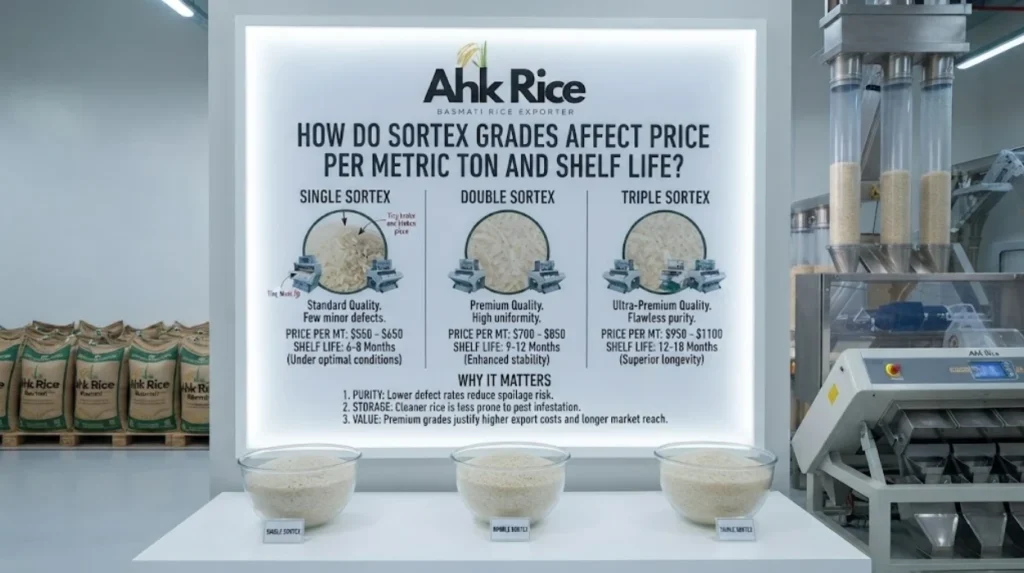
Additional Sortex passes can increase processing costs, but the premium depends on the starting grain, rejected material and order volume. Shelf life depends mainly on moisture, packaging, storage conditions and pest control. Sorting frequency alone does not establish a reliable expiry period.
Indicative price comparison for UAE buyers
As a market reference, published September 2026 Pakistani exporter price lists place several premium Basmati varieties around US$1,135–US$1,205 per metric ton FOB Karachi, depending on variety and processing type (source: PakistanRice.com, September 2026). These are market indications, not quotations for specific Sortex pass counts.
| Grade | Relative price position | Main cost consideration |
|---|---|---|
| Single Sortex | Lowest of the three in a like-for-like comparison | One sorting pass and lower processing input |
| Double Sortex | Moderate | Additional machine time and potential product rejection |
| Triple Sortex | Highest when extra processing is charged | Further machine time, handling and yield loss |
No universal, verified UAE premium exists for each additional pass. Request comparable quotations for the same variety, crop, broken percentage, moisture, packaging, order quantity and Incoterm. Compare FOB Karachi with FOB Karachi, or compare fully calculated landed costs on the same basis.
Does triple Sortex extend shelf life?
No. Sortex primarily improves visible purity and colour consistency. It does not replace moisture control, hygienic handling, pest management or protective packaging.
A properly dried and packed Basmati shipment can retain quality longer than rice stored in humid conditions, regardless of pass count. As a planning reference, commercially packed dry rice often carries a shelf-life target of 12–24 months, depending on the rice type, packaging and validated storage conditions. Buyers must confirm the supplier’s declared shelf life and product-specific evidence.
For UAE storage, specify a dry, clean warehouse, intact packaging and protection from heat, moisture and pests. Confirm the date coding and shelf-life basis before printing retail labels. The best commercial grade therefore combines the required appearance with validated storage and handling controls.
What decision factors should UAE importers use?
Choose Sortex grades through measurable acceptance criteria, not marketing terminology. Importers should compare samples, specifications, landed costs, storage needs and supplier controls. The following framework helps purchasing teams select the appropriate level without paying for processing that provides little measurable value.
| Decision factor | Single Sortex | Double Sortex | Triple Sortex |
|---|---|---|---|
| Sales channel | Bulk and value distribution | Mainstream and premium retail | Strict appearance-led premium retail |
| Incoming grain | Clean, uniform lots | Standard commercial lots | Lots requiring tighter visual refinement |
| Appearance target | Contract-compliant | Consistent retail presentation | Stricter agreed appearance tolerance |
| Cost priority | Highest priority | Balanced priority | Secondary to verified appearance gains |
| Approval method | Sample and defect limits | Side-by-side sample comparison | Demonstrated improvement over double sorting |
Before confirming a shipment, use this practical checklist:
- Define the Basmati variety, crop, processing type and required sorting passes.
- Set limits for moisture, broken grains, foreign matter and discoloured kernels.
- Approve a representative pre-shipment sample against written acceptance criteria.
- Compare itemised FOB or landed quotations on identical commercial terms.
- Verify the required inspection reports, food-safety documents and UAE import requirements.
UAE import compliance must be checked against the current rules for the specific product and shipment. A Sortex certificate alone does not establish compliance with every food-safety requirement.
How should buyers make the final selection?
Double Sortex is the strongest starting point for most premium UAE retail programmes, while single and triple Sortex remain valid for clearly defined commercial needs. The final decision should follow sample approval, specification comparison and cost validation rather than pass count alone.
Choose single Sortex for bulk orders that meet appearance and purity requirements at a competitive price. Choose double Sortex for branded retail and mixed distribution where consistent visual presentation supports the product position. Choose triple Sortex when the buyer’s documented acceptance standard justifies the additional processing expense.
AHK Rice supports Pakistani Basmati sourcing, processing coordination and export preparation for international buyers. Importers should agree on variety, sorting level, measurable specifications, packaging, inspection and shipment terms before placing an order. This approach connects product quality with the actual expectations of UAE retail and foodservice customers.
FAQs about Single, Double and Triple Sortex Basmati Rice
What is the difference between single, double and triple Sortex rice?
Single Sortex rice passes through optical sorting once, double Sortex twice, and triple Sortex three times. Additional passes provide further opportunities to remove detectable off-colour grains and impurities. Final quality depends on the incoming rice and the agreed specification.
Which Sortex grade is best for UAE supermarkets?
Double Sortex is a practical starting point for UAE supermarkets seeking consistent colour and presentation. Triple Sortex suits stricter appearance requirements, while single Sortex can serve value-led products. Buyers should compare approved samples before selecting a grade.
Does triple Sortex Basmati rice cost more?
Triple Sortex can cost more because it requires additional machine time, handling and potentially greater product rejection. The actual premium depends on the supplier’s processing setup, raw material quality and order volume. Request comparable quotations for all three grades.
Does double Sortex improve Basmati rice cooking quality?
Double Sortex primarily improves visual uniformity and removes targeted defects. Cooking quality depends more on the Basmati variety, grain condition, ageing, milling and preparation. Buyers should conduct cooking tests alongside visual inspections.
What specifications should UAE importers request?
UAE importers should request the variety, grain length, broken percentage, moisture limit, foreign-matter tolerance, discoloured-grain limit, packaging details and sorting level. They should also confirm applicable food-safety documentation, inspection requirements and shipment terms.