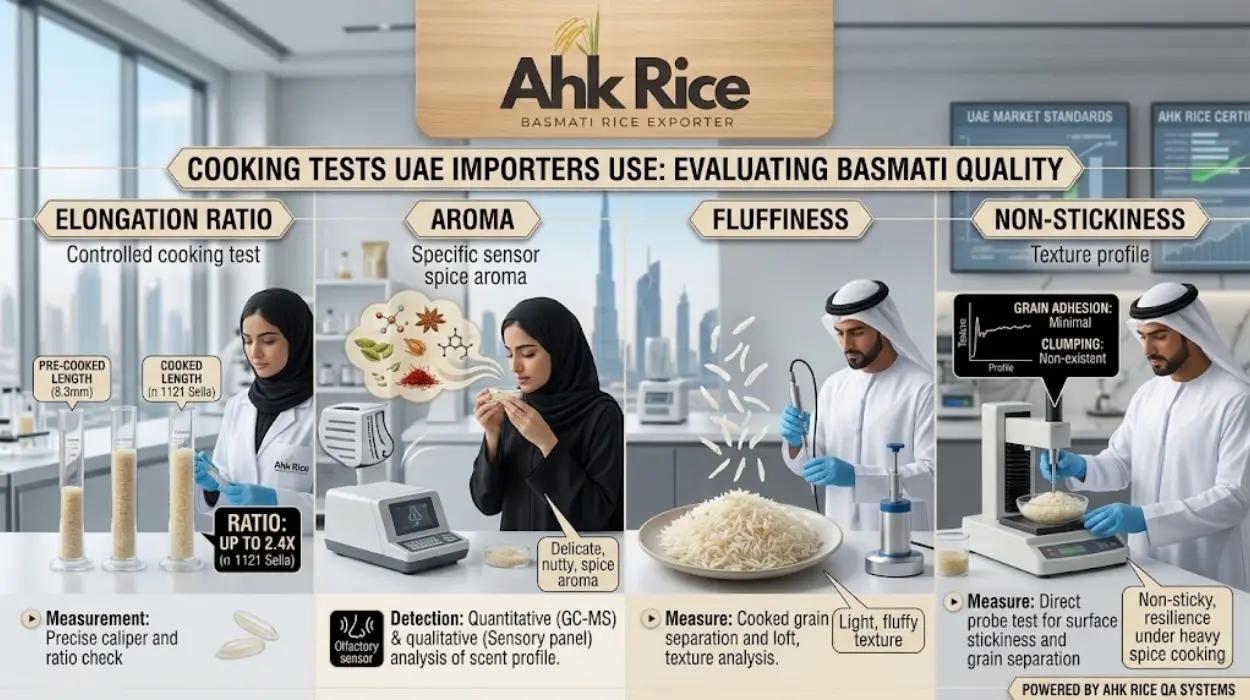
Cooking Tests UAE Importers Use: Elongation Ratio, Aroma, Fluffiness and Non-Stickiness
UAE importers should evaluate Pakistani Basmati rice through standardized cooking tests that measure grain elongation, aroma, fluffiness, and non-stickiness, because these four characteristics determine product suitability for retail, restaurants, catering, and wholesale distribution. Comparing 1121, Super Kernel, and 1509 Basmati rice under identical cooking conditions helps buyers select grades that match customer expectations and commercial requirements.
Importers assessing Pakistani Basmati rice should first understand how cooking quality, grain characteristics, and export grades influence Basmati selection. A consistent evaluation process connects raw grain specifications with cooked performance, allowing buyers to compare commercial samples before approving a purchase order. UAE buyers also need to consider processing type, moisture, broken-grain percentage, packaging, storage conditions, and the intended cooking application.
AHK Rice is a trusted Pakistani Basmati rice exporter based in Punjab, supplying 1121, Super Kernel, and 1509 varieties to more than 15 countries. Its end-to-end processing, custom packaging, and export coordination support buyers evaluating rice for UAE distribution. A structured sample assessment helps importers establish acceptance criteria before confirming shipment specifications.
What cooking tests should UAE importers use to evaluate Pakistani Basmati rice?
UAE importers should assess four primary cooking characteristics: elongation ratio, aroma, fluffiness, and non-stickiness. They should also inspect cooked grain integrity, colour, tenderness, and consistency across samples. Standardized water ratios, cooking times, and resting periods make comparisons more reliable.
Each test measures a different aspect of cooking performance. Elongation measures the change in grain length after cooking. Aroma evaluates the characteristic fragrance associated with Basmati rice. Fluffiness describes the separation and lightness of cooked grains, while non-stickiness measures how well grains remain separate rather than forming clumps.
Importers should use the same preparation protocol for every variety. They should record the raw grain condition, washing procedure, soaking duration, water quantity, cooking method, and resting time. These controls prevent preparation differences from distorting the comparison.
A practical test should include a representative sample of each candidate grade. Buyers can compare 1121, Super Kernel, and 1509 rice using the same equipment and observation criteria. The resulting records provide a clearer basis for approving a commercial sample and establishing shipment specifications.
What is the elongation ratio, and how should buyers measure it?
The elongation ratio compares cooked grain length with uncooked grain length. Buyers measure representative grains before and after cooking, then divide the average cooked length by the average raw length. The result indicates longitudinal expansion under the selected cooking conditions.
For example, a raw grain measuring 8.0 mm that reaches 16.0 mm after cooking produces an elongation ratio of 2.0. A grain reaching 20.0 mm produces a ratio of 2.5 under that test. These examples illustrate the calculation, not guaranteed performance for a particular rice variety.
Buyers should measure at least 20 to 30 representative grains per sample and calculate average raw and cooked lengths. They should use the same measuring instrument and avoid selecting only the longest grains. The sample should represent the commercial lot rather than a few visually impressive kernels.
The result depends on variety, processing, grain condition, soaking, water absorption, and cooking technique. A reported ratio therefore requires a documented test method. Importers should also inspect grain breakage because long cooked grains lose commercial value when many kernels split or fragment.
How do aroma tests identify suitable Basmati rice for the UAE market?
Aroma testing evaluates the characteristic fragrance released during cooking and immediately after opening the cooking vessel. Buyers should compare samples at consistent temperatures and cooking stages, recording fragrance intensity, characteristic Basmati notes, and any undesirable odours.
Basmati aroma is associated with volatile compounds, including 2-acetyl-1-pyrroline. The compound contributes to the distinctive popcorn-like fragrance associated with aromatic rice. Perceived aroma also depends on rice variety, storage history, processing, and freshness.
A practical assessment begins with dry-grain inspection. Buyers record whether the sample has a clean, characteristic smell or any musty, stale, or foreign odour. They then cook equal quantities in separate, clean vessels using identical preparation conditions.
After cooking, evaluators open each vessel and assess the aroma without adding spices, stock, oil, or other ingredients. Plain-water cooking helps isolate the rice’s natural fragrance. A simple rating scale from 1 to 5 can document intensity, while separate notes record aroma quality and undesirable odours.
Aroma should not be the sole acceptance criterion. Strong fragrance does not automatically establish superior grain integrity, cleanliness, or cooking consistency. UAE importers should combine sensory results with supplier specifications and applicable food-safety documentation.
How should importers test fluffiness and non-stickiness?

Fluffiness and non-stickiness should be evaluated by examining grain separation, surface condition, and texture after cooking and resting. Buyers should gently transfer the cooked rice onto a plate, separate it with a fork, and record clumping, breakage, and softness.
Fluffiness describes the light, separated appearance of cooked rice. Non-stickiness describes the tendency of individual grains to remain separate rather than adhering into compact masses. Both characteristics matter to restaurants, caterers, and retailers serving customers who expect distinct Basmati grains.
Importers should inspect the rice immediately after cooking and again after a standardized resting period, such as five minutes. They should note whether the grains remain elongated and separate or become sticky and compressed. Photographs taken under consistent lighting help document differences between samples.
Excessive stickiness can result from several factors, including starch on the grain surface, broken kernels, unsuitable water quantities, overcooking, or inadequate rinsing. A sample that performs poorly under one method should be retested using the agreed protocol before the buyer rejects the grade.
The test should also include texture. Rice that remains separate but feels excessively hard does not meet every foodservice requirement. Likewise, very soft rice that forms clumps may be unsuitable for dishes requiring clearly separated grains.
What are the available solutions for testing rice before import?
UAE importers can choose between standardized in-house cooking tests, supplier-provided commercial samples, independent laboratory assessments, and third-party pre-shipment inspections. Each approach serves a different purpose, from initial screening to documented verification before cargo dispatch.
Four approaches provide a practical evaluation framework.
1. In-house comparative cooking tests
Importers cook competing varieties using their own kitchen equipment and preferred recipes. This method works well for restaurant groups, distributors, and foodservice buyers who need to understand performance in actual operations.
Its main advantage is direct relevance to the buyer’s cooking process. Its limitation is the risk of inconsistent preparation between testers or locations.
2. Supplier-provided commercial samples
Suppliers provide representative samples for assessment before the buyer confirms a bulk order. Buyers can evaluate grain length, cooking performance, packaging requirements, and suitability for their target segment.
A sample should identify the variety, processing type, declared specifications, and relevant batch details. Importers should confirm whether the sample represents the grade intended for the commercial shipment.
3. Independent laboratory testing
Laboratories can assess applicable physical, chemical, and food-safety parameters using recognized methods. Depending on the testing scope, these may include moisture, broken-grain percentage, foreign matter, and relevant contaminant analysis.
Laboratory testing does not replace sensory cooking evaluation. It complements it by measuring characteristics that visual inspection and tasting cannot establish reliably.
4. Third-party pre-shipment inspection
A third-party inspector checks the cargo against agreed purchase specifications. Inspection can cover representative sampling, packaging, labelling, quantity, grain quality, and documentation.
This approach is especially useful for large orders or transactions requiring independent verification. Buyers should agree on sampling procedures, tolerances, and corrective actions before the inspection takes place.
How do 1121, Super Kernel, and 1509 compare in cooking tests?
1121 generally suits buyers prioritizing long cooked grains and premium presentation. Super Kernel suits aromatic Basmati buyers seeking traditional grain character and balanced commercial value. 1509 suits buyers evaluating long-grain presentation, yield economics, and price-sensitive distribution. Actual results require sample testing.
The three varieties serve overlapping but distinct commercial objectives. Their performance varies with grade, processing method, storage, and preparation conditions. Buyers should avoid approving a variety based only on its name or raw grain length.
| Attribute | 1121 Basmati | Super Kernel Basmati | 1509 Basmati |
|---|---|---|---|
| Main selection priority | Long cooked-grain presentation | Traditional aroma and balanced value | Yield and price competitiveness |
| Raw grain profile | Long-grain variety | Traditional aromatic grain | Long-grain variety |
| Elongation evaluation | Measure expansion and grain integrity | Measure expansion and consistency | Measure expansion and consistency |
| Aroma evaluation | Record characteristic fragrance | Assess traditional Basmati aroma | Assess fragrance in the selected grade |
| Fluffiness | Check separation and cooked length | Check separation and texture | Check separation and texture |
| Processing options | White, Steam, Sella, depending on supply | Confirm available processing specification | White, Steam, or Sella, depending on supply |
| Typical commercial fit | Premium retail and foodservice | Ethnic retail and South Asian distribution | Value-conscious wholesale and foodservice |
These descriptions indicate selection priorities, not guaranteed sensory scores. Buyers should request the precise processing type and grade before testing because white, Steam, and Sella rice can perform differently under the same cooking protocol.
For commercial approval, the buyer should record the raw grain specification, cooking results, acceptable broken-grain percentage, moisture limit, packaging format, and final acceptance criteria. The supplier should use these agreed requirements to prepare the shipment specification.
How do UAE retail and foodservice requirements differ?
UAE retail buyers generally prioritize repeatable cooking results, attractive cooked-grain appearance, aroma, and performance across household preparation methods. Foodservice buyers place greater emphasis on batch consistency, serving volume, holding performance, and suitability for biryani, pulao, and catering operations.
Retail and supermarket distribution
Retail importers need products that deliver predictable results across different household kitchens. Consumers may use electric rice cookers, saucepans, or pressure cookers, so buyers should test more than one common preparation method when the product targets a broad customer base.
Premium retail lines often prioritize 1121 for elongated presentation. Super Kernel can suit customers seeking traditional Basmati character, while 1509 can serve segments where competitive pricing is important. Packaging, shelf presentation, label compliance, and batch consistency also influence product selection.
Retail buyers should conduct repeat tests rather than relying on a single successful cooking session. Consistent results across multiple portions provide stronger evidence of commercial suitability.
Restaurants, catering, and institutional foodservice
Foodservice operators need rice that matches their menus, kitchen equipment, and service schedules. Biryani restaurants may prioritize grain length and separation, while high-volume catering operations also consider cooking yield, handling, and holding performance.
Steam and Sella processing should be evaluated against the actual menu. Buyers should test the selected rice in plain-water cooking first, then prepare a representative dish to check its practical performance. Spices and cooking fats can mask aroma differences, so the plain-rice test remains important.
Foodservice importers should also test cooked rice after the normal service holding period. The objective is to determine whether grains maintain the required texture and separation under actual operating conditions.
How should buyers compare price per metric ton and shelf life?
Buyers should compare supplier quotations on the same commercial basis and evaluate shelf life using documented storage conditions, packaging, and supplier guidance. FOB and CIF prices are not directly comparable without accounting for freight, insurance, destination charges, and other applicable costs.
The following table provides an evaluation structure rather than a live market quotation.
| Comparison factor | 1121 | Super Kernel | 1509 |
|---|---|---|---|
| Price per MT | Obtain a current grade-specific quote | Obtain a current grade-specific quote | Obtain a current grade-specific quote |
| Price drivers | Processing, grain quality, packaging, volume | Aroma, grade, broken percentage, packaging | Processing, grade, quantity, destination |
| Shelf-life verification | Check packaging and storage declaration | Check packaging and storage declaration | Check packaging and storage declaration |
| Cooking consistency | Test multiple portions | Test multiple portions | Test multiple portions |
| Commercial comparison | Premium presentation and market positioning | Aroma and balanced value | Cost efficiency and target-market fit |
No single price per metric ton applies to every grade. Buyers should request quotations with the same variety, processing type, broken percentage, moisture specification, bag size, order quantity, and Incoterm.
Shelf life also depends on the product’s condition and storage environment. Dry rice stored in clean, dry, pest-controlled conditions generally maintains quality better than rice exposed to moisture, heat, or damaged packaging. Importers should follow the supplier’s declared shelf-life guidance and applicable UAE labelling requirements rather than assuming that all varieties share one fixed shelf life.
Which cooking-test method works best for different buyers?
A standardized cooking test combined with commercial sample approval provides the strongest starting point for most UAE importers. Independent laboratory testing and pre-shipment inspection add verification when food-safety requirements, contract value, or buyer risk justify additional controls.
The best approach depends on the buyer’s purchasing objective. A restaurant testing a new menu ingredient needs direct kitchen performance data. A retail importer needs repeatability, packaging suitability, and consumer-facing quality. A large distributor needs documented specifications and effective controls before shipment.
| Buyer situation | Recommended method | Main decision |
|---|---|---|
| Initial supplier screening | Standardized side-by-side cooking | Shortlist suitable varieties |
| Premium retail launch | Repeat cooking tests and sample approval | Confirm appearance, aroma, and consistency |
| Restaurant or catering supply | Kitchen trials and holding tests | Verify menu and service suitability |
| Large-volume import | Sample approval plus independent inspection | Reduce shipment-quality disputes |
| Food-safety-sensitive procurement | Cooking tests plus relevant laboratory analysis | Verify sensory and measurable requirements |
Importers should not treat a successful cooking test as proof of complete food-safety compliance. Sensory evaluation, laboratory analysis, and cargo inspection answer different questions. A documented procurement process combines the relevant evidence before the buyer approves a commercial shipment.
What factors should UAE importers include in their final decision?
Importers should assess cooking performance alongside grain specifications, processing method, food-safety documentation, price, packaging, supplier consistency, and shipment terms. A clear acceptance sheet converts subjective preferences into measurable criteria that buyers and suppliers can follow.
Use the following five-factor decision framework before confirming an order.
| Decision factor | What to verify | Why it matters |
|---|---|---|
| Cooking performance | Elongation, aroma, fluffiness, non-stickiness | Confirms suitability for the intended menu or customer |
| Physical specifications | Grain length, broken percentage, moisture, purity | Establishes the agreed commercial grade |
| Compliance | Applicable certificates, laboratory reports, import documentation | Supports regulatory and contractual requirements |
| Commercial terms | Price per MT, Incoterm, quantity, packaging, payment | Makes supplier quotations comparable |
| Shipment control | Sample-to-order consistency, inspection, loading records | Connects approved quality with delivered cargo |
The acceptance sheet should identify the sample, variety, processing type, testing conditions, measured results, and buyer-approved tolerances. Both parties should retain the approved reference and confirm how any material difference in the shipment will be handled.
For ongoing supply, buyers should repeat the same assessment when the grade, processing specification, or source lot changes. This approach supports consistent purchasing decisions without requiring importers to rely solely on supplier descriptions.
Frequently asked questions
What is a good elongation ratio for Pakistani Basmati rice?
An elongation ratio of 2.0 means the cooked grain is twice its original length. Some premium Basmati products target greater expansion, but acceptance depends on the variety, processing type, test method, and buyer specification. Importers should set their threshold after evaluating representative samples.
Does a higher elongation ratio always mean better rice?
No. Elongation must be assessed alongside grain integrity, aroma, texture, and separation. A sample with long cooked grains can still fail if many kernels break or the rice becomes excessively soft or sticky.
How can UAE importers compare Basmati aroma fairly?
Cook equal quantities of each sample in clean vessels using the same water ratio and preparation method. Evaluate the fragrance immediately after cooking without spices or sauces, and record aroma intensity and any undesirable odours.
Which Pakistani Basmati variety is best for UAE restaurants?
The best variety depends on the menu, required presentation, purchasing budget, and cooking process. 1121 suits buyers prioritizing elongated grains, Super Kernel suits traditional aromatic Basmati applications, and 1509 suits buyers comparing long-grain presentation with commercial cost efficiency.
Should importers test Steam and Sella rice separately?
Yes. Steam and Sella are different processing types, and their cooking behaviour can differ. Buyers should request the exact processing specification and test each sample using consistent conditions before approving a purchase.
Can a cooking test replace laboratory testing?
No. Cooking tests assess sensory and practical performance. Laboratory testing verifies applicable measurable parameters, including selected quality and food-safety criteria. Importers should use both when the purchase specification or regulatory requirements call for them.
How should importers confirm that bulk rice matches an approved sample?
They should document the approved sample’s grade, processing type, physical specifications, and cooking results. They should then agree on representative sampling, inspection requirements, and acceptable tolerances for the commercial shipment before loading.