What Is Basmati Rice Purity?
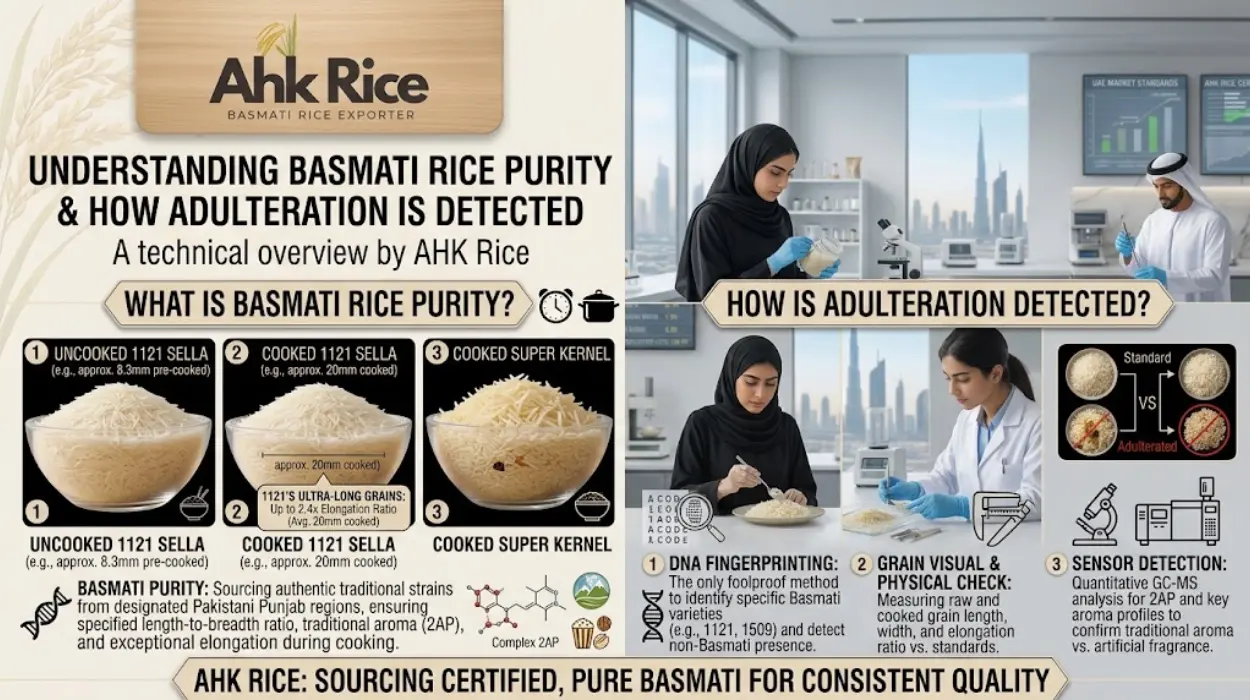
Basmati rice purity is the proportion of genuine Basmati grains in a rice batch, assessed through variety identity, physical characteristics, and laboratory testing. It helps buyers distinguish authentic Basmati from mixtures containing other rice varieties, broken grains, or foreign material.
Basmati is a group of aromatic, long-grain rice varieties associated with the traditional growing regions of the Indian subcontinent. Pakistani Basmati is cultivated mainly in Punjab, where climate, soil conditions, agricultural practices, and local varieties contribute to its characteristic aroma and grain properties.
Purity has several dimensions. Varietal purity measures whether the rice belongs to the declared variety. Physical purity evaluates unwanted material, including stones, husks, weed seeds, and other foreign matter. Commercial grade compliance checks characteristics such as broken-grain percentage, moisture content, grain length, and milling quality.
These measurements are related, but they are not interchangeable. A shipment can contain clean, whole grains and still fail a varietal purity test if it includes another rice variety. Likewise, genuine Basmati can contain excessive broken grains or moisture and fail the buyer’s commercial specification.
A reliable assessment therefore combines the declared variety, contractual specifications, physical inspection, and appropriate analytical tests.
How Is Basmati Rice Grown and Processed Before Purity Testing?
Basmati rice purity begins with variety selection and continues through cultivation, harvesting, milling, grading, and packing. Each stage affects grain identity, physical quality, traceability, and the risk of mixing with other varieties during commercial handling.
Cultivation and harvesting
Farmers select seed according to the intended variety, growing conditions, and market requirements. In Pakistan, important Basmati-producing districts include Hafizabad, Sheikhupura, Gujranwala, Narowal, and Sialkot.
Harvesting takes place when the crop reaches suitable maturity. Harvested paddy contains the outer husk and requires drying before milling. Separate handling of different varieties helps prevent accidental admixture.
Drying and milling
Processors control moisture during drying to reduce the risk of deterioration during storage. Milling removes the husk and bran layers to produce the specified rice form.
The main commercial forms include white rice, steamed rice, parboiled rice, and brown rice. Steam processing and parboiling use different treatments, so the final appearance and cooking behaviour differ.
Grading and packing
Screens, length graders, colour sorters, and other equipment separate grains according to physical characteristics. Optical sorting removes discoloured grains and selected foreign material.
Processors then pack rice in bags suited to retail, wholesale, or institutional distribution. Clean equipment, identified storage areas, batch records, and controlled transfers reduce cross-contamination between varieties.
Purity testing verifies the resulting batch. It does not replace process controls, because a laboratory sample represents only the material tested.
What Are the Key Components of Basmati Rice Purity?
Basmati rice purity assessment examines varietal identity, grain dimensions, physical cleanliness, moisture, broken-grain percentage, and processing consistency. Each component measures a different quality attribute, so buyers need defined acceptance limits rather than relying on appearance or a single laboratory result.
The key components include:
- Varietal identity: Confirms whether grains match the declared variety, such as 1121, Super Kernel, or 1509 Basmati.
- Grain length and shape: Measures raw grain dimensions, slenderness, and uniformity. Long grain alone does not establish Basmati authenticity.
- Broken-grain percentage: Measures the proportion of fragments against the agreed grading method. A batch containing genuine Basmati can still exceed the buyer’s broken-grain limit.
- Moisture content: Measures water present in the rice. Moisture affects storage stability and must meet the contract’s specification.
- Foreign matter: Includes stones, husk fragments, weed seeds, and other material that does not belong in the finished rice.
- Processing consistency: Evaluates milling quality, colour uniformity, and the presence of damaged or discoloured grains.
- Aroma and cooking characteristics: Assesses characteristic fragrance, texture, and grain elongation under a controlled cooking procedure.
These components support different decisions. Physical measurements establish grade compliance, while DNA-based methods address genetic identity. Sensory and cooking tests provide additional evidence about eating quality.
How Is Basmati Rice Adulteration Detected?
Basmati rice adulteration is detected through representative sampling, visual inspection, physical measurements, and laboratory analysis. DNA-based testing identifies genetic differences between varieties, while conventional tests assess grain characteristics, foreign material, moisture, and other contractual quality parameters.
1. Representative sampling
An inspector collects samples from different bags or locations within a shipment. The samples are combined or tested separately according to the inspection plan.
Sampling matters because a small handful cannot reliably represent an entire container. Sealed, labelled samples preserve traceability and support independent verification if the buyer disputes the results.
2. Visual and physical examination
Inspectors examine grain shape, length, colour, broken fragments, and foreign material. Image analysis and calibrated measuring equipment improve consistency when evaluating large batches.
These methods identify suspicious differences but cannot conclusively authenticate every variety. Several non-Basmati long-grain varieties resemble Basmati in appearance.
3. DNA-based variety identification
DNA testing examines genetic markers that distinguish rice varieties. Laboratories extract DNA from the sample and analyse selected markers using validated molecular methods, such as polymerase chain reaction (PCR).
The laboratory compares the resulting genetic profile with reference material. Depending on the method, it identifies a declared variety, detects another variety, or estimates the presence of an admixture.
4. Laboratory quality testing
Laboratories measure moisture, broken grains, foreign matter, and other parameters specified in the purchase contract. Separate chemical or food-safety analyses assess relevant contaminants and residues.
A DNA result does not automatically establish food safety. Equally, a satisfactory chemical analysis does not prove varietal authenticity. Each test answers a different question.
5. Documentation and result verification
The inspector records the sample identity, batch number, test method, laboratory findings, and applicable acceptance criteria. Buyers compare the results with the agreed specification before approving the shipment.
What Are the Benefits of Testing Basmati Rice Purity?
Purity testing reduces the risk of variety misrepresentation, inconsistent cooking performance, contractual disputes, and rejected shipments. It gives importers documented evidence for purchasing decisions, quality assurance, supplier evaluation, and traceability across retail, wholesale, and foodservice supply chains.
Testing offers several practical benefits.
- Product authenticity: Helps distinguish the declared variety from similar-looking rice.
- Consistent cooking performance: Supports predictable grain elongation, texture, and aroma when combined with cooking tests.
- Commercial protection: Helps buyers identify non-conforming batches before shipment acceptance.
- Retail confidence: Supports accurate product descriptions and quality specifications.
- Supplier accountability: Creates a documented basis for investigating differences between samples and delivered goods.
- Traceability: Connects laboratory results to identifiable lots, processing records, and shipment documents.
These benefits depend on a suitable sampling plan and a validated test method. A certificate without a clear sample identity, test scope, or acceptance standard provides limited assurance.
Which Basmati Rice Grades Require Purity Checks?
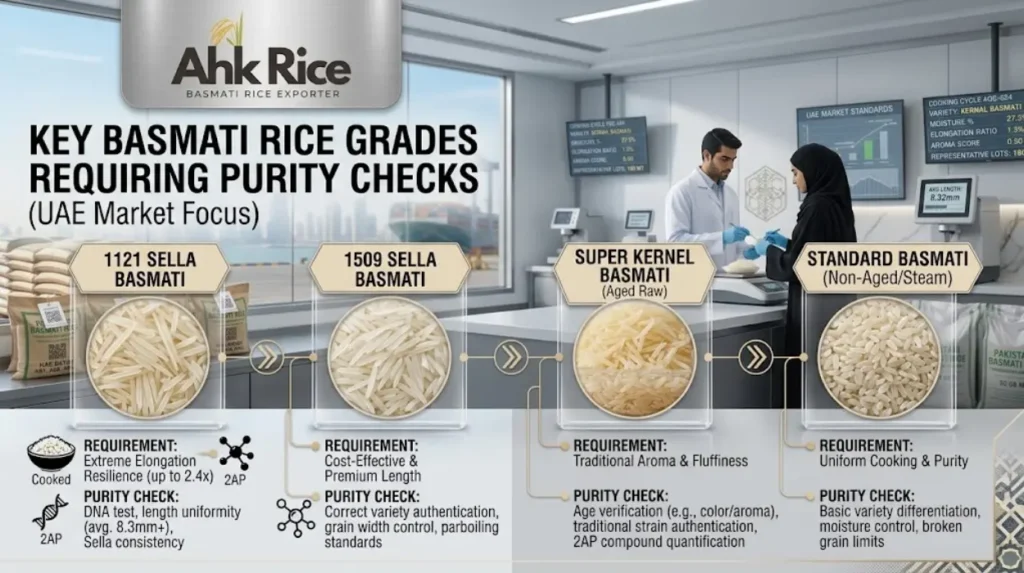
Purity checks apply to Basmati varieties and processing grades sold under specific commercial specifications. Important examples include 1121, Super Kernel, and 1509 Basmati rice, each supplied in different processing forms with distinct grain characteristics, buyer expectations, and contractual requirements.
1121 Basmati rice
1121 is known for its extra-long grain and substantial elongation during cooking. It is sold as white, steamed, Golden Sella, Creamy Sella, brown, and broken rice, depending on processing and buyer requirements.
Super Kernel Basmati rice
Super Kernel is a traditional aromatic Pakistani Basmati variety associated with Punjab. Buyers evaluate aroma, grain uniformity, moisture, broken-grain percentage, and varietal identity when specifying retail or wholesale shipments.
1509 Basmati rice
1509 is valued for its relatively short crop duration and commercial yield characteristics. It is supplied as white, steamed, and parboiled rice, including Golden Sella. Buyers assess grain dimensions, processing consistency, cooking performance, and conformity with the declared variety.
Other commercial grades
Additional classifications include premium whole-grain rice, broken Basmati, and grades defined by purity, grain length, or processing method. Broken rice remains a legitimate product when accurately declared. Its presence does not automatically indicate adulteration.
Which Markets Import Basmati Rice and Require Purity Verification?
Basmati importers use purity verification to confirm product identity, contractual quality, and compliance with destination-market requirements. Relevant markets include the UAE, Saudi Arabia, the United Kingdom, the United States, and other countries where buyers specify varietal, food-safety, labelling, and documentation requirements.
The UAE serves retail distributors, wholesalers, restaurants, catering businesses, and re-exporters. Importers commonly evaluate grain appearance, cooking performance, packaging, and batch consistency.
Saudi Arabian buyers source Basmati for household consumption, foodservice, catering, and institutional kitchens. Their purchasing specifications often distinguish long-grain varieties and processing forms.
In the United Kingdom and United States, importers also consider applicable food-safety rules, traceability, accurate labelling, and relevant contaminant limits. Requirements depend on the product, importing jurisdiction, and intended sale.
Other markets across Africa, Asia, and the Middle East have different commercial preferences and import procedures. Buyers must verify current requirements with the relevant authorities rather than assuming one certificate satisfies every destination.
Which Certifications and Documents Support Basmati Purity Verification?
Purity verification relies on appropriate laboratory reports, traceability records, and export documents that match the shipment and destination requirements. No single certificate universally proves varietal authenticity, commercial grade, and food safety, so importers must distinguish each document’s purpose.
Common supporting records include:
- Certificate of Analysis (COA): Records specified test results, such as moisture, broken grains, foreign matter, and other agreed parameters.
- DNA laboratory report: Documents genetic testing performed using a stated method and identified sample.
- Phytosanitary certificate: Confirms applicable plant-health requirements under the relevant export and import procedures.
- Certificate of origin: Identifies the declared country of origin under the applicable rules.
- Inspection certificate: Records findings from an agreed inspection process.
- Food-safety documentation: Includes applicable declarations, laboratory results, or compliance records required by the destination market.
Importers should check the issuing organisation, report date, batch reference, test method, and applicable acceptance limits. Laboratory accreditation, including accreditation to ISO/IEC 17025 for relevant testing activities, supports confidence in laboratory competence.
What Are the Common Misconceptions About Basmati Rice Purity?
Basmati purity cannot be established by grain length, aroma, appearance, or one general quality certificate alone. Reliable verification combines suitable sampling, physical inspection, appropriate laboratory testing, and records linked to the actual batch being purchased or imported.
Several misconceptions create avoidable commercial risks.
- Long grains always mean genuine Basmati: Other rice varieties also have long grains. DNA testing provides stronger evidence of genetic identity.
- Clean rice is pure rice: Optical sorting removes selected physical defects but does not reliably distinguish all genetically different varieties.
- A COA proves everything: A COA only supports the parameters actually tested. A moisture result does not establish varietal authenticity.
- Broken grains indicate adulteration: Broken grains are a grading characteristic. Their presence becomes a contractual issue when the declared percentage exceeds the agreed limit.
- A sample guarantees the entire shipment: A sample represents only the material collected. Effective sampling and batch traceability are necessary to reduce this risk.
- All markets accept identical documents: Import rules and buyer requirements differ by destination and product.
For buyers evaluating molecular verification, the next step is to understand which DNA method is suitable, what evidence an exporter should provide, and how laboratory findings support acceptance decisions.
Frequently Asked Questions
What is the most reliable way to test Basmati rice purity?
DNA-based variety testing provides evidence of genetic identity. Combine it with representative sampling, physical grading, and contractual quality checks for a more complete assessment.
Can adulterated Basmati rice be identified visually?
Visual inspection identifies differences in grain shape, colour, and dimensions. It cannot reliably distinguish every similar-looking rice variety, so laboratory testing is necessary when genetic identity is disputed.
Does DNA testing detect every type of rice adulteration?
No. DNA testing detects genetic differences within the capabilities of the selected method. It does not independently establish moisture, foreign matter, pesticide residues, or every food-safety parameter.
What is a Certificate of Analysis for rice?
A Certificate of Analysis records laboratory results for specified parameters. Buyers should check the sample identity, tested characteristics, laboratory details, and acceptance limits before relying on it.
Can 1121, Super Kernel, and 1509 Basmati be tested for purity?
Yes. Suitable methods can assess the identity of these varieties, subject to validated procedures and appropriate reference material. The test report should identify the method and its detection capabilities.