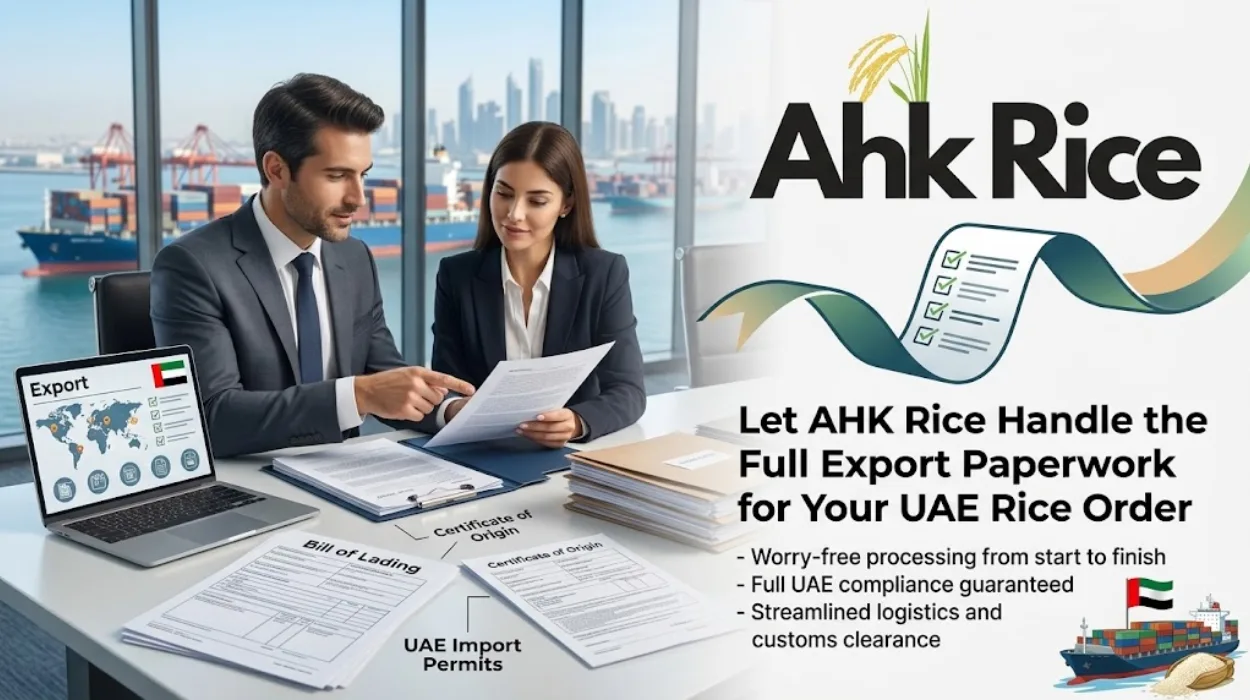
Let AHK Rice Handle the Full Export Paperwork for Your UAE Rice Order
Importing Pakistani Basmati rice into the UAE requires more than selecting a variety and agreeing on a price. Buyers must coordinate product specifications, export documents, shipping arrangements, destination requirements, and shipment approvals. Missing or inconsistent paperwork can delay customs clearance, increase storage costs, and disrupt delivery schedules.
For a practical introduction, read what documents are needed to export Basmati rice from Pakistan to the UAE. When the objective is to place an order, AHK Rice provides Pakistani Basmati rice export and supply services with coordinated processing, packaging, documentation, and shipment preparation.
What Is the Best Solution for Managing UAE Rice Export Paperwork?
The best solution is to coordinate rice specifications, export documentation, inspection requirements, packaging, and shipping before dispatch. A single export workflow reduces inconsistencies between commercial documents and cargo details, helping UAE importers prepare for clearance and receive shipments against agreed specifications.
A rice shipment involves several parties, including the exporter, freight forwarder, inspection provider, shipping line, and UAE importer. Each party handles different responsibilities. Problems arise when the commercial invoice, packing list, certificate details, and transport documents contain inconsistent information.
AHK Rice helps buyers coordinate the export process around the agreed order. The process begins with the rice variety, grade, quantity, packing format, destination, and Incoterm. These details establish the commercial basis for preparing the shipment and its supporting documents.
For example, a Dubai distributor ordering 25 metric tonnes of 1121 Basmati rice in 25 kg bags needs the product description, net weight, packaging count, and commercial value to remain consistent across relevant documents. The shipment plan must also reflect the agreed loading port and destination.
The essential documents commonly include:
- Commercial invoice: Records the seller, buyer, goods description, quantity, price, and applicable trade terms.
- Packing list: Identifies packaging units, bag weights, quantities, and shipment totals.
- Certificate of origin: Establishes the declared country of origin under the applicable certification process.
- Phytosanitary certificate: Confirms the relevant plant-health inspection and certification requirements for the shipment.
- Bill of lading: Serves as a key shipping document recording cargo and carriage details.
- Additional certificates: May include inspection, laboratory, conformity, or other documents required by the destination authorities, buyer, or agreed contract.
Not every shipment follows an identical document checklist. Requirements depend on the product, applicable UAE import rules, the buyer’s arrangements, and the shipment terms. The importer should confirm current requirements before the cargo leaves Pakistan.
Why Choose AHK Rice for Your UAE Rice Order?
AHK Rice combines rice sourcing, processing, grading, packaging, and export coordination to help UAE buyers manage one connected order workflow. Buyers establish specifications and documentation requirements before dispatch, reducing avoidable discrepancies and improving communication between commercial and logistics teams.
AHK Rice supplies Pakistani Basmati varieties, including 1121, Super Kernel, and 1509 Basmati rice. Each variety serves different commercial needs, from premium long-grain retail positioning to price-conscious wholesale and foodservice distribution.
The process starts with a written specification. Buyers confirm grain variety, grain length, broken percentage, moisture limits, purity requirements, processing type, and packaging. The parties also agree on quantity, price, delivery terms, and the required supporting documents.
AHK Rice then coordinates the order against those agreed details. This approach connects the product being prepared with the commercial description used in the paperwork. It also gives the buyer a defined basis for reviewing samples and approving the final order.
Consider a UAE wholesaler purchasing 1121 Golden Sella rice for restaurants and catering businesses. The buyer may require consistent grain length, low broken percentages, suitable moisture levels, and durable bulk packaging. The commercial documents must describe the same product and quantity that the buyer approved.
AHK Rice can coordinate the relevant preparation and documentation steps, subject to the agreed scope of service and applicable requirements. Buyers should confirm in writing which certificates, inspections, freight arrangements, and destination-side services are included in the quotation.
Which Export Documents Should You Confirm Before Shipment?
Confirm the required documents before loading, then check that the buyer details, product description, quantities, weights, origin, and transport information agree across the applicable records. Early verification gives the importer time to resolve discrepancies before they affect shipment release or clearance.
The commercial invoice and packing list form the foundation of the shipment record. Both should reflect the agreed order, while the packing list must accurately describe the actual packed cargo.
The certificate of origin should be obtained through the appropriate authorized process. The phytosanitary certificate must follow the applicable plant-health requirements and inspection procedure. Neither document should be treated as interchangeable with the other because each serves a different purpose.
The bill of lading is prepared through the shipping process using the relevant cargo and carriage information. Its details must align with the shipment arrangements and the instructions agreed with the buyer and freight forwarder.
For a detailed comparison, use the article Phytosanitary Certificate, Certificate of Origin, Bill of Lading and Commercial Invoice Explained. Replace the placeholder with the live MOFU article URL before publishing.
Before dispatch, AHK Rice and the buyer should establish a document checklist that identifies the responsible party, required format, issuing authority, approval stage, and expected completion date for each item. This is particularly important when the buyer has additional requirements for private-label retail, institutional supply, or inspection.
How Long Does Shipping from Pakistan to the UAE Take?
Sea freight from Karachi to UAE ports commonly takes several days to around two weeks of port-to-port transit, depending on the destination, service, and routing. Total delivery time is longer because export preparation, documentation, vessel schedules, customs clearance, and local delivery require additional time.
The following figures are planning estimates rather than guaranteed transit times. Actual schedules depend on the carrier, port, service availability, transshipment, and operational conditions.
| UAE destination | Indicative sea transit from Karachi | Planning consideration |
|---|---|---|
| Jebel Ali, Dubai | Approximately 3–10 days | Confirm vessel schedule and container availability |
| Khalifa Port, Abu Dhabi | Approximately 4–12 days | Allow for routing and terminal handling |
| Sharjah or other UAE ports | Approximately 4–12 days | Confirm the specific port and carrier service |
These ranges are indicative only. Buyers should obtain a current sailing schedule from the freight forwarder before confirming delivery commitments.
Export readiness also affects the timeline. Rice must be processed, graded, packed, and prepared according to the order. Required certificates and shipping instructions must be completed at the appropriate stages. After arrival, the importer must arrange clearance and inland transport.
AHK Rice can coordinate the export preparation and paperwork stages agreed for the order. However, vessel delays, port congestion, customs inspections, and other external events remain outside an exporter’s direct control. A reliable schedule therefore separates estimated sailing time from the complete order-to-delivery timeline.
What Does the Rice Sample Process Cost?
A sample process lets buyers assess grain appearance, aroma, cooking performance, and suitability before committing to a commercial shipment. The cost depends on sample quantity, courier destination, packaging, laboratory testing, and applicable certification or phytosanitary charges.
AHK Rice offers eligible buyers up to 20 kg of Super Kernel Basmati rice free for sampling. The buyer covers courier shipping and any applicable phytosanitary charges. Other sample sizes, varieties, destinations, and testing requirements should be confirmed before dispatch.
The process follows five stages.
- Submit the requirement. The buyer identifies the rice variety, preferred grade, intended application, destination, and sample quantity. The exporter confirms whether the requested sample is available.
- Confirm the sample specification. Both parties agree on the variety and relevant quality parameters. For commercial evaluation, the buyer should identify required grain length, broken percentage, moisture limits, processing type, and packaging expectations.
- Confirm the charges. AHK Rice confirms the sample arrangement and applicable shipping costs. Courier charges vary with parcel weight, destination, service level, and current carrier rates. Phytosanitary or other charges apply where required. Buyers should obtain the actual payable amount before authorizing dispatch.
- Dispatch and evaluate. The sample is packed and shipped using the agreed method. The buyer evaluates appearance, aroma, cooking characteristics, and compliance with the specification. If laboratory testing is required, its scope and cost should be agreed separately.
- Approve the commercial order. The buyer confirms the specification, quantity, packaging, price, and delivery terms. The approved specification becomes the reference for commercial production and final shipment checks.
A sample is not a substitute for shipment-specific inspection or a guarantee that every commercial lot is identical. AHK Rice and the buyer should record the final specification and agree on any required pre-shipment verification before production or loading.
What Factors Affect the Total Export Cost?
The total cost depends on rice variety, grade, quantity, packaging, inspection, documentation, freight, insurance, and the agreed Incoterm. Buyers should compare quotations using the same specification and delivery basis, rather than choosing an offer solely by its headline price per metric tonne.
A complete quotation should identify the rice price, order quantity, packaging format, and the responsibilities assigned to each party. Freight and insurance may be priced separately or incorporated into a delivered quotation, depending on the agreed terms.
Documentation expenses also vary. Some certificates involve issuing or inspection fees, while laboratory testing and third-party verification may create additional charges. Courier expenses for samples are separate from the cost of a commercial container shipment.
Destination charges require particular attention. Terminal handling, customs clearance, duties, taxes, inspection fees, and inland delivery may be payable by the importer unless the contract provides otherwise. The buyer should verify these charges with the relevant service providers.
AHK Rice can prepare an order-specific quotation based on the selected variety, grade, quantity, packing, destination, and delivery terms. Buyers should request a written breakdown that distinguishes included services from excluded charges and identifies who is responsible for each export and import requirement.
How Do You Start a UAE Rice Order with AHK Rice?

Start by sending the required variety, quality specification, quantity, packaging, UAE destination, and preferred Incoterm. Confirm sample requirements and documentation responsibilities, approve the commercial terms, and authorize production and shipment only after the agreed specification and export workflow are documented.
A practical order sequence keeps decisions clear:
- Submit the product specification and target quantity.
- Review the quotation, packaging options, and delivery terms.
- Request a sample where needed and confirm applicable costs.
- Approve the sample and final commercial specification.
- Agree on inspection, certification, and document requirements.
- Confirm production readiness, shipping arrangements, and document responsibilities.
- Review the applicable shipment documents and coordinate dispatch.
This sequence helps buyers avoid ordering rice before confirming the commercial and regulatory requirements. It also provides a shared reference for the supplier, importer, and logistics partners.
AHK Rice supports buyers seeking Pakistani Basmati rice with coordinated sourcing, processing, packaging, and export preparation. The right starting point is a complete written requirement, not an informal price request without a grade or destination.
Frequently Asked Questions
Does AHK Rice handle all UAE rice export documents?
AHK Rice can coordinate the export paperwork agreed for an order. The exact scope depends on the contract, issuing authorities, inspection requirements, and importer instructions. Confirm responsibilities for each document before shipment.
How much does a free rice sample cost?
Eligible buyers can request up to 20 kg of Super Kernel Basmati rice free for sampling. The buyer pays courier shipping and applicable phytosanitary charges. Confirm the destination-specific amount before dispatch.
Which certificates are required to export rice to the UAE?
Common documents include the commercial invoice, packing list, certificate of origin, phytosanitary certificate, and bill of lading. Additional documents may apply depending on current UAE requirements, product specifications, and the buyer’s arrangements.
How many days does rice shipping from Pakistan to Dubai take?
Indicative sea transit from Karachi to Jebel Ali is approximately 3–10 days, subject to routing and carrier schedules. Export preparation, port handling, customs clearance, and local delivery extend the overall timeline.
How can a UAE importer receive an accurate rice quotation?
Provide the rice variety, grade, quantity, packaging, destination port, and preferred Incoterm. Also specify required certificates, inspection, and testing. A complete specification enables a more meaningful quotation and clearer allocation of costs.