Why Are Welsh Distributors Expanding Premium Basmati Rice Categories?
Welsh distributors are expanding premium Basmati rice categories because customers increasingly distinguish rice by grain length, aroma, processing method, cooking performance, origin, and pack format. Here is why: UK distributors already separate premium Basmati, Sella, and long-grain products across retail, catering, and wholesale channels.
What Is Premium Basmati Rice?
Premium Basmati rice is aromatic long-grain rice selected for grain appearance, fragrance, cooking separation, processing quality, and consistent specifications. UK customs guidance defines Basmati as slender, fragrant, non-glutinous long-grain rice that expands lengthwise during cooking.
Basmati rice starts as paddy harvested from cultivated rice fields. Pakistan is one recognised source of Basmati rice, with Punjab providing important growing areas. Pakistan’s Rice Exporters Association identifies Basmati as a major Pakistani rice export category.
Premium positioning depends on measurable characteristics. Grain length, broken percentage, moisture, foreign matter, colour, aroma, and cooking behaviour separate commercial grades. UK tariff classification also distinguishes rice through processing status, grain size, and length-to-width ratio.
Welsh distributors therefore treat premium rice as a category rather than a single product. A retail shelf can contain 1121 White, 1121 Steam, Golden Sella, Super Kernel, and other long-grain products for different customer needs.
The category also connects directly with restaurants and caterers. Biryani, pulao, pilaf, curry meals, buffet dishes, and takeaway rice boxes require grains that cook consistently and remain visually separate. UK foodservice suppliers already market Basmati around these cooking characteristics.
With the product defined, the next question is how premium Basmati moves from cultivated paddy to a distributor-ready product.
How Is Pakistani Basmati Rice Processed?
Premium Basmati processing converts harvested paddy into cleaned, dehusked, polished, graded, sorted, tested, and packaged rice for controlled distribution. Each stage removes a specific quality risk and establishes measurable product characteristics.
How does the processing sequence work?
The standard sequence starts with harvested paddy and ends with packed rice. Processing methods differ between white, steam, Sella, and brown grades.
- Clean the paddy to remove stones, dust, straw, and other field material.
- De-husk the grain to remove the outer husk and produce brown rice.
- Grade the grain by size and physical characteristics.
- Polish the grain to produce the required white-rice finish.
- Parboil the rice for Sella production through controlled steaming and drying.
- Dry the rice to establish the required moisture level.
- Sort the grain by length, colour, broken percentage, and foreign matter.
- Inspect the rice against the agreed specification.
- Pack the rice into retail, wholesale, or foodservice packaging.
White Basmati follows cleaning, dehusking, polishing, grading, sorting, inspection, and packing. Steam rice receives controlled steaming before drying. Sella rice receives parboiling, drying, milling, and sorting.
Colour sorting provides another important control. Optical equipment identifies discoloured or defective grains and removes them from the finished batch. This creates a more uniform visual appearance for premium retail and foodservice products.
Processing also determines cooking behaviour. Sella and Steam products receive thermal treatment that changes grain structure. White Basmati retains a different processing profile. The correct grade therefore depends on the intended application.
With processing established, the next question is which grades create meaningful category differences for Welsh distributors.
Which Basmati Grades Are Available?
The principal AHK Rice range covers 1121, Super Kernel, and 1509 varieties, with white, steam, Sella, and brown processing options across the range. These grades serve different cooking, retail, catering, and positioning requirements.
What grades exist within 1121 Basmati?
1121 Basmati includes White, Steam, Golden Sella, Creamy Sella, and Brown processing grades in the AHK Rice range. The variety is associated with extra-long grains and strong visual presentation.
1121 White provides a polished white appearance and long cooked grains. Retail customers use it for biryani, pulao, pilaf, and everyday premium meals.
1121 Steam uses controlled steaming before drying. The process strengthens the grain and supports separate cooked grains. It suits foodservice operations requiring consistent cooking.
1121 Golden Sella uses parboiling and drying to produce a distinctive golden appearance. The processing method supports firm grain structure and makes it suitable for large-volume cooking.
1121 Creamy Sella uses parboiling while producing a lighter creamy appearance than Golden Sella. It provides another specification within the Sella category.
1121 Brown retains more of the grain’s outer layers. Brown rice targets consumers seeking a less-polished rice format.
What grades exist within Super Kernel?
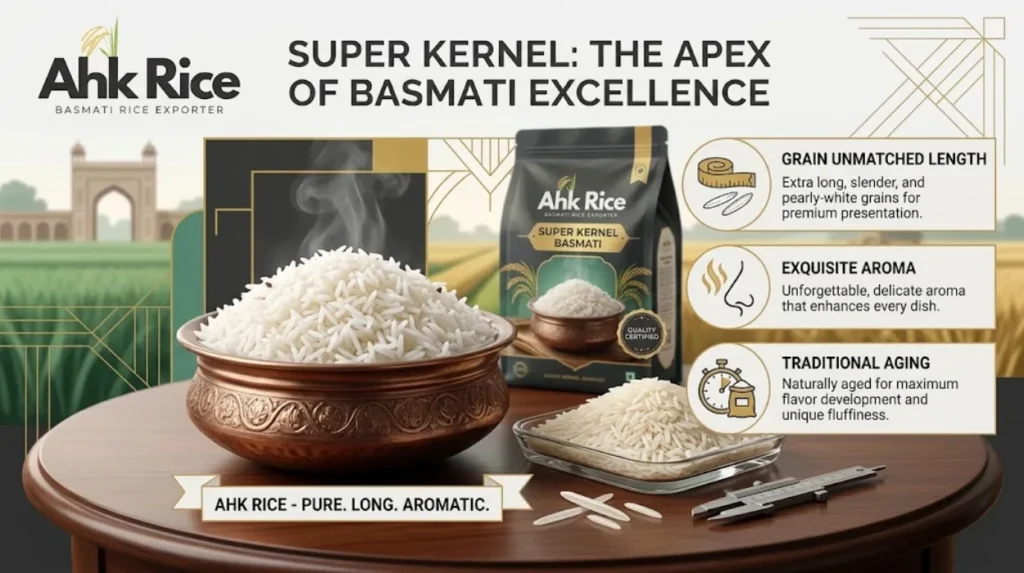
Super Kernel includes Steam, White, Sella, and Parboiled processing formats, giving distributors four distinct product specifications. Super Kernel is a Pakistani Basmati category recognised in UK import and retail channels.
Super Kernel White targets premium meals requiring polished grains. Super Kernel Steam provides a steamed alternative with a different cooking profile. Super Kernel Sella uses parboiling, while Super Kernel Parboiled provides another processed format for foodservice and wholesale applications.
What grades exist within 1509?
1509 includes White, Golden Sella, and Steam grades, giving distributors three processing choices within the variety. These formats allow category segmentation without changing the underlying variety.
1509 White provides a polished long-grain product. 1509 Golden Sella uses parboiling and drying. 1509 Steam uses controlled steaming to strengthen the grain.
A wider grade portfolio gives distributors more specification points. Customers can select based on appearance, cooking method, price position, and end use rather than choosing one generic Basmati product.
With the grade structure established, the next question is why this wider range matters to Welsh distribution businesses.
Why Are Welsh Distributors Expanding Premium Rice Categories?
Category expansion gives distributors more ways to serve retail, restaurant, catering, wholesale, and specialist-food customers without relying on one rice specification. UK suppliers already separate Basmati products by grade, pack size, processing method, and customer application.
Which customer uses premium Basmati?
Retail customers focus on appearance, aroma, origin, packaging, and cooking consistency. A premium 1121 product can occupy a different shelf position from everyday long-grain rice.
Restaurants focus on cooking performance. A biryani kitchen needs long grains that remain visually separate after cooking. Catering businesses also value predictable batch performance because large quantities require repeatable preparation.
Wholesale customers focus on specification and pack economics. A 20kg or 25kg sack serves professional kitchens differently from a 1kg or 5kg retail pack.
Private-label buyers add another requirement. They need consistent specifications across repeated shipments. UK distributors already operate private-label, bulk, and retail formats for rice categories.
What commercial benefit comes from category depth?
Category depth creates clearer price architecture. A distributor can position White, Steam, Sella, and Brown products at different points according to processing, packaging, and customer demand.
Category depth also reduces dependence on one buying profile. Retail buyers can choose polished White rice. Catering buyers can choose Steam or Sella. Health-focused customers can choose Brown rice.
Welsh distributors also operate within the wider Great Britain food system. Food imported into Great Britain must meet applicable food hygiene and safety requirements equivalent to domestic food production.
The commercial logic therefore links product diversity with specification control. The next question is where these grades are actually used.
Where Is Premium Basmati Rice Used?
Premium Basmati serves retail shelves, restaurants, catering operations, wholesalers, ethnic grocery channels, food manufacturers, and private-label programmes across the UK and international markets. UK suppliers explicitly target restaurants, caterers, retailers, and wholesalers.
Which markets import Pakistani Basmati?
Pakistani Basmati reaches the UK, Europe, Middle East, Africa, North America, and other international markets. Pakistan’s rice export sector supplies multiple international destinations, while UK distributors maintain established channels for Pakistani Basmati.
Within the UK, Welsh distributors can supply local retailers, independent shops, restaurants, caterers, wholesalers, and foodservice businesses. The same imported specification can therefore support several downstream channels.
Which food applications require different grades?
Biryani uses long aromatic grains where length and separation affect presentation. Pulao requires similar grain integrity and aroma. Catering kitchens often select Steam or Sella products for structured cooking.
Retail cooking applications use White, Steam, and Sella formats. Brown Basmati targets a different consumer preference. Foodservice therefore creates a direct reason to maintain multiple processing grades.
Market expansion also requires documentation and food-safety controls. The next question is which certifications and compliance documents matter during import.
Which Certifications and Compliance Controls Apply?
Relevant controls include HACCP-based food safety systems, ISO 22000 or equivalent systems, laboratory testing, pesticide-residue compliance, traceability, and required import documentation. Certification demonstrates a controlled system, while compliance documents verify shipment-specific requirements.
Which certifications matter for rice processing?
HACCP identifies and controls food-safety hazards during processing. ISO 22000 provides a food-safety management framework. BRCGS Food Safety is another recognised certification scheme used across food manufacturing and supply chains.
Certification is not identical to legal permission to import. A distributor must also verify product-specific UK requirements, labelling, customs classification, food safety, and applicable contaminant controls.
Which tests matter for Pakistani rice?
Pesticide-residue testing is important because Great Britain applies maximum residue levels to pesticides in food. Food that exceeds the applicable MRL cannot legally enter the market.
Pakistan-origin rice also has specific UK monitoring history. The current GB restrictions list was updated in July 2026 to include aflatoxins and ochratoxin A controls for rice contaminants from Pakistan.
Shipment documentation also requires attention. Depending on the product and import route, documents can include commercial invoices, packing lists, customs information, certificates of analysis, certificates of origin, and other applicable certificates.
Importers must verify the exact requirements for each consignment. UK food-import guidance covers product-specific requirements for cereals, including rice, and import controls can change.
Welsh distributors therefore need both product quality and documented compliance. That combination explains why premium Basmati categories require more than attractive packaging.
What Problems Do Distributors Commonly Face?
The main problems are inconsistent grain specifications, unclear processing descriptions, excessive broken grains, moisture variation, weak traceability, incomplete testing, and incorrect assumptions about certification. Each problem can affect cooking performance, shelf presentation, compliance, or repeat purchasing.
Is every long-grain rice premium Basmati?
No. Long-grain describes grain characteristics, while Basmati identifies a specific aromatic rice category. UK guidance defines Basmati separately from generic long-grain classifications.
Does Sella mean one single grade?
No. Sella describes a parboiled processing format. 1121 Golden Sella, 1121 Creamy Sella, and Super Kernel Sella represent different product specifications within the broader category.
Does certification guarantee product quality?
No. Certification verifies a management system or defined standard. Shipment quality still requires product inspection, laboratory testing, specification checks, and traceability.
Is packaging only a marketing decision?
No. Packaging protects the product and communicates mandatory information. UK cereal-import guidance covers packaging, labelling, hygiene, pesticides, and other compliance areas.
These distinctions prevent distributors from treating every premium rice product as interchangeable. The correct specification connects variety, processing, testing, packaging, application, and market requirements.
Why Is the Premium Category Expanding?
Welsh distributors are expanding premium Basmati because the category supports clearer segmentation across retail, foodservice, catering, wholesale, and specialist customers. Multiple varieties and processing grades allow distributors to match rice specifications with distinct commercial uses.
The strongest category structure begins with 1121, Super Kernel, and 1509. It then separates White, Steam, Golden Sella, Creamy Sella, Parboiled, and Brown formats according to processing and application.
Quality control completes the structure. Grain dimensions, broken percentage, moisture, foreign matter, colour, aroma, pesticide residues, contaminants, packaging, and traceability all influence the suitability of imported rice.
For distributors, premium Basmati is therefore a specification-led category. The product starts in Punjab’s rice-growing regions, passes through controlled milling and sorting, receives testing and documentation, and reaches UK distribution channels as a defined commercial grade.
Frequently Asked Questions
What is premium Basmati rice?
Premium Basmati is aromatic long-grain rice selected for grain appearance, aroma, cooking performance, processing quality, and consistent specifications.
Why do Welsh distributors stock several Basmati grades?
Different grades serve different retail, restaurant, catering, wholesale, and foodservice requirements.
What are the main Pakistani Basmati varieties?
Common commercial varieties include 1121, Super Kernel, and 1509, with different processing formats available within each variety.
What is the difference between White and Sella Basmati?
White Basmati is conventionally milled and polished. Sella Basmati is parboiled, dried, milled, and sorted before packaging.
Which certifications apply to imported Basmati rice?
Relevant systems include HACCP, ISO 22000, and BRCGS Food Safety. Shipment-specific testing and UK import compliance also apply.