What Moisture Percentage Is Recommended for Pakistan Basmati Rice Shipped to Saudi Arabia?
Saudi Arabian buyers consistently achieve the best balance of grain quality, shelf life, and import compliance when Pakistan Basmati rice is shipped at a moisture content of 12% to 13%, while remaining below the maximum limits accepted by commercial contracts and international trade standards.
Saudi Arabia is one of the world’s largest importers of Pakistani Basmati rice. Climate conditions, storage duration, shipping routes across the Arabian Sea, container temperatures, and warehouse handling all influence the recommended moisture level before export. Choosing the correct moisture percentage protects aroma, cooking performance, grain appearance, and commercial value throughout the supply chain. If you want to understand why Saudi Arabia’s climate affects these specifications, read our guide on:
How environmental conditions influence moisture management in imported Pakistani rice.
The moisture percentage is determined before loading containers using calibrated moisture meters during milling and final inspection. For:
Pakistan Basmati Rice Exporter Meeting Saudi Arabian Moisture Specifications. AHK Rice applies controlled drying, multiple quality inspections, customised packaging, and export documentation to maintain consistent moisture levels from Punjab processing facilities to Saudi Arabian ports.
Why is 12–13% moisture considered the recommended range for Pakistan Basmati rice exported to Saudi Arabia?
The recommended moisture range of 12–13% provides the best combination of grain stability, aroma preservation, reduced microbial activity, shipping safety, and cooking quality while remaining suitable for Saudi Arabia’s hot climate and long international logistics chain from Pakistan.
Moisture percentage measures the amount of water contained inside each rice grain before shipment. Even a difference of one percentage point changes how rice behaves during storage, transportation, milling recovery, and cooking.
Freshly harvested paddy normally contains over 20% moisture. Modern processing plants gradually reduce this level through controlled drying before milling.
For exports to Saudi Arabia, exporters generally target:
- 12.0%
- 12.5%
- 13.0%
These values provide enough internal moisture to preserve grain integrity without encouraging mould growth or reducing shelf life.
Commercial contracts may specify different tolerances depending on buyers, packaging methods, and intended retail markets. However, premium Basmati suppliers usually remain close to the 12–13% target.
How do different moisture percentages compare for Saudi Arabian imports?
Different moisture levels affect storage stability, grain appearance, cooking performance, shipping risks, and commercial acceptance. Rice exported within the recommended range consistently delivers better quality than rice that is excessively dry or excessively moist.
Pakistan Basmati Rice Moisture Comparison
| Attribute | Below 11.5% | 12–13% (Recommended) | Above 14% |
|---|---|---|---|
| Grain strength | Moderate brittleness | Excellent | Softens during storage |
| Aroma retention | Slight reduction | Excellent | Can deteriorate over time |
| Cooking quality | Slightly dry texture | Premium elongation | Sticky texture possible |
| Breakage risk | Higher during handling | Lowest | Moderate |
| Storage stability | Excellent but brittle | Excellent | Reduced |
| Microbial risk | Very low | Very low | Higher |
| Saudi commercial preference | Less common | Preferred | Usually avoided |
Maintaining balance matters more than simply reducing moisture as much as possible.
What solutions are available for maintaining the correct moisture before exporting rice?
Exporters use controlled drying, continuous moisture testing, climate-controlled storage, moisture-resistant packaging, and container inspection to achieve consistent quality throughout international shipping to Saudi Arabian buyers.
Maintaining moisture is a complete quality management process rather than one inspection before loading.
1. Controlled Drying
Modern drying systems gradually remove moisture.
Slow drying protects:
- Grain structure
- Kernel length
- Aroma compounds
- Milling yield
Rapid drying creates internal stress that increases broken grains.
2. Digital Moisture Testing
Professional exporters perform testing:
- Before milling
- During polishing
- Before packaging
- Before container loading
Multiple measurements improve consistency.
3. Climate-Controlled Warehousing
Temperature fluctuations change moisture distribution.
Well-managed warehouses minimise condensation before export.
4. Moisture-Resistant Packaging
Packaging influences moisture stability during sea transport.
Common export packaging includes:
- PP woven bags
- BOPP laminated bags
- Vacuum packs
- Retail laminated packaging
Each provides different protection levels depending on customer requirements.
5. Container Inspection
Export containers must be:
- Dry
- Odour free
- Clean
- Properly ventilated
- Free from condensation
Container preparation prevents moisture migration during transport.
How do different Pakistan Basmati varieties respond to moisture management?
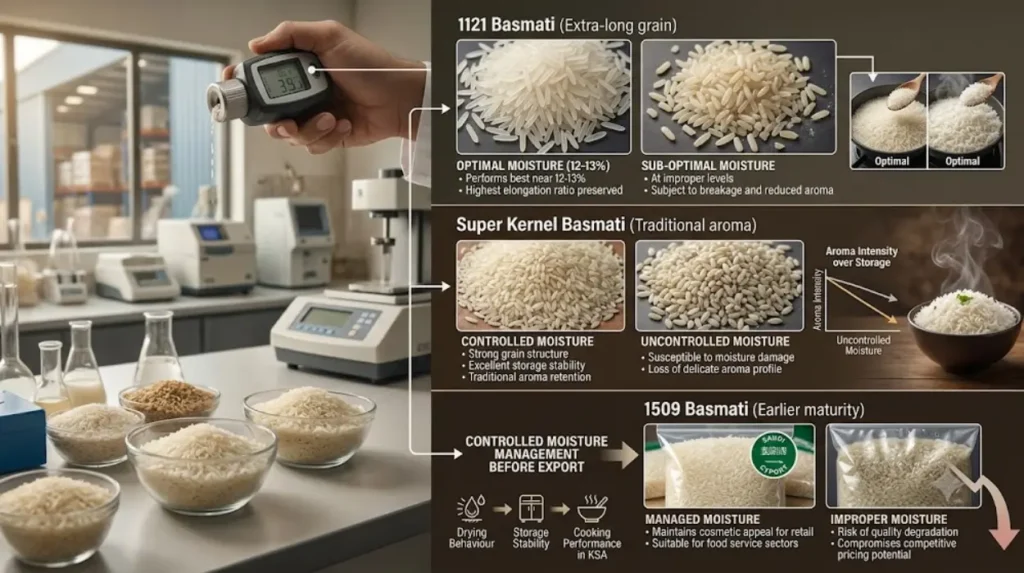
Every Basmati variety reacts differently because grain length, density, ageing process, and starch composition influence drying behaviour, storage stability, and cooking performance after export to Saudi Arabia.
Pakistan exports several premium aromatic rice varieties.
1121 Basmati
- Extra-long grain
- Highest elongation ratio
- Performs best near 12–13%
Super Kernel Basmati
- Traditional aroma
- Strong grain structure
- Excellent storage stability
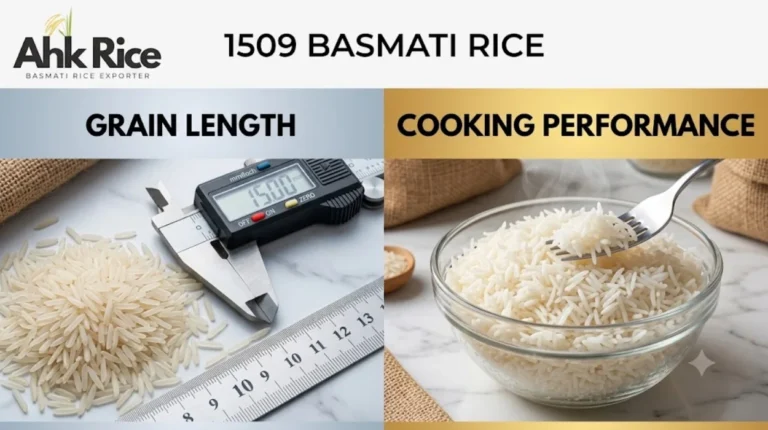
1509 Basmati
- Earlier maturity
- Competitive pricing
- Suitable for retail and food service sectors
Each variety benefits from controlled moisture management before export.
Which grades do Saudi Arabian buyers generally prefer?
Saudi Arabian importers purchase different grades according to consumer segment, hospitality demand, and wholesale distribution. Premium retail markets favour higher specifications, while food service buyers often balance quality with pricing.
Premium Retail
Preferred grades include:
- 1121 Steam
- 1121 Sella
- Super Kernel Steam
Priority:
- Long grains
- Bright appearance
- Strong aroma
Hospitality Sector
Hotels and restaurants usually select:
- 1121 Steam
- 1121 Sella
Requirements include:
- High elongation
- Low breakage
- Uniform cooking
Wholesale Distribution
Importers frequently purchase:
- Super Kernel
- 1509
- Standard Basmati grades
Focus remains on value and cooking consistency.
How do Saudi Arabia and other export markets compare in moisture expectations?
Although international moisture targets remain similar, market preferences differ because climate, storage duration, retail packaging, and consumer expectations influence purchasing specifications across importing regions.
Regional Comparison
| Market | Preferred Grades | Typical Moisture Target |
|---|---|---|
| Saudi Arabia | 1121 Steam, 1121 Sella, Super Kernel | 12–13% |
| United Arab Emirates | 1121 Premium, Super Kernel | 12–13% |
Saudi Arabia places greater emphasis on long storage stability because imported rice often passes through distributors before reaching retailers.
How does moisture percentage influence export pricing per metric tonne?
Moisture management affects commercial value because consistent quality reduces claims, protects grain recovery, lowers breakage, and improves buyer confidence throughout international trade.
Indicative 2026 export pricing illustrates the commercial relationship between quality and moisture consistency.
| Specification | Typical Export Price (USD/MT) |
|---|---|
| 1121 Steam Premium | 1,120–1,280 |
| 1121 Sella | 1,050–1,220 |
| Super Kernel Steam | 980–1,150 |
| 1509 Steam | 860–1,020 |
Prices vary according to:
- Harvest season
- Currency exchange
- Freight
- Packaging
- Contract volume
- Buyer specifications
Shipments maintaining consistent moisture within specification generally command stronger commercial acceptance because they reduce quality disputes.
How does moisture affect shelf life after export?
Proper moisture control extends storage life by reducing biological activity, preserving aroma compounds, protecting grain colour, and limiting the conditions that encourage spoilage during warehousing and retail distribution.
Shelf Life Comparison
| Moisture Level | Expected Shelf Life |
|---|---|
| 12–13% | 18–24 months |
| Around 13.5% | 12–18 months |
| Above 14% | Significantly reduced depending on storage conditions |
Storage quality also depends on:
- Temperature
- Relative humidity
- Packaging quality
- Warehouse hygiene
- Stock rotation
Moisture works together with these factors rather than independently.
Which moisture management approach works best for different buyers?
The most effective solution depends on product grade, packaging format, storage duration, retail strategy, and end-user expectations rather than using one identical specification for every shipment.
Decision Framework
| Buyer Situation | Recommended Approach | Primary Benefit |
|---|---|---|
| Premium retail importer | 12–12.5% moisture with laminated packaging | Maximum quality retention |
| Hotel supplier | 12.5% moisture with premium grading | Excellent cooking performance |
| Long storage inventory | Controlled drying with warehouse monitoring | Better shelf life |
| Wholesale distributor | Balanced moisture and durable PP packaging | Cost-effective logistics |
| Private label brand | Custom moisture verification before loading | Brand consistency |
Selecting the appropriate combination produces better commercial outcomes than focusing only on moisture percentage.
What are the advantages and disadvantages of different moisture strategies?
Every moisture strategy offers benefits and trade-offs. Exporters should balance grain protection, handling efficiency, storage duration, and customer requirements instead of targeting the lowest possible moisture level.
Lower Moisture (Below 12%)
Advantages
- Reduced microbial activity
- Longer storage potential
- Lower mould risk
Disadvantages
- Increased grain brittleness
- Higher breakage during milling
- Slight reduction in cooking texture
Recommended Moisture (12–13%)
Advantages
- Premium cooking quality
- Better aroma preservation
- Excellent grain appearance
- Lower commercial claims
- Strong storage stability
Disadvantages
- Requires continuous monitoring
- Demands better process control
Higher Moisture (Above 13.5%)
Advantages
- Less drying cost initially
Disadvantages
- Increased spoilage risk
- Reduced storage life
- Greater possibility of mould
- More quality disputes
- Lower commercial confidence
What factors should buyers evaluate before choosing a Pakistan Basmati supplier for Saudi Arabia?
Buyers should evaluate moisture control systems, laboratory testing, export certifications, processing consistency, packaging capabilities, and traceability because these factors directly influence product quality after arrival in Saudi Arabia.
Important evaluation criteria include:
- Moisture testing procedures
- Modern milling facilities
- Quality inspection records
- Export documentation
- Food safety certifications
- Packaging options
- Container loading standards
- Shipment traceability
- Experience serving Saudi Arabian buyers
- Consistent grading across multiple shipments
A supplier that manages these elements consistently is more likely to deliver rice that maintains its quality throughout transportation, customs clearance, storage, and final distribution.
For Pakistan Basmati rice exported to Saudi Arabia, maintaining a moisture content between 12% and 13% remains the most reliable approach for preserving grain quality, aroma, shelf life, and commercial value throughout the export journey. This range supports premium cooking performance while reducing the risks associated with excessive drying or excessive moisture. Learn:
Successful moisture management depends on a complete quality process that combines controlled drying, repeated moisture testing, appropriate packaging, clean containers, and careful storage practices. Buyers comparing suppliers should evaluate these operational capabilities alongside product grade, certifications, and export experience to ensure consistent results in the Saudi market.
Frequently Asked Questions
What is the recommended moisture percentage for Pakistan Basmati rice shipped to Saudi Arabia?
The recommended moisture content is 12% to 13%. This range helps preserve grain quality, aroma, shelf life, and cooking performance while meeting the expectations of most Saudi importers.
Why is moisture content important for Basmati rice exports?
Moisture content directly affects storage stability, grain breakage, aroma retention, cooking quality, and the risk of mould during transportation and warehousing.
How is the moisture level of exported rice measured?
Exporters use calibrated digital moisture meters to test rice at different stages, including after drying, before milling, during packaging, and prior to container loading.
Does Saudi Arabia have specific moisture requirements for imported rice?
Most Saudi buyers prefer Basmati rice with a moisture content of 12% to 13%, although exact specifications may vary according to individual contracts and product grades.
Which Pakistan Basmati rice varieties are commonly exported to Saudi Arabia?
The most popular varieties include 1121 Basmati, Super Kernel Basmati, and 1509 Basmati, each offering different grain characteristics, aroma, and price points.
How does moisture content affect the shelf life of Basmati rice?
Rice maintained at the recommended moisture level can typically achieve a shelf life of 18 to 24 months when stored under proper temperature and humidity conditions.
What packaging helps maintain the correct moisture level during shipping?
Moisture-resistant packaging such as BOPP laminated bags, PP woven bags, vacuum packs, and customised retail packaging helps protect rice during sea transport and storage.
Can moisture levels affect the export price of Pakistan Basmati rice?
Yes. Consistent moisture control improves grain quality, reduces claims, and increases buyer confidence, which can positively influence export pricing and long-term trade relationships.