How Does Basmati Rice Sample Approval Work Before a Bulk Import?
Basmati rice sample approval is the process of testing a representative rice sample before confirming a bulk import order. Importers assess grain length, broken percentage, moisture, aroma, appearance and cooking performance to establish the quality specifications that the commercial shipment must meet.
The process connects the buyer’s requirements with the exporter’s grading, processing and quality control procedures. It also reduces disagreements about grain quality, packaging, cooking results and contractual specifications after the rice reaches its destination.
For importers sourcing Pakistani Basmati rice, sample approval provides a practical way to evaluate varieties such as 1121, Super Kernel, and 1509 Basmati rice before committing to a container-sized order. The approved sample and written specifications establish a reference for production checks, pre-shipment inspection and final acceptance.
What Is Basmati Rice Sample Approval Before a Bulk Import?
Basmati rice sample approval is a buyer-led quality verification process that confirms whether a rice variety meets agreed commercial requirements before bulk purchasing. It evaluates physical grain characteristics, cooking performance, purity, moisture and other contractual specifications.
A rice sample is a small quantity taken or prepared to represent a particular variety, grade or production lot. The importer examines the sample before approving the product for a larger purchase.
The approval process starts with the buyer defining the intended use. A supermarket distributor, for example, prioritises consistent grain appearance, packaging and retail presentation. A restaurant wholesaler focuses on cooking performance, grain separation and suitability for large-volume preparation.
The exporter then identifies a suitable variety and processing grade. Pakistani Basmati varieties include 1121, Super Kernel and 1509, each with different grain characteristics and commercial positioning.
Sample approval does not simply mean that the rice looks attractive. It means the buyer has evaluated the product against defined requirements and recorded the specifications that apply to the proposed order.
How Does the Rice Sample Approval Process Work Step by Step?
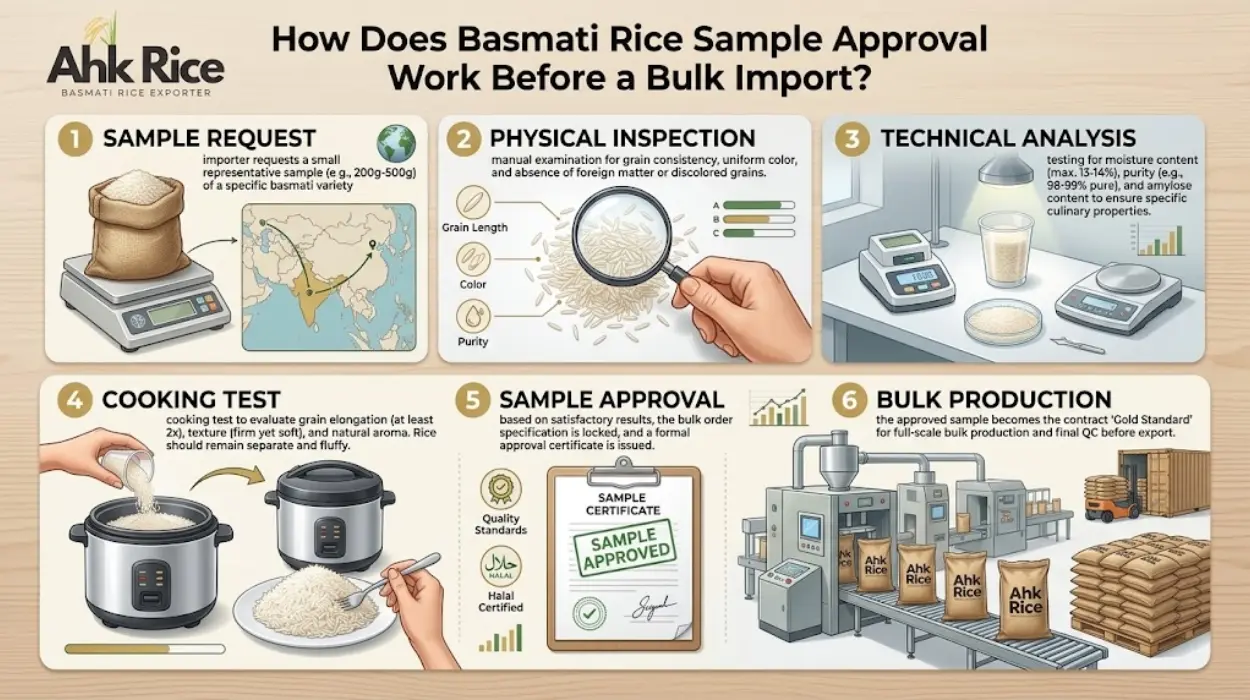
The sample approval process follows 8 stages: requirement submission, variety selection, specification confirmation, sample preparation, delivery, physical and cooking tests, written approval and production planning. Each stage records buyer expectations before the exporter processes and prepares the bulk shipment.
1. Submit the import requirements
The importer provides the destination market, required quantity, preferred variety, processing grade, packaging format and quality standards. These details help the exporter select an appropriate product rather than sending a sample that does not match the intended order.
2. Select the Basmati variety and grade
The buyer chooses between varieties such as 1121, Super Kernel and 1509. The importer also specifies whether the requirement is for white, steam, Golden Sella or another available processing grade.
3. Confirm the quality specifications
Both parties agree on measurable parameters, including grain length, broken percentage, moisture, purity, colour and relevant food safety requirements. The exporter records these parameters in a specification sheet.
4. Prepare and dispatch the sample
The exporter prepares a sample representing the proposed variety and grade. Sample size depends on the evaluation requirements. A small sample supports visual inspection, while a larger quantity supports repeated cooking tests and laboratory analysis.
Preparation commonly takes 1–3 days, while courier delivery commonly takes 4–7 days. Actual timing depends on preparation requirements, destination, customs clearance and courier service.
5. Inspect the physical characteristics
The importer examines grain length, uniformity, broken kernels, foreign matter, colour and visible defects. The results are compared with the agreed specification rather than judged only by appearance.
6. Conduct cooking tests
The buyer prepares the rice using the intended commercial cooking method. The evaluation covers aroma, elongation, texture, water absorption and grain separation. Restaurants and foodservice distributors often repeat tests under their normal kitchen conditions.
7. Record written approval
The importer confirms acceptance of the sample and its specifications in writing. Any required adjustments are documented before the commercial order proceeds. Verbal approval alone leaves room for disagreements about the accepted grade or quality limits.
8. Plan production and shipment
The exporter uses the approved specifications to guide processing, packing and quality checks. Pre-shipment inspection and agreed laboratory tests verify relevant requirements before loading. The approval record becomes a reference for comparing the commercial lot with the buyer’s expectations.
Which Quality Parameters Should Importers Check in a Basmati Rice Sample?
Importers should evaluate grain length, broken percentage, moisture, purity, colour, aroma and cooking performance. The exact acceptance limits depend on the selected variety, grade, contract and destination-market requirements, so buyers should document numerical limits before approving a sample.
| Quality parameter | What the importer checks | Why it matters |
|---|---|---|
| Grain length | Raw kernel length in millimetres | Supports grade selection and appearance |
| Broken percentage | Proportion of broken kernels | Affects presentation, yield and commercial value |
| Moisture content | Moisture percentage by weight | Influences storage stability and quality |
| Purity | Foreign matter and unwanted grain types | Supports product consistency |
| Colour | Uniformity and grade-specific appearance | Helps match retail and foodservice expectations |
| Aroma | Characteristic Basmati fragrance | Influences consumer acceptance |
| Cooking performance | Elongation, texture and grain separation | Determines suitability for intended dishes |
| Packaging | Bag material, size, labels and sealing | Supports handling and market requirements |
Numerical specifications matter because descriptions such as “long grain”, “low broken” and “premium quality” do not define measurable acceptance limits. An importer should state the required raw grain length and maximum broken percentage in the purchase specification.
For example, a buyer sourcing Super Kernel can request a defined grain-length range, a maximum broken percentage and a moisture limit. The exporter must confirm that the selected grade can meet those values before the buyer approves the sample.
Moisture testing requires particular attention because visual inspection does not establish the actual moisture content. A calibrated moisture meter or suitable laboratory method provides a more reliable measurement.
Cooking tests also require a consistent method. Water quantity, soaking time, cooking duration and resting time affect the result. Recording these conditions makes comparisons between the sample and subsequent production more meaningful.
How Do Basmati Rice Varieties and Processing Grades Affect Sample Approval?
Sample approval depends on the variety and processing grade because each product has different grain characteristics, appearance and cooking behaviour. Importers should evaluate the exact variety and grade intended for shipment, not approve one product and assume another will perform identically.
1121 Basmati
1121 Basmati is known for its extra-long grain and strong cooked-grain elongation. Importers supplying premium retail markets, restaurants and catering businesses assess grain uniformity, aroma and cooked appearance.
Available processing options include white, steam, Golden Sella, Creamy Sella, brown and broken grades, depending on the supplier’s product range. Each requires a matching sample because processing changes colour, texture and cooking behaviour.
Super Kernel Basmati
Super Kernel is a traditional aromatic Pakistani Basmati variety associated with Punjab. Buyers evaluate its characteristic aroma, grain appearance, cooking quality and suitability for their target market.
A representative sample helps importers determine whether the variety meets their product positioning, whether they supply ethnic grocery stores, wholesalers or foodservice operators.
1509 Basmati
1509 is a shorter-maturity Basmati variety valued in commercial trade for its long grain and potential price competitiveness. Buyers assess grain length, broken percentage, cooking performance and consistency against the contracted grade.
White, steam and Golden Sella options serve different requirements. The sample must match the selected grade because processing differences influence appearance and cooked texture.
Why processing grade matters
White rice, steam rice and parboiled rice are not interchangeable approval references. Parboiling changes the grain through soaking, heat treatment and drying before milling. Steam processing also affects the grain’s physical and cooking characteristics.
The buyer should record the variety, processing grade, crop or lot details where available, and required specifications on the approval document. This creates a clear reference for the product ordered.
What Are the Main Benefits of Approving a Rice Sample Before Import?
Sample approval helps importers evaluate product suitability, establish measurable quality expectations, reduce specification disputes and plan inventory before purchasing in bulk. Written approval also gives the exporter a defined reference for production control, inspection and communication throughout the order.
The main benefits are practical and commercial.
- Quality verification: Buyers inspect the product before committing to a large shipment.
- Cooking validation: Importers test whether the rice meets the needs of their customers and kitchens.
- Specification clarity: Both parties agree on measurable limits for grain quality, moisture and broken percentage.
- Cost control: Early identification of unsuitable grades reduces the risk of paying for a product that fails the buyer’s requirements.
- Consistent purchasing: Importers can reuse documented specifications when ordering the same grade again, subject to confirming each new order.
- Packaging planning: Buyers verify bag sizes, materials, labels and presentation before production.
- Clearer dispute resolution: A dated approval record helps establish what the buyer accepted, although it does not replace contractual terms or independent inspection.
Sample approval also supports market-specific purchasing decisions. A premium retailer needs attractive, uniform grains, while a high-volume catering business needs dependable cooking results and an acceptable cost per serving.
The sample should therefore be assessed against the actual commercial purpose rather than a generic idea of premium quality.
Which Documents and Certifications Apply to Basmati Rice Sample Approval?
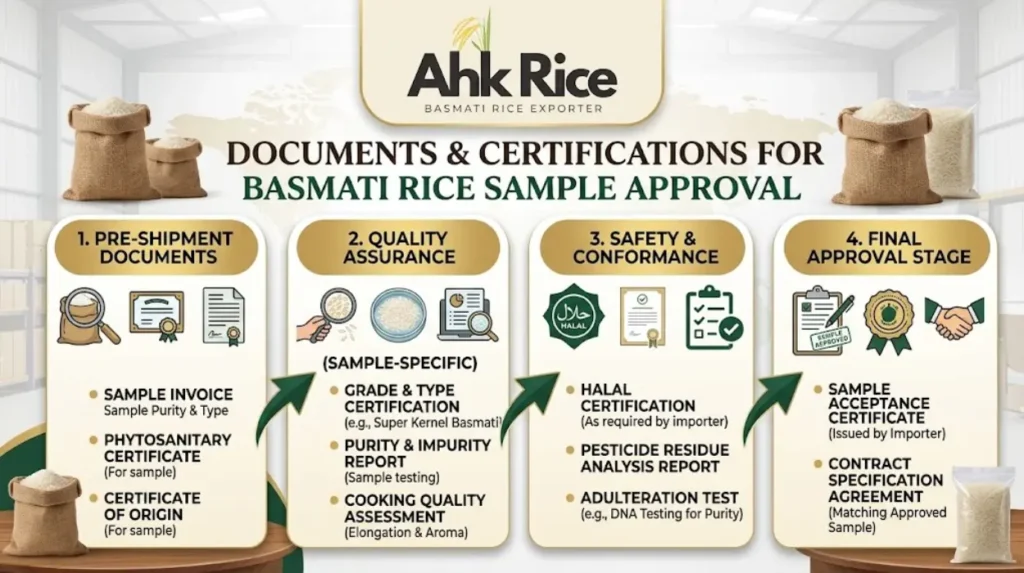
Sample approval normally uses a product specification sheet, sample identification record and written buyer acceptance. Commercial imports also require applicable food safety evidence, laboratory results, export documents and destination-specific compliance checks, depending on the importing country’s laws and the sales contract.
The sample stage and the commercial shipment stage have different documentation needs. A sample approval record confirms product acceptance, while regulatory documents demonstrate compliance with relevant import and export requirements.
Common records include:
- Product specification sheet: Defines the variety, grade, grain length, broken percentage, moisture and other agreed quality parameters.
- Sample identification record: Connects the tested sample to its variety, grade, preparation date and reference lot where applicable.
- Written approval: Records the buyer’s acceptance and any agreed conditions.
- Certificate of Analysis (COA): Reports test results for specified quality or safety parameters when testing is performed.
- Inspection report: Records the findings of an agreed inspection before shipment.
- Phytosanitary certificate: Applies where required by the destination’s plant-health rules.
- Certificate of origin: Establishes the declared origin when required for the import or trade arrangement.
- Commercial invoice and packing list: Describe the goods, quantities, packaging and transaction details.
- Bill of lading: Provides transport and shipment information for sea freight.
Food safety and management standards such as HACCP and ISO 22000 support hazard control and food safety management. They do not automatically prove that every rice consignment meets every importing country’s requirements.
Halal certification applies where required by the buyer, product claims or destination rules. Pesticide residue limits, contaminant testing, labelling and import permits depend on the relevant market and applicable regulations.
Importers should confirm current requirements with their customs broker and competent food or plant-health authority. Approval of a physical sample does not exempt the bulk shipment from regulatory checks.
What Common Problems Can Occur During Basmati Rice Sample Approval?
Common problems include testing the wrong grade, relying on vague specifications, using inconsistent cooking methods, approving an unrepresentative sample and failing to record acceptance. Importers prevent these issues by documenting requirements, identifying samples and verifying the production lot before shipment.
Approving the wrong product
A buyer tests steam Basmati but later orders Golden Sella. The two products have different processing characteristics, so the original approval does not establish acceptance of the substituted grade.
Prevention: Record the exact variety and processing grade on the sample label, specification sheet and purchase order.
Relying on appearance alone
Rice with attractive, long kernels can still fail the buyer’s cooking requirements or moisture limits.
Prevention: Combine visual inspection with measurements, cooking tests and laboratory analysis where relevant.
Using vague quality descriptions
Terms such as “premium”, “extra-long” and “low broken” do not specify numerical acceptance criteria.
Prevention: Agree on measurable limits, testing methods and acceptable tolerances before confirming the order.
Testing samples under different conditions
Different water ratios, soaking periods and cooking times create inconsistent results.
Prevention: Record a repeatable cooking method and use it for comparative testing.
Assuming the approved sample guarantees the entire shipment
A sample represents a defined product or lot. It does not guarantee that every future batch will have identical characteristics without production controls and verification.
Prevention: Link approval to written specifications, maintain batch traceability and arrange agreed pre-shipment inspection or testing.
Ignoring destination requirements
A sample can satisfy the buyer’s quality preferences but fail a destination’s labelling, residue or documentation requirements.
Prevention: Check market-specific import rules before production and final packing.
How Can Importers Confirm That Bulk Rice Matches the Approved Sample?
Importers confirm sample-to-shipment consistency by linking the approved sample to written specifications, production records and the relevant shipment lot. They then compare representative pre-shipment samples and inspection results against the contract before authorising dispatch.
Sample approval is the starting point for quality control, not its final stage. The exporter must translate the approved requirements into production instructions and measurable inspection criteria.
The process typically includes the following controls:
- Retain the approval record. Store the approved specification, sample reference, date and written buyer acceptance.
- Set production parameters. Use the approved variety, processing grade, grain-quality limits and packaging requirements.
- Check the processed rice. Measure the agreed characteristics during production and after milling.
- Take a representative sample. Identify the production lot and use an agreed sampling method.
- Verify compliance. Compare inspection findings and applicable laboratory results with the contract.
- Inspect the packaging. Check bag weight, sealing, printed information and shipping marks.
- Document the shipment. Maintain records connecting the inspected lot to the commercial order and shipping documents.
Buyers should define acceptable tolerances and the method for handling non-conforming goods before signing the contract. The agreement should also identify who arranges inspection, who pays for testing and what happens if results fall outside the approved limits.
A detailed explanation of how exporters maintain consistency between an approved sample and commercial production belongs in the next stage of the buyer’s research: sample-to-shipment matching and bulk rice quality control.
This relationship matters because the buyer needs more than an attractive sample. The buyer needs evidence that the supplied lot meets the agreed commercial specification.
Frequently Asked Questions
How long does Basmati rice sample approval take?
Sample preparation commonly takes 1–3 days, and courier delivery commonly takes 4–7 days. Physical inspection, cooking tests and written approval add time depending on the buyer’s evaluation process.
What should importers test in a Basmati rice sample?
Importers should check grain length, broken percentage, moisture, purity, colour, aroma and cooking performance. Laboratory testing supports verification of relevant safety and quality requirements.
Does sample approval guarantee the same quality in bulk shipments?
No. Sample approval establishes the agreed quality reference. Production monitoring, representative sampling, inspection and traceability are necessary to verify that the commercial shipment meets the approved specification.
Can importers request samples of different Basmati varieties?
Yes. Importers can evaluate varieties such as 1121, Super Kernel and 1509, including available white, steam and Golden Sella grades. Each sample should be clearly identified by variety and processing grade.
Which documents confirm rice sample approval?
The main records are the product specification sheet, sample identification details and written buyer acceptance. A COA, inspection report and other compliance documents support verification where required by the contract or destination market.