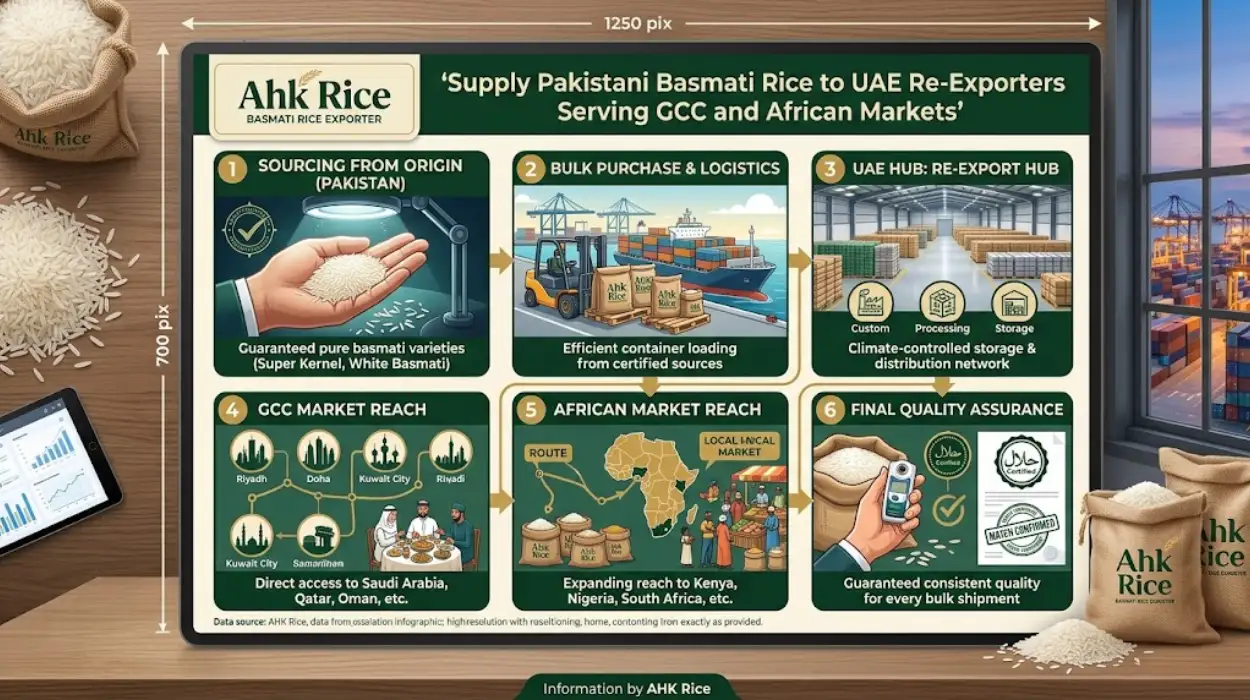
Supply Pakistani Basmati Rice to UAE Re-Exporters Serving GCC and African Markets
UAE re-exporters need consistent rice specifications, commercially workable prices, export-ready documentation and predictable shipment planning. Sourcing directly from Pakistan helps importers coordinate product grades, packaging and order quantities before goods arrive in the UAE for onward distribution.
Dubai and other UAE trading centres connect Pakistani rice suppliers with wholesalers, retailers, foodservice distributors and importers across the Gulf and African markets. However, a profitable re-export operation depends on matching each destination’s requirements rather than buying rice solely on its initial price.
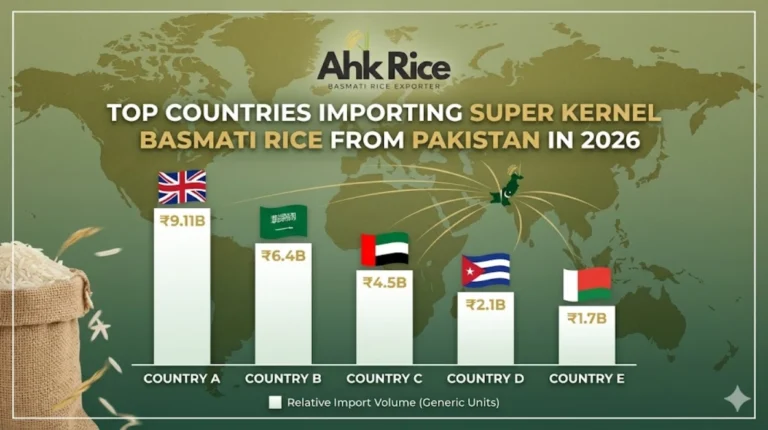
Businesses evaluating international demand should first understand which countries import the most Pakistani Basmati rice, then compare the UAE’s distribution advantages with other sourcing and trading options. This market knowledge helps buyers identify suitable grades, target customers and realistic order volumes.
The next step is to establish a supply arrangement that supports repeat orders. A reliable exporter should confirm the agreed variety, grain specifications, broken percentage, moisture level, packing format, inspection requirements and shipping terms before production or dispatch begins.
What is the best solution for supplying GCC and African markets from the UAE?
The practical solution is to source destination-specific Basmati grades from Pakistan, consolidate product specifications and arrange compliant shipments through the UAE. This approach helps re-exporters maintain purchasing control while adapting packaging and documentation to different customer requirements.
Pakistani Basmati varieties serve different commercial needs. Buyers should select products according to their customers’ cooking expectations, retail positioning and price sensitivity.
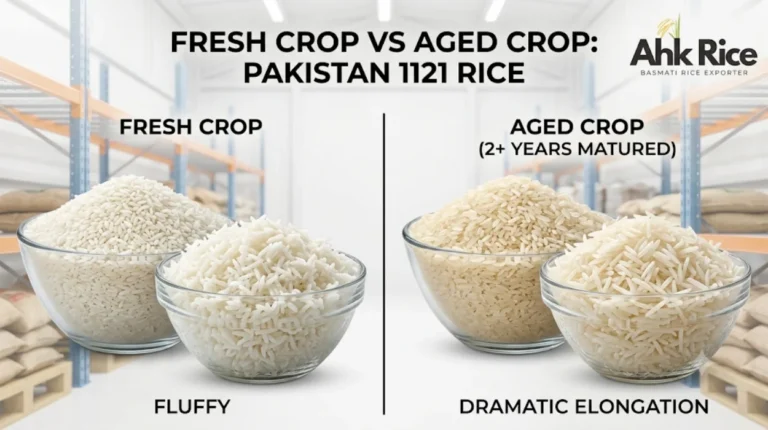
- 1121 Basmati: Suitable for premium retail, catering and foodservice buyers who prioritise long grains and cooked elongation.
- Super Kernel Basmati: Appropriate for traditional Basmati markets seeking characteristic aroma, texture and established Pakistani origin.
- 1509 Basmati: A practical option for buyers balancing grain length, supply economics and price-sensitive distribution.
- Steam and parboiled varieties: Suitable for specific retail, catering and institutional applications, depending on customer preferences.
Before placing a bulk order, UAE traders should request an approved sample and confirm the precise grade. The product supplied commercially must match the agreed sample and written specifications.
Re-exporters should also distinguish between importing rice into the UAE for local sale and exporting it onward to another country. The second transaction can require additional customs procedures, destination-specific import approvals, labelling and food-safety documents. The UAE importer and overseas buyer should confirm these requirements before shipment.
For a broader comparison of the UAE’s trading role, review why the UAE is a re-export hub for Pakistani Basmati rice to GCC, Africa and Central Asia.
Why should UAE re-exporters choose AHK Rice?
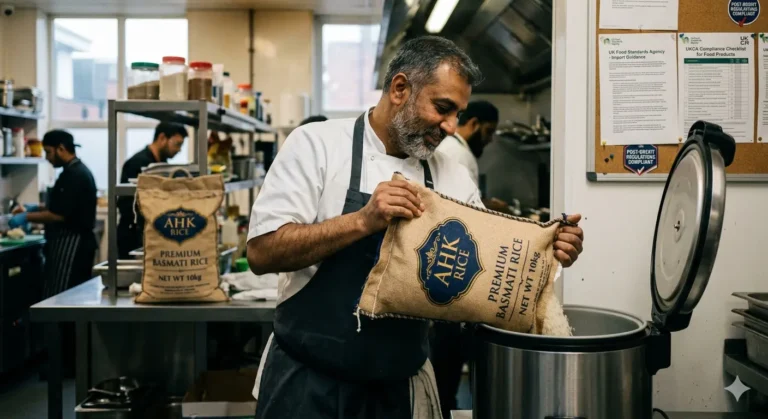
AHK Rice supplies Pakistani Basmati rice from Punjab, with options for different grades, packaging requirements and export destinations. Direct coordination with the exporter helps buyers align product specifications, commercial documentation and shipment preparation with their distribution plans.
AHK Rice supplies 1121, Super Kernel and 1509 varieties to international markets. Its export process can support buyers who need coordinated processing, packaging and shipment documentation rather than separate arrangements with multiple suppliers.
Through AHK Rice’s Pakistani Basmati rice export service, importers can discuss the variety, grade, order volume and destination requirements before requesting a formal quotation.
A professional purchase specification should identify:
- Rice variety and processing type.
- Minimum acceptable grain length, where applicable.
- Maximum broken percentage and moisture level.
- Packaging material, bag weight and branding requirements.
- Required inspection, laboratory testing and certificates.
- Quantity, Incoterm, destination port and shipment schedule.
These details reduce misunderstandings between the exporter, UAE importer and final overseas customer.
For example, a Dubai wholesaler supplying supermarkets in the GCC may require branded 5 kg and 10 kg bags. A distributor serving African wholesale customers may prioritise larger bags, competitive landed costs and consistent bulk availability. Both buyers need suitable rice, but their commercial specifications differ.
AHK Rice can discuss these requirements before confirming the order. Actual availability, specifications, production schedules and export arrangements must be agreed in the written quotation and contract.
What results can re-exporters expect from a structured supply process?
A structured sourcing process gives re-exporters clearer product control, more reliable purchasing calculations and fewer avoidable specification disputes. Results depend on the agreed contract, shipment execution, destination regulations and the buyer’s distribution network.
The main commercial benefit is consistency between sample approval and bulk delivery. When the buyer documents grain specifications, cooking performance, packaging and inspection requirements, both parties have a defined basis for acceptance.
A second benefit is improved cost visibility. The buyer can compare the supplier’s price with freight, insurance where applicable, customs charges, handling, storage, relabelling and onward transportation costs. This produces a more useful landed-cost calculation than comparing FOB prices alone.
A third benefit is better inventory planning. Buyers can schedule procurement against confirmed customer demand and estimated transit times, while allowing for production, port handling, customs clearance and possible delays.
Shipping estimates must be treated as planning ranges, not guaranteed delivery dates. As preliminary budgeting assumptions, buyers may allow approximately 3–7 days for Pakistan-to-UAE ocean transit, 7–18 days for onward GCC sea movements, and 15–35 days for some UAE-to-East or West African sea routes. Central Asian deliveries vary substantially by destination and inland transport requirements.
These are indicative planning ranges, not verified carrier schedules. Vessel routing, transshipment, port congestion, customs procedures and the exact destination can change the total lead time. Obtain a current sailing schedule and written freight quotation before committing to a delivery date.
How much does Pakistani Basmati rice supply cost?
The final cost depends on rice grade, order quantity, packing, inspection, freight, destination charges and the agreed Incoterm. UAE re-exporters should calculate the total landed cost before setting their resale price or confirming a customer margin.
The principal cost factors are:
| Cost factor | What buyers should confirm |
|---|---|
| Rice variety | 1121, Super Kernel or 1509, including processing type |
| Quality specifications | Grain length, broken percentage, moisture and agreed tolerances |
| Order quantity | Total metric tonnes and container-loading plan |
| Packaging | Bag size, material, printing and private-label requirements |
| Freight and insurance | Route, carrier, coverage and applicable surcharges |
| Inspection and documents | Laboratory tests, certificates and third-party inspection fees |
| Destination expenses | Customs, handling, storage, local transport and onward freight |
Request separate pricing for the rice, packaging, inspection and logistics wherever practical. This helps identify which expenses are included in the supplier’s offer and which remain payable by the buyer.
Under FOB terms, the contract generally allocates responsibility differently from CIF terms, where the seller arranges ocean freight and insurance to the named destination port. Buyers must check the precise Incoterm, named port and contract wording instead of assuming that all destination expenses are included.
No single price per metric tonne applies to every Basmati order. A valid quotation requires the variety, quality specification, volume, packing, destination and delivery terms.
What is the complete sample process, including costs?
A commercial sample allows the buyer to assess cooking quality and verify specifications before committing to bulk procurement. The process should document the requested grade, sample quantity, courier arrangements, laboratory requirements and acceptance criteria.
The standard process follows six steps.
Step 1: Submit the product requirement. The buyer specifies the variety, processing type, grain length, broken percentage, moisture limit, packaging preferences and target market.
Step 2: Confirm sample availability. The exporter confirms whether the requested sample can be prepared and identifies any applicable sample-preparation charges.
Step 3: Agree on shipping costs. Courier charges depend on the destination, parcel weight, service level and collection arrangements. Any phytosanitary or other regulatory charges must be confirmed separately if applicable to the shipment.
Step 4: Dispatch the sample. The exporter arranges the agreed shipment and provides available tracking information and relevant sample documentation.
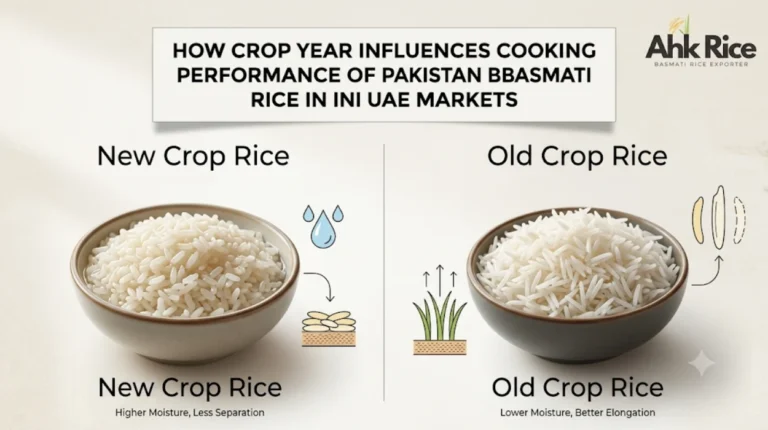
Step 5: Complete the quality assessment. The buyer checks aroma, grain appearance, cooking performance, elongation and consistency against the intended market’s requirements. Independent laboratory testing can be arranged when required.
Step 6: Approve the commercial specification. Both parties confirm the accepted sample, bulk specifications, packaging, quantity, price, payment terms and shipment conditions in writing.
AHK Rice may offer up to 20 kg of Super Kernel Basmati for sampling under its stated sample arrangement. The buyer covers courier shipping and applicable phytosanitary charges. Availability, destination eligibility and final costs should be confirmed before dispatch.
A sample is not a substitute for agreed bulk inspection or mandatory destination testing. Buyers should establish in advance whether the contract requires a pre-shipment inspection, certificate of analysis or independent laboratory report.
How can UAE re-exporters get started with AHK Rice?
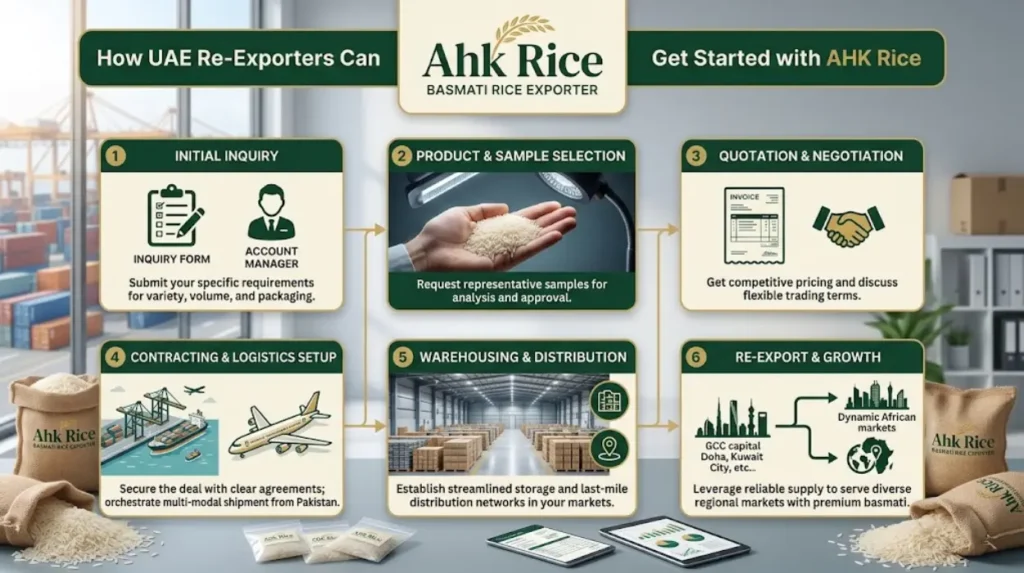
Start by matching the product to the target market, requesting a written quotation and confirming import requirements before approving production. A documented procurement process makes it easier to evaluate supplier offers and coordinate the UAE import and onward export transactions.
Prepare a purchase brief containing the following information:
- Destination countries and intended customer segment.
- Required Basmati variety and processing type.
- Quality parameters and approved sample requirements.
- Order volume and preferred packaging.
- Destination port, Incoterm and requested delivery window.
- Required certificates, inspections and labelling.
- Payment terms and target landed cost.
The exporter can then assess product availability, provide the relevant specifications and quote against the requested shipment terms. The UAE buyer should separately confirm re-export eligibility, customs procedures and food-label requirements for each destination.
For repeat business, retain the approved sample reference, signed specification, packing details and inspection results for every order. This creates a consistent purchasing standard and helps the buyer compare subsequent shipments objectively.
AHK Rice supports export enquiries for Pakistani Basmati varieties, including 1121, Super Kernel and 1509. The final purchase decision should depend on documented quality, confirmed costs, delivery feasibility and compliance with the destination market’s rules.
UAE re-exporters serving GCC, African and Central Asian markets should compare rice quality, total landed cost, shipment timing and destination compliance before committing to a supplier. Share your required variety, volume, packaging and destination with AHK Rice to request a tailored export quotation.
Frequently asked questions
Which Pakistani Basmati varieties suit UAE re-exporters?
1121 suits premium retail and foodservice segments that value long grains.
Super Kernel serves buyers seeking traditional aroma and Pakistani Basmati character.
1509 can suit price-sensitive wholesale and distribution channels.
The correct choice depends on the destination and customer expectations.
Approve a sample and written specification before placing a bulk order.
How long does shipping take from Pakistan to the UAE?
Ocean transit may take approximately 3–7 days under some routing arrangements.
Actual transit depends on the departure port, vessel schedule and destination port.
Production, loading and documentation add time before departure.
Customs clearance and port handling add time after arrival.
Confirm current schedules with the exporter and freight provider.
How much does a Basmati rice sample cost?
Sample preparation charges depend on the product and quantity requested.
Courier charges vary by destination, parcel weight and service level.
Applicable phytosanitary or other regulatory charges may be additional.
AHK Rice’s stated offer allows up to 20 kg of Super Kernel Basmati under its sample arrangement.
Confirm eligibility and the total payable amount before dispatch.
Can UAE importers re-export rice to African and GCC countries?
Re-exporting is possible when the relevant trade and regulatory requirements are met.
The importer must confirm UAE customs and re-export procedures.
The destination buyer must verify food-import permits and documentation.
Labelling, testing and certificate requirements differ between markets.
Confirm compliance before shipping or printing destination-specific packaging.
What information is needed for a rice export quotation?
Specify the variety, processing type and required quality parameters.
State the quantity, packaging format and destination port.
Identify any inspection, laboratory testing or certification requirements.
Confirm the preferred Incoterm and requested shipment period.
These details allow AHK Rice to prepare a quotation for the proposed order.