Which Countries Import the Most Pakistani Basmati Rice?
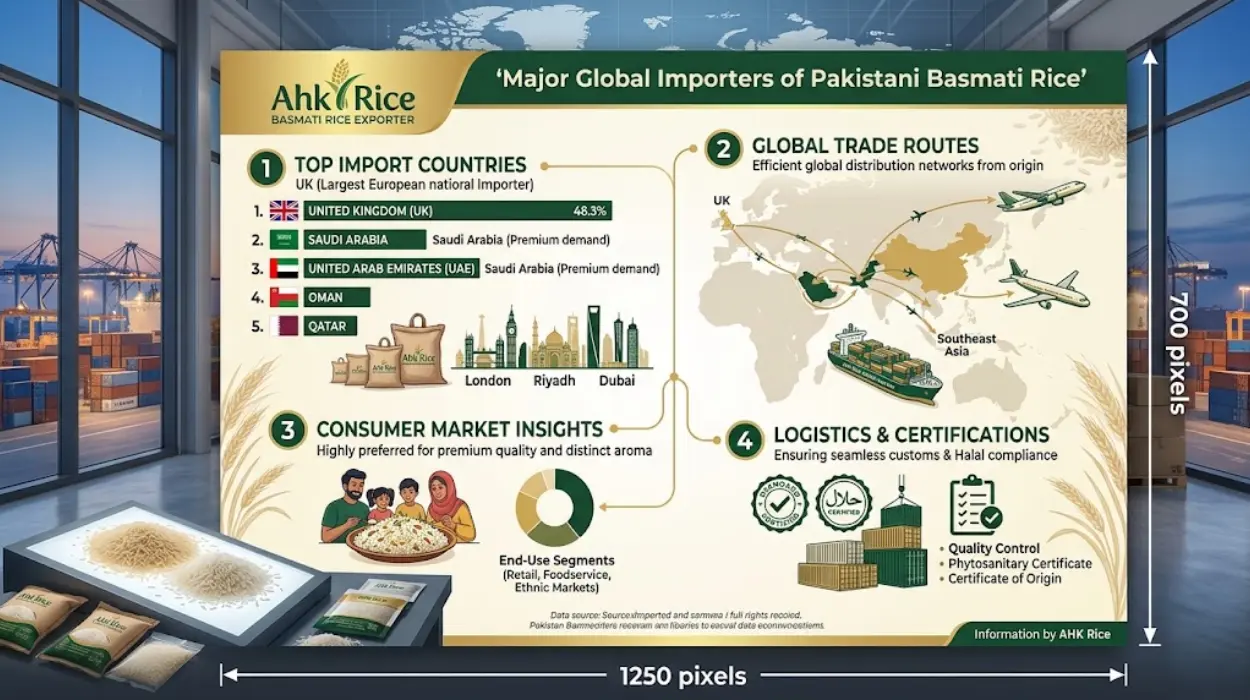
Pakistani Basmati rice reaches markets across the Middle East, Europe, North America, Africa, and Asia. Major destinations include the United Arab Emirates, Saudi Arabia, the United Kingdom, the United States, and other markets that source aromatic rice for retail, foodservice, wholesale, and distribution.
Pakistan produces Basmati rice primarily in Punjab, where suitable soil, climate, and agricultural conditions support its distinctive aroma and grain characteristics. Exporters supply different varieties according to buyers’ requirements, including grain length, milling quality, cooking performance, packaging, and price.
The United Arab Emirates serves as an important destination because Dubai connects rice importers, wholesalers, supermarkets, restaurants, and re-export businesses. Saudi Arabia also has demand for Pakistani rice among households, caterers, restaurants, and food distributors.
The United Kingdom and United States serve established South Asian grocery markets alongside mainstream retailers and foodservice businesses. African destinations, including markets in East and West Africa, also purchase Pakistani rice for wholesale distribution and household consumption.
Export rankings change by year, product classification, and measurement method. Basmati-only trade statistics differ from figures covering all Pakistani rice, including non-Basmati varieties. Import value, shipment volume, and the number of consignments also produce different rankings. A reliable comparison therefore uses a defined reporting period and the same product category.
Which Countries Lead Pakistan’s Basmati Rice Export Trade?
Pakistan’s leading Basmati export destinations include the United Arab Emirates, Saudi Arabia, Afghanistan, Oman, the United Kingdom, and the United States. Pakistan Bureau of Statistics data for FY2024 identifies the UAE as its largest listed Basmati destination by export value.
Pakistan Bureau of Statistics
The following figures show the scale of Pakistan’s Basmati trade in FY2024. They represent export value and quantity, not current-year rankings.
| Destination | Export value | Export quantity |
|---|---|---|
| United Arab Emirates | US$150 million | 149,092 MT |
| Saudi Arabia | US$112 million | 101,909 MT |
| Afghanistan | US$83 million | 75,674 MT |
| Oman | US$71 million | 58,249 MT |
| Italy | US$60 million | 46,004 MT |
| Yemen | US$56 million | 51,159 MT |
| United Kingdom | US$45 million | 37,395 MT |
| United States | US$31 million | 22,276 MT |
Source: Pakistan Bureau of Statistics, Annual Analytical Report on External Trade Statistics, FY2023–24. Figures are rounded export values and reported quantities.
Pakistan Bureau of Statistics
These figures establish a useful baseline for understanding demand. They also show why exporters distinguish Basmati-specific statistics from total rice exports. Countries that purchase large quantities of non-Basmati rice do not automatically rank among Pakistan’s leading Basmati buyers.
United Arab Emirates
The UAE is a major market for Pakistani Basmati rice because it combines domestic consumption with international distribution. Dubai’s trading infrastructure connects importers with buyers across the Gulf Cooperation Council (GCC), Africa, and other regions. The market serves supermarket chains, independent retailers, restaurants, catering companies, and wholesale distributors.
Saudi Arabia
Saudi Arabia imports Pakistani Basmati for household cooking, restaurants, catering, and large-scale meal preparation. Long-grain varieties such as 1121 Basmati suit buyers who prioritise grain elongation and presentation in rice dishes. Steam and Sella processing options serve different cooking and foodservice requirements.
United Kingdom and United States
The UK and US have established South Asian grocery channels alongside mainstream food retailers. Importers evaluate aroma, grain length, cooking consistency, packaging, traceability, and food safety. Retail-ready bags and bulk shipments serve different distribution models.
European markets
Italy, the Netherlands, Germany, France, and Belgium connect Pakistani rice with ethnic retail, foodservice, and specialist food distribution. European buyers also focus on pesticide residue limits, contaminant controls, traceability, and documentation required under applicable food regulations.
Where Is Pakistani Basmati Rice Grown?
Pakistani Basmati rice grows mainly in Punjab, where climate, soil, water availability, and seasonal conditions support aromatic grain development. Important growing areas include Gujranwala, Hafizabad, Sheikhupura, Narowal, and Sialkot, which supply paddy for milling and export preparation.
Basmati is a distinctive aromatic rice associated with long grains and characteristic cooked texture. Farmers cultivate it under specific growing conditions, then harvest mature paddy for drying, storage, and milling.
Punjab’s established rice-growing communities and processing infrastructure connect farms with domestic mills and export supply chains. Geographic origin matters because buyers use it to assess authenticity, expected grain characteristics, and the consistency of their supply.
After harvest, paddy requires controlled handling. Excess moisture encourages deterioration during storage, while careless drying can damage kernels. Mills manage drying and storage before removing the husk and bran to produce the required rice grade.
Origin alone does not guarantee a uniform shipment. Grain length, broken percentage, moisture, aroma, cleanliness, and milling quality depend on variety, crop conditions, storage, and processing controls.
How Is Pakistani Basmati Rice Processed for Export?
Export preparation converts harvested paddy into a graded, packed, and documented food product. The process includes drying, storage, dehusking, milling, polishing where specified, grading, sorting, quality inspection, packaging, and shipment preparation to meet the buyer’s agreed specifications.
1. Paddy reception and drying
Mills receive harvested paddy and assess its condition. Drying reduces moisture to a suitable level for safe storage and processing. Operators control drying conditions to reduce kernel cracking and preserve milling yield.
2. Dehusking and milling
Dehusking removes the outer husk. Further milling removes bran layers to produce white rice, while brown rice retains its bran. Processing choices depend on whether the order specifies raw, steam, or parboiled Sella rice.
3. Grading and sorting
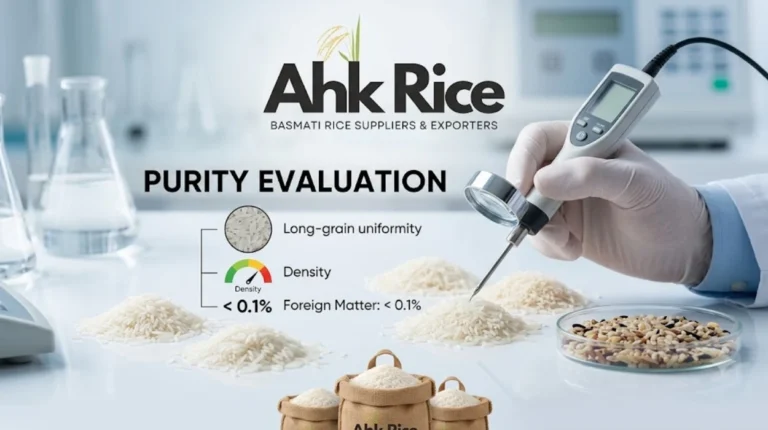
Grading separates whole kernels from broken grains and identifies the required size and quality categories. Optical or colour sorting equipment removes discoloured kernels and selected foreign material. Sieves and other cleaning systems support consistent product quality.
4. Quality testing
Quality teams assess grain length, moisture, broken percentage, foreign matter, appearance, and other contractual parameters. Buyers also specify requirements for residues, contaminants, microbiological safety where applicable, and inspection documents. Laboratory testing follows the destination market’s rules and the purchase contract.
5. Packaging and export preparation
Rice is packed into formats such as 5 kg, 10 kg, 25 kg, and 50 kg bags, depending on the order. Packaging identifies the product, net weight, country of origin, batch information, and other details required by the destination. Exporters then arrange documentation, container loading, and transport.
Which Grades and Varieties Do International Buyers Import?
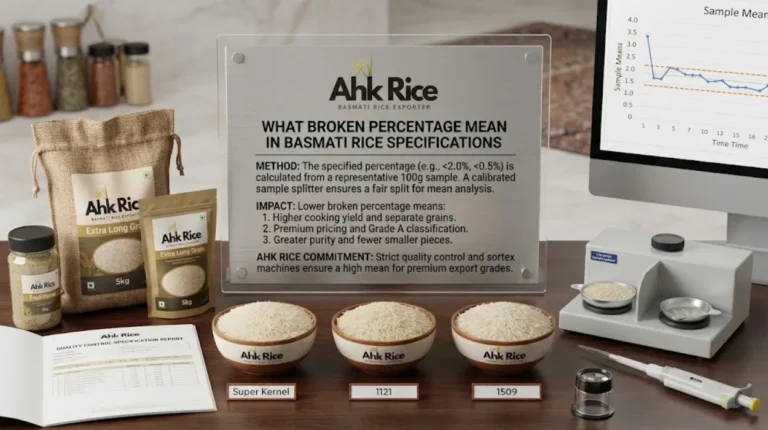
International buyers select Pakistani Basmati according to grain length, processing method, appearance, aroma, broken percentage, and intended use. Major commercial varieties include 1121, Super Kernel, and 1509, each available in different processing grades and specifications for retail, catering, wholesale, and private-label distribution.
| Variety or grade | Main characteristics | Typical applications |
|---|---|---|
| 1121 Basmati | Extra-long grain and strong cooked elongation | Premium retail, restaurants, catering |
| Super Kernel Basmati | Traditional aroma and familiar Basmati cooking characteristics | Household retail, ethnic grocery, foodservice |
| 1509 Basmati | Long grain and a shorter crop maturity cycle | Wholesale, bulk supply, value-focused retail |
| Steam Basmati | Heat-treated processing that changes grain firmness and cooking behaviour | Retail, restaurants, catering |
| Golden Sella Basmati | Parboiled rice with a golden appearance and firm cooked grains | Banquets, institutional kitchens, catering |
| Creamy Sella Basmati | Parboiled rice with a lighter cream-coloured appearance | Foodservice, wholesale distribution |
| Brown Basmati | Bran retained after dehusking | Whole-grain retail and specialist food markets |
| Broken Basmati | Kernels separated into broken-grain grades | Selected food manufacturing and price-sensitive applications |
The variety and processing method are separate specifications. For example, 1121 identifies a rice variety, while Steam and Golden Sella describe processing styles. Buyers should confirm both when requesting quotations or samples.
Grain length is also measured using a defined method. Raw kernel length and cooked grain elongation are different measurements. A supplier’s specification should identify which measurement applies rather than treating the two as interchangeable.
What Benefits Make Pakistani Basmati Attractive to Importers?
Pakistani Basmati offers aromatic grain characteristics, multiple variety choices, established export processing, and different milling options. These features help importers serve premium retail, ethnic grocery, restaurant, catering, and wholesale customers while selecting grades that match their target prices and cooking requirements.
The principal benefit is product choice. Importers can source extra-long 1121, aromatic Super Kernel, or 1509 according to their customers’ expectations. Processing options add flexibility for markets that prefer raw white rice, Steam rice, or parboiled Sella rice.
A second benefit is the established supply chain connecting Punjab’s farms with mills, packers, laboratories, freight operators, and export terminals. This structure supports commercial orders with defined specifications and repeat purchasing arrangements.
A third benefit is packaging flexibility. Importers serving supermarkets require retail branding and consumer information, while wholesalers and institutional buyers often prefer larger bags. Correct specifications reduce confusion between product grades and help buyers compare quotations accurately.
These benefits depend on execution. Consistent quality requires proper storage, grading, testing, packaging, and shipment controls. A variety name alone does not establish the quality of an individual consignment.
What Certifications and Import Requirements Apply to Pakistani Basmati Rice?
Import requirements depend on the destination, product classification, processing method, and buyer contract. Exporters and importers check food safety rules, plant-health documentation where applicable, residue limits, labelling, origin declarations, and required certificates before shipment to avoid compliance delays.
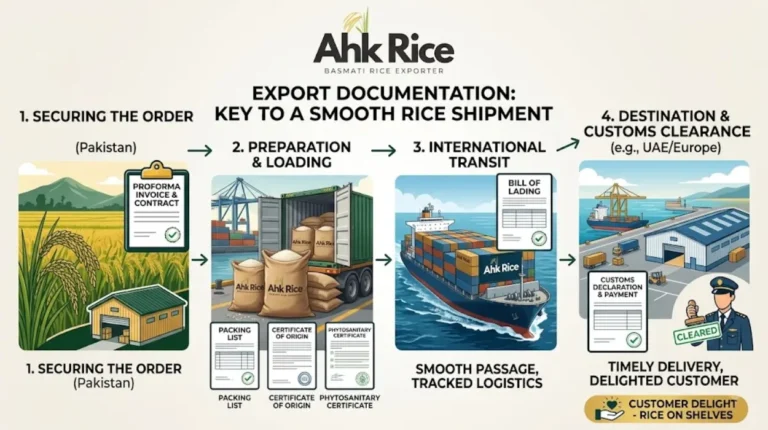
Common documents and controls include:
- Phytosanitary certificate: Issued when required by the destination’s plant-health rules.
- Certificate of origin: Identifies the declared country of origin under applicable trade procedures.
- Commercial invoice and packing list: Describe the goods, quantities, packaging, and transaction details.
- Bill of lading: Records the shipment and transport arrangement.
- Certificate of analysis (COA): Reports agreed product or laboratory parameters when required.
- Inspection or laboratory reports: Support compliance with contract specifications and destination-market requirements.
Food safety systems such as HACCP and ISO 22000 support hazard control and food safety management. Halal certification is relevant when required by the buyer, market, or product-specific rules. Neither a general certification nor a COA automatically replaces mandatory import documents or regulatory testing.
For the UAE, importers must verify applicable local food registration, label requirements, and clearance procedures. For the UK and European Union, relevant requirements include applicable maximum residue levels, contaminant limits, traceability, and food information rules. The United States has its own food import and facility requirements, including applicable FDA rules.
Requirements change, so the importer should confirm the current rules with the destination’s competent authority before goods leave Pakistan.
How Do Importers Use Pakistani Basmati Rice?
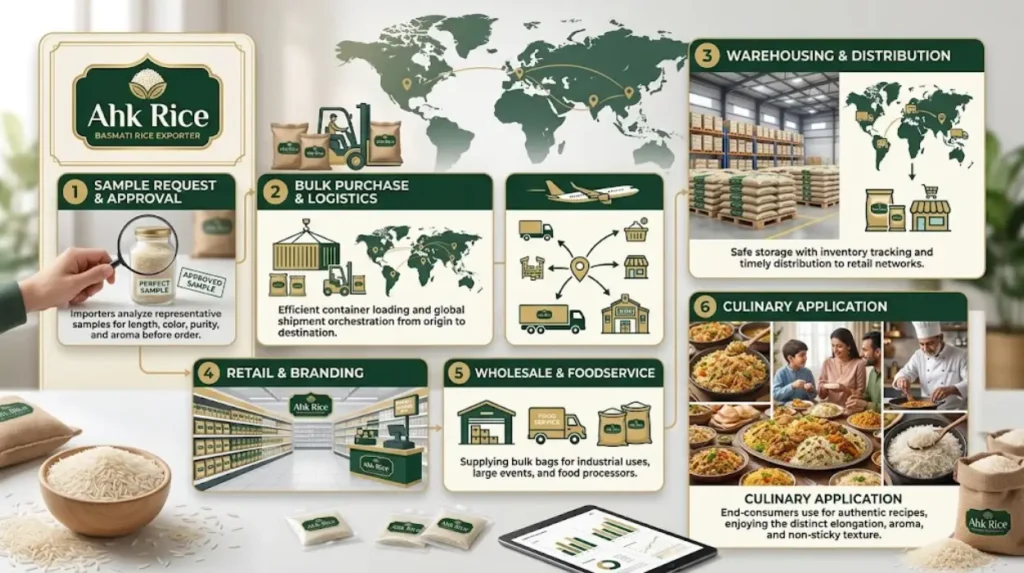
Importers distribute Pakistani Basmati through retail stores, ethnic grocery networks, restaurants, catering businesses, foodservice suppliers, and wholesale markets. Each channel has different requirements for grain quality, packaging, cooking performance, order volume, and pricing, which determine the appropriate variety and grade.
Retailers usually need consistent quality, attractive packaging, accurate labels, and repeatable cooking results. Super Kernel and 1121 serve buyers who prioritise aroma and grain presentation, while 1509 supports selected price-conscious segments.
Restaurants and catering companies assess how rice performs in biryani, pulao, and large-batch cooking. Sella grades suit kitchens seeking firm, separate cooked grains, although the final result also depends on cooking technique and the product specification.
Wholesalers typically evaluate bulk availability, bag weight, broken percentage, moisture, and shipment economics. Private-label businesses add requirements for brand artwork, packaging materials, print quality, and destination-specific labelling.
What Common Problems Affect Pakistani Basmati Rice Imports?
Import problems commonly involve inconsistent grain specifications, excessive moisture, broken kernels, inaccurate labels, incomplete documentation, and delays in inspection or customs clearance. Importers reduce these risks by approving written specifications, reviewing samples, confirming regulatory requirements, and checking shipment documents before dispatch.
A common misconception is that all long-grain rice is Basmati. Grain length alone does not establish variety, origin, aroma, or authenticity. Buyers should specify the variety and require supporting product documentation.
Another misconception is that every 1121 or Super Kernel shipment has identical cooking performance. Harvest conditions, storage, processing, and milling affect the finished product. A representative sample and agreed quality limits provide a more reliable basis for purchasing.
Moisture control is equally important. Poor drying or unsuitable storage increases the risk of deterioration, while unsuitable packaging can expose rice to moisture during handling and transit. Importers should agree on moisture limits and storage conditions.
Labelling errors create additional risk. Missing mandatory information, incorrect country-of-origin declarations, or inconsistent product descriptions can delay clearance. Importers should approve final artwork and verify required documentation before production and loading.
Why Is the UAE Important for Pakistani Basmati Rice Distribution?
The UAE combines domestic rice demand with established import, wholesale, logistics, and re-export networks. Dubai connects suppliers with regional distributors serving GCC countries, African markets, and parts of Central Asia, making the country an important commercial gateway for international rice trade.
UAE importers serve supermarkets, restaurants, independent grocery stores, catering companies, and bulk distributors. Some businesses sell rice within the UAE, while others arrange onward distribution according to destination regulations, commercial agreements, and customs procedures.
Re-export activity depends on more than geographical location. Buyers evaluate freight costs, warehousing, packaging, product demand, documentation, and the regulatory requirements of the final destination. Re-exported goods must meet the applicable rules for both the transit or trading arrangement and the receiving market.
The UAE’s role is especially relevant to exporters comparing direct shipments with regional distribution through Dubai. Understanding this trade structure helps explain why the UAE appears prominently in Pakistan’s Basmati export statistics.
For a deeper explanation of the regional supply chain, see the related guide on why the UAE is a re-export hub for Pakistani Basmati rice to GCC, Africa and Central Asia. Replace the temporary homepage path with the published URL of the MOFU article before publishing.
Frequently Asked Questions About Pakistani Basmati Rice Imports
Which country imports the most Pakistani Basmati rice?
The United Arab Emirates ranked first among the listed destinations in Pakistan’s FY2024 Basmati export statistics, with approximately US$150 million in exports and 149,092 metric tonnes. Rankings vary by reporting period.
Which Pakistani Basmati varieties are popular internationally?
1121, Super Kernel, and 1509 are important Pakistani Basmati varieties. Buyers select among them based on grain characteristics, aroma, cooking performance, processing grade, and price requirements.
Where is Pakistani Basmati rice grown?
Pakistani Basmati grows mainly in Punjab. Important growing districts include Gujranwala, Hafizabad, Sheikhupura, Narowal, and Sialkot.
What certifications and documents do rice importers need?
Requirements depend on the destination. Common documents include commercial invoices, packing lists, bills of lading, certificates of origin, and phytosanitary certificates where required. Buyers also check food safety controls, laboratory reports, labelling, and applicable import regulations.
Why does the UAE re-export Pakistani Basmati rice?
The UAE has established logistics, warehousing, wholesale, and distribution networks that connect suppliers with regional buyers. Dubai serves as a trading gateway for GCC and other international markets, subject to destination-specific import rules.
What should an importer check before buying Pakistani Basmati rice?
Importers should confirm the variety, grain length, moisture limit, broken percentage, processing method, packaging, laboratory requirements, delivery terms, and shipment documents. Reviewing a representative sample helps assess quality before placing a commercial order.