Why is the UAE a re-export hub for Pakistani Basmati rice?
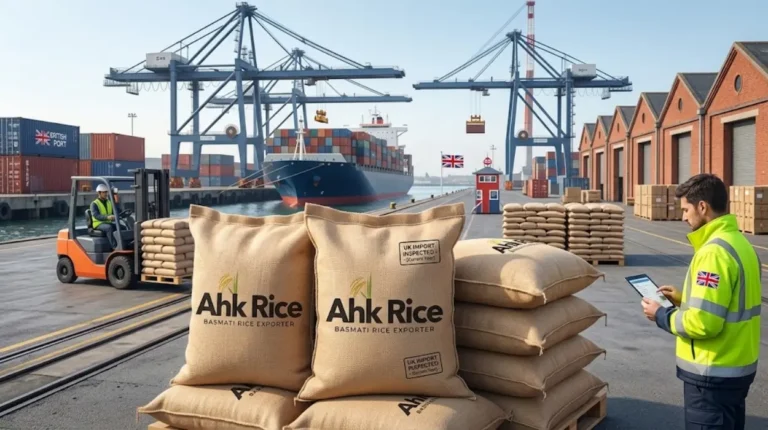
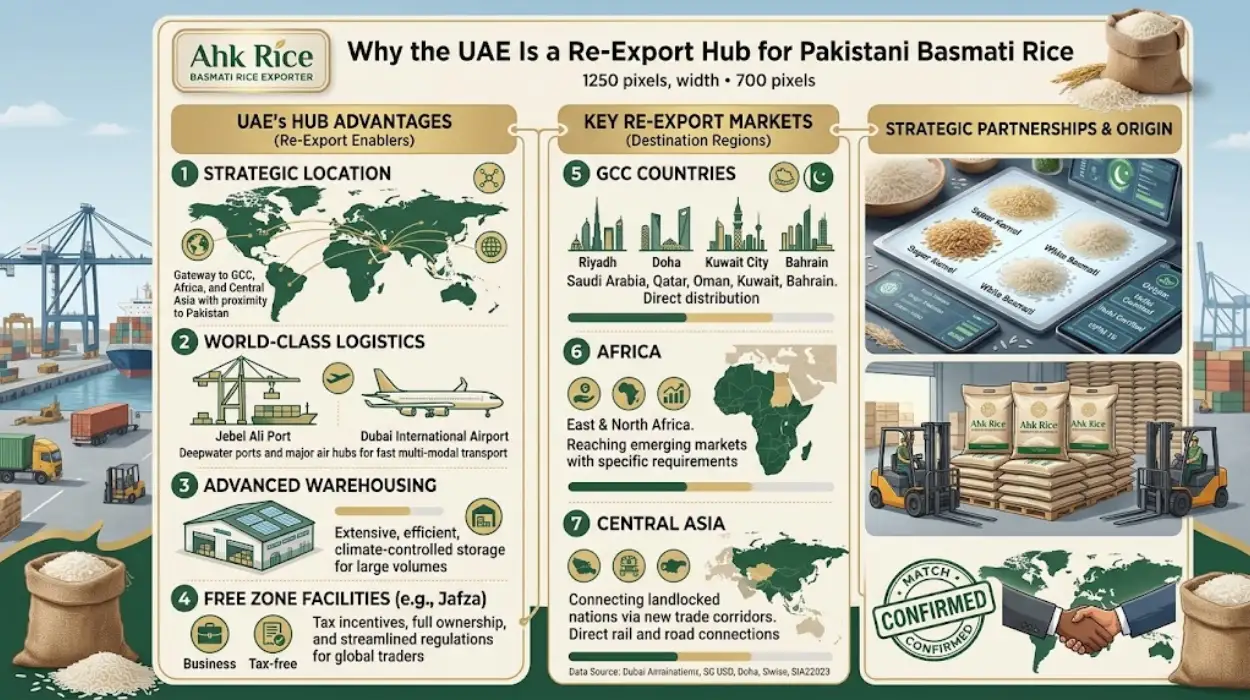
The UAE serves as a regional distribution hub because its ports, established food trading networks, warehousing facilities and access to GCC markets connect international suppliers with regional buyers. Pakistani Basmati rice exporters use this network to reach wholesalers, retailers and foodservice distributors across multiple destinations.
A re-export hub is a country or trading centre that imports products, then exports them to other markets with or without additional processing, repackaging or consolidation. Dubai and other UAE trading centres connect Pakistani rice mills with buyers who need reliable volumes, different grain grades and flexible packaging. This structure reduces the need for every regional buyer to establish direct sourcing relationships with multiple overseas suppliers.
Understanding how the UAE rice import market drives demand for Pakistani Basmati rice helps importers evaluate the commercial role of Dubai, local distribution channels and regional consumption patterns. The UAE’s re-export function is especially relevant for traders supplying Saudi Arabia, Oman, Qatar, Bahrain, Kuwait and selected markets in Africa and Central Asia.
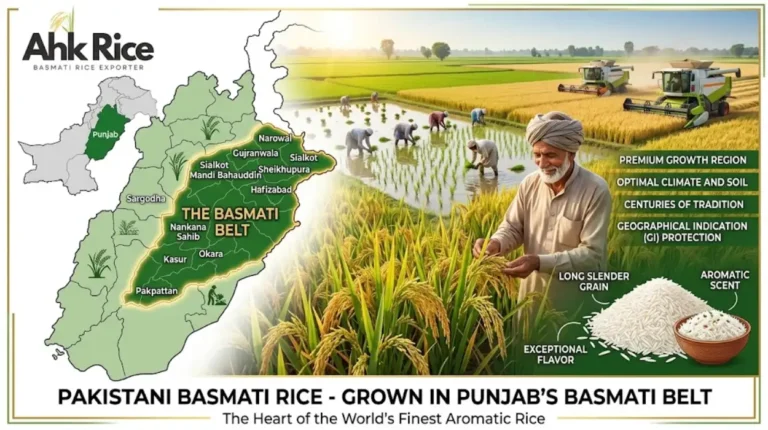
Pakistani Basmati rice fits this model because Punjab produces established aromatic varieties with different grain lengths, processing methods and price positions. Buyers can select premium long-grain rice for specialist retail or choose more cost-conscious grades for bulk distribution. AHK Rice’s Pakistani Basmati rice export services provide a sourcing reference for importers evaluating varieties, processing, packaging and export coordination.
What makes the UAE commercially attractive to rice re-exporters?
The UAE combines port access, established importers, free-zone infrastructure, food distribution networks and international connectivity. These advantages help traders coordinate shipments, maintain inventory and serve multiple markets, although each destination still requires appropriate documentation and import compliance.
Dubai’s position as a commercial centre supports food trading between Asia, the Middle East and Africa. Jebel Ali Port provides maritime connectivity, while Dubai’s wholesale and logistics ecosystem supports storage, cargo handling and onward distribution. Traders can source rice from Pakistan, hold inventory in the UAE and arrange deliveries according to customer demand.
The business model offers three main advantages:
- Consolidated sourcing: Importers can purchase several rice grades from Pakistani suppliers and distribute them through established regional networks.
- Inventory flexibility: Traders can maintain stock for repeat orders rather than arranging a separate shipment for every customer.
- Market segmentation: Importers can supply premium retailers, ethnic grocery stores, catering companies and price-sensitive wholesale buyers using different specifications.
These advantages do not eliminate customs duties, freight charges, destination registration or food safety requirements. Re-exporters must assess the applicable customs procedure, certificate requirements, labelling rules and transit arrangements for every destination.
What are the available solutions for supplying regional rice markets?
Re-exporters can operate through bulk distribution, branded retail packaging, private-label production or mixed-grade sourcing. The appropriate model depends on customer type, order volume, available working capital, destination regulations and the degree of control required over product specifications.
1. Bulk wholesale distribution
Bulk distribution focuses on supplying rice in larger commercial bags, commonly 25 kg or 50 kg, subject to buyer and destination requirements. The model suits wholesalers, foodservice distributors, institutional buyers and traders serving price-sensitive markets.
Its main advantage is operational simplicity. Buyers can prioritise grade consistency, loading efficiency, landed cost and repeat supply. Its limitation is reduced differentiation when several traders offer comparable rice specifications.
2. Branded retail packaging
Retail distribution uses consumer-facing packs, such as 1 kg, 5 kg and 10 kg bags, depending on the market. This approach suits supermarkets, ethnic grocery chains and established food brands.
Retail packaging supports product recognition and allows buyers to differentiate grain varieties, cooking characteristics and origin. However, it introduces additional costs for packaging materials, artwork, printing, labelling approval and inventory management.
3. Private-label supply
Private-label supply means a producer packs rice under the importer’s own brand. It suits distributors seeking to build a proprietary product range without operating a rice processing facility.
The importer controls brand positioning, pack sizes and market presentation. The supplier must maintain agreed specifications, packaging consistency and batch traceability. Minimum order quantities and packaging lead times can increase the initial investment.
4. Mixed-grade sourcing
Mixed-grade sourcing allows a trader to procure multiple varieties for different customer segments. A shipment programme can combine premium 1121 Basmati, traditional Super Kernel and cost-oriented 1509, subject to minimum order quantities and loading feasibility.
This approach broadens the customer base but requires careful stock planning. Each grade needs clear identification, separate quality specifications and appropriate documentation.
How do Pakistani Basmati rice varieties compare for UAE re-export?
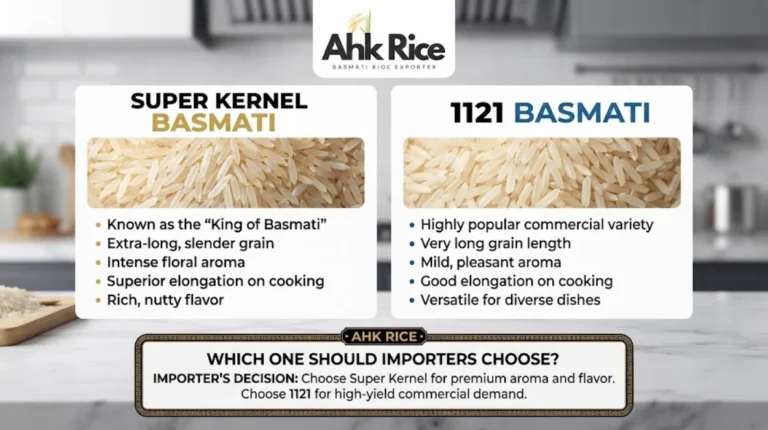
1121 suits buyers prioritising extra-long cooked grains and premium positioning, Super Kernel suits traditional aromatic Basmati segments, and 1509 suits buyers balancing grain length with cost efficiency. Final selection depends on laboratory results, milling quality, cooking performance and the target market.
| Attribute | 1121 Basmati | Super Kernel Basmati | 1509 Basmati |
|---|---|---|---|
| Main positioning | Premium long-grain rice | Traditional aromatic rice | Value-oriented long-grain rice |
| Typical raw grain length | Approximately 8.0–8.4 mm, depending on grade | Approximately 7.0–7.5 mm | Approximately 8.1–8.5 mm |
| Aroma | Distinctive Basmati aroma | Traditional, pronounced aroma | Basmati aroma, depending on lot |
| Processing options | Steam, Sella, white and other specifications | Raw, steam and other agreed grades | White, steam and Golden Sella options |
| Common buyer segment | Premium retail and foodservice | Ethnic retail and traditional wholesalers | Bulk trade and value-conscious distribution |
| Commercial priority | Grain elongation and premium presentation | Aroma and traditional cooking characteristics | Cost efficiency and long-grain appearance |
| Key quality checks | Broken percentage, moisture, grain uniformity and cooking performance | Aroma, moisture, purity and broken percentage | Grain consistency, broken percentage, moisture and cooking performance |
The grain lengths are indicative commercial ranges, not guaranteed specifications. Buyers should approve a representative sample and written specification before confirming an order.
How should importers compare prices per metric tonne?
Rice prices must be compared on an equivalent commercial basis. A lower FOB quotation does not automatically produce a lower landed cost because freight, insurance, handling, customs charges, packaging, inspection and onward distribution can change the final cost per metric tonne.
FOB Karachi generally places the main ocean freight responsibility with the buyer after loading under the agreed contract. CIF pricing includes cost, insurance and freight to the named destination port, subject to the applicable Incoterms rules. A UAE re-exporter should compare both structures using the same grade, packing, quantity and shipment terms.
| Cost component | UAE import for re-export | Direct shipment to destination |
|---|---|---|
| Rice purchase | Pakistani supplier quotation | Pakistani supplier quotation |
| International freight | Freight to UAE | Freight to destination market |
| Handling and storage | UAE port, warehouse and handling costs | Destination handling and any storage |
| Compliance | UAE import or transit requirements and onward documentation | Destination import requirements |
| Additional movement | Possible onward freight and re-export charges | Usually no UAE re-export leg |
A meaningful comparison uses a written quotation for the same quality specification and delivery basis. Traders should calculate the landed cost per metric tonne after all relevant charges and compare it with the achievable selling price in the destination market.
Which markets benefit most from the UAE re-export model?
GCC markets benefit from geographic proximity and established food distribution networks, while selected African markets offer opportunities for wholesale and retail supply. Central Asian buyers may also use UAE trading relationships, but route economics and destination-specific import rules determine whether the model is competitive.
GCC markets: Saudi Arabia, Oman, Qatar, Bahrain and Kuwait
GCC buyers often require dependable supply, consistent cooking performance and packaging suited to their customer segments. Saudi Arabia offers opportunities for large distributors and foodservice buyers. Qatar, Oman, Bahrain and Kuwait provide additional markets for wholesale and retail distribution.
Premium 1121 Basmati suits customers seeking long cooked grains and an elevated presentation. Super Kernel suits buyers serving traditional Basmati consumers. 1509 can serve price-conscious segments where the agreed specification meets customer expectations.
Importers must check destination food regulations, customs procedures and Arabic labelling requirements where applicable. UAE-compliant packaging does not automatically satisfy every neighbouring market’s rules.
African markets: differentiated demand and wholesale opportunities
African markets are not a single purchasing segment. Importers in North Africa, East Africa and West Africa operate under different tariff structures, consumer preferences, port conditions and food regulations.
Some distributors prioritise premium aromatic rice for specialist retail. Others focus on wholesale pricing, reliable availability and pack sizes suitable for local distribution. A UAE trader can use separate product lines to serve these segments, but must verify destination demand rather than assume one variety suits every country.
Central Asia: route economics and product suitability
Central Asian markets require a more specific assessment of transport routes, transit procedures, border formalities and final delivery costs. A UAE intermediary can coordinate sourcing and commercial documentation, but an additional trading or handling stage is not automatically cheaper than direct shipment from Pakistan.
Re-exporters should compare a UAE-based supply chain with direct Pakistani supply to the destination. The best route is the one that meets the required delivery terms and produces a competitive, compliant landed cost.
How do shelf life and storage requirements compare?
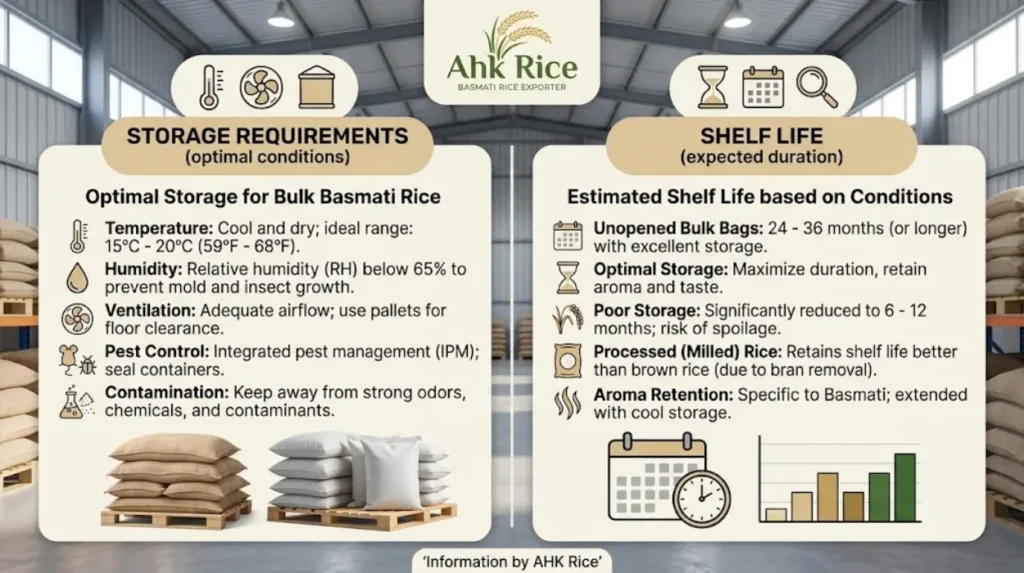
Shelf life depends on rice condition, moisture, packaging integrity, temperature, humidity and storage hygiene rather than the trading route alone. Re-exporters should follow validated product specifications and local requirements, while protecting stock against moisture ingress, pests, odours and damaged packaging.
Dry milled rice generally supports extended storage when kept under suitable conditions. However, a single shelf-life period does not apply to every product, packaging format or destination. Buyers should confirm the declared shelf life from the supplier’s product documentation and ensure the remaining shelf life meets the receiving market’s requirements.
| Storage factor | UAE warehouse | Onward destination storage |
|---|---|---|
| Temperature | Control heat exposure and warehouse conditions | Consider local climate and warehouse capacity |
| Humidity | Protect bags from condensation and moisture ingress | Check seasonal humidity and ventilation |
| Packaging | Inspect seals, stitching and barrier integrity | Check for transport damage and compromised bags |
| Stock rotation | Use batch tracking and first-expiry-first-out procedures where appropriate | Maintain traceability and rotate inventory |
| Shelf-life verification | Confirm production date, expiry or best-before information as applicable | Check destination rules and remaining shelf-life requirements |
Golden Sella, steam and white rice may differ in processing characteristics, but processing type alone does not establish a universal shelf-life advantage. Re-exporters should rely on validated specifications, packaging suitability and documented storage conditions.
What are the advantages and disadvantages of UAE-based re-exporting?
UAE-based re-exporting improves access to regional trading networks and supports inventory consolidation, but it also introduces another logistics stage, additional handling costs and potential compliance obligations. Its value depends on the volume, destination and commercial service delivered.
Advantages
- Market access: A UAE trader can build relationships with buyers across several countries.
- Flexible distribution: Inventory can support different order sizes and customer requirements.
- Product choice: Importers can maintain separate grades for premium, traditional and value-conscious segments.
- Commercial coordination: A regional trading base can simplify customer communication, consolidated purchasing and repeat orders.
Disadvantages
- Additional costs: Warehousing, handling and onward transport can reduce margins.
- More complex documentation: Re-export procedures require accurate records and appropriate customs declarations.
- Inventory exposure: Slow-moving stock ties up working capital and increases storage risks.
- Regulatory differences: Destination requirements can differ from UAE requirements, particularly for labelling, food registration and import documentation.
For example, a wholesaler with recurring orders across several GCC destinations may benefit from regional inventory. A buyer with one large, confirmed order for a single African port may find direct shipment from Pakistan more economical.
Which sourcing method works best for different buyers?
The best sourcing model matches the buyer’s distribution structure, order frequency, product positioning, cash flow and destination requirements. Importers should assess these factors together rather than selecting a route based only on the supplier quotation or the apparent convenience of UAE warehousing.
| Decision factor | UAE-based re-export | Direct shipment from Pakistan |
|---|---|---|
| Order frequency | Best considered for repeat regional orders | Suitable for planned, destination-specific orders |
| Number of markets | Useful when serving multiple destinations | Efficient when supplying one principal destination |
| Inventory needs | Supports regional stockholding | Reduces the need for intermediate stock |
| Shipment economics | Works when consolidation offsets extra costs | Works when direct freight and volume are competitive |
| Operational control | Provides a regional coordination point | Provides a more direct supplier-to-destination chain |
The comparison should begin with actual buyer requirements. A distributor serving several GCC customers may prioritise stock availability and short regional delivery lead times. An African importer purchasing a full container for one destination may prioritise freight economics and direct delivery. A Central Asian trader should assess the complete transit route before choosing either model.
What should buyers check before selecting a Pakistani Basmati supplier?
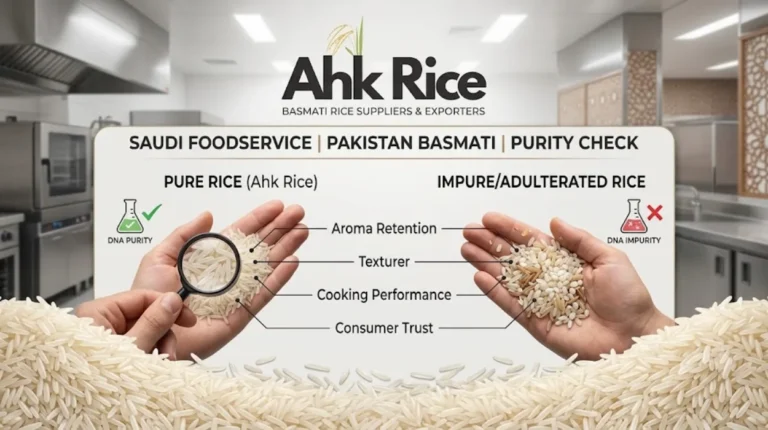
Buyers should verify product specifications, sample performance, quality documentation, packaging suitability, shipment terms and supplier coordination before confirming a purchase. These checks reduce specification disputes and help ensure the selected rice matches the needs of the final market.
A practical supplier evaluation includes:
- Written grade specification: Confirm variety, grain length, broken percentage, moisture, purity and processing type.
- Sample approval: Cook a representative sample using the intended preparation method and record the results.
- Quality documentation: Agree on the certificate of analysis, inspection arrangements and required export documents.
- Packaging approval: Confirm bag weight, material, printing, labels and destination-specific requirements.
- Commercial terms: Establish price basis, payment terms, shipment schedule, destination responsibilities and procedures for quality discrepancies.
AHK Rice supplies Pakistani Basmati varieties, including 1121, Super Kernel and 1509, to international markets. Its Punjab-based sourcing and export operations provide a reference for importers evaluating grade selection, processing, custom packaging and shipment coordination. Buyers should confirm the precise specifications and availability for each proposed order.
The UAE’s value as a re-export hub comes from its combination of trade infrastructure, regional distribution networks and access to international shipping. Pakistani Basmati rice offers a differentiated product range for traders serving premium retail, traditional wholesalers and price-conscious buyers.
The strongest sourcing strategy matches the variety, grade, packaging and delivery route to the destination market. Re-exporters should compare direct and UAE-based shipment costs, validate product samples, confirm shelf-life documentation and check the import requirements of every destination before committing to stock.
For importers planning recurring regional supply, the decision should rest on total landed cost, dependable specifications and the ability to serve customers consistently across multiple markets.
Frequently asked questions
Why does the UAE re-export Pakistani Basmati rice?
The UAE connects Pakistani suppliers with regional buyers through ports, trading companies, warehouses and distribution networks. Re-exporters can consolidate inventory and supply different grades to GCC, African and selected Central Asian destinations.
Which Pakistani Basmati variety is best for UAE re-exporters?
1121 suits premium long-grain positioning, Super Kernel suits traditional aromatic rice segments, and 1509 suits buyers prioritising cost efficiency alongside long-grain characteristics. The final choice depends on customer demand and approved product specifications.
Is re-exporting rice through Dubai cheaper than direct shipping?
Not in every case. Re-exporting can improve inventory flexibility and regional distribution, but extra handling, storage, freight and documentation add costs. Buyers should compare the full landed cost under both routes.
How should importers compare rice prices per metric tonne?
Compare equivalent grades, packing, quantity, payment terms and delivery conditions. Include international freight, insurance where applicable, handling, customs charges, storage and onward transport before calculating the final cost per metric tonne.
How long can Pakistani Basmati rice be stored in the UAE?
Storage life depends on the product specification, packaging, moisture control and warehouse conditions. Importers should use the supplier’s validated shelf-life information, maintain batch traceability and protect stock from heat, humidity, pests and damaged packaging.
What documents do UAE rice re-exporters need?
Requirements depend on the product, customs procedure and destination. Importers should verify the commercial invoice, packing list, certificate of origin, applicable phytosanitary or health documentation, transport documents and destination-specific food compliance requirements with the relevant authorities and logistics provider.