REAP Membership, Export Licence and Trade References: Exporter Due Diligence Checklist
For Pakistani Basmati rice importers, the most reliable exporter assessment combines REAP membership verification, valid export documentation, independent trade references, product specifications, and shipment controls rather than relying on price or membership claims alone. Buyers should verify each requirement against the transaction, destination, and supplier’s actual records.
Exporter due diligence begins with understanding how Pakistani rice moves from the mill to the importing market. Buyers evaluating origin, rice varieties, processing, and export procedures should first review this educational guide to Pakistani Basmati rice and its export supply chain. This context helps importers distinguish a supplier’s general business credentials from the evidence required to approve a specific shipment.
AHK Rice is a Pakistani Basmati rice exporter based in Punjab, supplying 1121, Super Kernel, and 1509 varieties to more than 15 countries. Its export model includes processing, custom packaging, and export documentation. Importers assessing AHK Rice or another Pakistani supplier should apply the same evidence-based checks before approving samples, negotiating contracts, or releasing payment.
What should importers verify before approving a Pakistani rice exporter?
Importers should verify five evidence categories: business identity, REAP membership, export eligibility, trade history, and shipment-specific quality controls. Each category answers a different risk question. Together, they establish whether the supplier’s credentials, commercial capacity, and proposed rice consignment meet the buyer’s requirements.
1. REAP membership and business identity
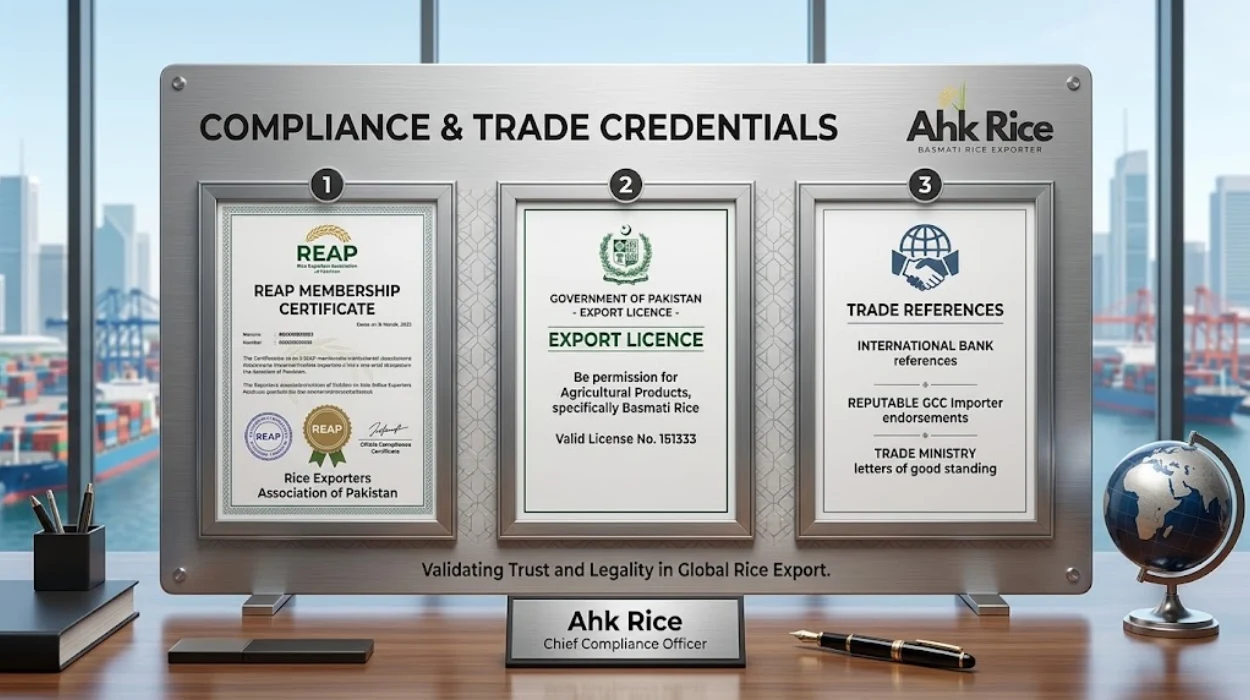
The Rice Exporters Association of Pakistan (REAP) is a trade association representing Pakistan’s rice export industry. Its membership records provide a starting point for checking a supplier’s industry affiliation. REAP publishes member profiles and membership information through its official website.
Importers should request the supplier’s registered business name, membership number, registration details, office address, and authorised representative’s information. Compare these details with the association’s available records. Confirm current membership status directly with REAP when the transaction requires additional assurance.
Membership supports identity verification, but it does not guarantee product quality, financial stability, shipment performance, or successful customs clearance.
2. Export licence and supporting documentation
An export licence or registration evidence establishes the legal basis for the relevant business activity. Buyers should ask which registrations and permissions apply to the exporter, commodity, destination, and shipment. They should verify the documents with the issuing authority when necessary.
REAP membership and government export requirements are related but distinct checks. Neither should replace verification of the other. The buyer should also confirm the exporter’s tax registration, banking details, and authority to issue the commercial documents used in the transaction.
3. Trade references and shipment history
Trade references help buyers assess performance beyond registration records. Request two or three verifiable business references, preferably from importers who purchased comparable rice grades and shipment volumes.
Ask references about specification consistency, loading schedules, document accuracy, packaging, communication, and dispute resolution. Where confidentiality prevents a reference from sharing invoices or contracts, request a redacted shipping document or another independently verifiable record.
What are the available solutions for exporter due diligence?
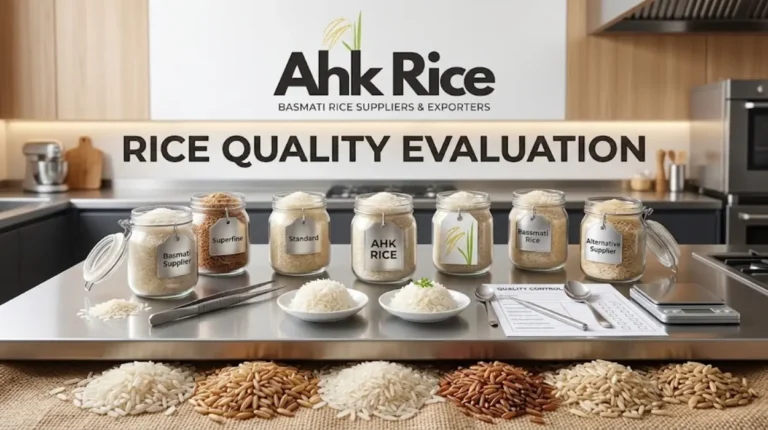
Buyers can assess suppliers through documentary verification, independent inspections, commercial references, sample testing, or a combined due diligence process. Documentary checks establish identity, inspections evaluate the goods, references test delivery performance, and samples demonstrate cooking characteristics before a larger purchase.
| Verification method | Main evidence | Best application | Main limitation |
|---|---|---|---|
| REAP and identity checks | Membership and registration records | Initial screening | Does not establish shipment quality |
| Export document review | Applicable registrations and shipping records | Legal and operational checks | Documents require authenticity checks |
| Trade references | Buyer feedback and transaction evidence | Evaluating delivery performance | References can be selective |
| Pre-shipment inspection | Sampling and inspection report | Bulk shipment approval | Inspection scope must be agreed |
| Sample and laboratory testing | Grain sample, test results, agreed specifications | Product acceptance | A sample does not guarantee every bag |
These approaches work best together. A registered exporter can still supply rice that fails an agreed specification, while a satisfactory sample does not prove the exporter has the capacity to complete a container order.
How do different Pakistani Basmati grades compare during supplier evaluation?
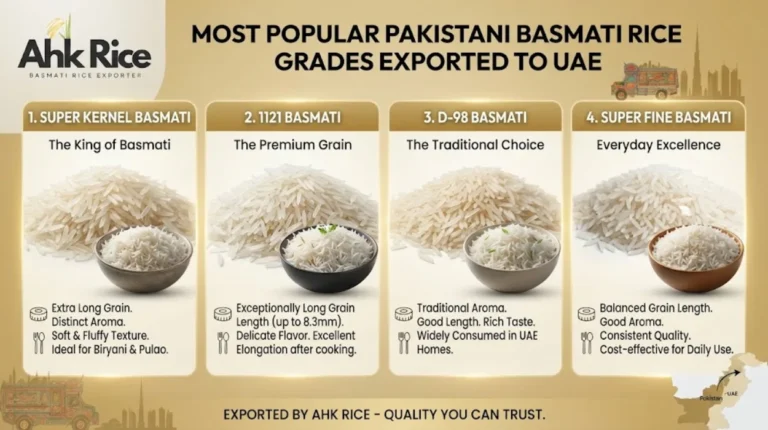
Buyers should compare rice varieties against seven attributes: grain length, aroma, processing type, broken percentage, moisture, cooking performance, and commercial price. A standardised specification sheet makes supplier quotations comparable and reduces disagreements between sample approval and final shipment.
The following comparison provides a practical starting point. Final figures must come from the exporter’s written specification and approved sample.
| Attribute | 1121 Basmati | Super Kernel Basmati | 1509 Basmati |
|---|---|---|---|
| Typical positioning | Premium long-grain market | Traditional aromatic market | Value-focused long-grain market |
| Raw grain length | Often around 8.0–8.3 mm, grade-dependent | Commonly around 7.0–7.5 mm | Often around 8.1–8.4 mm |
| Aroma | Premium aromatic profile | Traditional Basmati aroma | Aromatic profile varies by lot |
| Processing options | Steam, Sella, brown | Raw, Steam, Sella, brown, subject to availability | White, Steam and Golden Sella options |
| Broken percentage | Set in contract | Set in contract | Set in contract |
| Moisture | Set by specification | Common target at or below 12–13% | Common target at or below 13% |
| Cooking performance | Long grains and elongation | Aroma and grain separation | Long-grain presentation and yield efficiency |
These are indicative commercial characteristics, not guarantees for every lot. Buyers should establish the measurement method for grain length, permitted broken percentage, moisture tolerance, foreign matter, crop year, and cooking performance in the purchase contract.
A specification should also identify the packing format, bag weight, packaging material, batch identification, and inspection procedure. The supplier and buyer should approve the same sample and specification before production.
Which method works best for different importer requirements?
The appropriate due diligence method depends on order value, destination regulations, product sensitivity, and the buyer’s previous experience. First-time importers need more independent evidence, while established buyers can streamline repeat orders through documented supplier performance and consistent inspection procedures.
UAE importers: compliance, consistency, and delivery
UAE buyers should verify supplier credentials alongside product registration, labelling, and food-import documentation. The UAE government explains that food products must meet applicable food-safety requirements and that products covered by the national registration system must be registered before entering the market. Local authorities oversee food safety and labelling requirements.
For Dubai and other UAE markets, buyers commonly evaluate 1121 Steam or Sella for premium retail and foodservice, Super Kernel for traditional aromatic demand, and 1509 for cost-conscious bulk procurement. The correct choice depends on the intended customer and cooking requirements.
Saudi Arabia and wider GCC markets: supply reliability and grade suitability
Saudi Arabian and wider Gulf importers should prioritise dependable supply, consistent cooking results, compliant packaging, and accurate shipment documentation. Premium restaurants and catering businesses may favour long-grain 1121, while wholesale distributors may evaluate Super Kernel and 1509 against target selling prices.
Importers should confirm the destination-specific requirements with their customs broker and relevant food authority before production. Requirements for labelling, certificates, inspection, and product documentation must be assessed for the actual destination and consignment.
Price per MT comparison across grades and markets
The price per metric tonne (MT) must be compared on the same commercial basis. FOB Karachi, CIF destination-port, and delivered prices are not directly interchangeable because freight, insurance, handling, and other charges differ.
The following table is a comparison framework, not a live market quotation. Buyers should populate it with dated supplier offers for the same shipment quantity and contract conditions.
| Comparison factor | UAE quotation | Saudi Arabia quotation |
|---|---|---|
| Grade | 1121, Super Kernel or 1509 | 1121, Super Kernel or 1509 |
| FOB price per MT | Insert supplier’s dated offer | Insert supplier’s dated offer |
| Freight and insurance per MT | Add for CIF comparison | Add for CIF comparison |
| Landed cost per MT | Add applicable destination costs | Add applicable destination costs |
| Shelf-life and storage conditions | Confirm product and label requirements | Confirm product and label requirements |
A lower FOB quotation does not automatically mean a lower landed cost. For example, a buyer comparing a 25 MT order must account for the full shipment value, freight, insurance, inspection, and destination charges before selecting a supplier.
How should buyers compare shelf life and storage requirements?
Buyers should compare the declared shelf life, packing date, packaging barrier, moisture control, and storage instructions for each proposed rice product. Shelf life is a product-specific declaration, not a universal fixed period for all Basmati grades or processing methods.
White, Steam, and Sella rice may have different storage characteristics depending on processing, packaging, and conditions. Rather than assuming a fixed expiry period, ask the exporter for the declared shelf life, production or packing date, storage recommendations, and supporting product documentation.
| Evaluation point | UAE market | Saudi Arabia market |
|---|---|---|
| Shelf-life declaration | Confirm against product label and importer requirements | Confirm against product label and importer requirements |
| Storage conditions | Protect from heat, moisture, pests, and damaged packaging | Protect from heat, moisture, pests, and damaged packaging |
| Packaging | Select suitable sealed bags for the distribution channel | Select suitable packaging for wholesale or retail |
| Date marking | Verify applicable local labelling rules | Verify applicable local labelling rules |
| Arrival condition | Check bag integrity, moisture, and batch consistency | Check bag integrity, moisture, and batch consistency |
For UAE shipments, official guidance highlights food labelling and import controls, including applicable date-marking and registration requirements. Importers should confirm the exact rules for their product and emirate before printing packaging.
What are the pros and cons of different supplier verification methods?
Document checks are efficient for initial screening, independent inspections provide shipment-level evidence, trade references reveal commercial performance, and sample testing supports product selection. Each method has limitations, so buyers should combine checks according to transaction value and risk.
- Document verification: Establishes whether business and export records are consistent. It does not prove that the delivered rice matches the approved specification.
- Trade references: Provide insight into shipment reliability and communication. They are less useful when references cannot be independently verified.
- Pre-shipment inspection: Checks agreed product characteristics before dispatch. Its value depends on the sampling plan, inspection scope, and independence of the inspector.
- Sample testing: Allows buyers to assess aroma, cooking results, grain appearance, and relevant laboratory parameters. A single sample cannot guarantee the entire production lot.
- Combined verification: Connects identity, documentation, product quality, and commercial performance. It requires more coordination but provides a broader assessment.
For example, an importer ordering 100 MT for the first time should use stronger independent checks than a buyer placing a routine repeat order with a documented performance history.
What five factors should determine the final supplier decision?
The final decision should balance verified credentials, specification compliance, total landed cost, shipment reliability, and contractual protection. Buyers should document each factor before approving the supplier and release payments according to agreed milestones and verified documents.
| Decision factor | Evidence to request | Approval criterion |
|---|---|---|
| Business legitimacy | REAP membership and registration evidence | Details match independently checked records |
| Export readiness | Applicable export and shipment documents | Requirements are satisfied for the transaction |
| Product quality | Approved sample and specification sheet | Written tolerances are clear and measurable |
| Commercial reliability | Trade references and shipment records | Performance evidence matches the order’s needs |
| Cost and risk | Comparable quotations and contract terms | Landed cost, inspection, and remedies are defined |
The buyer should also agree on payment terms, inspection rights, delivery deadlines, claims procedures, and the documents required before the balance payment. Contracts should specify what happens when the shipment fails an agreed test or arrives with damaged packaging.
How should importers apply the checklist to AHK Rice?
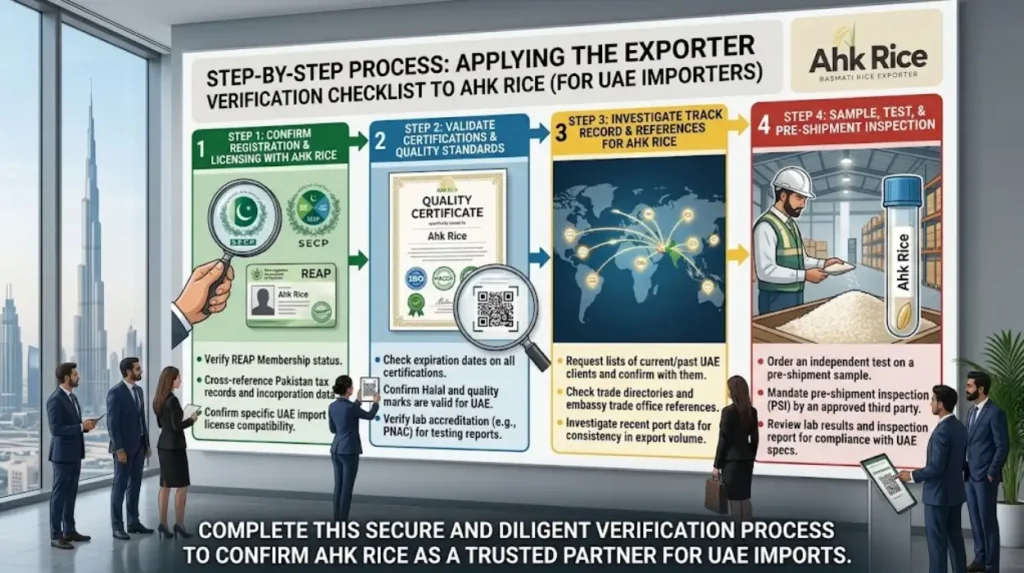
Importers should apply the same verification process to AHK Rice that they use for any prospective supplier. Confirm relevant credentials, request a written grade specification, evaluate samples, compare a dated quotation, and agree on shipment documentation before confirming the order.
AHK Rice is based in Punjab, Pakistan, and supplies REAP Membership, Export Licence and Trade References Exporter Due Diligence Checklist to international markets. Its offering includes processing, custom packaging, and export documentation. These capabilities give buyers several product options to evaluate against retail, wholesale, and foodservice requirements.
The next step is to assess the supplier against the buyer’s own destination, volume, grade, and compliance needs. For importers who have completed preliminary checks and are evaluating supplier suitability, the decision-focused article Why UAE Importers Choose AHK Rice as Their Pakistani Basmati Supplier can be linked here once its dedicated published URL is confirmed.
Frequently asked questions
Is REAP membership enough to verify a Pakistani rice exporter?
No. REAP membership helps verify a supplier’s industry affiliation, but buyers must also assess applicable registrations, trade references, product specifications, and shipment documentation.
What trade references should rice importers request?
Request verifiable references from buyers who purchased similar rice grades and quantities. Ask about product consistency, shipment timing, documentation, packaging, and dispute resolution.
Should importers inspect rice before shipment?
Yes, particularly for first orders and high-value consignments. Agree on the sampling method, quality limits, inspection scope, and corrective action before production or dispatch.
How should buyers compare Pakistani Basmati prices per MT?
Compare quotations for the same variety, grade, packing, quantity, and delivery basis. Convert FOB and CIF offers to a comparable landed-cost estimate using the relevant freight, insurance, and destination charges.
Which Basmati variety should UAE importers choose?
1121 suits buyers seeking premium long-grain presentation, Super Kernel suits traditional aromatic demand, and 1509 suits buyers prioritising long-grain value. Final selection should follow sample testing and target-market requirements.