Buy GI-Compliant Pakistani Basmati Rice with Certificate of Origin for USA Import
The best solution is to source Pakistani Basmati from an exporter that verifies product origin, documents the rice variety and specifications, and arranges an appropriate Certificate of Origin. US importers should also confirm applicable FDA requirements, customs documentation, and the product’s eligibility under current US import rules before shipment.
Importing Basmati rice involves more than choosing a grain length or negotiating a price per metric tonne. Buyers must establish where the rice originates, whether the product description matches the actual shipment, and whether the supporting documents satisfy the requirements of the destination market. Missing or inconsistent paperwork can cause customs delays, additional inspection costs, and disputes between buyers and suppliers.
The Basmati Geographical Indication (GI) framework helps distinguish rice associated with its recognized geographical origin. Buyers can understand the foundation through this guide to the Basmati Geographical Indication and its importance for US buyers. Before placing a commercial order, importers should connect origin claims with traceability records, product specifications, and shipment documents rather than relying on marketing statements alone.
A practical sourcing decision should establish four points: the rice’s declared origin, the variety and processing specification, the issuing authority for origin documentation, and the importer’s US compliance obligations. This process gives distributors, wholesalers, ethnic grocery suppliers, and private-label businesses a clearer basis for approving a supplier.
Why should USA importers choose AHK Rice?
AHK Rice provides Pakistani Basmati sourcing from Punjab with export-oriented processing, defined product specifications, custom packaging, and shipment documentation coordination. Importers can discuss their required grade, origin evidence, packaging format, and destination requirements before approving a commercial order.
AHK Rice supplies Pakistani Basmati varieties, including 1121, Super Kernel, and 1509 Basmati rice,. These varieties serve different purchasing priorities. 1121 suits buyers seeking long grains and premium presentation. Super Kernel serves traditional aromatic Basmati markets. 1509 provides another option for buyers balancing grain length, yield, and purchasing costs.
For importers evaluating a Pakistani Basmati rice exporter and its supply services, the decision should depend on verifiable documentation and the ability to meet the purchase specification. A supplier discussion should cover the declared country and region of origin, crop or lot traceability where available, milling and processing details, moisture limits, broken-grain percentage, packing requirements, and inspection arrangements.
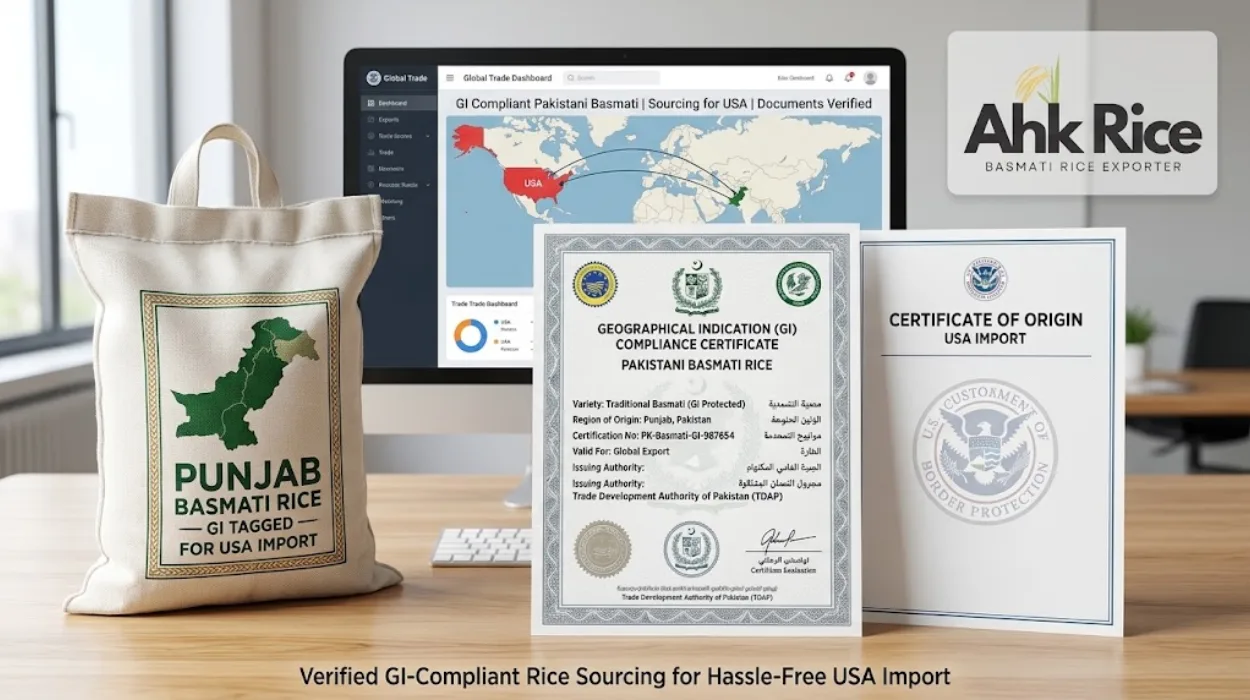
AHK Rice can coordinate the commercial specification and export paperwork with the buyer. However, a supplier’s statement that rice is GI-compliant does not independently establish legal eligibility for every US import. Importers should request the applicable GI registration or supporting evidence and confirm that the Certificate of Origin is issued by an authorized body. The certificate supports origin documentation, while GI evidence addresses a distinct geographical-origin claim.
A written purchase specification should identify the exact variety and grade, agreed quality tolerances, packing weight, marking requirements, inspection method, and document list. Both parties should approve these details before production and dispatch. This reduces misunderstandings about what the buyer expects to receive.
How does GI verification protect USA rice importers?
GI verification connects a geographical-origin claim with supporting evidence, helping importers assess authenticity and reduce exposure to misleading product descriptions. Buyers should compare origin records, supplier declarations, product specifications, and shipment documents before approving a purchase or advertising rice as GI-compliant.
A Certificate of Origin generally identifies the country of origin and relevant shipment information according to the issuing authority’s procedures. It should not automatically be treated as proof that every GI requirement has been met. Similarly, a laboratory report can assess specified quality or safety parameters, but it does not independently establish geographical origin.
Importers need to distinguish three checks:
- Origin verification: Confirm that the declared Pakistani origin is supported by appropriate records and a valid Certificate of Origin.
- GI verification: Request relevant registration, traceability, or other evidence supporting the specific geographical-origin claim.
- Product verification: Compare the agreed variety, grain dimensions, broken percentage, moisture, processing type, and packaging against the supplied lot and inspection results.
For a deeper comparison, read how Pakistan’s Basmati GI can protect USA importers from mislabeled or blended rice. This consideration-stage resource complements supplier due diligence by explaining why origin claims and actual product composition should be evaluated separately.
Consider a US distributor ordering 1121 Steam Basmati for a premium retail label. If the purchase agreement specifies Pakistani origin, a defined grain-length range, and a particular processing type, the supplier’s documents and the delivered lot should be checked against those requirements. A discrepancy should be investigated before the importer approves final payment or releases the product for retail distribution.
AHK Rice buyers should request relevant supporting documents before confirming an order. The exact evidence available depends on the product, supply chain, issuing authority, and agreed certification requirements. Clear records make it easier to investigate discrepancies and demonstrate the basis of an origin claim.
Which documents are required to import Pakistani Basmati rice into the USA?
US importers should prepare a Certificate of Origin alongside the commercial invoice, packing list, shipping document, and applicable food-import records. The final document set depends on the shipment, customs classification, transport arrangement, and current requirements of US authorities.
A typical export documentation checklist includes the following:
| Document or record | Purpose |
|---|---|
| Certificate of Origin | Supports the declared country of origin |
| Commercial invoice | Records seller, buyer, value, product description, and transaction terms |
| Packing list | Identifies package counts, weights, and packing details |
| Bill of lading | Records ocean shipment and carriage details |
| Phytosanitary certificate | Provided when required by applicable plant-health rules |
| Certificate of Analysis (COA) | Records agreed test results for specified quality or safety parameters |
| GI supporting evidence | Supports the specific geographical-origin claim |
| FDA Prior Notice records | Supports advance notification of an applicable food import |
| Food facility registration details | Relevant where registration is required under applicable FDA rules |
This list is a planning guide, not a statement that every document is mandatory for every shipment. A phytosanitary certificate, for example, depends on the applicable US plant-health requirements and the specific commodity. Importers should confirm requirements with US Customs and Border Protection, the Food and Drug Administration (FDA), and the US Department of Agriculture’s Animal and Plant Health Inspection Service (APHIS), as relevant.
FDA requirements can include food facility registration, Prior Notice, and applicable preventive-control or foreign-supplier obligations. The US importer should establish which requirements apply to its role and product. Customs classification, admissibility, and any applicable restrictions should be checked before cargo dispatch.
AHK Rice should receive the buyer’s document checklist before finalizing the shipment plan. Names, addresses, product descriptions, weights, country-of-origin declarations, and package markings should remain consistent across relevant documents. Any discrepancy should be corrected through the appropriate issuing party before submission or clearance.
What shipping time should USA importers expect?
Shipping time depends on the Pakistani loading port, vessel schedule, US destination port, transshipment route, and customs clearance. Importers should obtain a current carrier schedule and distinguish ocean transit from total delivery time, which also includes processing, documentation, port handling, and inland transportation.
For planning purposes, the following are indicative scheduling ranges, not confirmed transit commitments:
| Shipment stage | Indicative planning range |
|---|---|
| Sample preparation and dispatch coordination | 2–7 business days |
| Courier delivery of samples to the USA | 3–7 business days after dispatch, subject to service and customs |
| Export preparation after specification approval | 7–21 days, depending on stock and packing |
| Ocean transit to US West Coast ports | Approximately 25–40 days |
| Ocean transit to US East Coast ports | Approximately 35–50 days |
| Customs clearance and onward delivery | Additional time depending on inspection, port congestion, and inland destination |
Actual transit may fall outside these ranges. Vessel schedules, transshipment, weather, port congestion, and regulatory holds can change delivery dates. A shipment to Los Angeles, for example, can have a different transit and inland delivery schedule from a shipment entering through New York or another East Coast gateway.
AHK Rice should confirm the proposed loading window and shipping route before the importer commits to a delivery date. The buyer should also establish whether the quotation covers FOB Karachi, freight, insurance, destination charges, and inland delivery. These costs are allocated differently under different Incoterms.
How does the Pakistani Basmati rice sample process work, and what does it cost?
The sample process should verify cooking quality, product specifications, and suitability for the buyer’s target market before a bulk purchase. The importer confirms the variety and grade, reviews sample charges and courier arrangements, tests the rice, and approves a written specification before the commercial order proceeds.
AHK Rice can use the following workflow to coordinate a sample request:
- Submit requirements. Identify the preferred variety, such as 1121, Super Kernel, or 1509, together with the processing type, target grain length, packaging preference, and estimated order quantity.
- Confirm sample availability. Agree on sample quantity, product identity, preparation time, and any testing or documentation requirements.
- Confirm costs. Obtain a written breakdown of sample charges, courier fees, any applicable inspection or testing fees, and destination charges.
- Dispatch the sample. Confirm the courier, tracking details, declared contents, and any import requirements that apply to the sample.
- Complete cooking and quality tests. Evaluate aroma, grain separation, elongation, texture, appearance, and performance against the intended retail or foodservice application.
- Approve the commercial specification. Confirm the accepted sample, tolerances, packing, documentation, price basis, and proposed shipment schedule in writing.
Sample costs depend on the quantity, destination, courier service, testing requirements, and applicable charges. A sample offer may cover the rice itself while leaving courier and other applicable charges to the buyer. Importers should not assume that free product means free delivery.
For a US-bound sample, request the total courier cost and verify whether any additional documentation, import clearance, or inspection charges apply. No fixed courier amount should be assumed without a current quotation. The sample should be representative of the proposed commercial product, and its identity should be documented to reduce the risk of approving one specification and receiving another.
After approval, AHK Rice can coordinate the bulk order against the agreed specification. Buyers should retain the approved sample reference and purchase documents so any later quality dispute can be assessed against the original agreement.
What affects the price of GI-compliant Pakistani Basmati rice?
The price depends on the rice variety, grade, processing method, quality tolerances, packaging, order volume, and delivery terms. GI documentation and additional testing can also affect the total procurement cost when they require separate verification, inspection, or administrative work.
Importers should evaluate the complete landed cost rather than comparing supplier prices alone. A lower FOB price does not necessarily produce a lower final cost after ocean freight, insurance, port charges, customs-related expenses, and inland transportation.
| Cost factor | What the buyer should confirm |
|---|---|
| Variety and grade | 1121, Super Kernel, or 1509; agreed grain and quality specifications |
| Processing type | White, Steam, or Sella, as applicable |
| Quality tolerances | Moisture, broken grains, foreign matter, and agreed inspection criteria |
| Packaging | Bulk bags, retail packs, private-label printing, and required weights |
| Origin documentation | Certificate of Origin and applicable GI supporting evidence |
| Inspection and testing | Required laboratory tests, pre-shipment inspection, and associated fees |
| Order quantity | Total metric tonnes, production requirements, and container loading plan |
| Incoterms and destination | FOB, CFR, or CIF terms, freight allocation, insurance, and destination costs |
AHK Rice should quote against a defined specification and quantity. The quotation should state the currency, validity period, shipment window, packing details, payment terms, and included or excluded charges.
A US importer ordering premium 1121 Steam for branded retail distribution may prioritize consistent grain length, presentation, and documented quality. A bulk foodservice buyer may instead focus on cooking performance, broken-grain limits, and cost per usable kilogram. Both buyers need accurate origin documentation, but their commercial specifications can differ substantially.
What results can USA importers expect from a documented sourcing process?
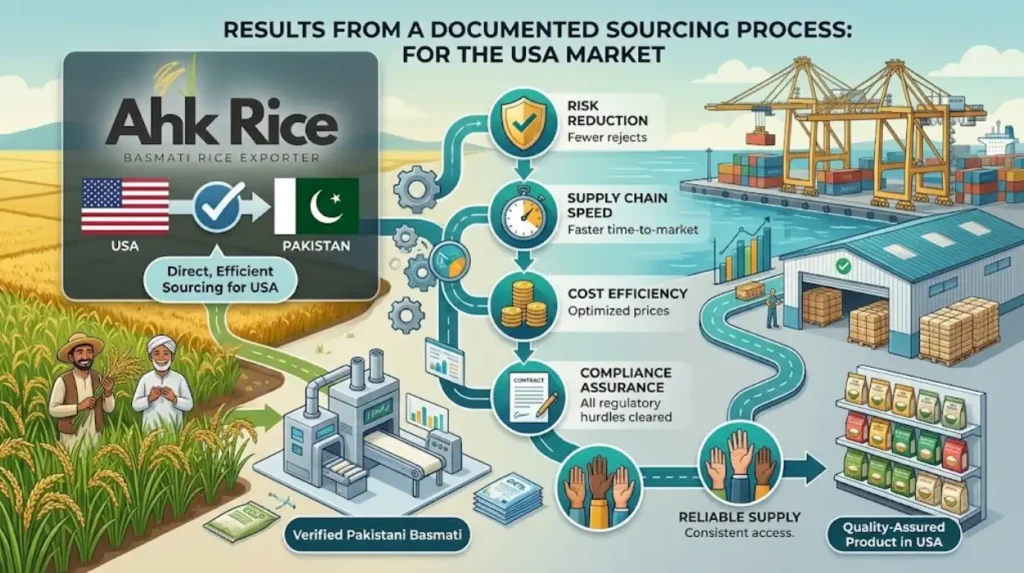
A documented sourcing process improves purchasing control, supports origin verification, and reduces avoidable specification disputes. Results depend on supplier records, representative samples, inspection quality, and compliance with US import requirements; certificates alone cannot guarantee customs clearance or prevent every supply-chain problem.
Importers can establish measurable acceptance criteria before production. These may include grain dimensions, maximum moisture, broken percentage, packaging weight, labeling requirements, and agreed testing methods. The buyer can then compare the commercial shipment with the purchase specification and supporting records.
A strong process also supports repeat purchasing. Distributors can retain the approved sample, supplier declarations, certificates, inspection reports, and shipment records for comparison with later orders. Where the same specification is maintained, these records help identify changes in quality or documentation across consignments.
AHK Rice buyers should agree on how discrepancies will be handled before payment and dispatch. The contract should explain inspection timing, acceptable tolerances, notification deadlines, and the process for resolving nonconformities. This creates a clearer commercial basis for addressing problems without assuming that a certificate guarantees product quality.
How can US importers get started with AHK Rice?
Start by submitting the required variety, quantity, destination, packaging, and origin-documentation criteria. AHK Rice can then assess the requested specification, coordinate sample arrangements, prepare a quotation, and discuss the documents needed for the proposed export shipment.
Use this decision sequence before committing to a commercial order:
- Define the target variety, grade, processing type, and end use.
- Request origin evidence and confirmation of the applicable Certificate of Origin process.
- Identify any GI-specific evidence needed to substantiate the product claim.
- Confirm US food-import, customs, labeling, and plant-health requirements with the relevant authorities and qualified import professionals.
- Arrange a representative sample and complete cooking and quality tests.
- Approve the written specification, price, Incoterms, payment conditions, and shipping window.
- Review the draft documents before dispatch and agree on inspection and discrepancy procedures.
The final decision should rest on documented product identity, acceptable quality, transparent costs, and a realistic delivery schedule. Importers should verify that the supplier can support the required claims before marketing the rice as GI-compliant.
Ready to discuss your US import requirements? Contact AHK Rice for a tailored export quotation covering your preferred Basmati variety, GI supporting evidence, Certificate of Origin, packaging, sample arrangements, and shipment requirements.
Frequently asked questions
What is a Certificate of Origin for Pakistani Basmati rice?
A Certificate of Origin identifies the declared country of origin under the issuing authority’s procedures. It supports customs and commercial documentation. Importers should verify the issuing authority and document details. It does not automatically prove every GI requirement or guarantee US import approval.
Is GI-compliant Pakistani Basmati rice automatically approved for import into the USA?
No. GI evidence and US import admissibility are separate matters. Importers must check applicable FDA, CBP, and APHIS requirements. The required checks depend on the product and shipment. Compliance should be confirmed before dispatch.
Which Pakistani Basmati varieties can US importers source?
Common commercial options include 1121, Super Kernel, and 1509. Availability depends on the supplier’s stock and production schedule. Buyers should specify the processing type and quality tolerances. A sample should be tested before bulk approval.
How long does Pakistani Basmati rice shipping to the USA take?
Ocean transit can take approximately 25–50 days, depending on the US destination and route. Export preparation and customs clearance add time. Vessel schedules and inspections can cause delays. Obtain a current shipping schedule before setting delivery commitments.
How much does it cost to import GI-compliant Pakistani Basmati rice?
The cost depends on the grade, quantity, packaging, documentation, freight, insurance, and destination charges. Sample courier fees and testing can add expenses. Request a quotation based on a complete specification. Compare total landed costs rather than FOB prices alone.