Pakistani Sella Basmati Rice Trade Opportunities in the UAE
Pakistani Sella Basmati Rice in UAE trade is a parboiled long-grain rice exported from Punjab, processed through steaming, drying, milling, and grading, and supplied to UAE importers for retail, hospitality, and bulk foodservice channels across Dubai, Abu Dhabi, and Sharjah ports.
Pakistani Sella Basmati Rice refers to parboiled basmati cultivated in irrigated plains of Punjab, Pakistan. The grain undergoes controlled hydrothermal treatment before milling. This process stabilizes starch, strengthens kernel structure, and improves cooking yield for export markets like the UAE.
Cultivation occurs in districts such as Hafizabad, Gujranwala, and Sialkot. Farmers irrigate fields using canal water systems. Harvesting happens at 20–22 percent moisture level to protect grain integrity before drying and storage.
Processing plants mill, dehusk, polish, and grade rice into export specifications. UAE buyers demand uniform length, low broken percentage, and controlled moisture levels. Sella rice maintains structure during long transport and humid storage conditions common in Gulf warehouses.
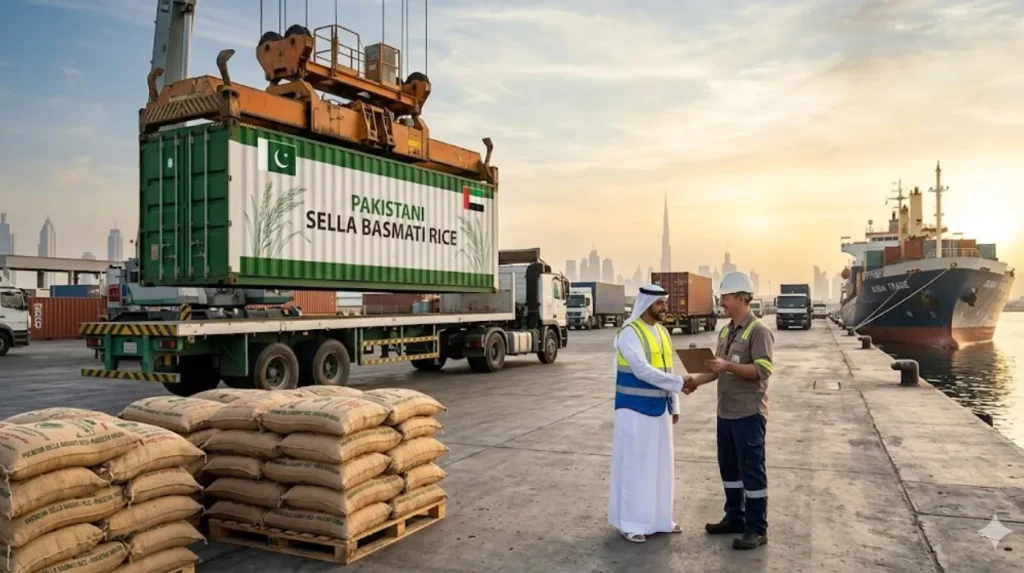
Sella rice trade aligns with UAE consumption patterns. Hotels, catering companies, and supermarkets import in bulk shipments through Jebel Ali Port and Khalifa Port.
With the product definition established, the next section explains how the full export and processing system functions from farm to UAE import entry.
How Does Pakistani Sella Basmati Rice Trade Work Between Pakistan and UAE?
The trade works through a structured export chain involving cultivation, milling, grading, certification, container loading, customs clearance, and sea shipment from Karachi or Port Qasim to UAE ports within 10–18 days transit time.
Cultivation begins with seed selection of basmati varieties such as 1121, 1509, and Super Kernel. Farmers irrigate fields, monitor crop maturity, and harvest at optimal grain hardness.
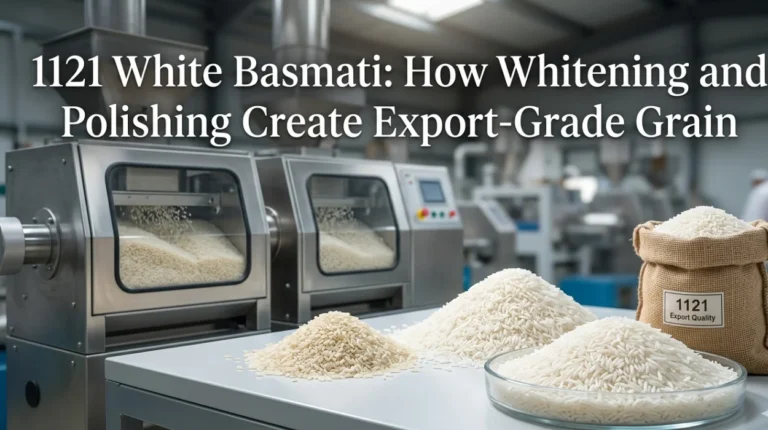
Dehusking removes outer layers from paddy rice. Milling separates bran layers while preserving kernel length. Polishing enhances surface texture without reducing grain integrity. Grading sorts rice by length, broken ratio, and color uniformity.
Certification authorities inspect pesticide residue, moisture levels, and export compliance. Testing labs verify EU and GCC food safety thresholds before shipment approval.
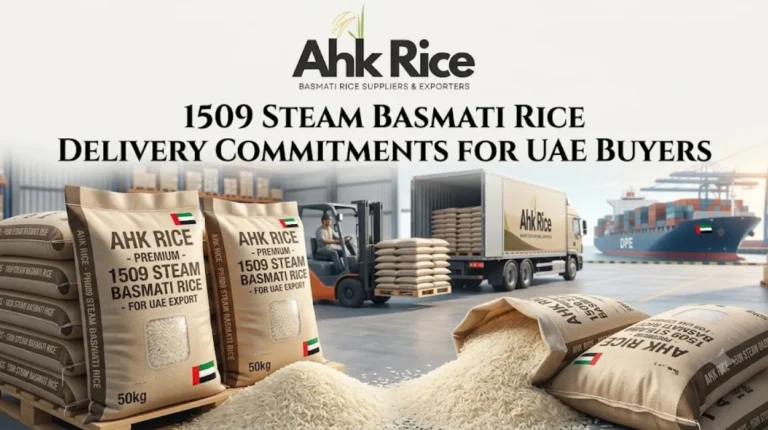
Loading operations pack rice into 25 kg, 40 kg, or 50 kg polypropylene bags. Containers are fumigated to eliminate pests. Shipping lines dispatch containers from Karachi terminals to UAE logistics hubs.
Customs clearance in UAE requires commercial invoice, phytosanitary certificate, and certificate of origin. Importers release cargo for warehousing and distribution across retail and hospitality sectors.
With the trade mechanism defined, the next section explains the structural components that determine rice quality and export pricing.
What Are the Key Components of Sella Basmati Rice for UAE Buyers?
Key components include grain length, parboiling strength, moisture content, broken percentage, aroma retention, milling yield, and color consistency, all directly influencing UAE import pricing and end-use performance in catering and retail markets.
Grain length defines market classification. Export-grade basmati ranges between 7.0 mm and 8.3 mm depending on variety. Longer grains command higher UAE retail pricing.
Parboiling strength determines kernel stability. Hydrothermal treatment gelatinizes starch inside the grain. This reduces breakage during cooking in high-temperature Gulf kitchens.
Moisture control stabilizes storage behavior. Export specifications maintain 12–13 percent moisture to prevent fungal growth during sea shipment and warehouse storage in humid UAE climates.
Broken percentage affects commercial grading. Premium grades maintain 1–5 percent broken grains while lower grades exceed 10 percent for bulk foodservice buyers.
Color sorting removes discolored or immature grains. Optical sorters detect defects and ensure uniform white or golden appearance depending on sella type.
Milling yield measures recovery rate from paddy to finished rice. Efficient mills achieve 65–70 percent head rice yield under controlled processing systems.
With structural components defined, the next section explains why UAE importers prefer Pakistani Sella Basmati over competing origins.
What Are the Benefits of Pakistani Sella Basmati Rice for UAE Importers?
Pakistani Sella Basmati Rice delivers high cooking yield, long storage stability, consistent grain elongation, strong aroma retention, and reduced breakage, making it suitable for UAE hospitality, retail chains, and institutional catering demand.
Cooking yield increases after parboiling. The grain absorbs water uniformly and expands without splitting. UAE restaurants prefer this behavior for buffet and catering operations.
Storage stability supports long-distance trade. Golden Sella maintains quality for 18 months in 40°C warehouse conditions, while steam rice degrades faster within 12 months.
Aroma retention preserves basmati fragrance. Controlled parboiling locks volatile compounds inside the kernel, ensuring consistent sensory quality during UAE cooking applications.
Breakage reduction improves commercial efficiency. Stronger kernels reduce waste during cooking and packaging. Importers gain higher usable output per container shipment.
Uniform elongation improves presentation quality. Cooked grains extend up to 1.5–2.0 times original length, supporting premium restaurant plating standards in Dubai hospitality chains.
Supply consistency ensures year-round availability. Punjab harvest cycles support continuous milling and export scheduling aligned with UAE procurement calendars.
With benefits established, the next section explains real-world applications across UAE market segments.
What Are the Main Use Cases of Sella Basmati Rice in UAE Markets?
Main use cases include hospitality catering, supermarket retail packaging, institutional food supply, airline catering kitchens, and wholesale distribution across UAE trading hubs such as Dubai, Sharjah, and Abu Dhabi.
Hospitality catering uses bulk rice for hotels and restaurants. Large kitchens require uniform cooking performance for buffet systems and banquet service operations.
Retail packaging targets supermarkets. Pack sizes range from 1 kg to 5 kg for household consumption. Branding and private labeling define shelf competitiveness.
Institutional food supply serves schools, hospitals, and government contracts. These buyers prioritize cost efficiency, storage stability, and consistent nutrition delivery.
Airline catering kitchens require controlled grain expansion. Meals must remain stable during reheating and transport at altitude-controlled environments.
Wholesale distribution channels operate through importers and distributors in Jebel Ali Free Zone. Containers are broken into palletized stock for regional redistribution.
Comparing Packaging and Private Label Options for UAE Rice Importers becomes relevant when importers evaluate branding and packaging strategy at this stage of procurement.
With applications defined, the next section addresses operational challenges and misconceptions in UAE rice trade.
What Are Common Problems or Misconceptions in UAE Rice Import Trade?
Common problems include incorrect grade selection, inconsistent moisture control, packaging mismatch, certification delays, and misunderstanding between steam and sella rice performance in humid UAE storage environments.
Grade selection errors occur when importers mix broken percentages with premium specifications. This leads to inconsistent cooking performance in retail and catering supply chains.
Moisture inconsistency causes storage instability. Rice above 13.5 percent moisture develops clumping and microbial risk in UAE warehouses without climate control.
Packaging mismatch affects logistics efficiency. Lightweight retail packaging cannot withstand long sea transit. Industrial polypropylene sacks are required for bulk shipments.
Certification delays occur when exporters fail to align documentation with GCC import regulations. Missing phytosanitary certificates delay customs clearance at UAE ports.
Steam vs Sella confusion impacts buyer expectations. Steam rice absorbs more moisture but loses structure faster. Sella rice maintains firmness under repeated heating cycles in catering environments.
In practical terms, Golden Sella performs better in UAE bulk storage. Steam rice suits short-cycle consumption markets with faster turnover rates.
With challenges clarified, the next section explains how all components connect into a structured trade ecosystem.
What Defines the Complete Value Chain of Sella Rice Trade to UAE?
The value chain consists of cultivation, harvesting, milling, parboiling, grading, certification, packaging, shipping, customs clearance, and distribution across UAE retail and foodservice networks under regulated import systems.
Cultivation stage grows basmati rice in Punjab irrigated lands. Farmers monitor crop maturity and harvest at controlled moisture levels.
Processing stage mills, dehusks, parboils, polishes, and sorts grains using mechanical and optical systems to ensure export-grade uniformity.
Quality inspection stage tests moisture, grain length, broken percentage, and pesticide residue before certification approval.
Packaging stage fills rice into export sacks or retail packs. Labels comply with UAE Arabic-English regulatory requirements.
Shipping stage loads containers, dispatches vessels from Karachi, and transports cargo through Arabian Sea routes.
Distribution stage clears customs in UAE and delivers goods to supermarkets, wholesalers, and hospitality suppliers.
This structure ensures traceable, standardized supply aligned with UAE import expectations and procurement cycles.
Frequently Asked Questions
What is Pakistani Sella Basmati Rice used for in UAE?
Pakistani Sella Basmati Rice is mainly used in UAE hotels, restaurants, catering services, and supermarkets. It is preferred for its long grain, strong texture, and ability to stay firm after cooking, making it ideal for bulk foodservice operations.
Why is Pakistani Sella Basmati Rice popular in UAE trade?
It is popular because it offers high cooking yield, long storage life, and consistent grain quality. UAE importers prefer it for its durability during shipping and stable performance in humid warehouse conditions across Dubai and other Emirates.
How is Pakistani Sella Basmati Rice exported to the UAE?
The rice is processed in mills in Pakistan, packed in export-grade bags, and shipped via Karachi ports. It is then cleared through UAE customs with proper certification before being distributed to wholesalers and retailers.
What quality factors do UAE buyers look for?
UAE buyers focus on grain length, low broken percentage, moisture control, aroma retention, and uniform color. These factors ensure better cooking results and consistent quality for both retail and hospitality use.
Is Sella Basmati Rice better than Steam Rice for UAE markets?
Yes, in most cases Sella rice is preferred for UAE bulk trade because it remains firm, stores longer, and performs better in catering environments. Steam rice is used more for quick turnover retail segments.