ISO 22000, HACCP, BRCGS and SQF Explained for USA Rice Buyers
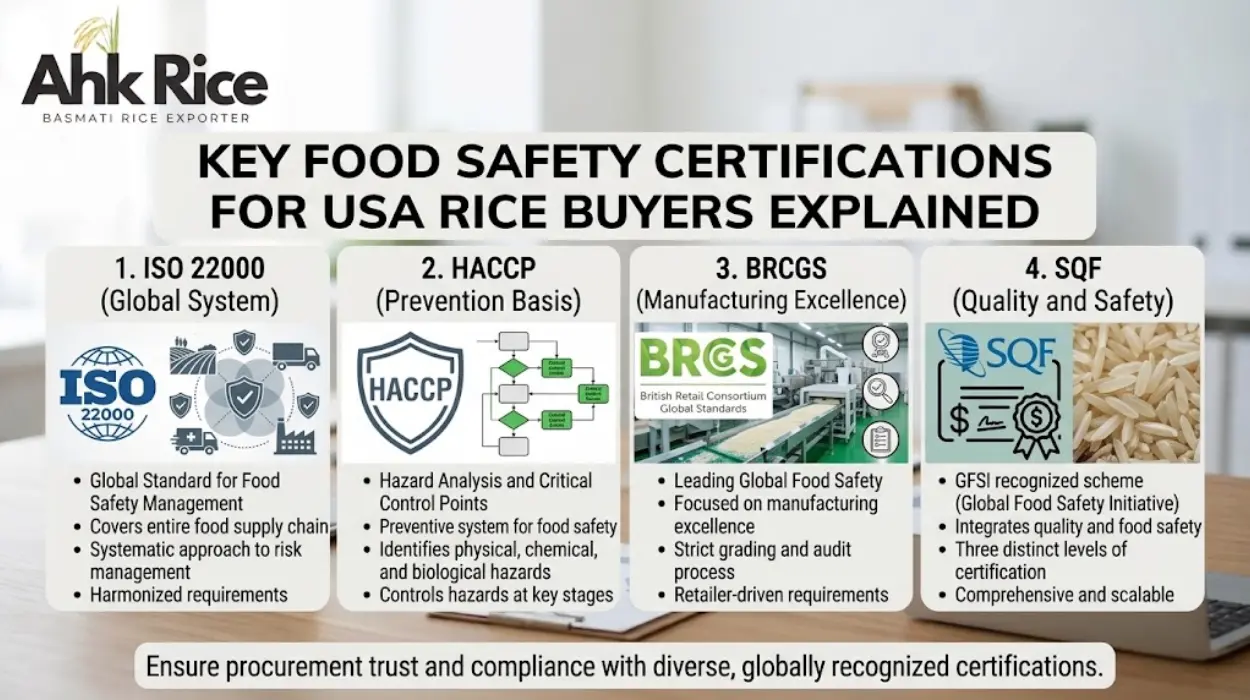
ISO 22000 provides a food safety management system, HACCP controls food safety hazards, BRCGS establishes a detailed certification standard for food manufacturers and processors, and SQF combines food safety requirements with quality management. For USA rice buyers, the best choice depends on supplier risk, customer requirements, and the importer’s compliance programme.
USA rice importers must evaluate more than the price, grain length, broken percentage, and moisture content of Pakistani Basmati rice. They must also assess supplier controls, contamination prevention, traceability, documentation, and the ability to investigate food safety incidents. Understanding these requirements alongside USA rice import food safety requirements and supplier documentation helps buyers build a supplier approval process that addresses both product specifications and food safety risks. Importers must distinguish between a supplier’s certification, the importer’s legal responsibilities, and the documents required for a specific shipment.
What are ISO 22000, HACCP, BRCGS and SQF?
ISO 22000 establishes a food safety management system, HACCP identifies and controls significant food safety hazards, BRCGS provides a detailed food safety certification standard, and SQF offers food safety and quality certification programmes. Each serves a different purpose in supplier evaluation.
ISO 22000: Food safety management
ISO 22000 is an international standard for food safety management systems. It establishes requirements for managing food safety throughout an organisation’s activities, including communication, prerequisite programmes, hazard analysis, operational controls, and continual improvement.
For rice exporters, these systems support controlled processing, hygienic storage, supplier monitoring, and documented corrective actions. Buyers should verify the certificate’s scope, covered facility, certification body, validity, and applicable standard edition.
ISO 22000 certification demonstrates that a management system meets the applicable certification requirements. It does not guarantee that every shipment is free from contamination or that every US import requirement has been met.
HACCP: Hazard Analysis and Critical Control Points
HACCP is a systematic method for identifying, evaluating, and controlling food safety hazards. It considers biological, chemical, and physical hazards and establishes controls based on the risks associated with a product and its processing.
For rice, hazard analysis can address foreign materials, chemical residues, pest contamination, unsuitable storage conditions, and other hazards identified through the facility’s assessment. Controls may include approved suppliers, screening equipment, inspection, sanitation, moisture monitoring, and verification activities.
HACCP is a food safety methodology, not a substitute for every broader management-system requirement. Buyers should request evidence that the supplier’s hazard analysis reflects its actual operations and that corrective actions are documented.
BRCGS: Brand Reputation through Compliance Global Standards
BRCGS is a standards organisation whose food safety certification programmes establish detailed requirements for food manufacturing and related supply-chain activities. Its Global Standard for Food Safety is relevant when evaluating facilities within its certification scope.
Buyers often value BRCGS certification when supplying supermarket chains, private-label programmes, or customers that require recognised third-party certification. The applicable standard includes requirements covering management commitment, hazard analysis, site standards, product control, process control, and traceability.
A buyer must confirm that the certificate covers the actual rice processing facility and activities involved in the order. Certification of a different site or an unrelated business activity does not establish compliance at the supplying facility.
SQF: Safe Quality Food
SQF is a food safety and quality certification programme administered by the Safe Quality Food Institute. It offers certification options designed for different sectors and supply-chain activities.
SQF can be particularly relevant when a US retailer, distributor, or foodservice customer requires suppliers to participate in a specified certification programme. Depending on the applicable programme and scope, certification addresses food safety management and may include quality-related requirements.
Importers should confirm the required SQF code, edition, site scope, and certification status. They should also determine whether the buyer requires SQF specifically or accepts another certification recognised by its supplier approval policy.
How do these four approaches compare?
ISO 22000 provides a management-system framework, HACCP focuses on hazard control, BRCGS supplies detailed auditable requirements, and SQF provides a structured certification programme. Buyers should compare their scope, customer acceptance, audit evidence, and relevance to the supplying facility.
| Comparison attribute | ISO 22000 | HACCP | BRCGS | SQF |
|---|---|---|---|---|
| Primary purpose | Food safety management system | Identify and control food safety hazards | Detailed food safety certification | Food safety and quality certification programmes |
| Main focus | Management, communication, hazard control, improvement | Hazard analysis and critical control points | Site, product, process, and management controls | Programme-specific food safety and quality requirements |
| Typical assessment | Third-party certification audit | Assessment of HACCP plan and its implementation | Audit against the applicable BRCGS standard | Audit against the applicable SQF code |
| System coverage | Organisation’s defined food safety management scope | Product and process hazards within the plan | Facility and activities within the certified scope | Site and activities within the certified scope |
| Retailer relevance | Depends on buyer requirements | Important foundational methodology | Frequently specified by individual retail customers | Frequently specified by individual retail customers |
| Shipment-level guarantee | No | No | No | No |
| Best evaluation use | Assess overall management-system controls | Assess hazard identification and control | Verify detailed site-level requirements | Verify compliance with a specified SQF programme |
The approaches are not interchangeable in every purchasing situation. HACCP is a methodology that can form part of a broader food safety management system. ISO 22000 incorporates HACCP principles alongside additional management-system requirements. BRCGS and SQF establish their own certification requirements, which buyers must assess against the actual needs of their customers.
Certification acceptance also varies by customer. A supermarket may mandate BRCGS or SQF, while another importer may accept a different independently verified system. Buyers should obtain written confirmation of acceptable certification schemes before approving a supplier.
Which food safety certification works best for USA rice imports?
The best approach depends on the importer’s customer contracts, supplier risk assessment, and certification policy. Retail supply chains may demand BRCGS or SQF, while other buyers prioritise a documented HACCP system and an appropriate management-system certification.
A distributor supplying independent grocery stores may prioritise supplier traceability, product specifications, hazard controls, and reliable documentation. A private-label supplier to a large retailer may face more specific certification requirements and additional audits. A foodservice distributor may focus on consistent product quality, packaging integrity, and documented controls at the processing facility.
Buyers should establish their requirements before requesting quotations. This avoids selecting a supplier on price and discovering later that the facility does not hold the certification required by the end customer.
AHK Rice supplies Pakistani Basmati rice varieties, including 1121, Super Kernel, and 1509, to international markets. Buyers considering AHK Rice’s Pakistani Basmati rice export services should evaluate the proposed product, processing specifications, available documentation, and facility evidence against their own supplier approval requirements. Any certification claim must be verified for the specific facility and scope rather than assumed from the supplier’s exporter status.
What are the advantages and disadvantages of each approach?
ISO 22000 offers broad management-system coverage, HACCP provides a focused hazard-control method, BRCGS supports detailed site-level verification, and SQF meets programme-specific buyer requirements. Their limitations arise when buyers mistake certification for complete legal compliance or shipment-level assurance.
ISO 22000: Broad management-system coverage
Advantages: ISO 22000 connects hazard control with management responsibilities, documented processes, communication, and continual improvement. It helps buyers assess whether a supplier manages food safety systematically instead of relying only on final-product inspection.
Disadvantages: Certification alone does not prove that a supplier meets every retailer’s requirements. Buyers must check the scope, audit status, and relevant product-specific controls.
Example: A rice importer evaluating a processor with several product lines can use the certificate and supporting records to assess the facility’s food safety management framework.
HACCP: Direct hazard control
Advantages: HACCP directs attention to actual hazards and the controls needed to prevent, eliminate, or reduce them to acceptable levels. It provides a practical foundation for food safety planning.
Disadvantages: Reviewing a HACCP plan alone does not establish that a facility meets every requirement of a comprehensive certification programme. Buyers must examine implementation and verification evidence.
Example: A buyer can review how a processor identifies physical contamination risks, validates relevant controls, monitors operations, and records corrective actions.
BRCGS: Detailed site requirements
Advantages: BRCGS provides a structured standard for assessing facility conditions, product safety, process controls, traceability, and management practices. It is useful when a customer specifically requires this certification.
Disadvantages: Certification involves preparation, audits, ongoing maintenance, and costs. It does not eliminate the need to verify individual shipments and import documentation.
Example: A private-label buyer can confirm whether the actual processing site holds the BRCGS certification required by the retailer’s supplier approval policy.
SQF: Programme-based assurance
Advantages: SQF offers structured certification against applicable programme requirements. It can align supplier assessment with US retailer and distributor expectations where SQF is specified.
Disadvantages: Buyers must identify the required SQF programme and scope. A certificate that does not satisfy the customer’s exact requirement cannot automatically replace the requested certification.
Example: A distributor can request the relevant SQF certificate and verify that the certified facility performs the activities covered by the purchase contract.
In every case, the strongest assessment combines valid certification evidence with facility-level documentation, product specifications, traceability records, and a risk-based review of the intended shipment.
What must USA rice buyers verify beyond certification?
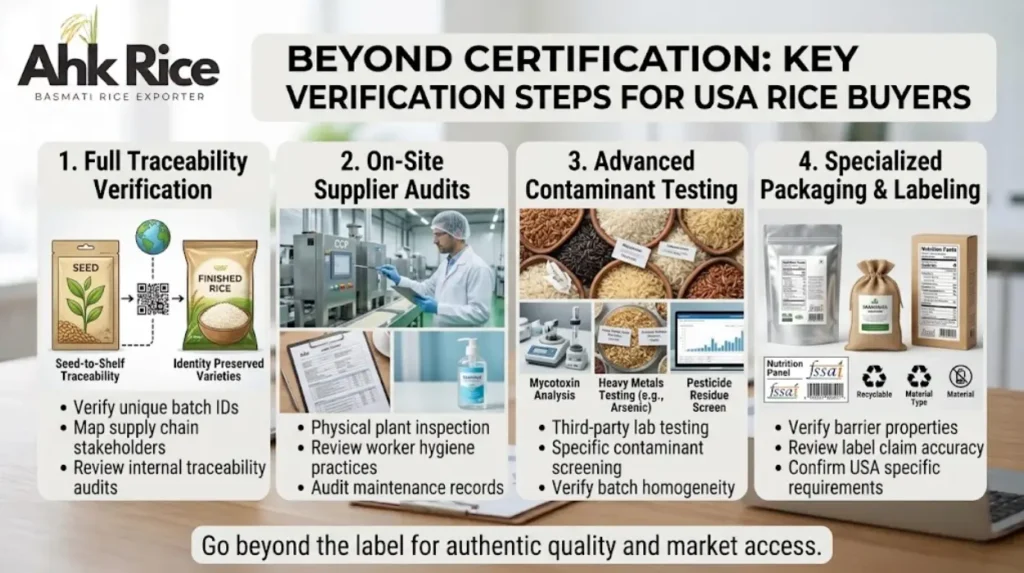
Certification is one part of supplier approval, not a replacement for US import compliance. Buyers must verify applicable FDA requirements, importer responsibilities, product documentation, traceability, labelling, and risk-based testing before releasing an order for shipment.
The US Food and Drug Administration (FDA) regulates food safety under applicable federal requirements. Rice importers must determine which requirements apply to their business, product, supplier, and shipment.
Key checks include:
- Foreign Supplier Verification Programs (FSVP): The responsible US importer must determine and meet applicable FSVP obligations, including risk-based evaluation and verification of foreign suppliers. A supplier certificate does not automatically fulfil these duties.
- Facility registration: Confirm applicable FDA food facility registration requirements and verify the relevant foreign facility information.
- Prior Notice: Ensure the required prior notice of imported food is submitted within the applicable timeframe.
- Product identity and labelling: Check product descriptions, country-of-origin declarations, net quantity, and other applicable labelling requirements for the intended market and packaging.
- Traceability: Establish how the shipment connects to the processor, production lot, packing records, and shipping documents. Determine whether additional traceability requirements apply to the product and business.
- Laboratory testing: Use a risk-based plan to determine whether testing for pesticide residues, heavy metals such as arsenic, mycotoxins, or other hazards is appropriate. Applicable legal limits and customer specifications must guide the decision.
- Shipment documentation: Verify the commercial invoice, packing list, transport document, certificate of origin where required, and any applicable inspection, analysis, or phytosanitary documents.
Buyers should also establish the product specification before production. For Basmati rice, this includes the variety, grain length, broken percentage, moisture limit, processing type, packaging format, and acceptance criteria. These specifications help connect food safety controls with commercial quality requirements.
A certificate does not establish that every batch meets a buyer’s pesticide, arsenic, moisture, or broken-grain limits. Shipment-specific evidence and appropriate testing remain important wherever the risk assessment or contract requires them.
How should buyers compare prices and shelf life across two USA market regions?
US rice buyers should compare supplier quotations using the same product grade, packaging, order volume, and Incoterm. Shelf life must come from the product specification and validated storage conditions, while regional demand determines the commercial value of each grade.
The following comparison separates two practical market segments: premium retail and private-label distribution, and bulk wholesale and foodservice distribution. These are commercial segments within the same US market, not separate legal jurisdictions.
| Evaluation factor | Premium retail and private label | Bulk wholesale and foodservice |
|---|---|---|
| Common product preference | 1121 Basmati and selected Super Kernel grades | Super Kernel, 1509, and suitable 1121 grades |
| Main buying priority | Grain appearance, aroma, consistency, retail presentation | Cost per serving, cooking performance, volume consistency |
| Packaging | Branded or private-label consumer packs | Bulk bags and foodservice-oriented packaging |
| Price per metric tonne | Premiums depend on grade, presentation, brand, and specifications | Cost efficiency depends on volume, processing, and agreed grade |
| Shelf-life assessment | Verify the declared shelf life for the specific retail pack | Verify the declared shelf life for the specific bulk pack and storage conditions |
Price comparison: There is no defensible universal price per metric tonne for either segment without a defined grade, quantity, shipment date, and delivery basis. Buyers should obtain comparable quotations in US dollars per metric tonne and distinguish FOB Karachi pricing from freight-inclusive CIF pricing. Packaging, inspection, insurance, freight, and destination charges can materially change the landed cost.
For a fair comparison, request separate prices for 1121, Super Kernel, and 1509 with the same broken percentage, moisture limit, processing type, bag weight, and Incoterm. A lower quotation for 1509 should not be compared directly with a premium 1121 specification without accounting for the difference in product requirements.
Shelf-life comparison: Do not assign a longer shelf life simply because rice is sold in a premium pack or bulk bag. The applicable period depends on the product, processing, packaging barrier, moisture control, storage conditions, and validated manufacturer declaration. Both market segments require stock rotation, protection from pests and moisture, and appropriate warehouse conditions.
Buyers should obtain the manufacturer’s declared shelf life and storage instructions for each product and packaging configuration. Where aged Basmati is marketed, the age and crop information should be documented rather than inferred from the variety name.
What five factors should determine the final supplier decision?
Choose the supplier that meets mandatory customer certification requirements, demonstrates effective hazard controls, provides traceable product and shipment documentation, satisfies the agreed rice specification, and delivers the best verified landed cost. Price alone is insufficient for food safety approval.
| Decision factor | What the buyer should verify | Decision rule |
|---|---|---|
| 1. Certification | Valid certificate, issuing body, site, scope, and expiry | Reject suppliers that fail a mandatory certification requirement |
| 2. Hazard controls | HACCP plan, risk assessment, monitoring, corrective actions | Require evidence that relevant hazards are controlled |
| 3. Import compliance | Applicable FDA requirements, FSVP arrangements, and shipment documents | Confirm responsibilities before placing the order |
| 4. Product quality | Variety, grain length, broken percentage, moisture, packaging, and test results | Approve a specification and acceptance criteria in writing |
| 5. Commercial value | Comparable price per MT, freight, inspection, lead time, and shelf-life declaration | Select the supplier offering the strongest compliant landed-value proposition |
The supplier approval decision should be documented. Buyers should record which certifications are mandatory, which documents are required before shipment, who reviews test results, and what happens if a lot fails the agreed specification. This process creates a repeatable basis for evaluating new suppliers and renewing existing contracts.
How can buyers work with a Pakistani Basmati exporter?
USA buyers should begin with a defined product specification, verify the processor’s food safety evidence, review sample and laboratory requirements, and agree on packaging, shipment documents, and acceptance criteria before production. This sequence reduces avoidable compliance and commercial risks.
AHK Rice is a Pakistani Basmati rice exporter based in Punjab, supplying 1121, Super Kernel, and 1509 varieties to international markets. Its export offering covers processing coordination, custom packaging, and export documentation. Buyers should request the current evidence relevant to their order and verify any certification or testing claims against the intended product and processing facility.
A practical purchasing process starts by identifying the market segment and grade. The buyer then defines grain specifications, broken percentage, moisture, processing type, packaging, and any retailer-specific certification requirements. The exporter and buyer can agree on sample approval, testing, inspection arrangements, shipping terms, and the documents required before dispatch.
The final contract should state the applicable product specification, certificate and document requirements, inspection procedure, shipment terms, and corrective action process for non-conforming goods. This creates a clearer link between food safety expectations and commercial delivery.
ISO 22000, HACCP, BRCGS, and SQF serve different purposes in food safety assurance. HACCP provides a hazard-control foundation, ISO 22000 establishes a management-system framework, and BRCGS and SQF provide structured certification programmes. US buyers should select an approach that satisfies customer requirements and supports a documented risk-based supplier approval process.
For Pakistani Basmati rice imports, certification is only one part of the decision. Product specifications, applicable FDA requirements, importer verification duties, traceability, testing, shipment documentation, landed cost, and storage conditions must also be evaluated. A consistent supplier assessment process helps buyers balance compliance, quality, and commercial value.
Frequently asked questions
Is HACCP the same as ISO 22000?
No. HACCP is a method for identifying and controlling food safety hazards. ISO 22000 is a broader food safety management-system standard that incorporates HACCP principles alongside management, communication, and continual improvement requirements.
Do US rice importers require BRCGS or SQF certification?
Not universally. Certification requirements depend on applicable regulations, customer contracts, retailer policies, and the importer’s supplier approval programme. Buyers must confirm whether their specific customer requires BRCGS, SQF, another certification, or additional verification.
Does ISO 22000 certification guarantee FDA compliance?
No. ISO 22000 certification does not automatically establish compliance with all FDA requirements. US importers must determine their legal obligations and verify applicable supplier, facility, product, and shipment requirements.
What documents should buyers request from a Pakistani rice exporter?
Depending on the product and transaction, buyers may request a valid facility certificate, product specification, certificate of analysis, traceability information, packing list, commercial invoice, transport document, and certificate of origin where applicable. Additional inspection or phytosanitary documents depend on the shipment and destination requirements.
Does certification guarantee pesticide and arsenic compliance?
No. Certification does not guarantee that every lot meets every applicable chemical contaminant limit. Buyers should use product-specific risk assessments, suitable laboratory methods, reliable test results, and applicable legal or contractual limits to evaluate the shipment.
Which rice variety is best for US retail and foodservice?
1121 often suits buyers prioritising long grain presentation and premium positioning. Super Kernel serves buyers seeking traditional Basmati characteristics, while 1509 can suit cost-sensitive volume requirements. The best variety depends on cooking performance, customer preferences, price, and the agreed product specification.
How should buyers compare shelf life?
Request the declared shelf life for the exact rice product and packaging format, along with storage instructions and supporting product information. Compare suppliers using the same storage assumptions and packaging conditions rather than relying on a generic shelf-life figure for all Basmati rice.
What is the most important step before the first order?
Define mandatory certification and import requirements before agreeing on price. Then verify the supplying facility, approve the product specification, establish testing and document requirements, and agree on the inspection and acceptance process in writing.