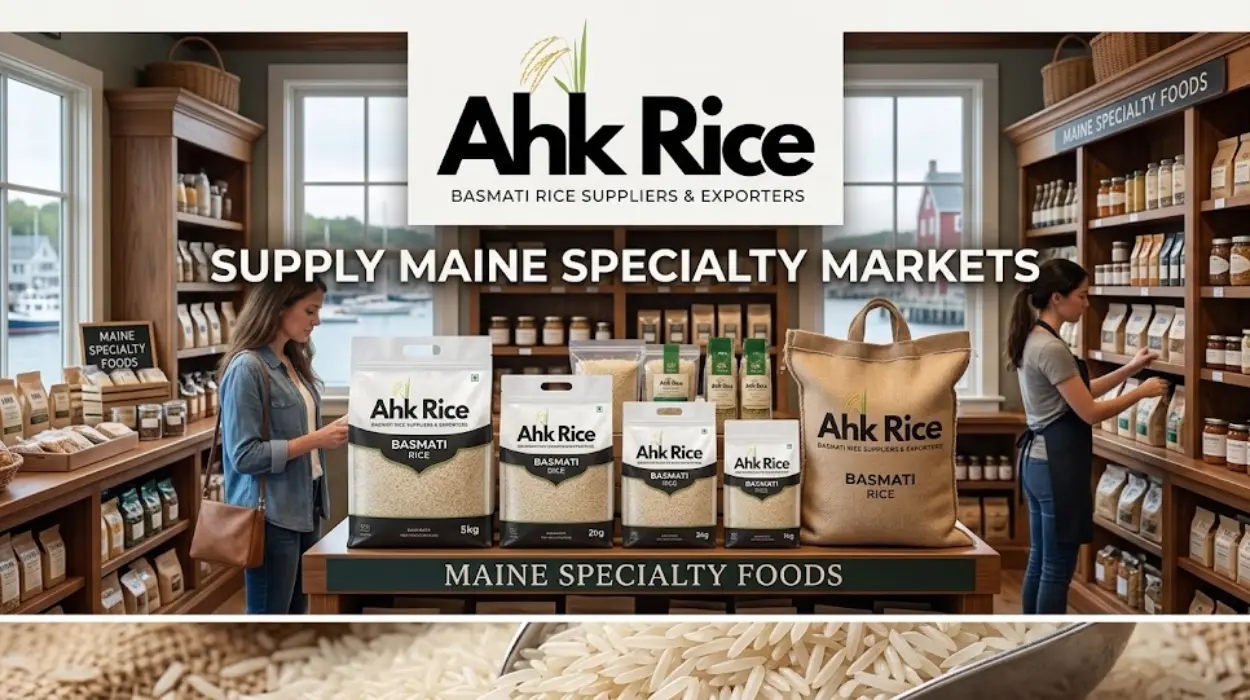
Supply Maine Specialty Food Markets with AHK Rice Products
Maine specialty food retailers need imported rice that is consistent in grain length, aroma, cooking performance, packaging, documentation, and replenishment timing. The best solution is a controlled supply program that fixes the rice specification before purchase, validates samples, prepares U.S.-compliant documentation, and plans ocean freight around the distributor’s inventory cycle. For buyers researching:
Why premium Basmati rice is growing in Maine specialty food stores, the key commercial issue is no longer simply finding Pakistani rice. It is selecting a supplier capable of repeating the same specification across commercial shipments.
AHK Rice supplies Pakistani Basmati rice programs for U.S. food businesses that need defined product specifications and export coordination. Its range can include 1121 Basmati, Super Kernel and 1509 varieties, depending on the required grain profile, processing style, packaging format and target retail or foodservice application. U.S. importers remain responsible for ensuring imported food complies with applicable U.S. requirements, while FDA requires relevant foreign food facilities to be registered and imported food shipments to meet Prior Notice requirements.
What is the best solution for supplying Maine specialty food markets?
The best solution is a specification-led supply program combining approved rice samples, controlled milling and grading, food-safe packaging, export documentation, planned ocean freight, and repeat-order controls so Maine buyers receive commercially consistent rice instead of variable spot-market shipments.
A specialty distributor should first define the finished product rather than start with a generic request for “premium Basmati.” The specification should identify variety, grain length, broken percentage, moisture, foreign matter tolerance, crop or aging requirement, milling condition, processing type, packaging weight, private-label requirements and intended market.
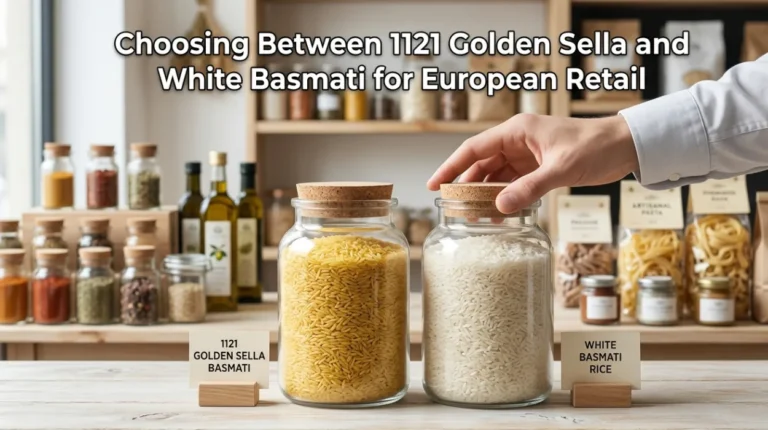
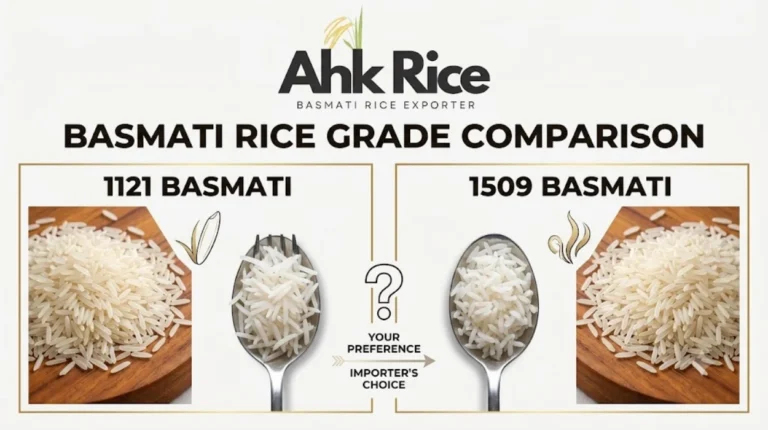
For Maine specialty stores, the product may be positioned around aroma, extra-long grains, restaurant cooking performance or premium retail presentation. A 1121 Steam Basmati specification can suit buyers seeking long grains and separated cooked rice. Super Kernel can fit buyers seeking a traditional premium Basmati profile. A 1509 program can provide another commercial option where grain length, processing and price need to be balanced.
The comparison of:
How specialty distributors select premium imported rice products should therefore happen before the purchase order. This prevents a common procurement error: comparing suppliers only on quoted price while ignoring yield, specification consistency, documentation, packaging quality and landed delivery timing.
AHK Rice can structure the supply around an approved reference sample. Once the buyer accepts the sample, the commercial specification becomes the benchmark for production. This gives the distributor a physical reference against which subsequent lots can be evaluated.
Why choose USA supply services from AHK Rice?
A U.S.-focused supply service is valuable because it connects Pakistani rice processing with American import requirements, commercial packaging, documentation, freight planning, and buyer specifications rather than treating export shipment as a simple commodity transaction.
The USA rice supply service is designed for buyers who need more than a product quotation. A commercial shipment requires coordination between the exporter, mill, inspection process, freight provider, customs broker and U.S. importer.
FDA states that imported food must satisfy U.S. requirements and that importers are responsible for ensuring food is safe, sanitary and properly labeled. FDA also requires applicable food facilities to register and requires Prior Notice for covered imported food shipments.
For a Maine distributor, this means supplier selection should include a documentation review before loading. The buyer should confirm the manufacturer or processing facility information, product description, package configuration, commercial invoice details, packing list, bill of lading information and other documents required by the importer and customs broker.
AHK Rice can also coordinate the physical supply chain around the approved specification. The objective is to make the rice specification, packaging specification and export documentation agree with each other.
Pakistan remains a major rice-exporting origin. USDA’s April 2026 Pakistan Grain and Feed Annual forecasts 2026/27 Pakistani rice production at approximately 9.8 million metric tons and rice exports at about 5.0 million metric tons, compared with projected 2025/26 exports of 4.7 million metric tons.
This production base gives U.S. buyers access to a substantial origin supply, but availability does not remove the need for supplier qualification. A distributor still needs to know exactly which variety and grade will be shipped.
How does the AHK Rice sample process work?
The sample process should move from written specification to representative sample, technical review, cooking evaluation, optional laboratory testing, packaging approval, commercial confirmation, and finally production against the approved reference before the first container is released.
A practical sample process can follow six stages.
Stage 1: Define the specification.
The buyer provides the target variety, processing type, grain requirement, broken percentage, moisture range, packaging size, annual volume and destination. If the rice will carry a private label, artwork and packaging requirements should also be identified at this stage.
Stage 2: Prepare the product sample.
AHK Rice prepares a representative sample matching the proposed commercial specification. The buyer should request enough material to assess both raw appearance and cooking performance rather than judging the rice only from a small visual sample.
Stage 3: Evaluate the sample.
The buyer checks grain length, uniformity, broken grains, aroma, whiteness or processing appearance, foreign matter, cooking expansion, separation and texture. For restaurant-oriented programs, the cooking test should reflect the actual preparation method used by the customer.
Stage 4: Optional laboratory testing.
If the importer requires laboratory verification, testing can be added for parameters relevant to the product and destination. An indicative buyer-side budget for an independent laboratory test can be around $75–$200 per sample, depending on the laboratory and test panel. This is a planning range, not a fixed AHK Rice fee.
Stage 5: Courier and sample handling.
For international samples, a buyer should budget approximately $40–$150 for courier and handling depending on weight, destination and service level. Product, packaging and laboratory costs can be additional. Exact costs should be confirmed before dispatch.
Stage 6: Approve the commercial reference.
The buyer confirms the accepted variety, grade, processing, packaging and test results. The approved sample becomes the reference for the purchase order. Any material change should require buyer approval rather than being silently substituted.
This process reduces the risk of approving one attractive sample and receiving a materially different commercial lot.
What shipping time should Maine buyers expect from Pakistan?
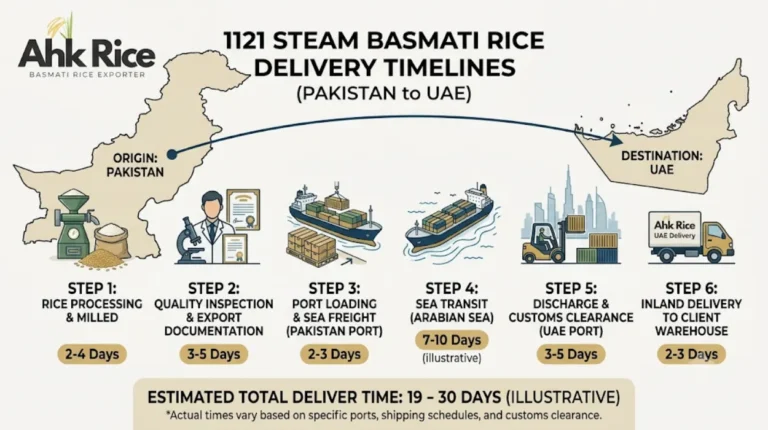
Maine buyers should normally plan approximately 35–55 days from commercial readiness in Pakistan to delivery into Maine, with ocean transit itself commonly taking roughly 30–45 days depending on routing, transshipment, port congestion, vessel schedule, customs clearance, and inland delivery.
Shipping time should be treated as a planning range rather than a guaranteed number of days. Karachi-area export loading, vessel availability, transshipment, U.S. port discharge, customs clearance and final trucking can each change the delivery date.
For a Maine specialty distributor, a practical planning model is:
| Supply stage | Planning range |
|---|---|
| Final specification and purchase order | 2–5 days |
| Production, grading and packing | 7–15 days |
| Export documentation and container loading | 3–7 days |
| Ocean freight Pakistan to U.S. gateway | 30–45 days |
| U.S. customs and port handling | 3–7 days |
| Inland delivery to Maine | 1–4 days |
| Typical total planning window | 46–83 days |
The exact timeline depends on the selected U.S. gateway and sailing schedule. Maine buyers should therefore avoid calculating replenishment from vessel departure alone. Inventory planning should begin with the expected retail stock-out date and work backward through inland delivery, customs, ocean freight, production and purchase-order approval.
FDA Prior Notice also needs to be incorporated into the import process. For food arriving by water, FDA guidance states that Prior Notice must be received and confirmed at least eight hours before arrival, subject to the applicable filing method and requirements.
What results can Maine specialty food distributors expect?
A controlled AHK Rice supply program can improve product consistency, reduce specification disputes, create predictable replenishment planning, simplify repeat purchasing, and give specialty retailers a stable premium rice product instead of relying on inconsistent spot-market availability.
The most important result is repeatability. A specialty distributor can establish one approved specification and use it for multiple purchase orders. That makes procurement easier because the buyer no longer has to redefine the product each time.
A second result is better inventory planning. Suppose a Maine distributor sells 2,000 kilograms of premium Basmati per month and wants 45 days of safety inventory. The buyer can establish a replenishment trigger before available stock falls below the quantity required to cover the next production and shipping cycle.
A third result is stronger retail consistency. If the first shipment has excellent grain separation and aroma but the second shipment has different cooking behavior, retailer confidence can suffer. Specification control helps reduce that variation.
A fourth result is clearer landed-cost management. Instead of comparing only FOB quotations, the distributor can evaluate product cost, packaging, testing, freight, customs-related expenses, inland transportation and inventory carrying requirements.
AHK Rice’s role is strongest when these elements are treated as one procurement system. The supplier is not simply providing rice. The supplier is helping convert a written product requirement into a repeatable export shipment.
How much does premium Pakistani rice supply cost?
The final cost depends on rice variety, grade, processing method, crop and aging requirements, order volume, packaging, private-label work, testing, freight, destination charges, exchange rates, and the commercial terms agreed between buyer and supplier.
A distributor should request a quotation against a complete specification. A price for “1121 Basmati” alone is not sufficient for a serious purchasing decision because 1121 can be supplied in different processing formats and quality specifications.
The main cost variables include:
| Cost factor | Effect on quotation |
| Rice variety | Determines base product positioning |
| Grade and broken percentage | Higher specifications can increase cost |
| Steam, white or Sella processing | Changes processing requirements |
| Packaging | Retail bags and custom printing add cost |
| Order volume | Larger repeat programs can improve efficiency |
| Laboratory testing | Adds per-lot or per-sample expense |
| Ocean freight | Changes with route and market conditions |
| Inland delivery | Depends on U.S. gateway and Maine destination |
| Private labeling | Artwork, bags, printing and setup affect cost |
| Payment terms | Can affect commercial pricing and working capital |
For a Maine buyer, the correct purchasing metric is landed cost per metric ton, not simply the lowest export quotation. A lower FOB price can become less attractive if the specification is weaker, packaging requires rework, documentation is incomplete or the shipment arrives too late for the distributor’s replenishment cycle.
Which rice specification should a Maine buyer select?
The correct specification depends on the customer application, retail positioning, expected cooking performance, target price, packaging format, and required volume; buyers should approve the exact product before negotiating recurring shipment quantities.
For premium specialty retail, grain appearance and aroma may receive greater weight. For restaurants, cooking expansion and separation can become more important. For a distributor serving both channels, a multi-SKU strategy may be more effective than forcing one rice specification across every customer.
A useful decision framework is:
| Buyer requirement | Recommended procurement response |
| Premium retail positioning | Prioritize grain appearance, aroma and packaging |
| Restaurant demand | Prioritize cooking performance and repeatability |
| Price-sensitive specialty channel | Balance grade against landed cost |
| Private-label launch | Approve packaging and product together |
| High repeat volume | Prioritize production capacity and replenishment reliability |
AHK Rice should be evaluated against the buyer’s actual specification rather than against an undefined category label. This approach creates a measurable purchasing standard and makes supplier comparison more objective.
How should a Maine distributor get started?
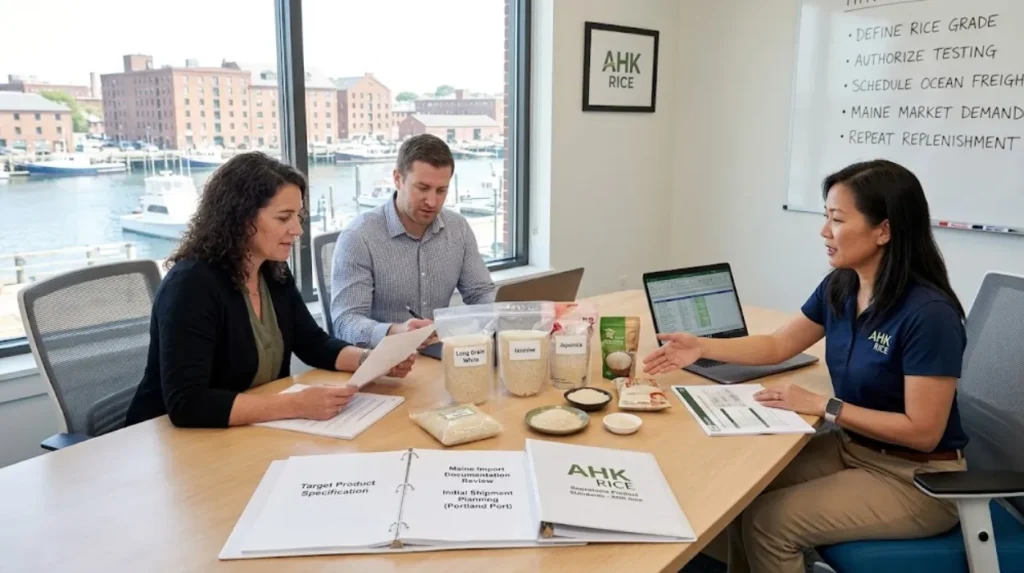
Start by submitting the target product specification, expected annual volume, package size, delivery destination, private-label requirements, and preferred timing; then approve samples, confirm commercial terms, complete documentation checks, and schedule production before inventory becomes critical.
The first commercial discussion should establish the product. The second should establish the shipment. The third should establish repeat supply.
A practical launch sequence is to define the rice grade and processing type, request a representative sample, conduct raw and cooking evaluations, authorize any required laboratory testing, approve packaging, confirm the purchase-order specification, review import documentation requirements with the U.S. importer or broker, and then schedule production and ocean freight.
For a new Maine specialty distributor, the first shipment should not be treated as an isolated transaction. It should establish the benchmark for future orders. Record the approved product specification, sample results, packaging configuration, lot information, shipment dates and receiving results so subsequent orders can be compared with the original standard.
This is where AHK Rice can become a long-term supply partner rather than simply a rice vendor. The commercial objective is a repeatable product, predictable documentation and a replenishment cycle that fits Maine specialty food distribution.
A buyer ready to proceed should provide the required variety, grade, processing method, package size, estimated quantity, delivery location and target shipment date. AHK Rice can then develop the appropriate product and export quotation around those requirements.
To begin the commercial process, submit the final specification and shipment requirements through the AHK Rice request-a-quote process.
Frequently Asked Questions
What rice products does AHK Rice supply to Maine specialty food markets?
AHK Rice can supply premium Pakistani Basmati varieties including 1121 Basmati, Super Kernel, and 1509, with specifications tailored to retail, restaurant, and specialty distribution requirements.
Why should Maine specialty food distributors choose AHK Rice?
AHK Rice provides specification-based sourcing, sample approval, processing, grading, packaging, export documentation, and shipment coordination to help U.S. buyers establish a consistent imported rice program.
How does AHK Rice handle product samples?
The process starts with the buyer’s required variety, grade, processing type, packaging, and quality specifications. A representative sample is then evaluated for appearance, grain characteristics, aroma, and cooking performance before commercial approval.
How much does rice sample testing cost?
Independent laboratory testing can typically cost around $75–$200 per sample depending on the laboratory and test panel. International sample courier costs may add approximately $40–$150, depending on destination and shipment characteristics.
How long does shipping from Pakistan to Maine take?
A Maine buyer should generally plan around 46–83 days for the complete supply cycle, including production, export preparation, ocean freight, U.S. handling, customs procedures, and inland delivery. Actual timing depends on routing and port conditions.
Which AHK Rice variety is best for Maine specialty stores?
The appropriate variety depends on the retailer’s positioning and customer requirements. 1121 Basmati can suit premium long-grain applications, while Super Kernel and 1509 can provide alternative combinations of grain characteristics, processing, cooking performance, and price.
Can AHK Rice provide private-label rice for Maine businesses?
Yes. AHK Rice can support private-label programs by coordinating the selected rice specification with packaging requirements, product preparation, and export shipment planning.