How Halal and Kosher Certification Works for Pakistani Basmati Rice Exports
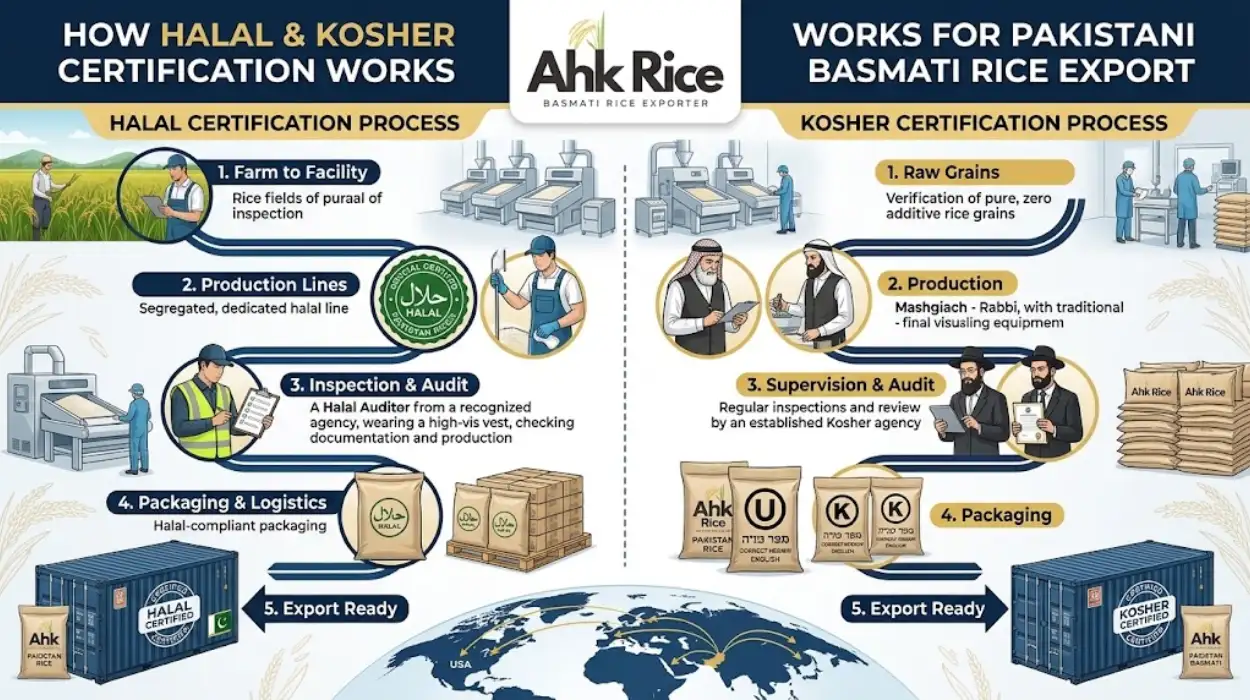
Halal and Kosher certification serve different religious dietary requirements, but both help rice importers establish product suitability, supplier accountability, and documented compliance. For Pakistani Basmati rice exporters, the right approach depends on the destination market, buyer specifications, processing practices, and certification requirements rather than grain variety alone.
Importers sourcing rice for the United States, Gulf Cooperation Council (GCC) countries, and specialist retail channels must distinguish religious certification from general food safety compliance. Understanding Pakistani Basmati rice export requirements and international sourcing helps buyers evaluate product documentation, processing controls, packaging, and shipment readiness before placing an order.
AHK Rice is a Pakistani Basmati rice exporter based in Punjab, supplying 1121, Super Kernel, and 1509 Basmati rice varieties to more than 15 countries. Its export offering covers processing, custom packaging, and export documentation. Buyers should confirm the exact certification status, issuing organization, and product scope for each proposed shipment.
What are Halal and Kosher certifications for Pakistani Basmati rice?
Halal certification verifies that a product and its relevant production processes comply with applicable Islamic dietary requirements, while Kosher certification verifies compliance with Jewish dietary law. Both involve defined standards, but their religious rules, certification authorities, and oversight procedures differ.
Halal certification establishes that food meets the requirements of an applicable Islamic certification standard. For plain Basmati rice, the assessment focuses on ingredients, processing aids, equipment cleanliness, contamination controls, storage, and handling. Rice is naturally plant-based, but processing and supply-chain practices still require evaluation.
Kosher certification confirms that a product meets Jewish dietary requirements under the applicable kosher standard. A certifying organization evaluates ingredients, production equipment, processing arrangements, and other relevant controls. Some programs require additional supervision or review based on the facility and production process.
Neither certification automatically proves that a product meets every destination’s import requirements. Halal or Kosher status does not replace food safety management, applicable contaminant testing, customs documentation, phytosanitary requirements, or destination-specific labeling rules.
For importers, the central distinction is the intended assurance. Halal certification supports access to customers seeking products that comply with Islamic dietary requirements. Kosher certification supports customers who require compliance with Jewish dietary laws. Both can strengthen buyer confidence when the certification is valid and applies to the actual product being purchased.
What are the available solutions for rice exporters seeking certification?
Rice exporters can pursue Halal certification, Kosher certification, both certifications, or neither when their target customers do not require them. The correct choice depends on the buyer’s written specifications, destination market, retail channel, and the certifier’s acceptance by the importer.
Four practical approaches are available.
1. Halal certification only
This approach suits exporters supplying customers who require documented Halal compliance. It is particularly relevant to Muslim-majority markets and distributors serving Halal-focused consumers. The exporter works with a recognized certification body to establish eligibility, complete the assessment, and maintain compliance.
2. Kosher certification only
This option targets kosher retail channels, Jewish food distributors, and buyers whose procurement policies require certification. The exporter must select a certifying organization accepted by the intended customer. Certification scope must cover the relevant product and production arrangements.
3. Dual Halal and Kosher certification
Dual certification allows an exporter to serve customers with different religious dietary requirements. It can support broader retail distribution when both certifications are commercially necessary. However, each program retains its own requirements, assessment procedures, and ongoing obligations.
4. No religious certification
Some buyers purchase conventional, plant-based Basmati rice without requiring either certificate. These buyers still need applicable food safety documentation, product specifications, traceability, and import compliance. An exporter should never represent uncertified rice as Halal-certified or Kosher-certified.
The most efficient solution is to establish the buyer’s certification requirements before arranging an audit. This avoids paying for a certificate that does not meet the customer’s procurement conditions.
How do Halal and Kosher certification processes compare?
Halal and Kosher certification both assess product suitability and relevant production controls, but their governing standards and approval authorities differ. Halal programs evaluate compliance with Islamic dietary requirements, while Kosher programs assess compliance with Jewish dietary law and applicable supervision rules.
| Comparison attribute | Halal certification | Kosher certification |
|---|---|---|
| Religious framework | Islamic dietary requirements | Jewish dietary requirements |
| Certification authority | An applicable Halal certification body | A recognized Kosher certification agency |
| Ingredient review | Checks ingredients, additives, and relevant processing aids | Checks ingredients, additives, and relevant processing aids |
| Equipment assessment | Reviews cleanliness, contamination risks, and applicable segregation controls | Reviews equipment status, production arrangements, and applicable kosher controls |
| Production supervision | Depends on the certification standard and facility risk | Depends on the certification program and production requirements |
| Documentation | Certificate, product scope, facility records, and applicable supporting documents | Certificate, product scope, facility records, and applicable supporting documents |
| Market purpose | Serves buyers requiring Islamic dietary compliance | Serves buyers requiring Jewish dietary compliance |
How does Halal certification work for Basmati rice?
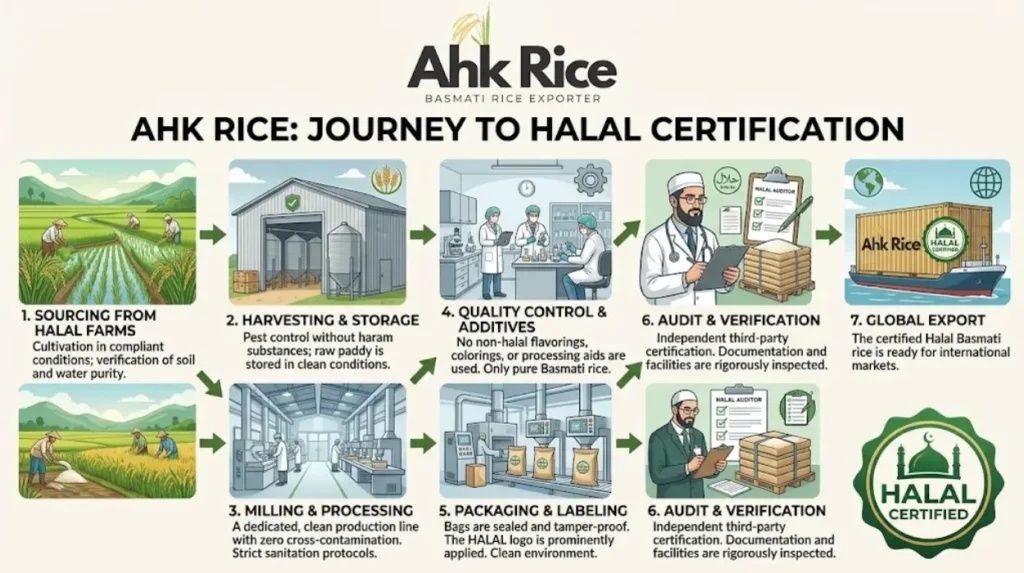
The exporter identifies a suitable certification body and submits information about the product, ingredients, processing facility, and supply chain. The certifier reviews the application, assesses relevant controls, and determines whether an audit or additional evidence is required.
For a rice mill, the assessment can cover cleaning, grading, polishing, color sorting, packing, storage, and contamination prevention. The certifier also reviews relevant processing aids and materials that could affect compliance.
Approval follows the certifier’s applicable requirements. The exporter must maintain the required records, follow the approved scope, and complete renewals or surveillance activities where applicable.
How does Kosher certification work for Basmati rice?
The exporter approaches a Kosher certification agency that serves the intended market and product category. The agency reviews ingredients, equipment, facility arrangements, and production procedures before deciding on the necessary inspection and supervision.
Plain rice presents a different assessment profile from products containing animal-derived ingredients or complex additives. Nevertheless, the certification agency determines the applicable requirements. Equipment use, processing materials, packaging arrangements, and other production details can influence approval.
The exporter must verify that the resulting certificate identifies the correct product and facility. Buyers should also confirm whether the certificate requires a specific symbol, supervision arrangement, or additional documentation.
Which certification works best for different export markets?
Halal certification generally takes priority when an importer requires Islamic dietary assurance, while Kosher certification is essential for buyers whose procurement specifications require kosher status. Exporters targeting both customer groups should assess dual certification against documented demand and market access requirements.
United States: ethnic and mainstream retail
The US market includes South Asian grocery stores, mainstream supermarkets, foodservice distributors, institutional buyers, and specialty kosher retailers. Their requirements differ according to customer demographics and procurement policies.
For South Asian grocery distribution, Pakistani Basmati varieties such as 1121 and Super Kernel may appeal to buyers prioritizing aroma, grain length, and cooking performance. Halal certification becomes commercially relevant when the distributor or its customers require it.
Kosher certification is particularly relevant when the intended channel requires kosher-approved products. A conventional supermarket listing does not automatically require either certification, so buyers should verify their own procurement specifications.
For US shipments, religious certification does not replace applicable US food import requirements. Importers must assess the relevant Food and Drug Administration (FDA) requirements, food facility obligations, prior notice, labeling, and other applicable rules. Requirements depend on the product, parties, and transaction.
GCC markets: Halal-focused distribution
GCC destinations, including the United Arab Emirates and Saudi Arabia, serve extensive Halal-oriented consumer markets. Importers commonly evaluate Halal compliance alongside food safety, labeling, origin, and shipment documentation.
For premium retail and foodservice, 1121 Basmati may suit buyers seeking long grains and an aromatic cooked profile. Super Kernel can serve traditional Basmati retail and wholesale channels, while 1509 can suit buyers prioritizing commercial value and volume.
The importer must confirm which Halal certification bodies and documents the destination authority accepts. A certificate accepted by one buyer or country does not automatically satisfy every GCC destination’s requirements.
Kosher certification becomes relevant when a distributor specifically serves kosher customers or requires it contractually. It is not a substitute for Halal compliance where Halal certification is mandatory.
How do prices and shelf life compare?
Certification affects procurement costs and market access, but it does not determine rice prices by itself. Grain variety, grade, broken percentage, moisture, aging, packaging, order quantity, and shipping terms remain major pricing factors. Shelf life depends on product quality, packaging, storage conditions, and the validated date marking.
The following figures are illustrative planning ranges, not verified live quotations or guaranteed transaction prices.
| Commercial factor | Halal-certified Basmati | Kosher-certified Basmati |
|---|---|---|
| Indicative FOB price per metric tonne | US$1,000–US$1,400 for selected commercial grades | US$1,000–US$1,400 for comparable grades |
| Price premium | Depends on certification fees, demand, and order volume | Depends on certification fees, supervision, and demand |
| Shelf life | Commonly 18–24 months for suitable, properly packed white rice | Commonly 18–24 months for suitable, properly packed white rice |
| Main market consideration | Halal requirements and destination acceptance | Kosher requirements and certification scope |
| Final commercial price | Confirm grade, packing, volume, and Incoterm | Confirm grade, packing, volume, and Incoterm |
These ranges are broad budgeting examples. Actual quotations can fall outside them, and certification alone does not establish a reliable price difference between otherwise identical shipments. Buyers should obtain current offers based on a complete specification.
The stated shelf-life range is also a general planning reference rather than a certification guarantee. The exporter must validate the declared shelf life for the actual product and packaging. Brown rice, for example, has different storage characteristics from white Basmati because its higher oil content increases susceptibility to rancidity.
For both certification types, storage in clean, dry conditions with protection from moisture, pests, and contamination supports product quality. The product label and applicable regulations determine the declared best-before or expiry information.
What are the advantages and disadvantages of each certification approach?
Single certification limits unnecessary administrative work when a buyer needs only one religious assurance. Dual certification broadens potential market access but increases compliance responsibilities. Uncertified supply can suit buyers without religious certification requirements, provided the exporter makes accurate product claims.
Halal certification: advantages and limitations
The principal advantage is access to buyers requiring documented Halal compliance. Certification can support procurement reviews, retailer onboarding, and customer confidence when the certificate is accepted in the destination market.
The limitation is that acceptance varies by jurisdiction, importing organization, and certification scheme. Exporters must verify recognition rather than assuming a certificate is universally valid. Application, audit, renewal, and monitoring activities also require time and resources.
Example: A UAE distributor requests Halal-certified 1121 Steam Basmati in 5 kg retail bags. The exporter confirms the buyer’s accepted certification body, verifies the product scope, and aligns the packaging and shipment documents with the order.
Kosher certification: advantages and limitations
Kosher certification can qualify rice for customers whose procurement standards require kosher status. It can support specialty retail distribution and foodservice channels that evaluate religious compliance as part of supplier approval.
The limitations include certification fees, possible production supervision, and restrictions determined by the certifying agency. A certificate from one organization may not meet another customer’s requirements.
Example: A US distributor seeks Kosher-certified Super Kernel Basmati for a specialty retail program. The exporter confirms that the specific rice product and production facility fall within the agency’s approved scope before shipment.
Dual certification: advantages and limitations
Dual certification can help an exporter serve separate Halal and Kosher customer segments without maintaining entirely different product lines, provided both certification programs approve the production arrangements.
The disadvantage is additional administration and the possibility of overlapping or different operational requirements. Each certifier must independently approve the relevant scope.
Example: A US importer sells rice through South Asian grocery stores and a kosher-focused retail channel. Dual certification may support both programs if the importer requires it and both certifiers approve the product and facility.
No certification: advantages and limitations
Conventional supply avoids certification costs where customers do not require religious approval. It can suit general wholesale or foodservice orders with clearly defined food safety and quality specifications.
The limitation is restricted access to buyers that mandate Halal or Kosher documentation. The exporter must not use certification marks or claims without appropriate authorization.
Which factors should importers evaluate before choosing a certification method?
Importers should prioritize written buyer requirements, destination recognition, product and facility scope, total compliance costs, packaging claims, and ongoing certificate validity. These factors establish whether certification supports the intended sales channel and whether the shipment can meet its contractual requirements.
Use this five-factor decision framework before approving a supplier.
| Decision factor | Question to ask | Recommended action |
|---|---|---|
| Destination market | Which country will receive the shipment? | Verify local import rules and accepted certification bodies. |
| Customer requirements | Does the buyer require Halal, Kosher, both, or neither? | Obtain written specifications before production. |
| Product and facility scope | Does the certificate cover the exact product and production site? | Check the certificate, scope, validity, and issuing organization. |
| Commercial cost | Do certification and supervision costs fit the order volume and margin? | Compare the complete landed-cost implications, not just the certificate fee. |
| Packaging and shipment | Do labels and export documents match the approved product and destination rules? | Approve artwork and documentation before dispatch. |
Buyers should also request a product specification covering grain variety, average grain length, broken percentage, moisture, processing method, packaging format, and shelf-life declaration.
For 1121, Super Kernel, and 1509, the commercial specification must identify the exact grade and processing type. Halal or Kosher certification does not establish grain length, cooking performance, moisture content, or broken percentage.
Importers should request the relevant certificate, confirm its validity directly with the issuing organization when necessary, and ensure the product description matches the commercial invoice and packing list. Where applicable, food safety certificates, laboratory reports, phytosanitary documents, and certificates of origin must be evaluated separately.
How can buyers source certified Pakistani Basmati rice confidently?
Buyers should begin with the destination market and the required certification, then verify the supplier’s product specifications, certificate scope, packaging, and export documentation. A written quotation and pre-shipment approval process help align the order with the buyer’s compliance and commercial requirements.
AHK Rice supplies Pakistani Basmati varieties from Punjab and supports export processing, custom packaging, and shipment documentation. Importers evaluating the supplier should specify the required variety, grade, certification, destination, bag size, quantity, and Incoterm in their inquiry.
The next step is to confirm the availability and scope of the requested certification. Buyers should not assume that every variety, facility, or shipment carries the same approval. Documentary verification must precede any certification claim in packaging or sales materials.
For US ethnic and mainstream retail buyers, the commercial decision should also account for shelf positioning, cooking performance, label requirements, and the distributor’s certification policy. Importers can then compare offers on equivalent specifications instead of choosing solely by price per metric tonne.
A supplier’s ability to provide traceable documentation and a clearly defined product specification makes the sourcing process easier to audit. The buyer remains responsible for verifying destination requirements and ensuring the proposed shipment meets its own contractual and regulatory obligations.
Halal and Kosher certification support different religious dietary requirements and should be selected according to the buyer’s market, procurement specifications, and accepted certification standards. Halal certification is relevant to buyers requiring Islamic dietary compliance, while Kosher certification serves customers who require compliance with Jewish dietary law. Dual certification makes sense when both customer groups justify the additional cost and oversight.
For Pakistani Basmati rice exporters, successful sourcing depends on more than certification. Buyers must compare grain specifications, processing quality, packaging, shelf life, documentation, and destination compliance. Verifying each requirement before production reduces avoidable delays and improves purchasing decisions.
Frequently asked questions about Halal and Kosher Basmati rice exports
Is all Pakistani Basmati rice automatically Halal?
Plain Basmati rice is naturally plant-based, but it is not automatically Halal-certified. Certification requires approval under an applicable scheme. Buyers must verify the certificate, product scope, facility, and issuing body before making a certified-product claim.
Can Basmati rice be both Halal and Kosher-certified?
Yes, a Basmati rice product can hold both certifications when the relevant certification bodies independently approve it. Each certificate must cover the product and production arrangements, and both programs’ requirements must remain satisfied.
Does Kosher certification replace Halal certification?
No. Kosher and Halal certifications follow different religious standards. Buyers requiring Halal compliance must verify an accepted Halal certificate rather than treating a Kosher certificate as a substitute.
Does Halal certification increase the price of Basmati rice?
Certification can add administrative, auditing, and monitoring costs, but the final price depends on the complete commercial arrangement. Variety, grade, order volume, packaging, freight, and Incoterms also affect the quotation.
How long does certified Basmati rice remain suitable for sale?
Properly packed white Basmati rice commonly carries a planning shelf-life range of 18–24 months, subject to validated product specifications and storage conditions. Certification does not independently guarantee shelf life. The exporter must establish and declare an appropriate date based on the product and applicable requirements.
What documents should a US importer request?
The importer should request the applicable religious certificate, product specification, commercial invoice, packing list, and relevant food safety and import documentation. Additional documents depend on the product, shipment, and applicable US requirements.
Should exporters obtain both certifications before finding a buyer?
Exporters should first assess demand and obtain written buyer requirements before committing to dual certification. This approach helps avoid unnecessary costs and ensures the chosen certification bodies meet the intended customers’ acceptance criteria.
Does Halal or Kosher certification guarantee US import approval?
No. Religious certification does not guarantee customs clearance or compliance with US food import rules. Importers must independently verify applicable FDA requirements, labeling, documentation, and other relevant regulatory obligations.