Why Does Export History Influence Rice Supplier Selection Decisions?
Export history influences rice supplier selection because it provides measurable evidence of a supplier’s experience with international shipments, product specifications, export documentation, destination requirements, and logistics execution. A buyer can use shipment records, market coverage, repeat orders, certifications, and compliance documents to assess whether a supplier can manage international procurement consistently.
For rice importers, export history is not simply the number of containers a company has shipped. It is the documented record connecting a supplier with products, destinations, customers, customs procedures, food-safety requirements, and delivery performance. A supplier exporting Pakistani Basmati rice to multiple markets develops operational experience across different import regulations and commercial specifications.
Pakistan has an established rice export sector. Trade Development Authority of Pakistan data for 2023–24 recorded rice exports of about 5.97 million tonnes with a value of $3.88 billion, including approximately $844.37 million in premium Basmati exports. This market scale makes supplier-level export performance an important procurement consideration.
What is rice export history and why does it matter?
Rice export history is the documented record of a supplier’s previous international rice shipments, including destinations, varieties, quantities, documentation, compliance, packaging, logistics, and delivery performance. It matters because these records show how the supplier has handled actual cross-border transactions.
Export history begins with individual shipments and develops into a commercial record. A shipment record normally connects the product, quantity, buyer market, shipment date, documentation, container information, and destination.
A buyer evaluating a Pakistani rice supplier can examine whether the supplier has exported 1121 Basmati, Super Kernel, or 1509 rice into markets with comparable requirements. Export experience in the same market is especially relevant because food-import procedures differ between countries.
For example, a supplier shipping rice to the United States needs experience with U.S. food-import requirements, while shipments to European markets require attention to EU food-safety and traceability rules. U.S. importers are responsible for ensuring imported food meets applicable safety and labeling requirements, while food facilities handling products for the U.S. market have FDA registration obligations where applicable.
Export history therefore functions as a form of operational evidence. It does not replace laboratory testing, audits, certificates, or contractual specifications. It helps buyers determine whether a supplier has repeatedly operated within those systems.
How does a supplier’s export history work as a selection criterion?
Export history works as a selection criterion by converting previous shipments into measurable supplier evidence. Buyers compare destinations, shipment frequency, product grades, quantities, documentation, compliance records, and delivery performance against the requirements of their intended rice import program.
The process starts with supplier identification. The importer defines the required rice variety, grade, packaging, annual volume, destination, and regulatory requirements.
The second stage is historical verification. The buyer requests evidence showing previous export activity. Relevant evidence includes commercial invoices, packing lists, bills of lading, certificates, laboratory reports, inspection records, and destination-market documentation.
The third stage is market matching. A supplier with experience exporting the same rice variety into the buyer’s destination has more directly relevant evidence than a supplier with experience only in unrelated markets.
The fourth stage is performance comparison. Buyers assess whether previous shipments followed agreed specifications and whether documentation was complete and consistent.
Pakistan’s export process also uses the Pakistan Single Window for electronic export declarations and regulatory interactions. Its Single Declaration export system provides one interface for export declarations and routes relevant information to government agencies.
This creates an important connection between export history and operational capability. A supplier with repeated export transactions has experience working with commercial documents, customs declarations, regulatory submissions, and shipment preparation.
What are the key components of rice export history?
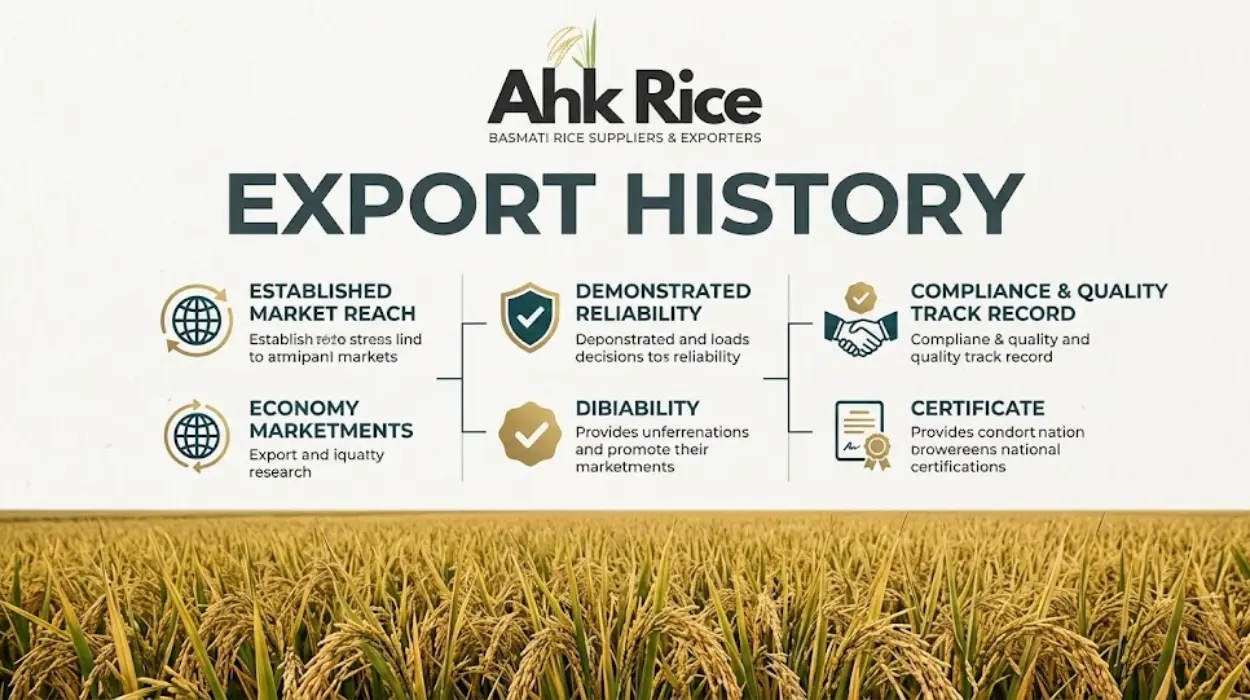
The key components are export destinations, shipment frequency, product varieties, quantities, documentation, quality records, certifications, compliance history, packaging formats, logistics performance, and customer continuity. Together, these components show the depth and relevance of a supplier’s international operating experience.
Export destinations
Destination history identifies the countries and regions previously supplied. Examples include Saudi Arabia, the United Arab Emirates, the United States, European countries, and African markets.
Destination diversity indicates exposure to different import procedures. Destination relevance is more important than a large destination count when the buyer has a specific market requirement.
Product varieties
Product history shows which rice varieties the supplier has exported. Examples include 1121 Basmati, Super Kernel, and 1509 rice.
Variety-level history helps buyers confirm that the supplier understands grain specifications, processing requirements, packaging, and commercial terminology for the requested product.
Shipment quantities
Shipment quantity shows whether the supplier has handled commercial volumes comparable with the buyer’s requirements. A supplier shipping 20-tonne orders has a different operating history from one regularly managing containerized bulk programs.
Quantity should be assessed against shipment frequency. One large shipment does not demonstrate the same continuity as repeated shipments over several seasons.
Documentation
Export documentation provides another measurable component. Examples include commercial invoices, packing lists, certificates of origin, phytosanitary documentation where applicable, inspection reports, bills of lading, and customs declarations.
Documentation accuracy matters because errors can affect customs processing, regulatory review, payment, and cargo release.
Quality and laboratory records
Quality records connect export history with actual product specifications. Examples include moisture, broken grains, foreign matter, grain length, damaged grains, and relevant contaminant testing.
A supplier’s previous laboratory documentation demonstrates how product specifications were measured and reported.
Certifications
Certifications provide evidence of compliance with defined standards. Depending on the product, buyer, and destination, relevant certifications and systems include HACCP, ISO 22000, BRCGS, FSSC 22000, Halal certification, and other market-specific requirements.
Certification should always be checked for scope, validity, issuing organization, facility, and covered product. A certificate attached to a company does not automatically prove that every product or facility is covered.
What benefits does export history provide to rice importers?
A documented export history reduces uncertainty by giving importers evidence about supplier capability, market experience, product consistency, documentation practices, regulatory awareness, and logistics execution before a long-term procurement relationship is established.
The first benefit is supplier qualification. Buyers can distinguish between a supplier with documented international transactions and one with limited export experience.
The second benefit is regulatory assessment. Previous shipments demonstrate whether the supplier understands the documentation and controls required by different destinations.
The third benefit is specification control. Historical product records show whether a supplier has previously produced and shipped rice according to defined commercial specifications.
The fourth benefit is logistics evaluation. Export history can reveal experience with container loading, shipping documentation, port procedures, freight coordination, and delivery scheduling.
The fifth benefit is continuity assessment. Repeated exports to the same market provide stronger evidence of operational familiarity than a single transaction.
This is particularly important in regulated food markets. The European Union treats traceability as a core food-safety requirement and requires food businesses to maintain information that allows products to be followed through the supply chain.
For U.S. procurement, foreign supplier verification is also important. Under the FDA’s Foreign Supplier Verification Programs framework, U.S. importers perform risk-based verification activities for foreign suppliers. A supplier with organized export records therefore provides useful evidence for the importer’s supplier qualification process.
Where is export history most useful?
Export history is most useful when buyers compare suppliers for recurring contracts, regulated destinations, high-volume programs, private-label packaging, or products requiring detailed quality and compliance documentation before shipment.
Recurring import contracts
A buyer planning monthly or quarterly rice imports needs evidence of repeatable supply performance. Export history helps establish whether the supplier has managed recurring international orders.
Regulated markets
Export history is particularly useful where food imports face detailed documentation, inspection, traceability, or contaminant controls.
The European Union applies risk-based controls to imported food and regularly updates controls according to identified risks. Its 2026 import-control framework also emphasizes stronger monitoring of non-compliant commodities and countries.
Rice from Pakistan has also been subject to specific EU control measures concerning pesticide residues and certain contaminants under the EU regulatory framework. This makes destination-specific compliance experience relevant when assessing suppliers for European distribution.
Private-label programs
Private-label buyers need consistency in product specifications, packaging, labeling, documentation, and shipment preparation. Previous private-label export work provides useful evidence of this capability.
Food-service distribution
Restaurants, caterers, and institutional buyers often require consistent cooking characteristics and supply continuity. Export history helps the importer evaluate whether the supplier has experience maintaining repeat specifications.
What common problems occur when buyers assess export history?
Common problems include unverifiable shipment claims, confusing company age with export experience, counting every destination equally, accepting expired certifications, ignoring product-specific history, and treating one successful shipment as proof of long-term supply capability.
A company can have operated for 15 years without having 15 years of export activity. Business age and export history are separate measurements.
Another problem is counting destinations without checking shipment frequency. Exporting one container to 10 countries does not provide the same evidence as repeated shipments to 3 relevant markets.
Product mismatch is another common error. Experience exporting non-Basmati rice does not automatically demonstrate experience with premium Basmati specifications.
Certification is also frequently misunderstood. A buyer needs to verify the certificate’s validity, scope, facility, and issuing body rather than simply recording the certificate name.
Documentation should also be checked against actual shipments. A supplier that provides a complete sample document set demonstrates stronger procedural organization than one that only provides general statements about compliance.
The strongest evaluation connects multiple records. For example, a buyer can compare the supplier’s product specification, laboratory report, packing list, commercial invoice, certificate, bill of lading, and destination requirements for the same shipment.
How should importers interpret export history before selecting a supplier?
Importers should interpret export history as one part of a structured supplier qualification process. The strongest evidence combines relevant destination experience, repeated shipments, matching rice varieties, verified documentation, quality records, certifications, and demonstrated compliance with destination-market requirements.
Export history should answer practical procurement questions.
Has the supplier exported the requested rice variety?
Has the supplier shipped to the intended country?
How frequently has the supplier shipped there?
What quantities has the supplier handled?
Which packaging formats has the supplier used?
Which certificates and laboratory reports accompanied previous shipments?
Were shipments supported by complete customs and commercial documentation?
Can the supplier demonstrate traceability from processing through shipment?
These questions turn export history into a measurable selection framework.
A buyer should then compare historical evidence with the proposed procurement specification. If the buyer requires 1121 Basmati in 5 kg retail bags, previous exports of bulk Super Kernel rice do not provide equivalent evidence. If the buyer requires European distribution, previous shipments into markets with different food-control systems provide useful background but do not replace EU-specific compliance verification. Explore:
How Can Importers Evaluate a Rice Supplier’s Export Performance?
Export history is therefore strongest when it is relevant, recent, documented, and connected to the exact product-market combination under consideration.
What should buyers verify before relying on a supplier’s export history?
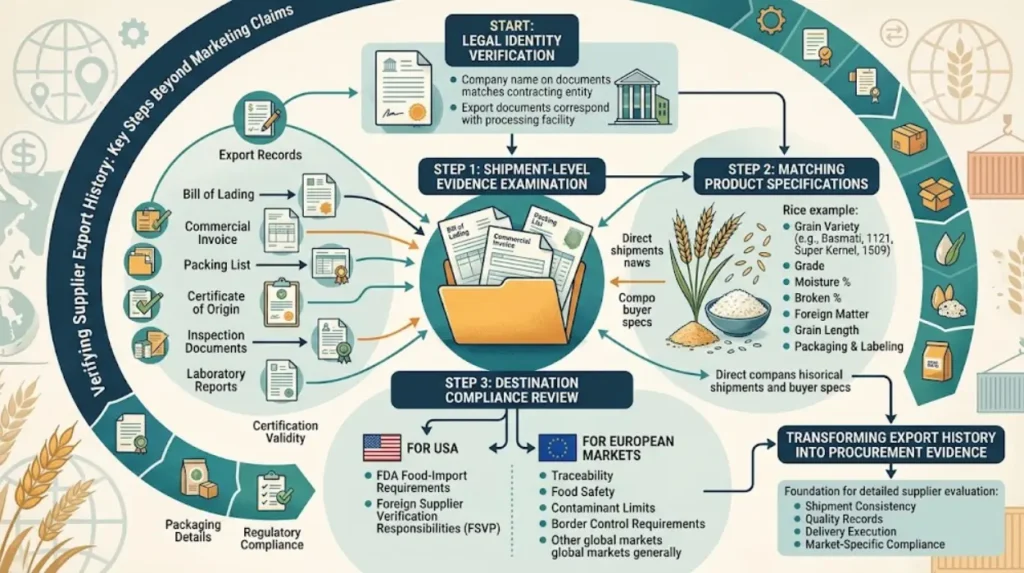
Buyers should verify shipment evidence, product specifications, destination markets, company and facility identity, certification validity, laboratory documentation, export records, packaging details, and regulatory compliance rather than relying on unsupported claims about international experience.
The verification process starts with the legal supplier identity. The company named on export documents should correspond with the contracting entity and relevant processing facility.
Next, buyers should examine shipment-level evidence. Examples include bills of lading, commercial invoices, packing lists, certificates of origin, inspection documents, and laboratory reports.
The product specification should then be matched with the historical shipment. Grain variety, grade, moisture, broken percentage, foreign matter, grain length, packaging, and labeling requirements should correspond to the buyer’s specification.
The final step is destination compliance. For the United States, this includes applicable FDA food-import requirements and foreign supplier verification responsibilities. For European markets, buyers should assess traceability, food-safety, contaminant, and applicable border-control requirements.
This approach changes export history from a marketing claim into procurement evidence. It also provides the foundation for a more detailed evaluation of supplier performance, including shipment consistency, quality records, delivery execution, and market-specific compliance.
AHK Rice is a Pakistani Basmati rice exporter based in Punjab, supplying 1121, Super Kernel, and 1509 varieties through international markets. Its product and export context fits within the wider Pakistani rice-export sector, where commercial buyers assess both product specifications and international supply capability.
Frequently Asked Questions
Why does export history matter when selecting a rice supplier?
Export history shows whether a rice supplier has experience managing international shipments, product specifications, export documentation, customs procedures, certifications, and destination-market requirements.
What should importers check in a rice supplier’s export history?
Importers should check previous destinations, shipment quantities, shipment frequency, rice varieties, packaging formats, quality reports, certificates, bills of lading, customs documents, and evidence of compliance with destination-country requirements.
Does export history prove that a rice supplier provides consistent quality?
Export history provides evidence of previous supply activity, but it does not independently prove current quality. Importers should also review laboratory reports, product specifications, inspection records, samples, and batch-level quality documentation.
Why is destination-specific export experience important?
Destination-specific experience shows that the supplier has handled the regulatory, documentation, labeling, customs, and logistics requirements of that market. Experience exporting to the United States, Saudi Arabia, UAE, or European markets involves different compliance considerations.