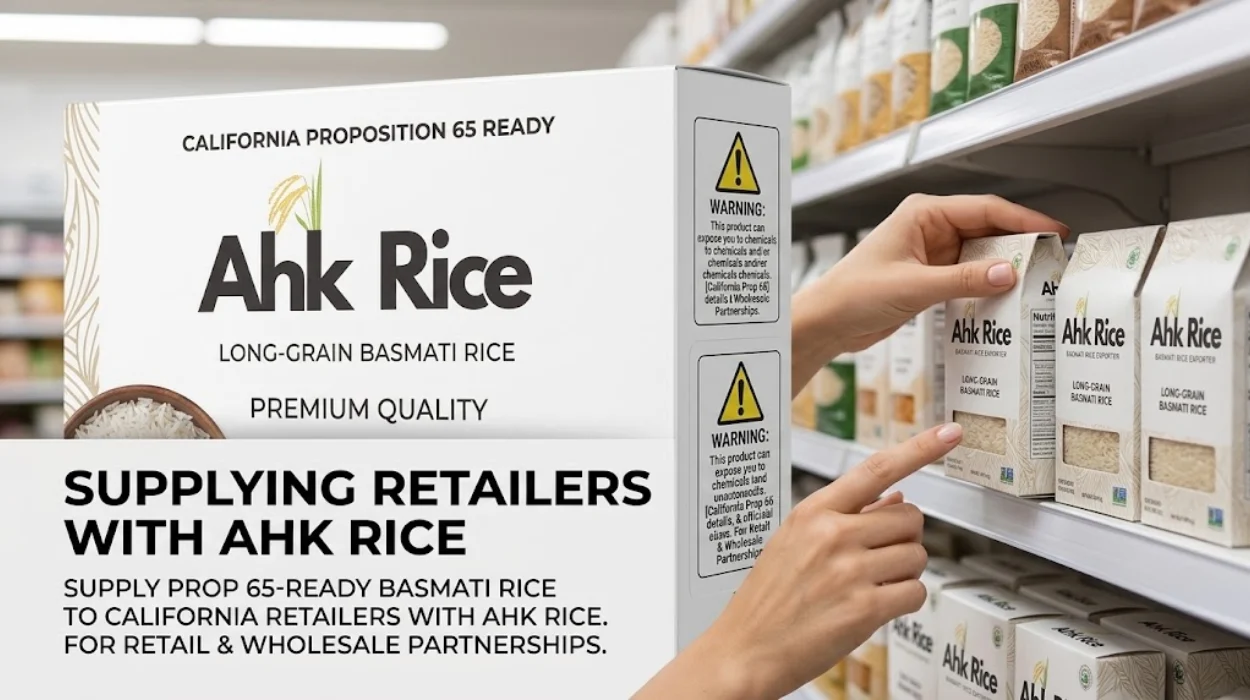
Supply Prop 65-Ready Basmati Rice to California Retailers with AHK Rice
The best solution is to source Pakistani Basmati rice against documented product specifications, risk-based contaminant testing, and California-specific compliance requirements. Retailers need traceable lots, reliable laboratory evidence, reviewed labels, and a clear process for evaluating potential Proposition 65 warning obligations before distribution.
California Proposition 65, formally known as the Safe Drinking Water and Toxic Enforcement Act of 1986, regulates exposures to chemicals identified by California as causing cancer or reproductive harm. Rice suppliers must evaluate relevant chemical risks and the way their products are consumed. Compliance requires more than a generic certificate stating that rice is safe.
For California grocery chains, ethnic food distributors, private-label brands, and foodservice wholesalers, the purchasing decision should begin with the product specification and compliance documentation. Buyers should identify the rice variety, country of origin, intended packaging, distribution channel, and applicable testing requirements before confirming a commercial order.
Retailers importing Pakistani Basmati rice should also understand that Proposition 65 is not a blanket certification for imported food. A supplier cannot guarantee that a product is Prop 65 compliant simply by providing a standard export certificate. The applicable chemical exposure, relevant legal thresholds, and any warning obligations must be assessed for the actual product and its intended use.
Businesses beginning their research can review what California Proposition 65 means for imported rice before establishing their purchasing specifications.
Why Does Proposition 65 Matter When Selling Basmati Rice in California?
Proposition 65 matters because businesses selling products in California must evaluate whether consumer exposure to listed chemicals triggers a warning obligation. Rice buyers should assess relevant contaminants, serving patterns, laboratory results, and applicable exposure thresholds before approving products for retail distribution.
The law does not prohibit every product containing a listed chemical. Instead, it generally prohibits businesses from knowingly and intentionally exposing individuals to listed chemicals without a clear and reasonable warning, subject to statutory exemptions and applicable legal requirements.
For rice, the assessment may involve inorganic arsenic and other relevant contaminants. The appropriate testing panel depends on the product, sourcing history, risk assessment, and current regulatory guidance. Buyers should not assume that every contaminant has the same legal status or that one laboratory result resolves every compliance question.
California’s Proposition 65 warning requirements also differ from federal food safety requirements. Compliance with the US Food and Drug Administration’s food safety framework does not automatically establish compliance with Proposition 65. Similarly, passing a general food safety test does not necessarily establish that consumer exposure falls below the relevant Proposition 65 threshold.
Retailers should establish a documented review process covering:
- Product identity and country of origin.
- Lot-specific laboratory results where appropriate.
- Relevant chemical concentrations and exposure estimates.
- Intended serving size and consumption assumptions.
- Packaging and warning requirements.
- Documentation retention and supplier traceability.
For a more detailed purchasing assessment, review Prop 65 warnings, heavy metal testing, and compliance for Basmati rice sold in California. This comparison-focused resource helps buyers distinguish laboratory measurements from the exposure assessment needed to evaluate warning obligations.
Why Choose AHK Rice for California Retail Distribution?
AHK Rice supports commercial buyers sourcing Pakistani Basmati through defined product specifications, processing coordination, custom packaging, and export documentation. California buyers should establish testing and compliance requirements before ordering, then confirm that the agreed evidence matches the actual product and shipment.
AHK Rice is a Pakistani Basmati rice exporter based in Punjab, supplying varieties including 1121, Super Kernel, and 1509 to international markets. Its export workflow covers product sourcing, processing, grading, packaging coordination, and shipment documentation.
For California retailers, the objective is to establish a purchasing specification that connects the product to the evidence required for import and distribution. Buyers can specify grain variety, broken percentage, moisture limits, processing preferences, bag sizes, and required laboratory documentation during the quotation stage.
Different varieties serve different commercial requirements. 1121 Basmati suits premium retail positioning where grain length and cooked appearance matter. Super Kernel Basmati supports traditional aromatic rice assortments. 1509 Basmati offers an alternative for buyers prioritizing commercial value and particular foodservice applications.
However, variety selection alone does not establish Proposition 65 compliance. Buyers must evaluate the relevant risks for the actual product and obtain appropriate evidence for the intended market.
AHK Rice can coordinate the commercial requirements that make an export order easier to evaluate, including agreed specifications, packing arrangements, and shipment documents. The buyer should confirm the availability and scope of any requested contaminant testing before placing the order.
A practical supplier evaluation should establish whether the exporter can provide:
- A written product specification and agreed quality tolerances.
- Traceable production or shipment lot identification.
- Available laboratory reports relevant to the buyer’s risk assessment.
- Packaging details and proposed label information.
- Commercial invoices, packing lists, and applicable export documents.
- Agreed procedures for reviewing results before shipment.
These requirements create a more controlled purchasing process without treating an export certificate or laboratory report as a universal guarantee of legal compliance.
What Testing and Documentation Should California Retailers Request?
California retailers should request risk-based contaminant testing, identifiable sample and lot information, product specifications, and documentation supporting their compliance assessment. Laboratory results must be interpreted against applicable legal thresholds and estimated consumer exposure rather than treated as automatic proof that a warning is unnecessary.
A useful testing plan begins with the product and its supply chain. Buyers should determine which contaminants require analysis, select a laboratory with appropriate methods and accreditation, and confirm that the report identifies the tested material and relevant detection or quantification limits.
For inorganic arsenic, total arsenic measurements may not provide the complete information needed for every assessment. The appropriate analytical method depends on the question being investigated, and arsenic speciation may be relevant when distinguishing inorganic arsenic from other forms.
Retailers should also verify that the results relate to the product being purchased. A report for a different variety, supplier, crop, or production lot may not adequately represent the shipment under consideration.
Recommended procurement documentation
| Document or control | Purpose |
|---|---|
| Product specification | Defines variety, grain quality, moisture, and broken percentage |
| Laboratory report | Records measured contaminants and analytical details |
| Lot identification | Connects testing evidence to the relevant product batch |
| Packaging specification | Confirms bag material, weight, and printing requirements |
| Export documents | Supports shipment traceability and customs processing |
| Label review | Checks required product information and applicable warnings |
| Exposure assessment | Evaluates whether Proposition 65 warning obligations apply |
The buyer should document acceptance criteria before testing begins. If results exceed the agreed specification or raise compliance concerns, the parties should establish a procedure for investigation, additional testing, lot rejection, or other corrective action.
A laboratory result does not replace legal review. Businesses should obtain qualified regulatory advice when determining whether a warning is required, whether an exemption applies, or whether a proposed warning satisfies California requirements.
What Results Can Retailers Expect From a Structured Compliance Process?
A structured compliance process gives retailers clearer purchasing decisions, stronger lot traceability, and better visibility into product risks before distribution. Results depend on the quality of supplier documentation, the suitability of laboratory methods, and the accuracy of the exposure assessment.
Consider a California distributor planning to introduce 1121 Basmati rice in five-kilogram retail bags. The distributor defines its product specification, requests representative samples, establishes testing requirements, and reviews proposed packaging before authorizing commercial production.
The laboratory report is then checked against the specified lot. If the findings support the agreed requirements, the buyer proceeds to the remaining compliance review. If results require further investigation, the distributor can pause approval while the supplier and relevant technical specialists assess the issue.
This process reduces uncertainty compared with purchasing rice first and investigating compliance questions after the shipment arrives.
The expected operational benefits include:
- Better purchasing control: Buyers establish acceptance criteria before committing to shipment.
- Improved traceability: Product and laboratory records can be linked to identifiable lots.
- More informed label decisions: Packaging is reviewed against the actual compliance assessment.
- Reduced avoidable delays: Documentation gaps can be identified before shipment.
- Clearer supplier accountability: Testing, specifications, and corrective actions are defined in advance.
These are process benefits, not guarantees of regulatory approval, uninterrupted customs clearance, or a particular commercial result. Actual outcomes depend on the product, evidence, applicable law, and import conditions.
How Much Does Prop 65-Ready Basmati Rice Cost?
The total cost depends on rice variety, grade, order quantity, packaging, laboratory testing, compliance review, and shipping arrangements. Buyers should request an itemized quotation that separates the rice price from testing, packaging, freight, insurance, and other applicable charges.
There is no single universal price for Prop 65-ready Basmati rice. A standard export quotation may not include additional California-specific testing, specialized laboratory analysis, label review, or independent inspection.
The final cost should be evaluated using the following components.
| Cost factor | What affects the price |
|---|---|
| Rice variety | 1121, Super Kernel, or 1509 selection |
| Product grade | Grain length, broken percentage, moisture, and processing |
| Order quantity | Trial orders, commercial volumes, and container quantities |
| Packaging | Bulk bags, retail packs, custom printing, and packaging materials |
| Laboratory testing | Analytical panel, sample count, methods, and laboratory fees |
| Compliance review | Exposure assessment, technical review, and label evaluation |
| Logistics | Inland transport, port charges, ocean freight, and insurance |
| Import costs | Applicable customs duties, brokerage, and destination charges |
Testing costs vary because different analytical methods and sample requirements carry different fees. A buyer requesting inorganic arsenic analysis, a broader contaminant panel, and independent lot verification should expect a different testing budget from a buyer requesting only routine quality documentation.
California-specific legal review may also require a separate budget. Buyers should confirm whether the supplier can coordinate testing or whether the retailer must appoint its own laboratory and compliance adviser.
To compare quotations fairly, specify the required variety, grade, packing format, order quantity, delivery terms, testing scope, and document requirements. A low rice price is not necessarily the lowest landed cost if testing, packaging corrections, or missing documents create additional expenses.
How Long Does Shipping to California Take?

Shipping time depends on production readiness, testing turnaround, export documentation, vessel schedules, port congestion, and US customs processing. Buyers should obtain a shipment-specific timeline rather than rely on a fixed delivery promise or assume that ocean transit represents the complete order lead time.
A California-bound order generally involves several stages: specification approval, sample evaluation, production planning, laboratory testing where required, export clearance, ocean transport, US entry processing, and inland delivery.
For initial planning, buyers can use these indicative ranges, which are estimates rather than confirmed schedules:
| Stage | Indicative planning range |
|---|---|
| Sample preparation and dispatch | 3–10 business days |
| Laboratory testing and report review | 5–15 business days, depending on the panel |
| Commercial processing and packing | 7–21 days, depending on stock and specifications |
| Ocean transit to a California port | Approximately 25–40 days |
| Customs, terminal handling, and inland delivery | Several additional days to two weeks or longer |
Some stages can overlap. Others cannot begin until the preceding approval is complete. A first-time private-label order may require additional time for artwork, packaging production, and compliance review.
The actual route and vessel schedule determine transit time. Port congestion, inspections, documentation errors, and customs holds can extend delivery beyond these planning ranges.
Retailers should therefore agree on the shipment schedule after confirming stock availability, sample approval, testing requirements, packaging readiness, and delivery terms. AHK Rice should confirm the actual production and shipping timeline for the specific order before the buyer commits to a retail launch date.
How Does the Sample Process Work, and What Does It Cost?
The sample process should verify product quality before a commercial commitment and establish whether the proposed testing can support the buyer’s compliance review. Buyers should agree on sample quantity, courier charges, laboratory fees, and acceptance criteria before dispatch.
A practical process has five stages.
Stage 1: Define the product. The buyer selects the rice variety, grade, intended retail format, and target order volume. The buyer also identifies the relevant contaminant testing and documentation requirements.
Stage 2: Request a representative sample. AHK Rice confirms sample availability and the applicable preparation and dispatch arrangements. The buyer should ask how the sample relates to the proposed commercial lot and whether a separate production-lot sample will be needed.
Stage 3: Confirm costs and dispatch. Sample rice may be offered without charge under an agreed sampling arrangement. However, courier freight, customs-related charges, and any applicable phytosanitary or handling costs must be confirmed before shipment. If independent laboratory testing is required, its cost should be quoted separately.
Stage 4: Evaluate quality and compliance evidence. The buyer checks grain appearance, aroma, cooking performance, and the agreed quality parameters. The buyer or its appointed laboratory then conducts the required contaminant testing using an appropriate sample and method.
Stage 5: Approve the commercial specification. Once the sample and documentation are accepted, the buyer confirms packaging, order quantity, testing arrangements, delivery terms, and the required shipment documents.
Sample charges vary by quantity, destination, courier service, and testing scope. A buyer should not assume that free rice samples include free international delivery or laboratory analysis.
For reliable results, the parties should also distinguish between a preliminary product sample and a representative sample from the actual commercial lot. Approval of one sample does not automatically prove that every later shipment will have identical characteristics.
How Can California Retailers Get Started With AHK Rice?
Retailers can begin by sharing their product requirements, destination, target quantity, packaging format, and testing expectations. AHK Rice can then clarify product availability, sampling arrangements, export documentation, and quotation terms so buyers can evaluate the proposed supply before placing a commercial order.
Start by preparing a purchasing brief that identifies the intended variety, target grain specifications, packaging size, expected annual demand, and preferred delivery terms. Include the testing panel requested by your compliance team and explain whether you need private-label packaging or bulk commercial bags.
Next, request the available specification sheet and confirm which laboratory reports and lot-traceability records can be provided. Ask for written confirmation of sample costs, courier arrangements, testing responsibilities, and the proposed production schedule.
Before shipment, ensure that the product specification, laboratory evidence, exposure assessment, and label review are complete to the extent required for the transaction. Agree on how the parties will handle an unsatisfactory result or a documentation discrepancy.
This approach gives California importers a defined process for evaluating Pakistani Basmati rice without confusing product quality, food safety testing, and Proposition 65 legal compliance.
For a quotation covering rice specifications, packaging, sample arrangements, testing requirements, and shipment terms, contact AHK Rice through its request-a-quote page.
Frequently Asked Questions
Is Prop 65 certification mandatory for Basmati rice imported into California?
Proposition 65 does not operate as a universal product certification scheme for imported rice. Businesses must evaluate whether the product creates exposure to listed chemicals that triggers a warning obligation, considering applicable thresholds, exemptions, and legal requirements.
Does laboratory testing guarantee that Basmati rice is Prop 65 compliant?
No. Testing measures specific substances under defined analytical conditions. Compliance assessment may also require exposure calculations, serving assumptions, appropriate legal thresholds, and review of applicable warning obligations.
Can AHK Rice supply 1121 and Super Kernel Basmati rice to California buyers?
AHK Rice supplies Pakistani Basmati varieties including 1121, Super Kernel, and 1509 to international markets. California buyers should confirm current availability, specifications, packaging options, and the documentation available for their particular order.
How much does testing for arsenic in Basmati rice cost?
The price depends on the laboratory, analytical method, sample count, and testing scope. Buyers should request a separate quotation and confirm whether the analysis measures total arsenic or specifically evaluates inorganic arsenic.
How long does it take to receive a commercial rice shipment in California?
Ocean transit may take approximately 25–40 days, depending on the route and vessel schedule. Production, testing, documentation, customs processing, and inland delivery add time, so buyers should obtain a shipment-specific timeline before confirming launch dates.