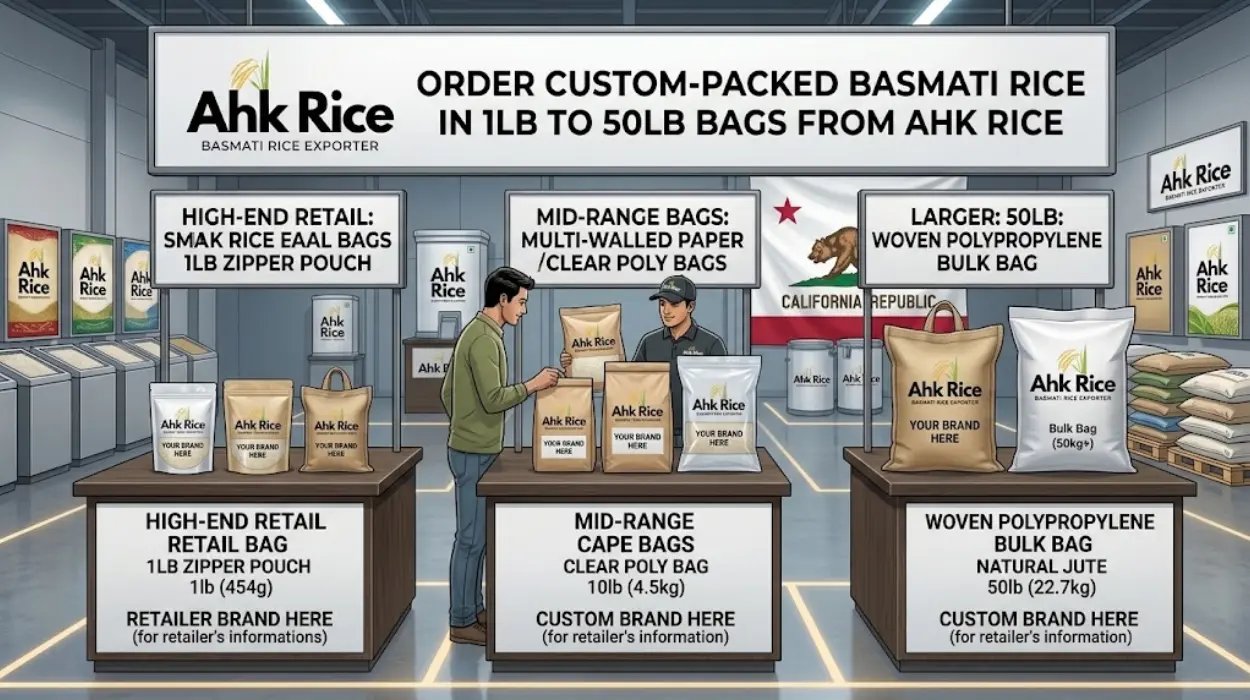
Order Custom-Packed Basmati Rice in 1lb to 50lb Bags from AHK Rice
Importers, grocery distributors, private-label brands, and foodservice suppliers need Basmati rice packaging that matches their target customers, storage requirements, and distribution channels. Ordering custom-packed Basmati rice in 1lb to 50lb bags allows USA buyers to select retail-ready formats, bulk foodservice packaging, and private-label options from one export supplier.
AHK Rice supplies Pakistani Basmati rice varieties, including 1121, Super Kernel, and 1509 Basmati rice, with customizable packaging options and export coordination. Buyers can define bag weights, packaging materials, branding requirements, rice specifications, and shipment quantities before confirming an order.
What Is the Best Solution for Ordering Custom-Packed Basmati Rice?
The best solution is to select rice grades, bag weights, packaging materials, and branding requirements according to your sales channel before requesting a commercial quotation. This approach helps importers align product specifications with customer expectations, packaging costs, shipping arrangements, and applicable US food-labeling requirements.
Different markets require different packaging formats. A specialty grocery retailer may prioritize 1lb, 2lb, or 5lb bags that fit household shopping habits. A supermarket distributor may prefer 5lb and 10lb formats, while restaurants and institutional kitchens often need 20lb, 25lb, or 50lb bags.
Buyers should also distinguish between the rice specification and the packaging specification. Grain length, broken percentage, moisture level, processing method, and crop year determine the rice grade. Bag weight, material, printing, closure, and label design determine the packaging configuration.
For an overview of available formats and their suitability for American distribution, read what packaging options are available for Basmati rice exported to the USA. Use this information to establish your requirements before discussing production and shipping.
Which Bag Sizes Should USA Importers Choose?
Choose 1lb to 5lb bags for consumer retail, 10lb bags for larger households, and 20lb to 50lb bags for bulk distribution and foodservice. The most suitable format depends on customer purchasing habits, shelf space, handling requirements, and the economics of transporting each packaged unit.
| Bag size | Typical target market | Main commercial advantage |
|---|---|---|
| 1lb | Specialty stores and small households | Accessible trial size |
| 2lb | Premium grocery retail | Convenient household quantity |
| 5lb | Supermarkets and ethnic grocery stores | Practical retail format |
| 10lb | Family-oriented retail and wholesalers | Higher purchase volume per unit |
| 20lb | Restaurants and foodservice distributors | Reduced replenishment frequency |
| 25lb | Commercial kitchens and bulk buyers | Practical bulk handling |
| 50lb | Institutional kitchens and wholesale distribution | Large-volume purchasing |
These are recommended packaging applications, not guaranteed market demand figures. Buyers should confirm their preferred sizes with distributors and retailers before finalizing production quantities.
Why Choose AHK Rice for Custom-Packed Basmati Rice?
AHK Rice offers Pakistani Basmati sourcing, rice processing, customizable packaging coordination, and export support for international buyers. Importers can align the rice variety, grade, packing format, and shipment requirements through one supplier rather than coordinating every specification independently.
AHK Rice supplies 1121, Super Kernel, and 1509 Basmati rice from Pakistan. Each variety serves different commercial priorities, allowing buyers to match their product positioning with their intended customers.
The company’s service scope covers rice sourcing, grading, processing, packaging coordination, and export documentation. Buyers can discuss their specifications before confirming an order, including the required rice variety, processing style, bag weight, packaging material, and destination.
Explore the AHK Rice Basmati rice export and packaging service to discuss product specifications and packaging requirements.
Which Rice Variety Works Best for Your Packaging Strategy?
Select 1121 for premium long-grain positioning, Super Kernel for aromatic Basmati retail and distribution, and 1509 for buyers prioritizing commercial efficiency. The final choice should reflect cooking performance, target retail price, buyer expectations, and the product specification agreed before shipment.
- 1121 Basmati: Suitable for premium retail, private-label grocery products, and foodservice customers seeking long grains and characteristic Basmati aroma.
- Super Kernel Basmati: Suitable for aromatic rice ranges serving South Asian grocery stores, specialist retailers, and distributors.
- 1509 Basmati: Suitable for buyers evaluating yield, grain presentation, and price positioning across retail and bulk channels.
Processing also affects product selection. Steam rice, Golden Sella, and other agreed processing styles can serve different cooking applications and customer preferences. Buyers should specify the required variety and processing method instead of relying on the generic term Basmati alone.
AHK Rice can coordinate the selected rice specification with the intended packaging format. Final product availability, grade tolerances, and packaging options must be confirmed in the commercial offer.
What Results Can Buyers Expect from Custom Rice Packaging?
Custom packaging gives importers greater control over product presentation, retail positioning, and distribution formats. When the bag specification matches the rice grade and sales channel, buyers can maintain a consistent product identity while organizing procurement around their actual commercial requirements.
For example, a US importer supplying independent grocery stores may order 5lb Super Kernel Basmati bags with private-label artwork. A restaurant distributor may instead select 25lb bags of an agreed 1121 or 1509 specification to simplify warehouse handling and commercial kitchen replenishment.
Custom-packed orders can support several business objectives:
- Consistent branding: Approved artwork and label specifications help maintain a recognizable product identity.
- Channel-specific sizing: Retailers and foodservice distributors receive formats suited to their customers.
- Specification control: Documented rice and packaging requirements provide a reference for evaluating delivered goods.
- Procurement planning: Agreed bag weights and shipment quantities make stock allocation easier.
- Export coordination: Confirmed packing lists, product specifications, and shipping documents support the import process.
These benefits depend on clear specifications, quality controls, accurate documentation, and suitable packaging materials. Custom packaging does not automatically guarantee higher sales, lower freight costs, or regulatory approval.
What Packaging and Label Requirements Should USA Buyers Confirm?
USA importers should approve packaging materials, product labels, net weight declarations, ingredient information, and applicable food-labeling details before production. Requirements depend on the product and its presentation, so the importer should verify the final artwork against applicable FDA regulations and other relevant federal and state requirements.
Retail-ready packaging typically requires the product name, net quantity, responsible business details, and other applicable label information. Nutrition labeling and ingredient declarations must follow the rules relevant to the product and any applicable exemptions. Country-of-origin marking and import documentation should also be addressed.
Private-label buyers should provide approved artwork, brand assets, barcode requirements, and written packaging specifications. They should confirm whether labels need English-only or additional language content based on their distribution plan.
The importer should also establish whether the packaging material provides adequate protection against moisture, contamination, handling damage, and storage conditions. Food-contact materials must meet applicable requirements.
AHK Rice and the buyer should agree on the packaging specification before production. The US importer remains responsible for confirming that its product, label, and import arrangements comply with applicable US requirements.
How Much Does Custom-Packed Basmati Rice Cost?
Custom-packed Basmati rice pricing depends on the rice variety, grade, order volume, bag weight, packaging material, printing requirements, and shipping terms. Buyers should request a quotation based on a complete specification rather than comparing suppliers using rice price alone.
The main cost factors include:
- Rice variety and grade: 1121, Super Kernel, and 1509 differ in market positioning and specification.
- Processing method: Raw, Steam, and parboiled options may carry different processing costs.
- Packaging size: Smaller bags generally require more individual packaging units per tonne.
- Packaging material: Standard woven polypropylene, laminated materials, and retail-oriented packaging have different costs and performance characteristics.
- Printing and branding: Custom artwork, printing plates, label requirements, and minimum production runs can affect the final price.
- Order quantity: Production efficiency, packaging minimums, and container utilization influence the economics of an order.
- Shipping terms: FOB, CFR, and CIF quotations allocate freight, insurance, and other responsibilities differently.
- Destination requirements: Inspection, documentation, testing, and compliance-related expenses may add to the landed cost.
How Should Buyers Compare Quotations?
Compare quotations using the same rice specification, packaging configuration, order quantity, and Incoterm. A lower initial price does not necessarily represent better value when packaging, freight, insurance, inspection, and destination charges differ.
Request a written quotation identifying the rice variety, processing method, grain specifications, bag sizes, packaging material, printing requirements, total quantity, and shipment terms.
Ask the supplier to clarify which costs are included and which remain payable by the buyer. For US shipments, also establish who arranges freight, cargo insurance where applicable, customs brokerage, and any required inspections.
AHK Rice can assess the requested configuration and provide pricing subject to confirmed specifications, order volume, and shipping arrangements. Buyers should obtain a current written offer before making purchasing commitments.
How Long Does Shipping Take from Pakistan to the USA?

Shipping time depends on the destination port, vessel schedule, transshipment arrangements, customs clearance, and inland delivery requirements. Buyers should distinguish ocean transit from total order lead time, which also includes production, packaging, documentation, port handling, and delivery after arrival.
For planning purposes, importers can use the following preliminary estimates for shipments from Pakistan. These are indicative ranges, not confirmed transit schedules or delivery guarantees.
| Destination market | Indicative ocean transit planning range | Important considerations |
|---|---|---|
| US West Coast | Approximately 25–40 days | Route, transshipment, and port congestion |
| US East Coast | Approximately 35–50 days | Canal routing, vessel connections, and port schedule |
| US Gulf Coast | Approximately 30–45 days | Routing, terminal availability, and onward delivery |
Actual transit times can fall outside these ranges. Buyers should obtain a current shipping schedule from the freight forwarder before confirming delivery commitments.
The full order timeline starts before vessel departure. Rice availability, packaging-material procurement, artwork approval, production scheduling, quality checks, and export documentation all influence readiness. After arrival, customs processing and domestic transportation add further time.
AHK Rice buyers should confirm the expected cargo-ready date and estimated vessel departure during order negotiations. Retail promotions and seasonal demand require additional planning time to accommodate potential delays.
How Does the Sample and Ordering Process Work?
Start by defining your rice specification and packaging requirements, then request a sample, evaluate its quality, approve the final specification, and confirm the commercial order. This sequence allows buyers to assess product suitability before committing to a larger shipment.
Step 1: Submit Your Requirements
Specify the rice variety, processing method, preferred grain length, broken percentage, moisture limit, bag sizes, packaging material, branding requirements, destination, and estimated order quantity.
If you are developing a private-label product, provide your artwork and labeling requirements early. This helps identify packaging limitations before production begins.
Step 2: Request a Commercial Sample
Ask AHK Rice to confirm sample availability, the sample quantity, and the courier arrangement. Buyers should specify whether they need a raw-grain sample, a cooked-rice evaluation sample, or a sample of the proposed packaging.
Sample costs vary according to rice quantity, courier destination, packaging, and documentation requirements. A buyer may need to pay the courier charge and any applicable inspection or phytosanitary costs, depending on the shipment and destination rules.
For budgeting purposes, obtain an itemized sample quotation instead of assuming that the sample or delivery is free. Confirm whether the sample charge is refundable or credited against a subsequent order, because this arrangement must be agreed in writing.
Step 3: Evaluate and Approve the Specification
Check grain appearance, aroma, cooking performance, broken percentage, and other agreed parameters. For commercial procurement, document the accepted specification and identify any required laboratory testing or Certificate of Analysis (COA).
A sample demonstrates the product submitted for evaluation, but it does not independently guarantee the quality of every future shipment. Buyers should establish the inspection and acceptance criteria that apply to the commercial order.
Step 4: Approve Packaging and Confirm the Order
Review bag weight, material, printing, label artwork, carton or pallet requirements where applicable, and packaging quantities. Approve the final specification before production and confirm payment terms, production timing, shipment terms, and required documents in the sales contract.
Step 5: Prepare the Export Shipment
AHK Rice coordinates the agreed processing, packing, quality checks, and export arrangements. The buyer and supplier should confirm the applicable commercial invoice, packing list, certificate of origin where required, phytosanitary documentation where applicable, and transport documents.
US importers should separately verify applicable FDA requirements, prior-notice arrangements, customs entry requirements, and Foreign Supplier Verification Program responsibilities. The precise documentation depends on the product and shipment circumstances.
How Can Importers Get Started with AHK Rice?
Importers can begin by sending their target rice variety, bag sizes, packaging specifications, destination port, and estimated order quantity for review. Providing these details allows AHK Rice to assess the requested configuration and clarify pricing, samples, packaging feasibility, and shipping arrangements.
Before placing an order, confirm these five points:
- Rice variety, grade, and processing method.
- Bag sizes from 1lb to 50lb and packaging material.
- Private-label artwork and applicable labeling requirements.
- Sample availability, courier costs, and quality approval procedures.
- Commercial price, order quantity, lead time, and shipping terms.
This information creates a practical basis for comparing offers and moving from product evaluation to procurement. Buyers should confirm every commercial, technical, and compliance requirement in writing before authorizing production.
To discuss custom-packed Basmati rice specifications, sample arrangements, and an export quotation, request a quote from AHK Rice.
Frequently Asked Questions
Can I order Basmati rice in bags ranging from 1lb to 50lb?
Yes, buyers can request packaging configurations ranging from small retail bags to bulk formats.
Available sizes depend on packaging capabilities and minimum production quantities.
Specify the required bag weights and total order quantity when requesting a quotation.
Private-label printing and customized artwork should be approved before production.
AHK Rice will need to confirm feasibility and pricing for your exact requirements.
Which Basmati rice varieties can AHK Rice supply?
AHK Rice supplies Pakistani 1121, Super Kernel, and 1509 Basmati rice varieties.
1121 suits premium long-grain positioning and aromatic rice markets.
Super Kernel serves buyers seeking aromatic Basmati for retail and distribution.
1509 can suit buyers prioritizing commercial efficiency and price positioning.
Confirm the grade, processing method, and specification before placing an order.
How much does a custom-packed Basmati rice order cost?
Pricing depends on rice variety, grade, packaging material, bag size, and order quantity.
Printing, labeling, testing, and documentation can affect the final quotation.
Freight, insurance, and destination charges depend on the agreed shipping terms.
Request an itemized commercial offer using your complete product specification.
Confirm all costs and payment terms before approving production.
Can I receive a sample before placing a bulk order?
Yes, buyers can request a sample subject to availability and supplier confirmation.
The sample quantity and type should match the intended product evaluation.
Courier charges and applicable documentation or inspection costs may apply.
Confirm sample fees and any credit against a future order in writing.
Approve the commercial specification before authorizing bulk production.
How long does shipping Basmati rice from Pakistan to the USA take?
Ocean transit depends on the destination port, vessel schedule, and shipping route.
Preliminary planning estimates are approximately 25–50 days, depending on the US coast.
Production, packaging, documentation, customs clearance, and inland delivery add time.
Request an updated shipping schedule before committing to a delivery date.
AHK Rice and the buyer should confirm the expected cargo-ready date and shipping terms.