Packaging, Labelling and FBA Requirements for Selling Imported Basmati Rice Online
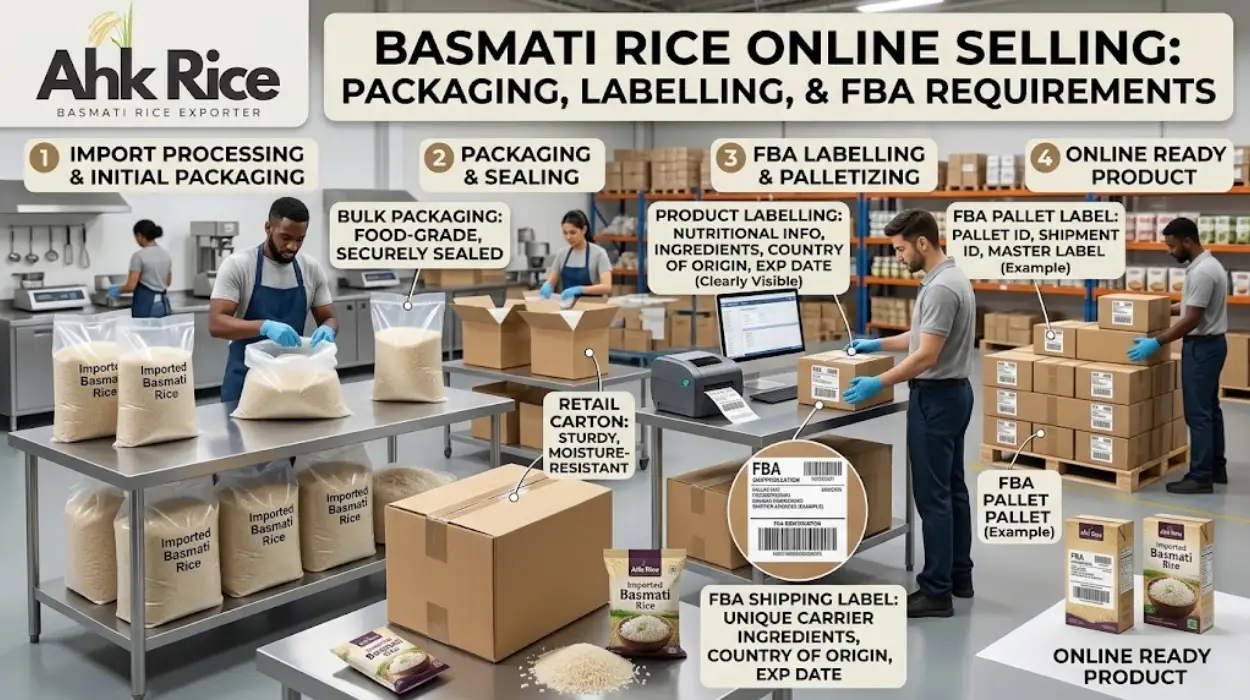
Selling imported Basmati rice online in the United States requires food-compliant packaging, accurate labels, suitable shelf-life protection, and a fulfillment method that controls shipping costs. For most new sellers, lightweight food-grade retail bags combined with protective shipping cartons offer a practical balance between product quality, customer experience, and Amazon Fulfillment by Amazon (FBA) requirements.
Understanding whether Pakistani Basmati rice can be sold on Amazon and US e-commerce platforms helps sellers evaluate market access before investing in packaging, inventory, and advertising. The next step is choosing a rice variety, packaging format, and fulfillment strategy that match the target customer and sales volume.
Imported Basmati rice is available in varieties such as 1121, Super Kernel, and 1509 Basmati rice. Each offers different grain characteristics, price positioning, and culinary applications. AHK Rice is a Pakistani Basmati rice exporter based in Punjab, supplying these varieties to more than 15 countries through end-to-end processing, custom packaging, and export coordination. Its Basmati rice packaging and export services provide a starting point for businesses evaluating private-label supply.
What packaging options are available for selling imported Basmati rice online?
Rice sellers can choose food-grade woven polypropylene bags, laminated pouches, stand-up zipper bags, and larger bulk bags. The right format depends on pack size, moisture protection, product positioning, shipping weight, resealability, and compatibility with the selected fulfillment network.
Food-grade polypropylene bags: Woven polypropylene packaging provides strength and cost efficiency for larger rice quantities. A suitable food-contact liner helps protect the rice from contamination and moisture. This format suits 5 kg, 10 kg, and 20 kg packs serving ethnic grocery customers, wholesalers, and high-volume households.
Laminated retail pouches: Multilayer packaging combines a printable outer surface with barrier materials selected for product protection. It supports branded designs, clear product information, and a premium appearance. Sellers should verify food-contact suitability and barrier performance with their packaging supplier.
Stand-up zipper pouches: Resealable pouches appeal to customers who purchase smaller quantities and value convenient storage. Their additional material, zipper, and production costs can increase the packaging cost per kilogram. They work best when the selling price supports a premium retail position.
Bulk bags: Larger packs reduce packaging material per kilogram and suit restaurants, caterers, and commercial kitchens. They require stronger handling and shipping arrangements because their weight affects fulfillment charges and delivery convenience.
Protective shipping cartons: A retail bag is not automatically suitable for parcel delivery. A corrugated carton can protect the package against punctures, rough handling, and damaged seals. Sellers should test the complete packaged product rather than assess the retail bag alone.
How do rice packaging and fulfillment methods compare?
Retail packaging protects the product and communicates the brand, while fulfillment packaging protects the order during delivery. Amazon FBA transfers storage, picking, packing, and shipping responsibilities to Amazon, whereas merchant fulfillment gives sellers greater operational control.
Amazon FBA means Fulfillment by Amazon. A seller sends eligible inventory to Amazon fulfillment centers, where Amazon stores products and processes customer orders under its applicable policies. Fulfillment by Merchant (FBM) means the seller or a third-party logistics provider handles order fulfillment.
| Comparison attribute | Laminated retail pouch | Woven polypropylene bag | Retail pack with shipping carton |
|---|---|---|---|
| Primary purpose | Branded consumer presentation | Strength and economical bulk packing | Parcel protection and delivery |
| Typical pack sizes | 1 kg, 2 kg, 5 kg | 5 kg, 10 kg, 20 kg | Depends on the inner retail pack |
| Moisture protection | Depends on the barrier structure and seal | Depends on liner and closure | Adds external protection but is not a moisture barrier by itself |
| Branding potential | High | Moderate to high with printed designs | Supports branded or plain outer packaging |
| Material cost per kilogram | Generally higher for smaller packs | Generally lower for larger packs | Adds a separate packaging cost |
| E-commerce suitability | Good when sealed and protected | Good when adequately secured | Useful for fragile seals and parcel handling |
| Best application | Branded retail and premium listings | Value-oriented and bulk sales | FBA or merchant-fulfilled parcel orders |
Packaging materials must be selected according to their intended food-contact use. A package that looks premium does not automatically provide adequate moisture, oxygen, or puncture protection. Sellers should obtain supplier specifications and validate the package under expected storage and transportation conditions.
What labelling requirements apply to imported Basmati rice in the USA?
Retail packages of imported Basmati rice must carry accurate, applicable food-label information and meet U.S. requirements. Sellers should verify FDA rules, ingredient declarations, net quantity, responsible business details, country-of-origin marking, and any applicable nutrition-label exemptions before printing commercial packaging.
The U.S. Food and Drug Administration (FDA) regulates most packaged foods, including rice, while U.S. Customs and Border Protection (CBP) administers import entry and country-of-origin marking requirements. Importers must determine which requirements apply to their product, business, and distribution model.
A compliant label commonly addresses the following elements:
- Statement of identity: Identify the food clearly, such as “Basmati Rice.”
- Net quantity: State the net weight in the required U.S. customary and metric units, using the applicable placement and formatting rules.
- Ingredient declaration: Identify ingredients when required. A single-ingredient rice product generally has a simpler declaration than a seasoned rice mix.
- Responsible business information: Include the required name and place of business of the manufacturer, packer, or distributor.
- Country of origin: Ensure the imported product receives the required country-of-origin marking under applicable CBP rules.
- Nutrition Facts: Determine whether the product requires a Nutrition Facts panel or qualifies for an exemption. Exemptions have specific conditions and do not remove other applicable obligations.
- Allergen information: Assess the complete formulation and processing arrangements. Plain rice does not ordinarily contain a major U.S. food allergen as an ingredient, but added ingredients and cross-contact risks require appropriate assessment.
- Claims and certifications: Support claims such as organic, gluten-free, non-GMO, or specific grain-length descriptions with appropriate evidence and applicable compliance checks.
English is generally necessary for U.S. retail labels subject to FDA requirements. Additional languages may be used, but they must not create misleading or inconsistent information. Sellers should also ensure the physical package and online listing describe the same product, quantity, and relevant attributes.
A nutrition-label exemption should never be assumed solely because rice is a simple food. Eligibility depends on the applicable rule and the business’s circumstances. Importers should verify the current FDA requirements before production and obtain professional regulatory advice where the label or exemption status is uncertain.
What are Amazon FBA packaging requirements for rice sellers?
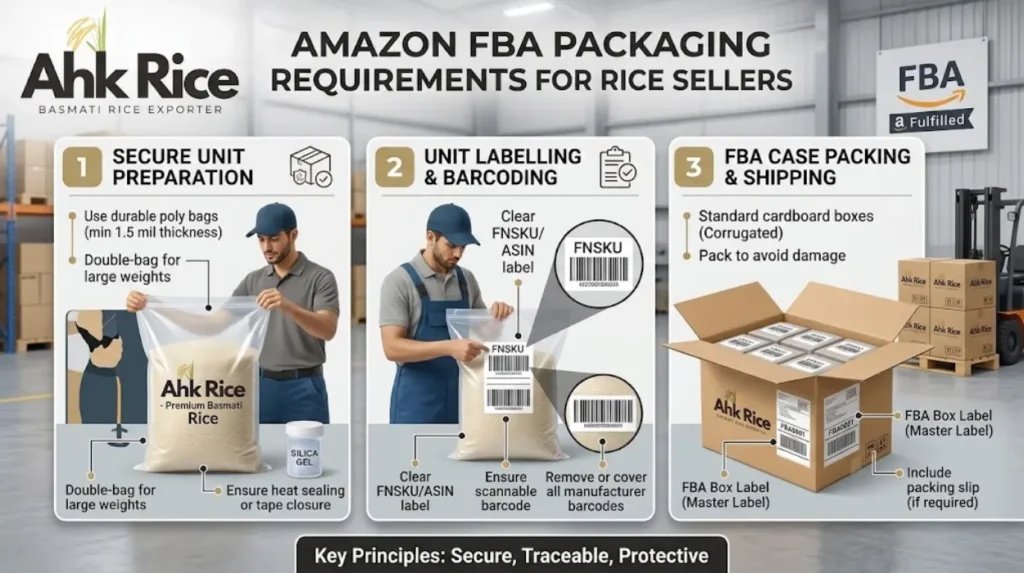
Amazon FBA sellers must follow the current product-preparation, packaging, barcode, shipment, and food-category policies applicable to their inventory. Rice packages must remain identifiable, securely closed, and suitable for handling throughout fulfillment without leaking, opening, or exposing the food.
Before sending imported rice to an Amazon fulfillment center, sellers should confirm the following:
- Secure seals: Heat-seal retail pouches or use an appropriate closure that prevents accidental opening. Test the seal against normal parcel handling.
- Product identification: Apply the correct barcode or other accepted product identifier. Confirm whether the listing uses a manufacturer barcode or an Amazon barcode and whether additional labeling is required.
- Packaging integrity: Ensure the retail bag withstands handling, stacking, and transportation. Use an outer carton when necessary to prevent punctures or damaged closures.
- Shipment preparation: Follow the current FBA shipment-creation instructions, carton requirements, box labels, and carrier arrangements.
- Expiration and date information: Determine whether the product or category is subject to date-marking, shelf-life, or remaining-life requirements. Do not assume every dry rice product has the same rule.
- Food safety and traceability: Retain supplier details, lot or batch information, shipment records, and relevant quality documentation to support product traceability.
Amazon’s requirements change and can vary by category, product, and fulfillment program. Sellers must consult the current Amazon Seller Central policies before ordering packaging materials or shipping inventory.
FBA does not replace the seller’s legal responsibilities as an importer, brand owner, or food business. Amazon accepting an inbound shipment does not establish that the product or its label complies with every applicable U.S. law.
Which rice varieties and packaging sizes suit different U.S. markets?
Premium grocery customers generally value grain appearance, aroma, cooking performance, and brand presentation, while value-focused buyers prioritize price per kilogram and dependable availability. Choosing 1121, Super Kernel, or 1509 according to the customer segment helps align product specifications with packaging and pricing.
Three Pakistani Basmati varieties provide distinct commercial options:
- 1121 Basmati: Known for its long grain and cooked elongation, 1121 suits premium retail, biryani-focused customers, and foodservice buyers seeking an attractive cooked appearance.
- Super Kernel Basmati: Offers traditional Basmati aroma and a familiar eating profile for South Asian households and ethnic grocery channels. It suits branded retail and distributors serving repeat customers.
- 1509 Basmati: Provides an alternative for buyers prioritizing yield, cost positioning, and bulk availability. Steam and parboiled processing options can serve different cooking and foodservice requirements.
For online retail, 1 kg and 2 kg packs offer accessible trial sizes, while 5 kg packs suit regular household consumption. Larger 10 kg packs can serve high-volume buyers, subject to shipping economics and platform requirements.
These sizes are commercial options, not mandatory Amazon pack sizes. The best format depends on the target customer, listing price, shipping weight, storage space, and fulfillment charges.
How do U.S. market regions affect rice selection, pricing, and shelf life?
U.S. West Coast and East Coast sellers should evaluate freight, distribution access, local customer demand, and inventory turnover separately. Rice variety and packaging influence the product’s selling price and storage performance, but neither region guarantees a particular wholesale price or shelf life.
The West Coast offers access to major import gateways and established Asian grocery markets. The East Coast provides access to large metropolitan customer bases and distribution networks. Actual logistics costs depend on the origin, port, inland destination, shipment size, and carrier arrangements.
| Commercial factor | U.S. West Coast | U.S. East Coast |
|---|---|---|
| Potential customer segments | Asian grocery, specialty retail, online households, foodservice | Ethnic grocery, mainstream retail, online households, foodservice |
| Suitable varieties | 1121 for premium positioning; Super Kernel for traditional retail; 1509 for value-focused demand | 1121 for premium positioning; Super Kernel for traditional retail; 1509 for value-focused demand |
| Wholesale price per MT | Obtain a current destination-specific quote | Obtain a current destination-specific quote |
| Freight considerations | Compare ocean freight, port handling, and inland delivery to the warehouse | Compare ocean freight, port handling, and inland delivery to the warehouse |
| Shelf-life planning | Use validated packaging and stock rotation based on the product specification | Use validated packaging and stock rotation based on the product specification |
| Distribution priority | Match inventory to regional demand and delivery coverage | Match inventory to regional demand and delivery coverage |
Price comparison: AHK Rice has previously supplied a planning benchmark of US$1,165–US$1,205 per metric tonne for Super Kernel Basmati on an FOB Karachi basis. This is a historical, user-provided benchmark, not a verified current offer or a delivered U.S. price. It excludes costs that depend on freight, insurance, customs treatment, inland transport, packaging, and other commercial terms. Obtain fresh quotations for 1121 and 1509 rather than assuming a fixed price difference.
Shelf-life comparison: Dry white rice can retain quality for an extended period when stored correctly, but the actual shelf life depends on processing, moisture, packaging, storage temperature, pests, and handling. Parboiled rice may perform differently in storage and cooking than raw white rice. Sellers should establish a defensible shelf-life specification with the processor and validate that the packaging supports it. Do not print an arbitrary expiry period or promise a universal shelf life.
What are the advantages and disadvantages of FBA and merchant fulfillment?
FBA reduces the seller’s direct responsibility for daily order fulfillment, while merchant fulfillment offers more control over inventory storage, packaging presentation, and dispatch. The right choice depends on sales volume, fulfillment charges, available warehouse capacity, and the cost of shipping heavy food products.
FBA advantages
- Amazon handles storage, picking, packing, and shipping for eligible orders.
- Eligible offers can receive Prime-related benefits under applicable program conditions.
- Centralized fulfillment can simplify order processing as sales grow.
FBA disadvantages
- Fulfillment, storage, inbound transportation, and other applicable fees reduce margins.
- Heavy rice packs can make shipping economics less attractive.
- Sellers must follow inbound preparation rules and manage inventory replenishment.
Merchant-fulfilled advantages
- Sellers control dispatch, warehouse procedures, and the choice of shipping provider.
- Custom packaging and inserts are easier to coordinate within the seller’s own workflow.
- Local or third-party storage can suit businesses with established distribution arrangements.
Merchant-fulfilled disadvantages
- The seller manages delivery performance, customer service obligations, returns, and shipping arrangements.
- Shipping costs for heavy parcels can be difficult to control.
- Meeting marketplace delivery expectations requires reliable inventory and fulfillment operations.
For example, a seller launching a 2 kg branded pouch with limited initial demand may prefer a small, carefully measured FBA test. A wholesaler selling 20 kg bags to restaurants may find direct pallet or commercial delivery more economical. The decision should follow a complete landed-cost and fulfillment-cost calculation, not a blanket assumption that one method always costs less.
How should a seller choose the right packaging and fulfillment strategy?
Choose packaging and fulfillment by comparing compliance, product protection, delivered cost, customer demand, and operational capacity. A five-factor assessment helps sellers avoid investing in premium packaging or large inventory before validating their target market and sales economics.
| Decision factor | Questions to answer | Practical choice |
|---|---|---|
| Regulatory compliance | Are the food label, import documentation, and packaging materials suitable for the product? | Verify requirements before printing or shipping |
| Target customer | Does the buyer want premium retail, everyday household packs, or bulk rice? | Match variety and pack size to the segment |
| Product protection | Will the bag withstand storage, handling, and parcel delivery? | Test seals, barriers, and outer cartons |
| Unit economics | What are the landed product cost, packaging cost, marketplace fees, and delivery charges? | Compare contribution margin per order |
| Sales and inventory | Can demand support the minimum order quantity and stock rotation? | Begin with a controlled assortment and replenish against sales |
A private-label seller should approve the rice specification, package artwork, net weight, label information, and commercial terms before production. A physical or commercial sample can help validate cooking performance, grain appearance, packaging quality, and customer expectations.
The next stage is to coordinate sourcing, packaging, export documents, and delivery planning with a supplier that understands the product and destination. AHK Rice supplies Pakistani Basmati varieties and supports buyers with processing, custom packaging, and export coordination. Final U.S. compliance remains the responsibility of the relevant importer and brand owner.
Selling imported Basmati rice online requires more than an attractive package. Sellers must coordinate food-label compliance, packaging strength, product specifications, import documentation, shelf-life planning, and fulfillment economics. The strongest strategy matches the rice variety and package size to a defined customer segment, then validates total costs before scaling inventory.
For businesses preparing to launch a branded product, the next step is to evaluate sourcing and private-label production requirements alongside marketplace preparation. AHK Rice can help buyers assess Pakistani Basmati options, custom packaging, and export coordination for their planned product range.
Frequently asked questions
Does Amazon FBA allow imported Basmati rice?
Rice may be eligible for sale through Amazon subject to current category, food-product, seller, and fulfillment requirements. Sellers must confirm their eligibility and follow the applicable preparation and shipment policies before sending inventory.
What is the best packaging size for selling Basmati rice online?
A 1 kg or 2 kg pack can support trial purchases and smaller households, while 5 kg packs suit regular household use. Larger packs should be evaluated against shipping costs, customer demand, and fulfillment fees.
Does imported Basmati rice need a Nutrition Facts label?
Many packaged foods require Nutrition Facts labeling, but specific exemptions apply to qualifying products and businesses. Sellers should verify the applicable FDA requirements rather than assuming that plain rice is automatically exempt.
How long does packaged Basmati rice last?
Shelf life depends on the rice type, processing, moisture, packaging, storage conditions, and validated product specification. Sellers should use documented shelf-life information and appropriate stock rotation rather than applying one expiry period to every variety.
Is FBA cheaper than merchant fulfillment for rice?
Neither method is universally cheaper. Compare product weight, package dimensions, storage, inbound freight, marketplace fees, delivery charges, order volume, and labor costs before choosing a fulfillment model.
Can AHK Rice supply private-label Basmati rice for the U.S. market?
AHK Rice supplies Pakistani Basmati varieties and offers processing, custom packaging, and export coordination. Buyers should confirm the available specifications, packaging options, documentation, order quantities, and U.S. compliance requirements before placing an order.