When Is Basmati Rice Planted and Harvested in Pakistan?
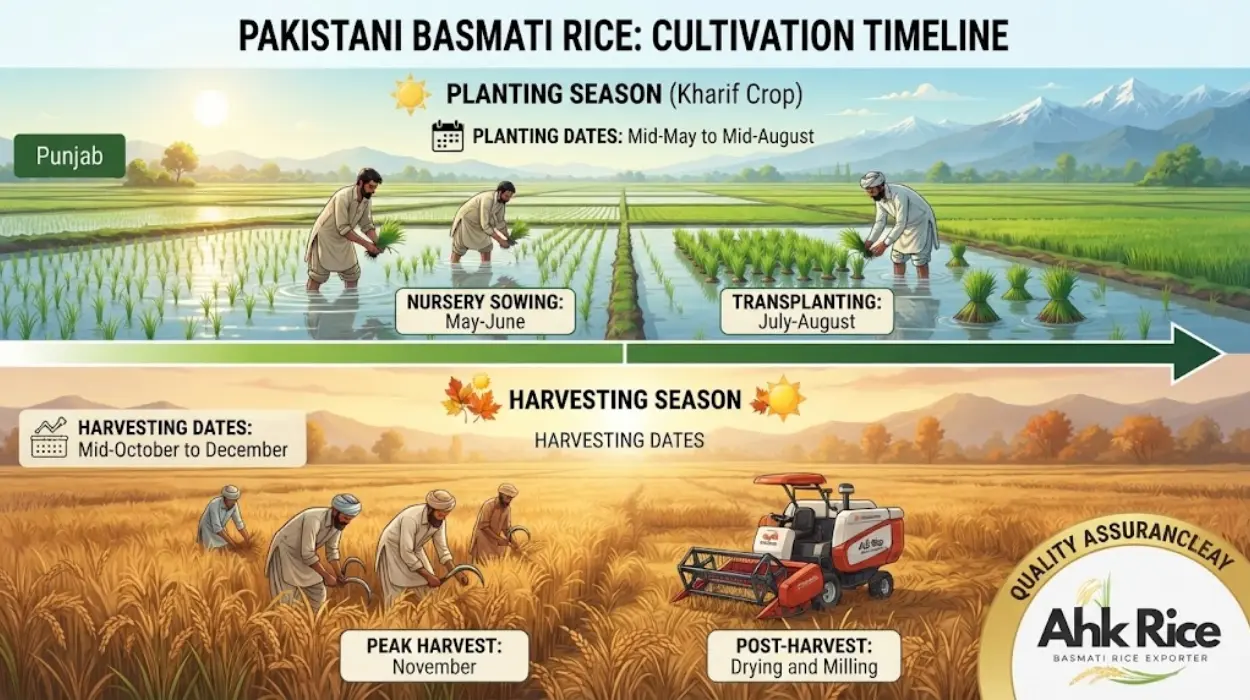
Basmati rice in Pakistan is generally planted from June 1 to June 25 and harvested from September through October, depending on variety and crop maturity. Here is why: Punjab Basmati varieties use a May-June nursery and reach harvest after roughly 100-150 days from transplanting.
When is Basmati rice planted in Pakistan?
Pakistani Basmati rice is normally sown from June 1 to June 25, with nursery preparation beginning during May and transplanting following the nursery stage. Punjab Agriculture Department records place major Basmati varieties within this planting window.
Basmati rice follows the Kharif agricultural cycle in Pakistan. Punjab remains the central production region for Pakistani Basmati. Major growing areas include districts across the traditional rice belt of Punjab.
The crop starts with nursery preparation. Farmers sow Basmati seed in a nursery during May or early June. The young plants then move into prepared rice fields.
The standard sowing window differs by variety. Super Basmati, Basmati 370, Basmati 515, Punjab Basmati, and PK 1121 Aromatic are listed with sowing periods beginning in June.
Punjab Agriculture Department data lists PK 1121 Aromatic with a June 1 to June 25 sowing period and a 126-day maturity period. Super Basmati has the same sowing window and a 115-day maturity period.
The exact field schedule therefore depends on the variety, nursery age, transplanting date, irrigation, temperature, and crop management.
The planting calendar establishes the first supply milestone. The next stage is nursery preparation and field transplanting.
How does Basmati rice cultivation work in Pakistan?
Basmati cultivation moves through nursery sowing, field preparation, transplanting, irrigation, crop management, maturity, harvesting, drying, and post-harvest handling. Each stage affects grain quality and final milling recovery.
How is the Basmati nursery prepared?
Nursery preparation starts before field transplanting. Farmers prepare a suitable seedbed and sow selected Basmati seed during the recommended nursery period.
Rice in Pakistan is commonly transplanted rather than directly planted into the final field. The nursery stage gives farmers established seedlings for field planting.
How is Basmati transplanted?
Farmers prepare the main field through puddling and irrigation. They then transplant young rice seedlings into standing or saturated soil.
Punjab Agriculture Department research recommends controlled standing water after transplanting. Its guidance identifies 1 to 1.5 inches of standing water for 21 days as a water-saving practice.
How does the crop reach maturity?
Basmati maturity depends on the genetic variety. Punjab records show maturity periods ranging from less than 100 days for some newer fine varieties to more than 120 days for traditional varieties.
PK 1121 Aromatic, for example, has a recorded maturity period of 126 days. Kissan Basmati has a recorded maturity period of 94 days.
This difference explains why one Basmati field can become harvest-ready earlier than another field planted during the same month.
With cultivation stages established, the next question is how the harvest calendar determines commercial availability.
When is Basmati rice harvested in Pakistan?
Pakistan’s Basmati harvest generally falls between September and October, with the exact harvest date determined by variety, transplanting date, maturity period, and field conditions. Rice crop studies identify September-October as the main harvest period.
Harvesting begins after the rice plant reaches physiological maturity. Farmers monitor grain development, plant condition, and field readiness before cutting.
Traditional Basmati varieties often require longer maturity periods. Newer varieties can reach maturity faster. Punjab Agriculture Department research shows that fine-rice maturity periods have declined substantially through varietal development.
Harvest timing affects the next stages of the rice supply chain. Farmers cut mature paddy, collect the crop, reduce excess moisture, and move the paddy toward milling facilities.
The harvest therefore creates the first major availability point for the new crop. Exporters then process, grade, pack, and prepare rice for international markets.
What happens to Basmati rice after harvesting?
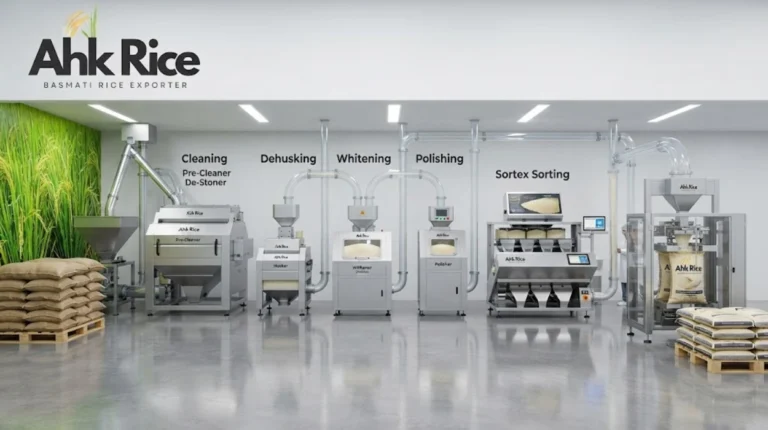
Harvested Basmati passes through drying, cleaning, dehusking, milling, grading, sorting, quality inspection, packing, and dispatch before reaching export markets. Each processing stage converts harvested paddy into an export-ready rice specification.
What are the main processing stages?
A commercial rice operation follows several defined stages:
- Dry the paddy to control moisture before storage and milling.
- Clean the paddy to remove field debris and foreign material.
- De-husk the grain to remove the outer rice husk.
- Mill the grain to remove remaining bran layers.
- Polish the grain according to the required market presentation.
- Grade the rice according to length, broken percentage, moisture, and appearance.
- Sort the rice using mechanical and optical sorting systems.
- Inspect the rice against the agreed commercial specification.
- Pack the rice into the required retail, wholesale, or foodservice format.
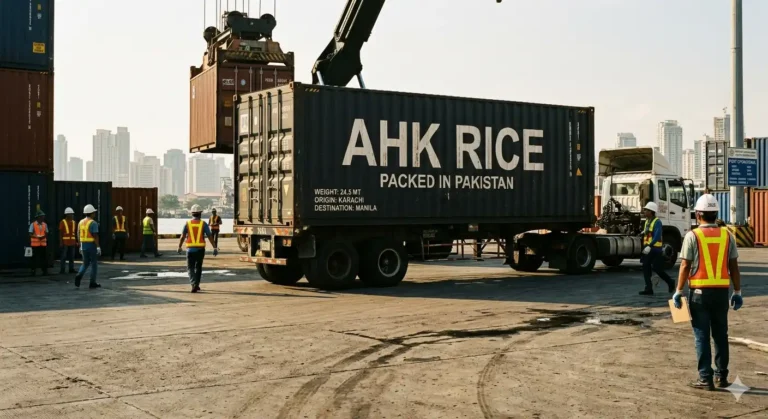
- Load the shipment into export containers after documentation and inspection.
Parboiled products follow additional processing. The paddy undergoes soaking, steaming, drying, milling, and sorting before packing.
Punjab Agriculture Department research specifically identifies standardized parboiling technology as a method for controlling colour variation, off-odour, and milling recovery problems.
These processing stages connect the agricultural harvest to commercial grades. The next issue is understanding which Basmati varieties follow this calendar.
Which Basmati varieties are planted and harvested in Pakistan?
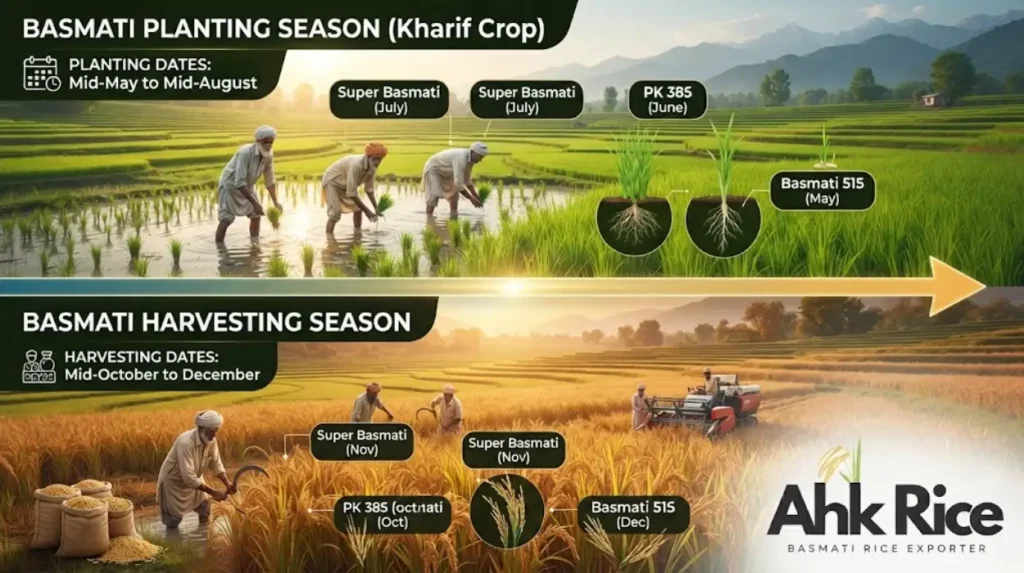
Pakistan cultivates multiple Basmati varieties, including Super Basmati, Basmati 515, Basmati 385, Basmati 370, Punjab Basmati, and PK 1121 Aromatic. Their maturity periods differ.
Which traditional Basmati varieties are important?
Super Basmati remains a major fine-grain variety associated with Punjab. Punjab Agriculture Department records show a June 1-25 sowing period and 115-day maturity period.
Basmati 370 has a 125-day maturity period. Basmati 515 has a 115-day maturity period. Basmati 385 has a 105-day maturity period.
Which long-grain varieties affect export supply?
PK 1121 Aromatic is important for extra-long aromatic rice production. Punjab Agriculture Department records list its grain length at 8.16 mm and maturity at 126 days.
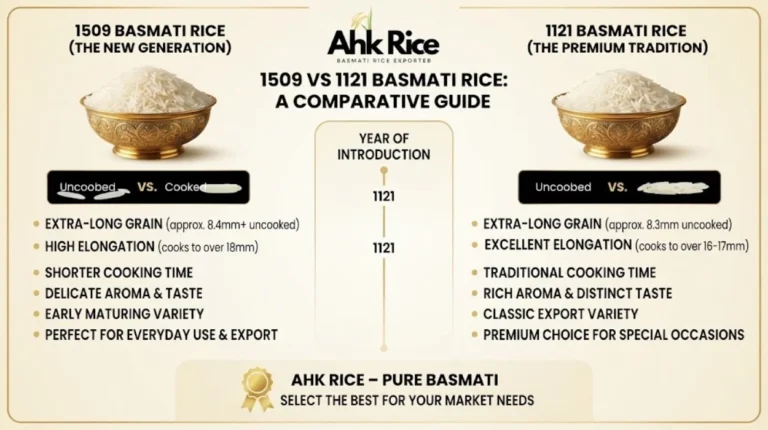
AHK Rice supplies commercial Pakistani Basmati categories including 1121, Super Kernel, and 1509. These products serve different retail, wholesale, foodservice, and private-label requirements.
Variety selection therefore affects planting dates, harvest timing, processing requirements, and commercial availability.
How does Pakistan’s Basmati harvest calendar affect UAE rice supply?
Pakistan’s September-October Basmati harvest creates the main new-crop supply window, while UAE buyers manage inventory around processing, shipping, demand cycles, and Ramadan purchasing schedules.
The UAE is a major destination for Pakistani rice. Dubai also functions as a regional distribution and re-export centre.
New-crop paddy becomes available after harvest. Milling and grading then convert paddy into finished rice. Exporters dispatch processed rice after quality checks, packaging, documentation, and container loading.
UAE buyers therefore track more than the field harvest date. They also monitor milling capacity, available grades, vessel schedules, port clearance, warehouse inventory, and expected retail demand.
Ramadan planning adds another commercial factor. Ramadan follows the Islamic lunar calendar, so its Gregorian dates shift each year. Buyers must calculate backwards from the expected demand period.
A practical planning model starts with the required arrival date. Buyers then allow time for milling, packing, container loading, ocean freight, customs clearance, and domestic distribution.
This makes the September-October harvest important even for UAE stock required months later. Harvest establishes the new-crop supply base, while logistics determine the actual arrival window.
The harvest calendar therefore connects directly with UAE procurement planning, pricing, and inventory management.
How does the harvest season affect Basmati rice pricing?
Basmati pricing responds to new-crop availability, variety, grain quality, broken percentage, moisture, processing grade, packaging, quantity, freight, and destination costs. Harvest timing is one supply-side factor.
New-crop availability increases the quantity of freshly harvested paddy entering the supply chain. Milling then creates commercial rice inventories.
Pricing does not depend on harvest timing alone. A buyer purchasing 1121, Super Kernel, or 1509 receives a different specification and market position.
Grade also changes the commercial value. Long grain, aroma, low broken percentage, controlled moisture, processing type, and packaging all affect the final quotation.
UAE buyers should therefore compare complete specifications rather than comparing only a price per metric tonne.
The same harvest can produce different commercial values across grades. The next section explains the most common calendar misunderstandings.
What are the common misconceptions about Pakistan’s Basmati harvest?
Basmati does not have one universal harvest date across Pakistan; variety, nursery timing, transplanting, maturity period, and local field conditions determine the actual harvest window.
Does every Basmati variety mature at the same time?
No. Punjab records show substantial differences in maturity. PK 1121 Aromatic reaches 126 days, while Kissan Basmati reaches 94 days under listed maturity data.
Does September mark the only harvest month?
No. September begins the major harvest period, while October also forms part of the rice harvesting window. Crop duration and transplanting dates shift individual field schedules.
Does harvest mean export-ready rice?
No. Harvested paddy still requires drying, cleaning, dehusking, milling, grading, sorting, inspection, and packing before export dispatch.
Does Ramadan always follow immediately after harvest?
No. Ramadan changes position within the Gregorian calendar each year. UAE importers therefore plan inventory from the required arrival date rather than using the harvest month alone.
Understanding these distinctions prevents buyers from treating agricultural harvest dates as direct shipment dates. The final step is connecting the calendar with procurement planning.
How should UAE buyers plan Basmati stock around Pakistan’s harvest?
UAE buyers should work backward from the required retail or foodservice availability date and include milling, inspection, packing, shipping, customs clearance, and distribution time.
A practical stock plan starts with expected Ramadan demand. The buyer then determines the required warehouse arrival date.
The next calculation covers export processing. The supplier needs time to source paddy or finished rice, mill and grade the product, complete quality checks, pack the shipment, and load containers.
Shipping then becomes a separate planning stage. Ocean transit, port procedures, customs clearance, and UAE distribution add time after container dispatch.
Buyers also need to define the required specification. A purchase plan should state variety, processing type, grain length, broken percentage, moisture, packing size, quantity, and destination.
Frequently Asked Questions
When is Basmati rice planted in Pakistan?
Basmati rice is generally planted from June 1 to June 25 in Punjab. Nursery preparation starts during May or early June, followed by transplanting into prepared rice fields.
When is Basmati rice harvested in Pakistan?
Basmati rice is generally harvested during September and October. The exact date depends on the variety, transplanting date, crop maturity, and field conditions.
How long does Basmati rice take to mature?
Maturity varies by variety. Punjab Agriculture Department data lists 94 days for Kissan Basmati, 115 days for Super Basmati, and 126 days for PK 1121 Aromatic.
Where is Basmati rice cultivated in Pakistan?
Punjab is the principal Basmati-producing region. Important rice-growing areas include the traditional rice belt around the Kallar Tract and other Punjab districts.
When does new-crop Pakistani Basmati become available?
New-crop paddy becomes available mainly after the September-October harvest. Milling, grading, sorting, quality testing, and packaging then determine when finished export rice becomes available.
How does the harvest calendar affect UAE buyers?
The harvest calendar identifies the new-crop supply period. UAE buyers must also plan milling, inspection, packing, shipping, customs clearance, and warehouse distribution before the required stock date.
How should UAE buyers plan Basmati for Ramadan?
UAE buyers should calculate backward from the required Ramadan warehouse date. The plan should include rice processing, container loading, ocean transit, customs clearance, and domestic distribution time.