Pakistani vs Indian Basmati Rice: Which Should Indonesian Importers Choose?
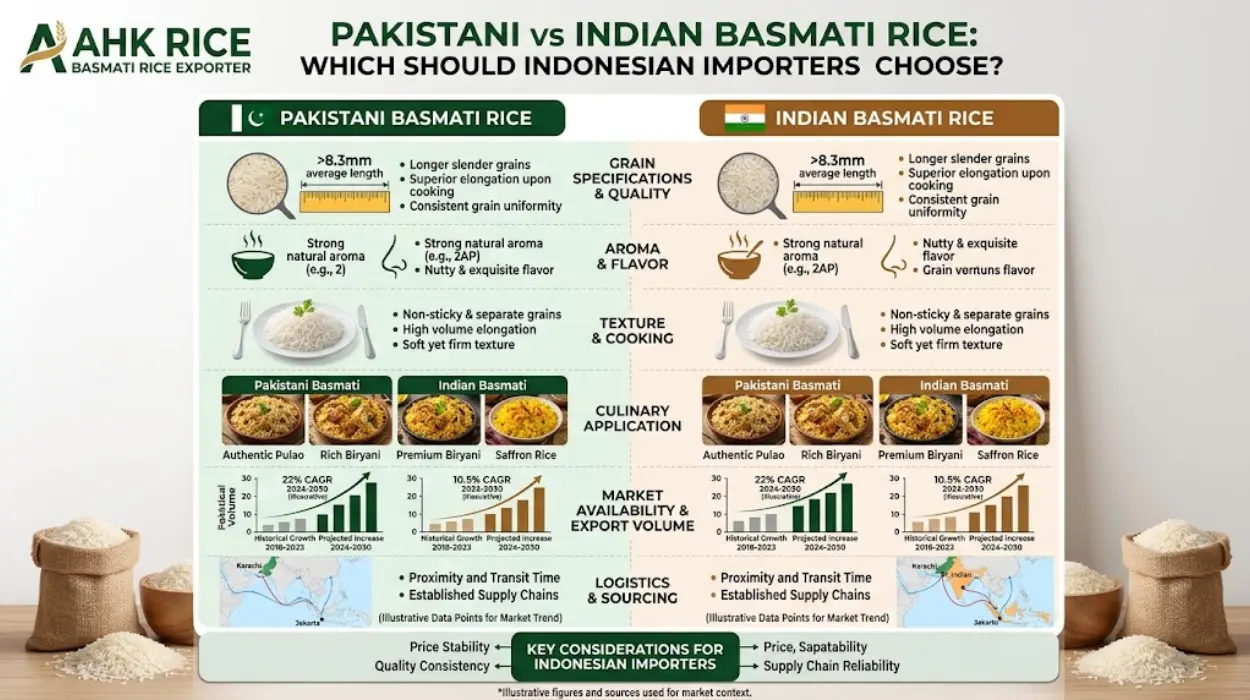
Pakistani and Indian Basmati rice are two major choices for Indonesian importers seeking long-grain aromatic rice. Both origins offer premium varieties, different grain characteristics, white and parboiled processing options, and commercial grades. The right choice depends on aroma, cooked elongation, grain consistency, target customers, purchasing costs, and reliable export arrangements.
Indonesia imports specialty rice to serve restaurants, hotels, modern retail channels, and consumers seeking specific rice varieties. Basmati occupies a distinct position because of its natural fragrance, long kernels, and cooking characteristics. Pakistani varieties such as1121, Super Kernel, and 1509 compete with Indian varieties such as Pusa Basmati 1121, Pusa Basmati 1509, and traditional Basmati selections.
Understanding their agricultural origins, processing methods, quality specifications, and export requirements helps Indonesian buyers evaluate suppliers using measurable product characteristics rather than country reputation alone.
What Is the Difference Between Pakistani and Indian Basmati Rice?
Pakistani and Indian Basmati rice are aromatic long-grain varieties grown in different South Asian agricultural regions. Pakistani Basmati comes mainly from Punjab, while Indian Basmati originates primarily in northern states. Both offer distinctive aroma, grain elongation, and commercial processing options.
Basmati is a fragrant rice category recognized for its slender kernels, characteristic aroma, and ability to elongate during cooking. Its quality depends on genetics, growing conditions, harvesting, aging, milling, and storage.
Pakistani Basmati production concentrates in Punjab districts including Hafizabad, Gujranwala, Sheikhupura, Narowal, and Sialkot. The region’s soil, climate, and agricultural practices support traditional aromatic varieties and newer commercial cultivars.
India produces Basmati across northern agricultural regions, particularly Punjab, Haryana, Uttar Pradesh, Uttarakhand, Delhi, Himachal Pradesh, and Jammu and Kashmir.
Both countries supply international markets with raw white, steamed, and parboiled rice. However, their variety portfolios and commercial specifications differ.
How Is Pakistani and Indian Basmati Rice Grown and Processed?
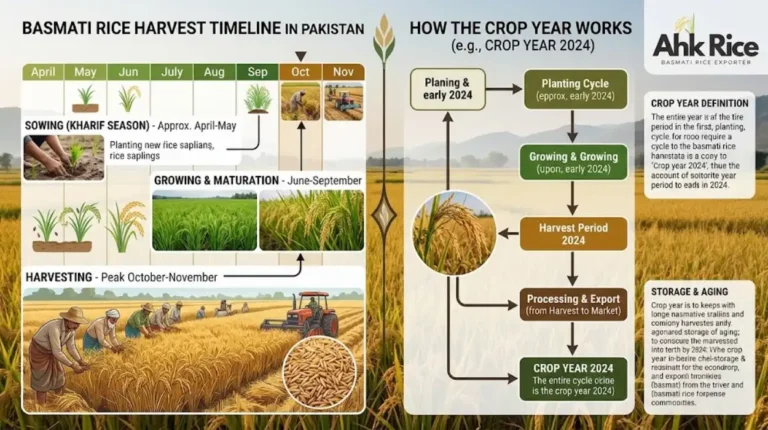
Basmati production begins with suitable seeds and agricultural conditions, followed by cultivation, harvesting, drying, milling, grading, and packaging. Both countries use controlled processing stages to protect grain quality, natural fragrance, kernel appearance, and export consistency.
1. Agricultural Cultivation
Farmers select certified or approved seeds according to regional agricultural recommendations. Paddy cultivation requires suitable temperatures, water availability, soil conditions, and crop management.
Pakistani Punjab supports varieties such as Super Basmati, PK-1121, and 1509. Indian farmers cultivate varieties including Pusa Basmati 1121, Pusa Basmati 1509, and Pusa Basmati 1.
2. Harvesting and Drying
Farmers harvest mature paddy when the crop reaches its appropriate maturity stage. The harvested rice contains an outer husk and requires drying before storage and milling.
Controlled drying reduces excess moisture and protects kernels against cracking, fungal development, and storage deterioration.
3. Milling and Cleaning
Rice mills remove the outer husk and bran layers to produce milled rice. Processing equipment separates foreign materials, immature kernels, and damaged grains.
Sortex optical sorting identifies and removes discoloured grains and other visible defects. Double Sortex processing provides an additional sorting stage for buyers requiring tighter visual consistency.
4. Processing into Commercial Types
Exporters prepare different Basmati products according to buyer specifications.
- White Basmati: Milled rice without parboiling, retaining its natural white appearance.
- Steam Basmati: Rice receives controlled steam treatment before final drying and milling.
- Golden Sella: Parboiled rice undergoes soaking, steaming, drying, and milling, producing its characteristic golden colour.
- Creamy Sella: Parboiled rice with a lighter cream-coloured appearance.
- Brown Basmati: Rice retains its bran layer after removing the husk.
5. Grading and Packaging
Exporters classify rice according to kernel length, broken percentage, moisture, foreign matter, and colour. Packaging options include 5 kg, 10 kg, 20 kg, 25 kg, and 50 kg bags.
Bulk shipments use buyer-approved packaging, container loading plans, and export documentation.
Which Basmati Rice Varieties Are Available in Pakistan and India?
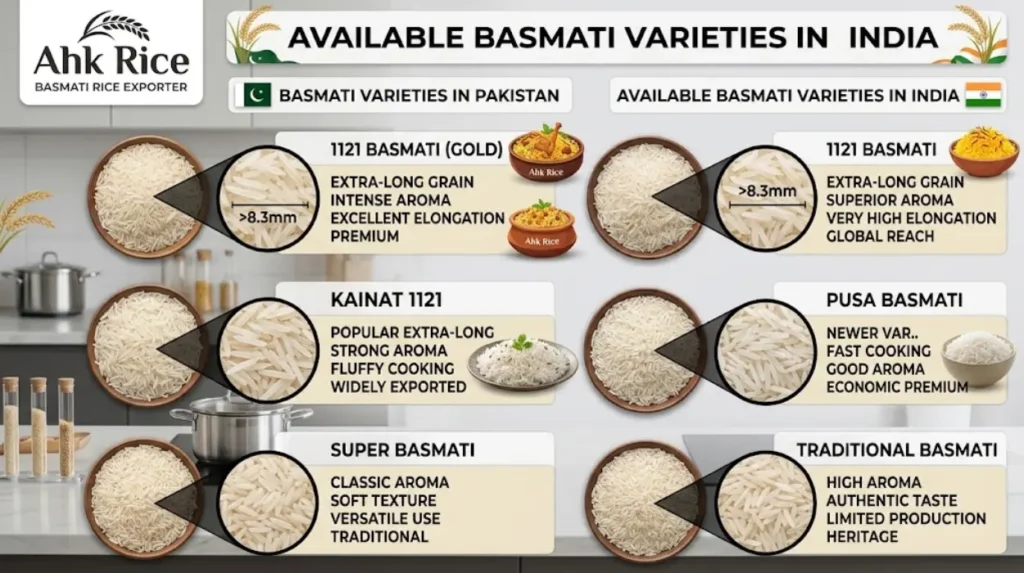
Pakistan and India offer premium aromatic and extra-long-grain Basmati varieties for different commercial applications. Pakistani exporters supply 1121, Super Kernel, and 1509, while Indian exporters supply Pusa 1121, Pusa 1509, and traditional varieties.
Pakistani Basmati Varieties
1121 Basmati Rice
1121 is an extra-long-grain variety known for its impressive cooked length and slender appearance. Raw kernel length commonly measures approximately 8.0–8.3 mm, depending on the variety and grade.
It is available in white, steam, and parboiled forms. Premium retail brands, restaurants, wedding caterers, and foodservice distributors use 1121 for biryani and other rice dishes.
Super Kernel Basmati Rice
Super Kernel is a traditional Pakistani aromatic Basmati variety. Its raw grain length generally measures approximately 7.0–7.5 mm.
It is valued for its characteristic fragrance, slender appearance, and cooking performance. It serves ethnic grocery retailers, wholesalers, and restaurants seeking recognizable Pakistani Basmati quality.
1509 Basmati Rice
1509 is an extra-long-grain, shorter-duration cultivar. Its raw kernel length generally measures approximately 8.1–8.4 mm, depending on grade and specification.
It offers a commercial option for buyers balancing grain appearance, processing performance, and purchasing costs. Steam and Golden Sella versions serve catering, restaurants, and institutional foodservice.
Indian Basmati Varieties
India supplies several established commercial varieties.
- Pusa Basmati 1121: Recognized for exceptionally long cooked kernels and premium presentation.
- Pusa Basmati 1509: A shorter-duration cultivar with extra-long grain characteristics.
- Pusa Basmati 1: An established aromatic commercial variety.
- Traditional Basmati: Includes traditional selections valued for their characteristic fragrance and regional identity.
The variety name alone does not establish shipment quality. Buyers need verified specifications, representative samples, and final inspection results.
What Are the Main Quality Components of Pakistani and Indian Basmati Rice?
Basmati quality depends on physical, chemical, sensory, and cooking characteristics. Importers evaluate raw grain length, moisture, broken percentage, purity, aroma, cooking elongation, and head rice recovery before approving commercial shipments.
The following components provide a practical basis for comparing Pakistani and Indian suppliers.
Grain Length and Appearance
Raw kernel length determines the physical grain category. Extra-long varieties attract buyers seeking premium shelf presentation.
However, grain length must be measured consistently using an agreed laboratory or inspection method.
Aroma and Fragrance
Basmati contains naturally occurring aromatic compounds, particularly 2-acetyl-1-pyrroline (2AP). This compound contributes to its characteristic popcorn-like fragrance.
Variety, crop conditions, aging, and storage influence the final aroma profile.
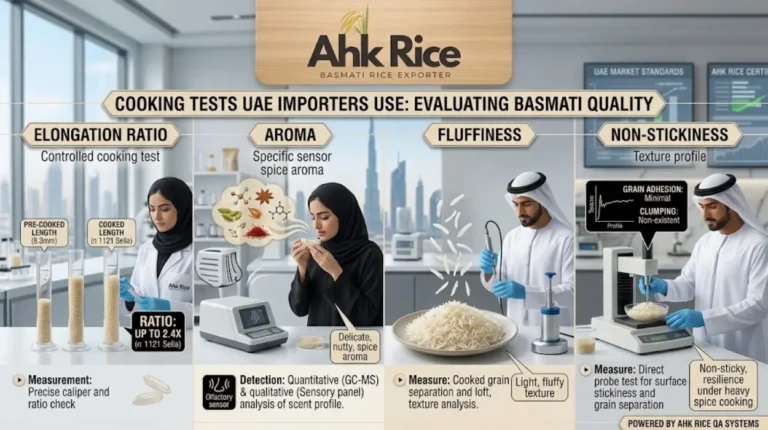
Cooking Elongation
Cooking elongation describes the increase in kernel length after cooking. It influences presentation in biryani, pulao, and other rice dishes.
A longer raw kernel does not automatically guarantee superior cooked elongation. Buyers should conduct standardized cooking tests.
Moisture and Broken Percentage
Moisture control protects rice during storage and transportation. Export specifications commonly target a maximum moisture level of 12–13%.
Broken percentage indicates the proportion of kernels that do not meet the agreed whole-grain length classification. Premium retail buyers frequently request lower broken percentages.
What Are the Benefits of Choosing Pakistani or Indian Basmati Rice?
Pakistani and Indian Basmati provide different sourcing advantages through their variety portfolios, aromatic characteristics, grain specifications, and established export networks. Importers should select origin according to product positioning, customer preferences, quality requirements, and landed cost.
Pakistani Basmati offers Indonesian buyers access to Super Kernel’s traditional fragrance and 1121 and 1509 extra-long-grain selections. These varieties support premium retail, ethnic distribution, restaurants, and institutional catering.
Indian Basmati offers an extensive range of established varieties, including Pusa 1121 and Pusa 1509. Its large export industry provides buyers with multiple commercial grades and processing options.
Both origins provide:
- White, steam, and parboiled processing options.
- Retail and wholesale packaging formats.
- Premium and commercial grain specifications.
- Export documentation and quality inspection.
- Private-label and bulk supply arrangements.
The commercial advantage depends on the actual specification and supplier performance rather than nationality alone.
Which Markets Import Pakistani and Indian Basmati Rice?
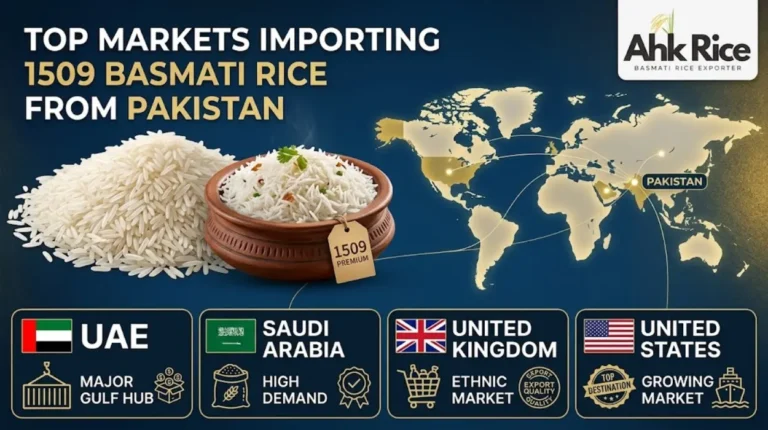
Both countries export Basmati to international markets, including the Middle East, Europe, North America, Africa, and Southeast Asia. Indonesia represents an important destination for specialty rice, including Basmati used by restaurants and premium food channels.
Major importing markets include:
- Indonesia: Specialty rice distributors, hotels, restaurants, and premium grocery retailers.
- United Arab Emirates: Wholesale distributors, supermarkets, restaurants, and re-export businesses.
- Saudi Arabia: Foodservice operators, rice wholesalers, and retail chains.
- United Kingdom: Ethnic supermarkets, food distributors, and private-label brands.
- United States: Premium grocery retailers, restaurant suppliers, and ethnic food distributors.
- Malaysia: Wholesale importers, supermarkets, and institutional foodservice businesses.
Indonesia’s official import statistics demonstrate the commercial presence of both origins. According to Indonesia’s Statistics Agency (BPS), Indonesia imported approximately 803,845 tonnes of rice from Pakistan and 246,588 tonnes from India in 2024. These figures cover all rice categories, not exclusively Basmati. BPS-Statistics Indonesia+1
In 2025, BPS recorded total rice imports of approximately 450,734 tonnes. Pakistan supplied 49,373 tonnes, while India supplied 52,501 tonnes. These figures demonstrate that annual sourcing patterns change with Indonesian import requirements and market conditions. BPS-Statistics Indonesia
What Should Indonesian Importers Consider Before Choosing a Supplier?
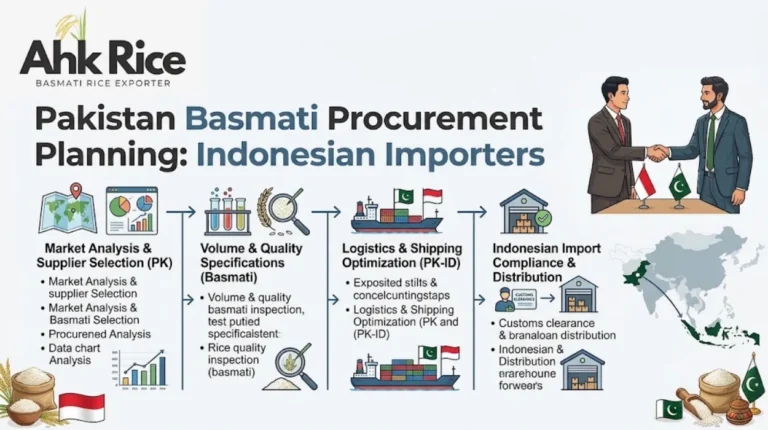
Indonesian importers should compare approved import access, product specifications, supplier capacity, documentation, shipment costs, and quality consistency. A competitive quotation alone cannot establish whether rice meets Indonesian requirements or the buyer’s commercial expectations.
1. Indonesian Import Regulations
Indonesia applies controls to rice imports through its national food import framework. An APEDA advisory dated December 4, 2025, explains that specialty rice, including Basmati, remains relevant to Indonesian demand, while rice imports operate under quota-based controls.
The advisory identifies the National Food Agency (BAPANAS) as responsible for determining import recommendations according to supply and demand. Importers require the appropriate recommendation and import approval before arranging shipments. APEDA
2. Quality Certifications and Documentation
Buyers should examine applicable food safety and export documentation before confirming an order.
Important documents and quality credentials include:
- Phytosanitary Certificate issued by the competent authority.
- Certificate of Origin identifying Pakistani or Indian origin.
- Certificate of Analysis (COA) covering agreed quality parameters.
- Commercial invoice and packing list.
- Bill of Lading and applicable customs documentation.
- HACCP or ISO 22000 food safety management certification.
- FSSC 22000 certification where applicable.
- Halal certification meeting relevant Indonesian recognition and regulatory requirements.
These documents serve different purposes. A food safety certification demonstrates management-system controls, while a phytosanitary certificate addresses plant health requirements. Neither replaces Indonesian import approval.
3. Supplier Processing Capacity
Importers should examine the supplier’s ability to maintain specifications across multiple containers. Processing capacity, milling controls, sorting equipment, moisture management, and warehouse conditions directly affect shipment consistency.
A reliable supplier maintains approved samples, production specifications, inspection records, and traceability throughout the order.
4. Landed Cost
The purchasing decision should consider FOB price, ocean freight, insurance, port handling, customs duties, taxes, and inland transportation.
A lower FOB quotation does not automatically produce a lower landed cost in Jakarta, Surabaya, or another Indonesian destination.
Which Pakistani or Indian Basmati Rice Is Suitable for Indonesian Applications?
The most suitable variety depends on the intended application, cooking performance, customer expectations, and purchasing budget. Premium biryani restaurants prioritize fragrance and elongation, while wholesalers and catering operators also consider consistency, processing type, and cost.
| Indonesian buyer segment | Suitable rice characteristics |
|---|---|
| Premium restaurants | 1121 or Pusa 1121 |
| Traditional aromatic rice retailers | Super Kernel or traditional Indian Basmati |
| Wedding caterers | 1121 Golden Sella |
| Hotels and institutional kitchens | 1509 Steam or Golden Sella |
| Premium grocery brands | Long-grain white Basmati |
| Wholesale distributors | Consistent commercial grades and competitive landed cost |
Restaurant and Hotel Applications
Restaurants serving biryani, pulao, and other aromatic rice dishes require long, separate cooked kernels. Natural fragrance and consistent cooking results influence customer satisfaction.
1121 and traditional aromatic varieties serve premium menu requirements. Golden Sella also suits kitchens that prioritize firm cooked grains and holding performance.
Retail and Wholesale Applications
Retailers require consistent grain appearance, attractive packaging, and recognizable product specifications. Wholesalers prioritize volume availability, competitive quotations, and repeatable quality.
Super Kernel serves buyers seeking traditional Pakistani Basmati characteristics. Pusa Basmati varieties provide Indian-origin alternatives for comparable premium retail categories.
Institutional and Catering Applications
Hotels, event caterers, and commercial kitchens purchase rice in larger quantities. They evaluate cooking yield, batch consistency, storage performance, and price per serving.
1509 and 1121 processing grades provide options for these requirements.
What Are the Common Misconceptions About Pakistani and Indian Basmati Rice?
Several misconceptions arise when buyers compare Basmati by origin alone. Grain length, fragrance, cooking performance, price, and certification require individual verification because neither Pakistani nor Indian origin guarantees identical quality across every shipment.
Misconception 1: Indian Basmati Always Has Better Aroma
Aroma depends on the genetic variety, cultivation conditions, aging, and storage. Pakistani Super Kernel and Indian traditional Basmati both offer characteristic fragrance.
Misconception 2: Longer Raw Grains Always Cook Better
Raw grain length and cooked elongation are separate measurements. Cooking tests provide a more accurate comparison of kernel separation, expansion, texture, and aroma.
Misconception 3: All 1121 Rice Has Identical Specifications
1121 varieties from different origins and suppliers have different quality profiles. Buyers must establish grain length, moisture, broken percentage, and cooking performance through an approved specification.
Misconception 4: Lower FOB Price Means Better Value
The final purchasing decision includes freight, insurance, import charges, product quality, and shipment reliability. Importers should compare landed cost per usable kilogram rather than FOB price alone.
Misconception 5: Basmati Imports Follow the Same Rules as Regular Rice
Indonesia distinguishes specialty rice requirements from ordinary rice imports. Importers must confirm current quota availability, import recommendations, and applicable approvals before shipment. APEDA
How Should Indonesian Buyers Make the Final Choice?
Indonesian buyers should select Pakistani or Indian Basmati through specification-based evaluation, sample testing, regulatory confirmation, and landed-cost comparison. The strongest supplier is the one that consistently delivers the approved variety, quality, documentation, and shipment schedule.
Pakistan offers Super Kernel, 1121, and 1509 varieties with different aromatic and grain-length characteristics. India offers Pusa 1121, Pusa 1509, Pusa Basmati 1, and traditional Basmati selections.
Neither origin is universally superior. The appropriate choice depends on the product category, cooking requirements, customer segment, and commercial agreement.
Indonesian importers should request representative samples, confirm the final Certificate of Analysis, review processing specifications, and verify import eligibility before issuing a purchase order.
A documented comparison of aroma, elongation, price, and supply reliability gives buyers a stronger basis for selecting their preferred Basmati origin.
Frequently Asked Questions
Is Pakistani Basmati Rice Better Than Indian Basmati Rice?
Neither origin is automatically better. Pakistani Super Kernel offers traditional aromatic characteristics, while Pakistani and Indian 1121 varieties provide extra-long grain options. The best choice depends on sample quality and buyer specifications.
Which Basmati Rice Is Best for Indonesian Biryani Restaurants?
1121 Basmati is a strong option for premium biryani because of its long cooked kernels. Super Kernel suits restaurants prioritizing traditional fragrance, while Golden Sella serves kitchens requiring firm cooked grains.
What Is the Difference Between Pakistani 1121 and Indian Pusa 1121?
Both belong to the 1121 variety category, but cultivation, processing, grading, and commercial specifications influence their final quality. Buyers should compare actual grain measurements and cooking-test results.
Can Indonesian Importers Import Basmati Rice Directly from Pakistan?
Yes, specialty Basmati imports are recognized in Indonesia’s import framework. Importers must obtain the relevant import recommendation and approval and comply with current quota, food safety, and phytosanitary requirements.
What Certifications Should Indonesian Basmati Importers Request?
Importers should review applicable phytosanitary documentation, Certificate of Origin, COA, and food safety certifications such as HACCP or ISO 22000. Halal documentation must also meet applicable Indonesian requirements.