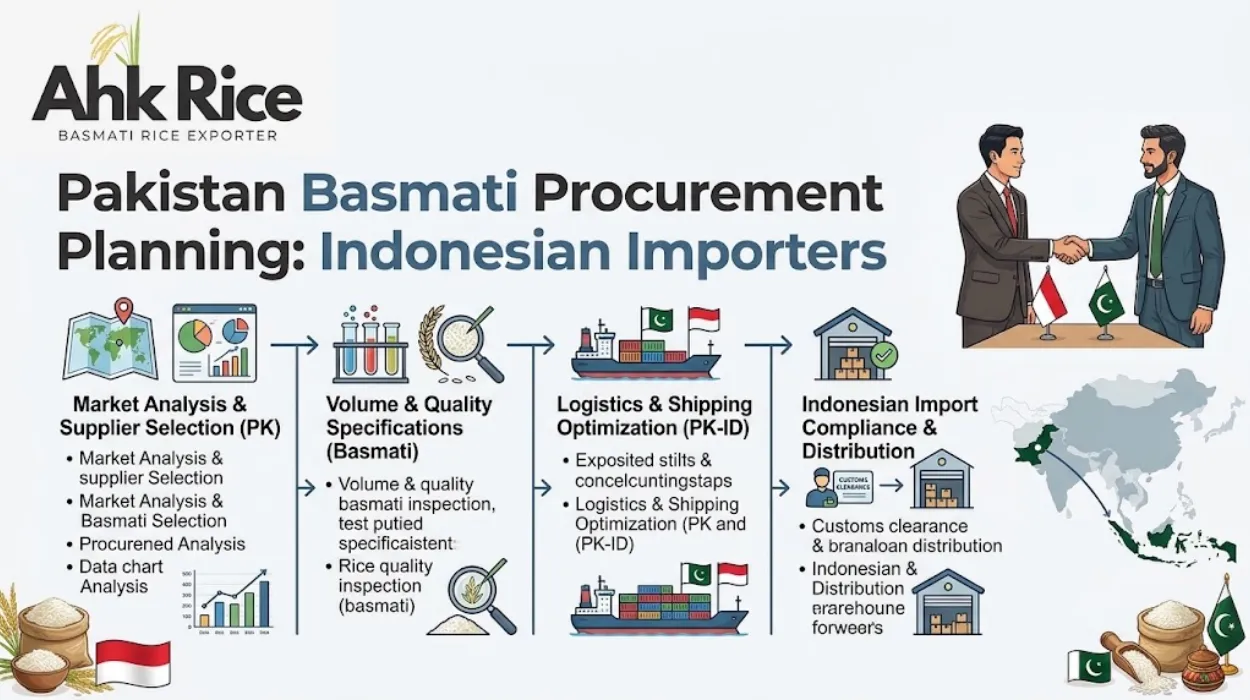
AHK Rice Pakistan Basmati Procurement Planning for Indonesian Importers
Indonesian importers need grade-specific procurement plans, verified quality specifications, and reliable shipment schedules to control Pakistani Basmati rice purchasing costs. Here is why: rice procurement involves more than selecting a grain variety. Importers must coordinate processing, packaging, inspection, shipping, customs clearance, and inventory planning. AHK Rice provides a practical sourcing route for buyers who need consistent Basmati supply from Pakistan.
The right procurement plan connects rice grade, buyer requirements, shipment quantity, and delivery timing. Our educational guide, Why Does Procurement Planning Matter for Indonesian Pakistani Basmati Rice Buyers?, explains the commercial risks behind unplanned purchases. This article focuses on the final decision: how Indonesian importers can source, verify, and schedule Pakistani Basmati rice with fewer supply disruptions.
What is the best solution for Pakistani Basmati procurement in Indonesia?
A grade-specific purchasing plan with approved specifications, pre-shipment inspection, and scheduled dispatch provides the strongest procurement solution. Here is why: Indonesian distributors and foodservice buyers require different grain lengths, processing types, packaging formats, and inventory cycles. A single rice specification cannot serve every retail, wholesale, and restaurant operation.
Match the rice grade to the buyer
1121 Basmati suits premium retail and foodservice applications that require long, slender grains. Super Kernel Basmati provides a traditional aromatic profile and supports premium meal preparation. 1509 Basmati offers a practical option for buyers seeking long-grain appearance and competitive purchasing economics.
| Procurement attribute | 1121 Basmati | Super Kernel Basmati | 1509 Basmati |
|---|---|---|---|
| Grain profile | Extra-long | Long and aromatic | Long-grain |
| Common processing | Steam, Sella, Golden Sella | Steam, Sella | Steam, Sella |
| Buyer segment | Premium retail | Premium foodservice | Mid-premium retail |
| Main requirement | Grain length | Aroma and texture | Value and appearance |
| Packaging options | PP, woven, retail packs | PP, woven, retail packs | PP, woven, retail packs |
| Procurement priority | Uniformity | Cooking performance | Cost control |
| Best purchasing approach | Specification-led | Quality-led | Volume-led |
The comparison shows why procurement planning must begin with the intended use. Importers should approve the grade before discussing price, quantity, and dispatch dates.
Select the processing type
Steam Basmati preserves the natural grain structure through controlled processing. Sella Basmati uses parboiling to improve grain firmness and handling performance. Golden Sella provides a distinct golden appearance and supports buyers seeking a recognizable retail presentation.
Indonesian buyers can compare these processing options through How Should Indonesian Importers Plan Pakistan Basmati Purchases by Grade?. The comparison helps importers align grade selection with cooking performance, shelf-life requirements, and market positioning.
Why choose AHK Rice for Indonesian procurement?
AHK Rice offers Pakistani Basmati sourcing with processing, grading, packaging, and export coordination under one procurement relationship. Here is why: importers need a supplier that can translate commercial requirements into measurable product specifications and shipment documents.
Control the product specification
AHK Rice supplies Pakistani Basmati rice from Punjab, where the crop is cultivated and harvested for export markets. The procurement process begins with the requested grade, grain length, processing type, broken percentage, moisture requirement, and packaging format.
AHK Rice can coordinate the specification around 1121, Super Kernel, and 1509 Basmati. This gives Indonesian buyers a defined purchasing route instead of comparing unrelated offers from multiple suppliers.
Coordinate processing and packaging
AHK Rice uses processing stages that include cleaning, dehusking, polishing, grading, sorting, and packaging. Each stage supports a specific procurement outcome. Cleaning removes unwanted material. Dehusking removes the husk. Grading separates rice by quality and size. Sorting improves uniformity.
Custom packaging supports Indonesian retail and wholesale requirements. Importers can request suitable bag sizes, printed packaging, and shipment quantities according to their distribution model. Packaging decisions should match warehouse handling and expected sales volume.
Support export documentation
Export procurement requires more than a commercial invoice. Buyers should confirm the purchase contract, packing list, certificate of origin, inspection documents, and applicable phytosanitary documentation. Indonesian importers must also verify the current requirements of their customs and food authorities.
AHK Rice can coordinate the export process around the agreed shipment specification. This reduces communication gaps between processing, documentation, loading, and dispatch.
What results can Indonesian importers expect?
A documented procurement plan improves purchasing control, shipment visibility, and product consistency. Here is why: buyers can compare supplier offers against the same specifications and identify cost changes before approving an order.
Reduce specification disputes
A clear purchase specification records the grade, processing type, grain length, broken percentage, moisture, foreign matter, packaging, and quantity. Both parties use the same reference during production and inspection.
This approach reduces disagreements over appearance or quality at delivery. It also gives importers a stronger basis for evaluating future shipments.
Improve inventory planning
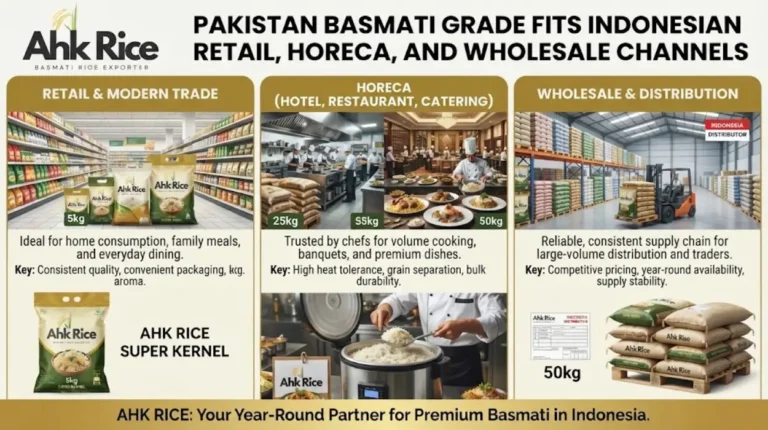
Rice procurement should reflect the buyer’s sales cycle. Retail distributors need stock for repeated customer demand. Restaurant groups need predictable supply for menu consistency. Wholesale buyers need quantities that match warehouse capacity.
For example, an Indonesian distributor purchasing 100 MT of 1121 Steam should confirm monthly sales, warehouse capacity, expected arrival date, and reorder timing. The buyer can then schedule the next shipment before stock reaches a critical level.
Improve shipment visibility
Shipping schedules depend on production readiness, container availability, vessel schedules, port operations, and customs clearance. Importers should receive dispatch updates and document copies before the vessel arrives.
AHK Rice can coordinate shipment planning around the approved order. The buyer should confirm the agreed delivery point and shipping terms before finalizing the purchase.
How much does Pakistani Basmati rice procurement cost?
The final purchasing cost depends on rice grade, processing, packaging, quantity, shipping terms, and destination logistics. Here is why: two orders with the same rice variety can have different costs because their specifications and delivery requirements differ.
Understand the main pricing factors
Grade selection affects the base rice price. 1121 Basmati generally targets premium buyers seeking long grain appearance. Super Kernel suits buyers prioritizing aroma and traditional cooking characteristics. 1509 can support cost-sensitive retail procurement.
Processing also affects cost. Steam, Sella, and Golden Sella require different processing operations. Packaging changes the cost through bag material, printing, size, and packing configuration.
Quantity affects the commercial offer. A full-container order allows the supplier to plan production and loading more efficiently than a small mixed shipment. Buyers should compare offers using the same quantity and specification.
Shipping terms also change the final landed cost. FOB pricing covers the goods and agreed export loading obligations. CIF pricing includes the agreed freight and insurance components to the named destination port. Indonesian importers should request a clear breakdown of the commercial offer.
Plan a sample before the bulk order
A sample allows the buyer to evaluate grain appearance, aroma, cooking performance, and packaging quality before approving commercial production.
A practical sample process follows these steps:
- Submit the required grade, processing type, and target quantity.
- Confirm the sample specification and delivery address.
- Request a representative rice sample.
- Review the grain appearance and cooking performance.
- Approve the sample against the agreed specification.
- Confirm the commercial offer and production schedule.
Sample costs depend on sample quantity, packaging, courier charges, and destination. A small evaluation sample may cost less than a larger sample shipment. The supplier should confirm the exact sample charge before dispatch.
Estimate shipment timing
Shipping days depend on the destination port, vessel schedule, export documentation, and customs clearance. The following planning estimates are useful for budgeting, not guaranteed delivery commitments.
| Indonesian market | Planning estimate | Main timing factors |
|---|---|---|
| Jakarta | 20–35 days | Vessel schedule and port clearance |
| Surabaya | 22–38 days | Route and transshipment |
| Medan | 25–42 days | Vessel availability and inland delivery |
| Makassar | 25–45 days | Route and port operations |
Production and export preparation add time before vessel departure. Importers should confirm the complete lead time with AHK Rice before placing an order.
How can Indonesian importers get started?
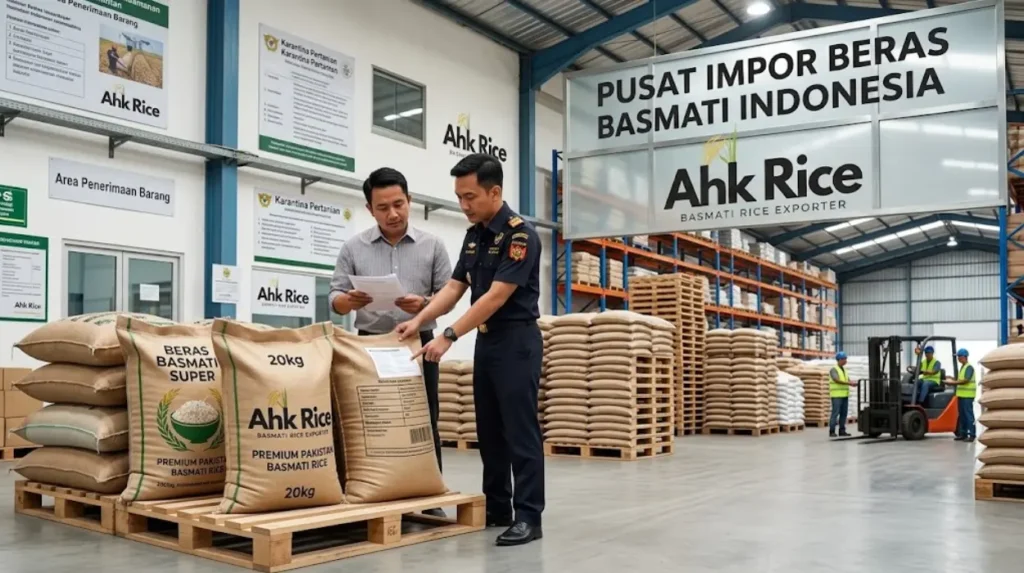
Start with a written product specification, sample approval, commercial quotation, and confirmed shipment schedule. Here is why: procurement decisions become easier when the supplier and buyer agree on measurable requirements before production begins.
Prepare the purchasing brief
Include the following details:
- Rice variety and processing type.
- Required grain length and broken percentage.
- Moisture and foreign matter limits.
- Packaging material and bag size.
- Required shipment quantity.
- Destination port and shipping terms.
- Sample requirements and delivery address.
- Expected purchasing and delivery schedule.
A complete brief allows AHK Rice to prepare a more accurate commercial offer. The buyer should also state whether the rice is intended for retail, wholesale, catering, or restaurant use.
Confirm the sample and quotation
The buyer should review the sample before approving the bulk order. The quotation should identify the product specification, quantity, packaging, shipping terms, payment conditions, and estimated dispatch schedule.
The buyer should compare the sample with the agreed specification. The supplier should confirm production readiness before loading.
Approve production and dispatch
Once the specification and quotation are approved, the buyer can confirm the order. AHK Rice can coordinate processing, packaging, export documentation, and dispatch around the agreed requirements.
The importer should maintain communication throughout production and shipment. This supports better inventory planning and helps the buyer prepare for customs clearance.
What is the final procurement decision for Indonesian importers?
Choose the Pakistani Basmati grade that matches your market, approve a representative sample, and purchase against a documented specification. Here is why: grade selection controls product positioning, while specification control protects quality and commercial expectations.
AHK Rice provides a practical sourcing relationship for Indonesian importers purchasing 1121, Super Kernel, and 1509 Basmati rice. The right procurement plan connects product quality, packaging, shipping, and inventory requirements into one purchasing decision.
Indonesian importers can request a quotation from AHK Rice to begin a grade-specific procurement plan through the request a quote page.
Frequently Asked Questions
Which Pakistani Basmati grade is best for Indonesian importers?
1121 Basmati suits premium retail and restaurant buyers seeking extra-long grains. Super Kernel supports buyers prioritizing aroma and cooking performance. 1509 offers a competitive option for mid-premium retail. The best grade depends on the buyer’s product positioning and target customers.
How should importers compare Steam and Sella Basmati?
Steam Basmati supports buyers seeking a natural grain appearance and cooking performance. Sella Basmati uses parboiling to improve grain firmness and handling. Importers should compare both grades through sample testing. The final choice should match the intended retail, wholesale, or foodservice application.
What information should a buyer provide before requesting a quotation?
Buyers should provide the rice variety, processing type, quantity, packaging format, destination port, and shipping terms. They should also state their required quality specifications and sample needs. This information helps the supplier prepare an accurate commercial offer.
How long does Pakistani Basmati rice take to reach Indonesia?
A practical planning estimate is 20–45 days, depending on the destination port and shipment route. Production, export preparation, vessel schedules, and customs clearance affect the complete lead time. Importers should confirm the expected dispatch and arrival schedule before ordering.
Can AHK Rice provide custom packaging for Indonesian buyers?
AHK Rice can coordinate custom packaging for Pakistani Basmati rice. Buyers can discuss bag size, packaging material, printing, and packing requirements during procurement planning. The final packaging specification should be approved before production begins.