Where Is Pakistani Basmati Rice Grown? Punjab’s Basmati Belt Explained
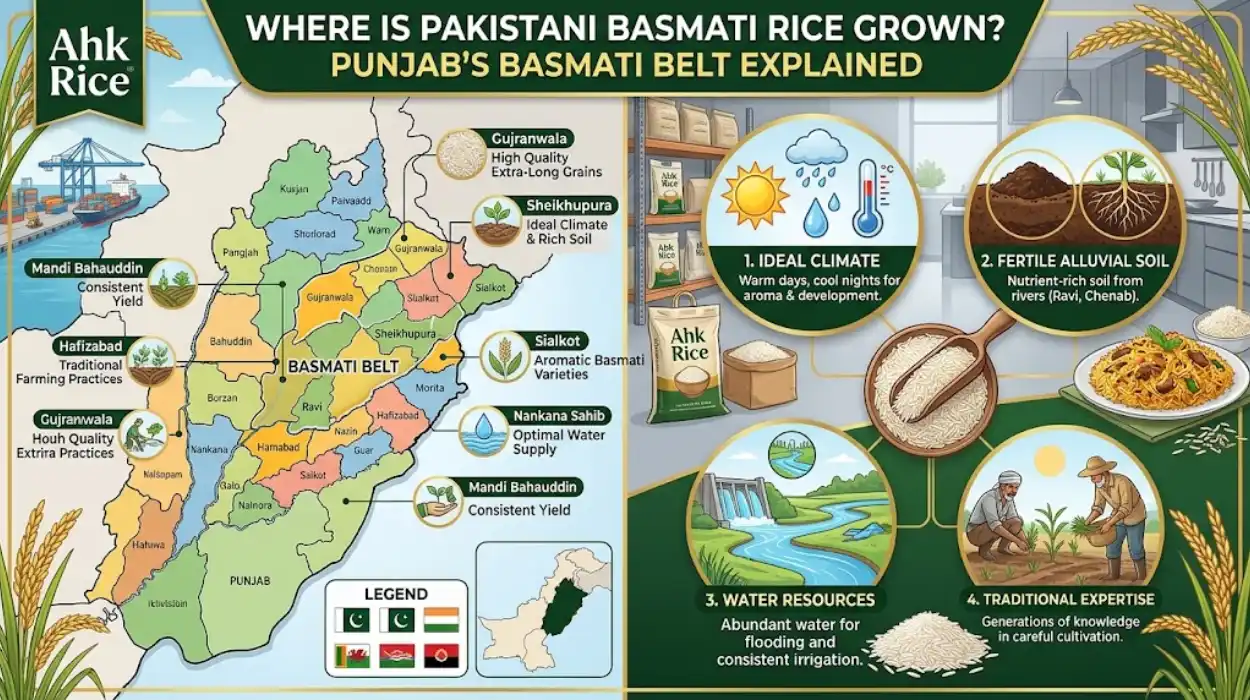
Pakistani Basmati rice is primarily grown in Punjab, especially across the historic Kalar Tract, where fertile alluvial soil, suitable temperatures, seasonal rainfall and river-based irrigation support aromatic, long-grain rice production. Major growing districts include Gujranwala, Hafizabad, Sheikhupura, Sialkot, Narowal, Gujrat and Nankana Sahib.
Pakistan’s Basmati-growing geography extends beyond Punjab, but the province remains the country’s principal centre for traditional Basmati cultivation. Its agricultural conditions support several commercial varieties, including 1121, Super Kernel, and 1509 Basmati rice. Understanding the growing region explains how agricultural conditions influence grain development, aroma, processing quality and international market demand.
What Is the Pakistani Basmati Rice Growing Region?
The Pakistani Basmati rice growing region is concentrated in Punjab’s fertile agricultural districts, particularly the Kalar Tract between the Ravi and Chenab river systems. This region produces aromatic, slender-grain rice for domestic consumption and international export markets.
Basmati is a long-grain aromatic rice traditionally cultivated across the Indo-Gangetic Plains. In Pakistan, Punjab provides the most established agricultural environment for commercial Basmati production. Its farming communities have developed specialised cultivation practices that support traditional aromatic varieties and modern export-oriented cultivars.
The Kalar Tract is the historic heart of Pakistani Basmati production. It includes seven important districts:
- Gujranwala: An established rice-growing and agricultural trading centre.
- Hafizabad: A major source of Basmati paddy and rice processing activity.
- Sheikhupura: An important cultivation and milling centre.
- Sialkot: Known for agricultural production and established Basmati cultivation.
- Narowal: Supports traditional aromatic rice cultivation.
- Gujrat: Forms part of the wider Kalar rice-growing landscape.
- Nankana Sahib: An important area for Basmati cultivation and parboiled rice production.
The Kalar Tract contributes approximately 50% of Pakistan’s total Basmati rice area and production, according to the government’s Basmati cluster development report.
Pakistan’s recognised Basmati geographical area also includes specified districts in Sindh, Khyber Pakhtunkhwa, Balochistan and Azad Jammu and Kashmir. However, Punjab remains central to the country’s traditional Basmati identity and commercial supply chain.
How Is Basmati Rice Grown and Processed in Punjab?
Basmati production begins with selecting suitable seeds and preparing agricultural fields. Farmers cultivate paddy under controlled water conditions, harvest mature crops, dry and store the grain, and send it for milling, grading, polishing and export preparation.
Basmati production involves agricultural and industrial stages. Each stage influences grain quality, moisture, aroma, appearance and suitability for international buyers.
1. Seed Selection and Field Preparation
Farmers select suitable Basmati varieties according to regional conditions, seed availability and market demand. Fields are levelled and prepared to support uniform water distribution.
Common cultivation varieties include Super Basmati, PK-1121 and other improved Basmati cultivars.
2. Nursery Preparation and Transplantation
Farmers prepare rice nurseries and grow seedlings before transplanting them into prepared fields. Transplanting gives farmers control over plant spacing and crop establishment.
Rice cultivation generally follows the summer monsoon agricultural cycle. Sowing and transplanting schedules depend on the variety, local weather and agricultural recommendations.
3. Irrigation and Crop Management
Rice plants require sufficient water during important growth stages. Punjab’s canal irrigation system, rainfall and groundwater resources support agricultural production.
Farmers manage weeds, insects, plant diseases and nutrient requirements throughout crop development. Balanced fertilisation and appropriate water management help maintain healthy plants and grain formation.
4. Harvesting and Paddy Drying
Farmers harvest mature rice plants when the grains reach the appropriate maturity stage. Harvest timing affects grain quality, breakage and final milling recovery.
The harvested paddy is dried to achieve suitable storage moisture. Proper drying reduces the risk of fungal growth, deterioration and grain damage during storage.
5. Milling and Export Processing
Rice mills transform harvested paddy into finished commercial rice through several operations:
- Pre-cleaning: Removes straw, dust, stones and other foreign materials.
- Dehusking: Removes the outer husk from paddy.
- Paddy separation: Separates unhusked grains from brown rice.
- Whitening: Removes bran layers to produce white rice.
- Polishing: Improves grain surface appearance.
- Grading: Separates grains according to length, broken percentage and quality.
- Sortex cleaning: Uses optical technology to remove discoloured and defective grains.
- Packaging: Places approved rice into retail or bulk export bags.
Some varieties also undergo steam or parboiling treatment before milling. These processing methods create different commercial products for different cooking applications.
What Makes Punjab Suitable for Basmati Cultivation?
Punjab provides suitable alluvial soils, river-based irrigation, seasonal rainfall and temperature patterns that support Basmati cultivation. These environmental factors influence plant development, grain filling, aromatic compound formation and the physical characteristics of harvested rice.
Basmati quality does not depend on geographical location alone. Soil composition, crop genetics, water availability, temperature and agricultural management work together to determine the final grain characteristics.
1. Fertile Alluvial Soil
Punjab’s agricultural land contains alluvial deposits carried by the Indus River system and its tributaries, including the Chenab, Ravi, Jhelum and Sutlej.
These soils generally have a sandy loam to loam texture. They provide suitable drainage and nutrient conditions for rice cultivation.
The official Pakistani Basmati specification describes geographical-area soils with slightly alkaline pH values, generally ranging from 7.3 to 8.5.
2. Suitable Temperature Conditions
Temperature affects flowering, grain filling and crop maturity. Basmati quality is particularly sensitive to environmental conditions during grain development.
Relatively cooler temperatures during grain filling support the development and retention of aromatic compounds. Appropriate seasonal temperature patterns also contribute to normal grain maturation.
3. River and Canal Irrigation
Punjab benefits from an extensive irrigation network connected to the Indus Basin irrigation system.
Canals, rivers, rainfall and groundwater provide water for agricultural fields. Consistent water availability supports crop establishment and development, although excessive or poorly managed irrigation creates environmental and production problems.
4. Seasonal Rainfall and Humidity
The monsoon season contributes rainfall during the rice-growing cycle. Humidity and solar radiation also influence crop development.
Farmers must balance rainfall, irrigation and field drainage. Waterlogging, drought and irregular rainfall affect plant health and harvesting conditions.
What Are the Main Pakistani Basmati Varieties and Grades?
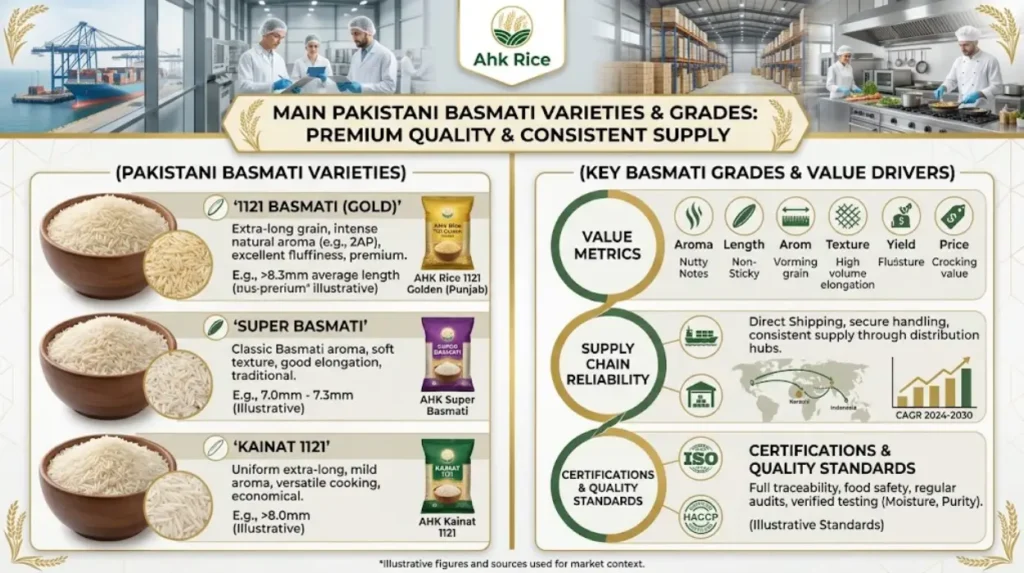
Pakistan produces several commercial Basmati varieties with different grain lengths, aromatic characteristics, cooking properties and market applications. The principal export varieties include 1121, Super Kernel and 1509, available in white, steam, parboiled and other processing grades.
Each variety serves different retail, wholesale, foodservice and international distribution requirements.
1. 1121 Basmati Rice
1121 Basmati is a premium long-grain variety recognised for its exceptional grain length and cooked elongation.
Its commercial specifications include:
- Long, slender raw grains.
- Strong cooked-grain elongation.
- Distinctive Basmati aroma.
- Separate cooked grains when prepared correctly.
Common processing grades include:
- 1121 White Basmati.
- 1121 Steam Basmati.
- 1121 Golden Sella.
- 1121 Creamy Sella.
- 1121 Brown Basmati.
- 1121 Broken Rice.
It is widely used for biryani, pulao, premium retail products and catering applications.
2. Super Kernel Basmati Rice
Super Kernel is a traditional Pakistani aromatic Basmati variety associated with Punjab.
Its characteristics include a slender grain profile, natural aroma and suitable cooking performance. Raw grain length commonly falls around 7.0–7.5 mm, depending on the crop and specification.
Commercial grades include white, steam, golden Sella, creamy Sella and brown rice.
Super Kernel serves ethnic grocery retailers, wholesalers, restaurants and distributors looking for traditional Pakistani Basmati.
3. 1509 Basmati Rice
1509 is an improved Basmati variety recognised for its long grain, relatively shorter crop duration and commercial yield potential.
Its raw grain length commonly falls around 8.1–8.5 mm, depending on the specification.
Available processing grades include:
- 1509 White Basmati.
- 1509 Steam Basmati.
- 1509 Golden Sella.
- 1509 Creamy Sella.
- 1509 Brown Basmati.
- 1509 Broken Rice.
It serves bulk wholesale, institutional foodservice, catering and price-conscious premium rice markets.
Understanding Processing Grades
White rice undergoes conventional milling to remove the husk and bran. Steam rice receives a steaming treatment before milling. Sella rice undergoes parboiling, which involves soaking, heating and drying paddy before milling.
Golden Sella and Creamy Sella differ in their final colour and processing characteristics. Brown Basmati retains its bran layer, while broken rice consists of fractured grain pieces separated during milling and grading.
Which Countries Import Pakistani Basmati Rice?
Pakistani Basmati rice reaches international markets through established export channels serving the Middle East, Europe, North America, Africa and Asia. Import demand depends on consumer preferences, grain specifications, pricing, food regulations and local distribution requirements.
Different markets purchase Basmati according to their culinary traditions and commercial requirements.
1. Middle Eastern Markets
Saudi Arabia, the United Arab Emirates, Oman, Qatar, Kuwait and Bahrain are important destinations for Pakistani rice.
Consumers use Basmati for traditional dishes such as kabsa, mandi, biryani and pulao. Long-grain 1121 and 1509 varieties serve retail, wholesale and foodservice demand.
2. European Markets
The United Kingdom, Germany, France, Italy and other European countries import Pakistani Basmati through specialist distributors, ethnic supermarkets and food wholesalers.
Super Kernel and 1121 serve premium retail and traditional food markets. Importers also evaluate food safety, pesticide residues, traceability and packaging compliance.
3. North American Markets
The United States and Canada purchase Pakistani Basmati for grocery retail, private-label brands, restaurants and foodservice distribution.
Importers evaluate grain consistency, country-of-origin declarations, packaging requirements and applicable food safety regulations.
4. African and Asian Markets
African destinations include Kenya, South Africa and other regional distribution markets. Asian destinations include Malaysia and other countries with established demand for aromatic rice.
Import requirements differ by destination. Buyers evaluate product specifications, phytosanitary documentation, certificates of origin and applicable food safety standards before importing shipments.
What Certifications and Quality Standards Apply to Pakistani Basmati Rice?
Pakistani Basmati exports require compliance with applicable food safety, phytosanitary, origin, labelling and importing-country regulations. Relevant certifications and supporting documents establish product quality, traceability, processing controls and shipment eligibility.
The exact requirements depend on the destination country, importer and product category.
Important standards and documents include:
1. HACCP
Hazard Analysis and Critical Control Points identifies food safety hazards and establishes controls at important production stages.
Rice processors use HACCP-based systems to manage contamination risks during handling, milling, storage and packaging.
2. ISO 22000
ISO 22000 establishes requirements for a food safety management system. It helps food businesses manage hazards throughout their production and supply chains.
3. Phytosanitary Certificate
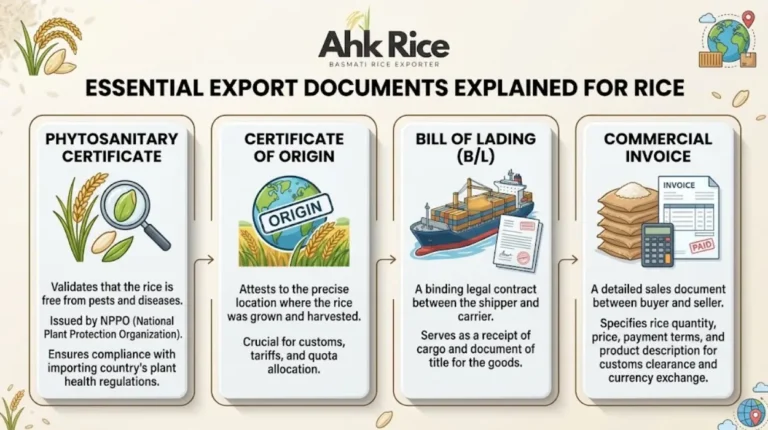
The phytosanitary certificate is issued by the authorised plant protection authority. It confirms that the consignment meets the applicable plant health requirements of the importing country.
4. Certificate of Origin
This document identifies the country in which the exported rice originates. Importers use it for customs procedures and origin verification.
5. Food Safety and Residue Testing
Importers frequently require laboratory reports covering pesticide residues, heavy metals, moisture, broken percentage and other agreed specifications.
Testing requirements depend on the destination market and applicable maximum residue limits.
6. Halal and Organic Certification
Halal certification applies when required by the buyer or destination market. Organic certification is relevant when rice is marketed under an applicable organic production and labelling scheme.
A certification logo alone does not establish compliance. The certificate must be valid, relevant to the product and issued by an appropriately recognised certification body.
What Are the Main Benefits and Uses of Punjab-Grown Basmati Rice?
Punjab-grown Basmati provides aromatic grain, long-grain cooking performance, multiple processing options and commercial variety selection. These characteristics make it suitable for household cooking, premium grocery retail, restaurants, catering operations and international wholesale distribution.
Its benefits depend on the variety, crop quality, processing method and cooking application.
Key Benefits
- Natural aroma: Traditional Basmati varieties contain aromatic compounds that create their characteristic fragrance.
- Long grain: Varieties such as 1121 and 1509 provide extended raw grain length.
- Cooked elongation: Selected varieties expand considerably during cooking.
- Product variety: White, steam, Sella and brown options serve different requirements.
- Commercial flexibility: Different grades support retail bags, bulk packaging and institutional supply.
Common Applications
Basmati is used in biryani, pulao, pilaf, kabsa, mandi and other rice-based dishes.
Foodservice operators select grain according to cooking consistency and holding requirements. Grocery retailers choose varieties and packaging according to customer preferences. Importers select specifications that match their distribution channels and target markets.
What Are the Common Misconceptions About Pakistani Basmati Rice?
Several misconceptions confuse Basmati’s geographical origin, grain length, processing grades and export quality. Understanding these differences helps buyers distinguish authentic regional rice from varieties that simply resemble Basmati in appearance.
1. All Pakistani Rice Comes from Punjab
Punjab is the principal Basmati-producing province, but Pakistan also grows non-Basmati rice in Sindh and other regions. The country’s rice industry includes several agricultural varieties.
2. Every Long-Grain Rice Is Basmati
Grain length alone does not establish Basmati identity. Variety characteristics, aromatic properties, geographical origin and applicable product specifications also matter.
3. Golden Sella Is a Separate Rice Variety
Golden Sella describes a parboiled processing grade rather than a separate botanical rice variety. The underlying variety can be 1121, Super Kernel or another suitable cultivar.
4. Longer Raw Grain Always Means Better Quality
Raw grain length is only one quality parameter. Aroma, moisture, broken percentage, grain uniformity, purity and cooking performance also determine commercial quality.
5. Every Export Shipment Needs the Same Certification
Import regulations differ between countries. A certificate required for one destination does not automatically apply to every other market.
Understanding these distinctions provides a more accurate picture of Pakistani Basmati production, processing and international trade.
Frequently Asked Questions
Where is most Pakistani Basmati rice grown?
Most Pakistani Basmati rice is grown in Punjab, particularly in the Kalar Tract. Major districts include Gujranwala, Hafizabad, Sheikhupura, Sialkot, Narowal, Gujrat and Nankana Sahib.
Why is Punjab famous for Basmati rice?
Punjab has fertile alluvial soil, suitable seasonal temperatures, river-based irrigation and established rice cultivation practices. These conditions support aromatic rice varieties and long-grain development.
What is the Kalar Tract in Pakistan?
The Kalar Tract is a historic Basmati-growing region in Punjab. It includes Gujranwala, Hafizabad, Sheikhupura, Sialkot, Narowal, Gujrat and Nankana Sahib.
Which Basmati rice varieties are grown in Pakistan?
Major commercial varieties include 1121, Super Kernel and 1509 Basmati. Each offers different grain lengths, aromatic characteristics, cooking performance and commercial applications.
Is 1121 Basmati grown in Punjab?
Yes. Punjab is an important cultivation region for 1121 Basmati. Hafizabad, Nankana Sahib and other established rice-growing districts support its production.