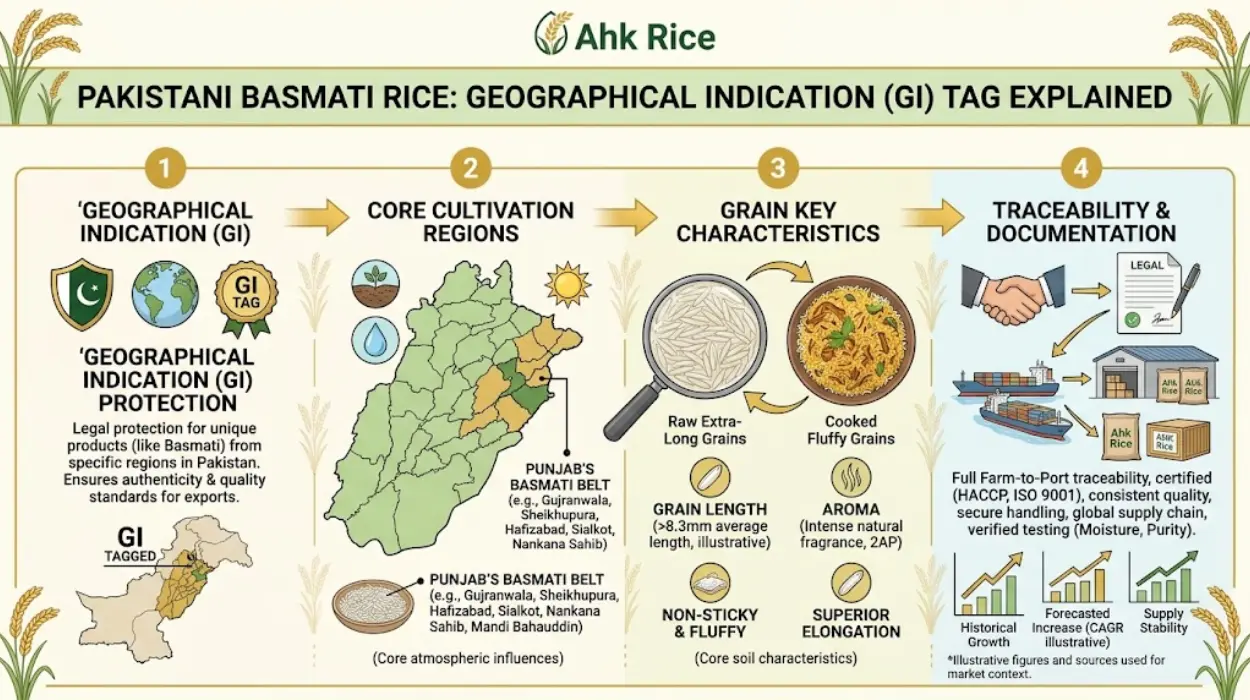
What Is the Basmati Geographical Indication (GI) Tag of Pakistan?
Pakistan’s Basmati Geographical Indication (GI) tag identifies Basmati rice associated with Pakistan’s recognised geographical origin, traditional cultivation practices, and distinctive grain characteristics. It protects the connection between the rice and its origin while supporting authenticity, traceability, and accurate product identification in international trade.
What Is the Basmati Geographical Indication (GI) Tag of Pakistan?
Pakistan’s Basmati GI identifies rice produced within specified geographical areas under defined product specifications. It connects the product’s name, agricultural origin, traditional cultivation, and distinctive quality characteristics, creating a legal framework for protecting geographical identity and preventing misleading origin claims.
A Geographical Indication (GI) is an intellectual property designation that identifies a product through its geographical origin. Its quality, reputation, or other characteristics are associated with that location.
Basmati is a long-grain aromatic rice traditionally cultivated across parts of the Indo-Gangetic Plains. Pakistani Basmati is associated with the fertile agricultural areas supplied by the Indus River system and its tributaries.
Pakistan introduced the Geographical Indications (Registration and Protection) Act, 2020 to establish a legal framework for registering and protecting products linked to geographical origins. The Act includes Basmati rice among the prospective Pakistani geographical indications. TIPP
Pakistan also submitted an application to the European Union for protection of the name Basmati as a Protected Geographical Indication (PGI). The European Commission published the application under reference PGI-PK-02990 in 2024, opening the opposition process. Publication of an application is not the same as final registration. EUR-Lex+1
The distinction matters because Pakistan’s domestic GI framework and international recognition are separate legal processes.
How Does Pakistan’s Basmati GI System Work?
Pakistan’s Basmati GI framework works through geographical boundaries, product specifications, producer identification, and conformity assessment. These elements establish which rice qualifies for geographical recognition and provide a basis for identifying products that misrepresent their origin or protected characteristics.
The system begins with identifying the geographical production area. Rice must originate from the defined locations and satisfy the applicable product specifications.
The next step involves documenting the rice’s characteristics, including grain dimensions, aroma, cooking performance, and cultivation conditions. Producers and other supply-chain participants use these specifications to establish product conformity.
A certification body assesses whether the product meets the requirements of the relevant GI specification. Authorized users receive the right to use the geographical designation under the applicable registration framework.
The protection framework also addresses misleading commercial descriptions. For example, a trader cannot legitimately describe rice from an unrelated geographical origin as Pakistani-origin Basmati simply to benefit from Pakistan’s reputation.
What Is the Legal Framework Behind GI Protection?
Pakistan’s GI Act 2020 establishes procedures for registration, authorized users, certification, and protection against misleading geographical indications.
The Act defines a book of specifications as a document describing the geographical area, production standards, product specifications, and qualification process. This document provides the technical foundation for geographical recognition. TIPP
What Is the Difference Between GI and PGI?
GI is the general concept of identifying goods through geographical origin. PGI is a specific protection category under the European Union’s geographical indication system.
Pakistan’s application for Basmati uses the PGI category. The application describes the product and its geographical production area for consideration under EU rules.
This distinction is important for exporters because national protection does not automatically create equivalent protection in every foreign market.
Where Is Pakistani Basmati Rice Grown?
Pakistani Basmati grows across specified districts of Punjab, Sindh, Khyber Pakhtunkhwa, Balochistan, and Azad Jammu and Kashmir. These regions share suitable soil, water availability, temperature patterns, and agricultural practices associated with traditional aromatic rice production.
Punjab is the principal centre of Pakistani Basmati cultivation. Important districts include Gujranwala, Hafizabad, Sheikhupura, Sialkot, Narowal, Lahore, and Mandi Bahauddin.
The geographical specification also identifies production areas outside Punjab. These include Shikarpur, Jacobabad, and Larkana in Sindh; selected districts in Malakand Division; Naseerabad and Jaffarabad in Balochistan; and Mirpur and Bhimber in Azad Jammu and Kashmir.
How Does Geography Influence Basmati Quality?
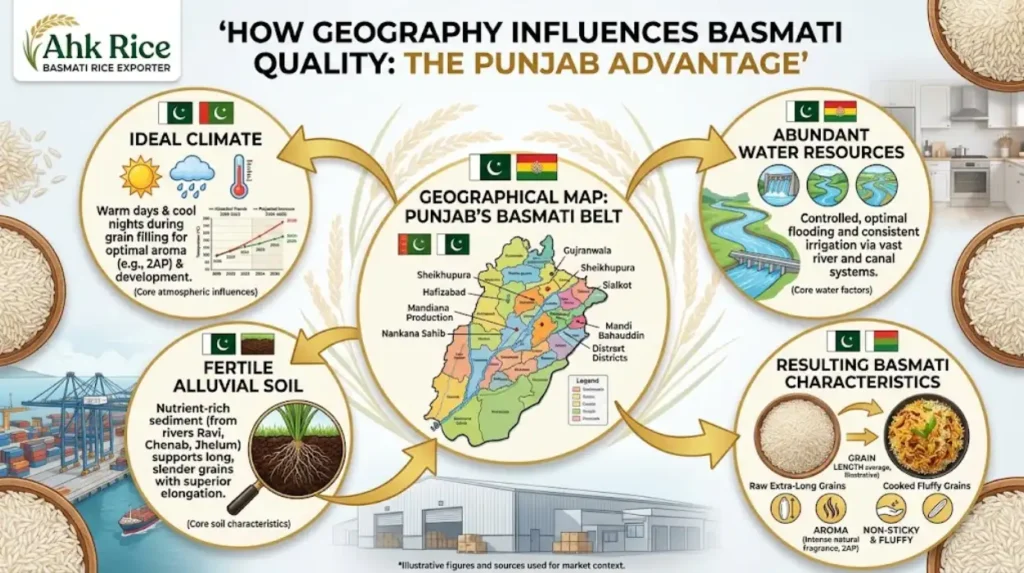
The geographical environment influences grain development, aroma, and cooking characteristics. Soil composition, irrigation, temperature, sunlight, and crop maturity contribute to the final product.
The alluvial plains of the Indus, Chenab, Ravi, Jhelum, and Sutlej rivers provide the agricultural environment described in Pakistan’s Basmati product specification.
The aromatic compound 2-acetyl-1-pyrroline (2AP) contributes to Basmati’s characteristic fragrance. Suitable temperature conditions during grain filling support aroma development and retention. TDAP
What Are the Key Components of Pakistan’s Basmati GI?
Pakistan’s Basmati GI specification connects geographical origin with measurable grain characteristics, aroma, cultivation conditions, processing practices, and product conformity. Together, these components establish the identity of qualifying rice and distinguish authentic Basmati from ordinary aromatic long-grain rice.
The main components include:
1. Geographical Origin
The rice must originate from the geographical production area described in the applicable specification. This requirement connects the product with its recognised agricultural environment.
2. Grain Characteristics
Basmati has long, slender kernels and a high length-to-breadth ratio. Its grain structure supports elongation during cooking without excessive sideways expansion.
3. Aroma and Flavour
The characteristic fragrance comes primarily from 2-acetyl-1-pyrroline. Cooked Basmati also has a distinctive taste and delicate mouthfeel.
4. Cooking Performance
Authentic Basmati develops a soft, fluffy texture with relatively separate grains. Its cooked length increases while maintaining grain integrity.
5. Production Specifications
The specification documents cultivation areas, approved varieties, agricultural conditions, production practices, and product characteristics. These details support conformity assessment and geographical identification.
How Is Pakistani Basmati Rice Processed Step by Step?
Pakistani Basmati processing converts harvested paddy into export-ready rice through cleaning, drying, dehusking, separation, whitening or parboiling, grading, optical sorting, inspection, and packaging. Each stage controls impurities, moisture, grain appearance, and final product consistency.
Step 1: Paddy Harvesting and Collection
Farmers harvest mature Basmati paddy, generally during October and November. The harvested crop moves to rice mills for receiving, initial inspection, and processing.
Step 2: Cleaning and Drying
Cleaning equipment removes straw, dust, stones, and other foreign materials. Drying brings moisture to the required processing level and reduces the risk of deterioration during storage.
Step 3: Dehusking
Rubber-roll husking machines remove the outer husk from paddy. This process produces brown rice, which retains its bran layer and germ.
Step 4: Paddy Separation
Paddy separators distinguish unhulled grains from brown rice. Unhulled grains return for further husking, while brown rice advances through the milling process.
Step 5: Whitening or Parboiling
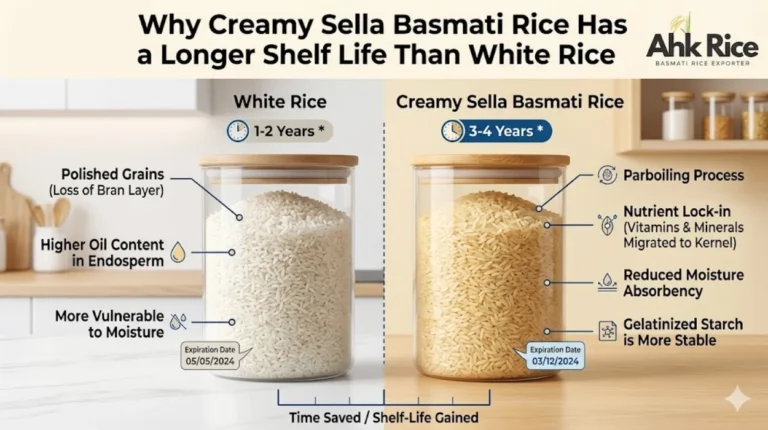
Whitening machines remove bran layers to produce white rice. Parboiling involves soaking, steaming, and drying paddy before milling. It produces varieties such as Golden Sella and Creamy Sella.
Step 6: Grading and Sortex Sorting
Grading machines separate rice according to length and size. Optical Sortex machines identify and remove discoloured grains and other visual defects. Double Sortex processing applies an additional sorting stage for tighter visual consistency.
Step 7: Quality Inspection and Packaging
The finished rice undergoes checks for grain length, moisture, broken percentage, impurities, and appearance. Exporters pack approved rice into buyer-specified packaging, including 5 kg, 10 kg, 25 kg, and 50 kg bags.
What Are the Main Grades and Varieties of Pakistani Basmati?
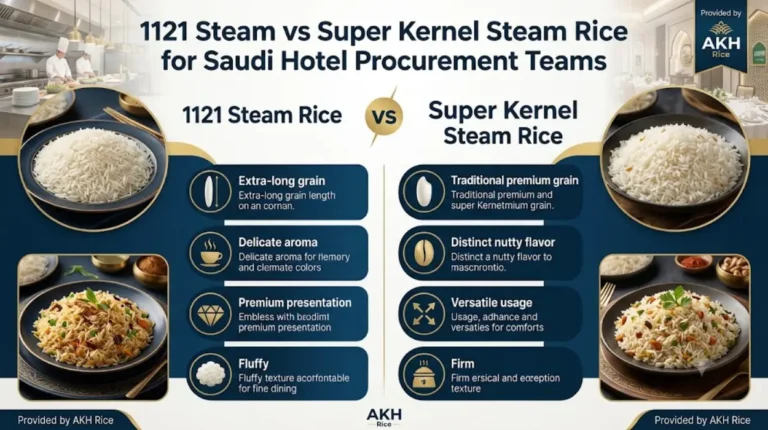
Pakistani Basmati is commercially available in traditional and modern varieties, including 1121, Super Kernel, and 1509. Each variety has different grain dimensions, aroma, cooking performance, processing options, and market applications for retail, wholesale, and foodservice buyers.
The main commercial varieties include:
1121 Basmati
1121 is recognised for its extra-long slender grain and pronounced cooked-grain elongation. Commercial forms include Steam, Golden Sella, Creamy Sella, Brown, and broken rice.
Super Kernel Basmati
Super Kernel is a traditional Pakistani aromatic Basmati variety associated with Punjab. It is used for biryani, pulao, premium retail, and South Asian food distribution.
1509 Basmati
1509 is a high-yielding, shorter-duration Basmati variety. Its cultivation cycle generally takes around 95–105 days. Its commercial forms include Steam and Golden Sella.
Other Commercial Grades
Exporters also supply different milling and quality grades, including:
- White Basmati: polished white rice for retail and wholesale.
- Steam Basmati: rice processed through steaming before final drying and milling.
- Golden Sella: parboiled rice with a characteristic golden colour.
- Creamy Sella: parboiled rice with a lighter creamy appearance.
- Brown Basmati: rice retaining its bran layer.
- Broken Basmati: broken kernels separated during milling and grading.
These are commercial processing and quality categories, not separate geographical indications.
How Does the Basmati GI Tag Benefit Farmers, Exporters, and Importers?
Basmati GI protection supports geographical authenticity, producer recognition, product differentiation, and consumer confidence. It gives farmers and exporters a framework for protecting origin-based reputation while helping importers assess whether rice matches its declared geographical identity.
The benefits extend across the rice supply chain.
1. Protection Against False Origin Claims
GI protection provides legal grounds to challenge misleading geographical descriptions. For example, rice grown outside the recognised Pakistani production area cannot legitimately claim Pakistani geographical origin merely because it has similar grain dimensions.
2. Stronger Product Identity
Geographical recognition distinguishes Pakistani Basmati from other aromatic rice varieties. Buyers can evaluate origin alongside grain length, aroma, processing method, and cooking performance.
3. Better Market Differentiation
Importers use geographical origin to position products in premium grocery stores, ethnic food distribution, and specialist rice markets. Pakistani origin provides a distinct product identity for these channels.
4. Support for Farmers and Producers
GI protection connects product reputation with the agricultural communities responsible for cultivation. It supports collective recognition and provides a framework for protecting the commercial value of traditional production areas.
5. Improved Supply-Chain Accountability
Documented production specifications help supply-chain participants establish product identity. Importers can combine origin documentation with batch records, inspection reports, and laboratory testing.
Which International Markets Import Pakistani Basmati Rice?
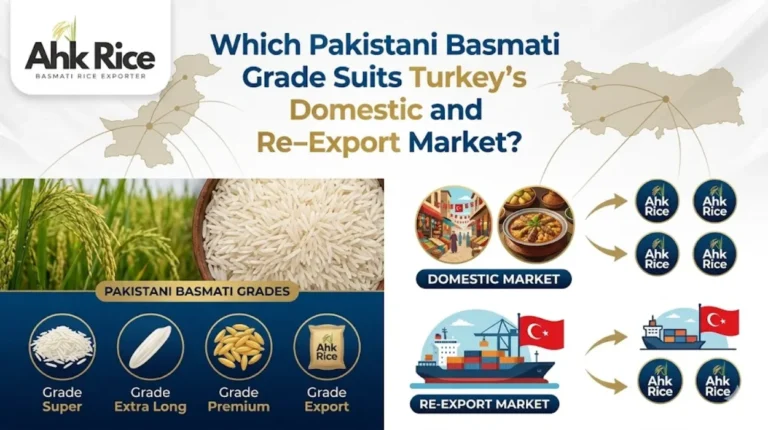
Pakistani Basmati serves international markets across the Middle East, Europe, North America, and Asia. Major destination markets include the United Arab Emirates, Saudi Arabia, Iraq, the United Kingdom, and the United States, where buyers source rice for retail, wholesale, and foodservice distribution.
Middle Eastern Markets
The UAE, Saudi Arabia, Iraq, and other Gulf markets have established demand for aromatic rice. Restaurants, catering companies, wholesalers, and supermarkets purchase Basmati for biryani, mandi, pulao, and everyday meals.
European Markets
The United Kingdom and other European destinations serve ethnic grocery retailers, food distributors, and specialist rice importers. Buyers focus on origin documentation, food safety, packaging, and consistent product specifications.
North American Markets
The United States and Canada import Basmati for ethnic supermarkets, private-label brands, restaurants, and wholesale distribution. Importers assess food safety compliance, pesticide residue limits, labelling, and shipment documentation.
Asian Markets
Asian destinations, including Malaysia and Indonesia, have demand for imported aromatic rice. Importers evaluate grain characteristics, competitive pricing, origin declarations, and local import requirements.
A geographical indication strengthens product identification, but it does not replace the destination country’s import regulations.
What Is the Difference Between Basmati GI Protection and Rice Certifications?
A geographical indication protects the connection between a product and its geographical origin. Food safety certifications, laboratory reports, and export documents address different requirements, including production hygiene, contamination control, product quality, and regulatory compliance.
These terms describe different aspects of rice trade:
| Document or system | Main purpose |
|---|---|
| Geographical Indication | Protects geographical identity |
| HACCP | Identifies and controls food safety hazards |
| ISO 22000 | Establishes a food safety management system |
| Halal certification | Verifies applicable halal requirements |
| Phytosanitary Certificate | Addresses plant health requirements |
| Certificate of Origin | Declares the product’s country of origin |
| Certificate of Analysis (COA) | Reports specified laboratory or product test results |
A GI designation does not automatically establish that a shipment is pesticide-free, organic, halal-certified, or compliant with every importing country’s food safety regulations.
Importers must assess each requirement independently.
What Are the Common Problems and Misconceptions About Pakistan’s Basmati GI?
The main misconceptions concern geographical ownership, domestic registration, international recognition, product quality, and certification. A GI identifies geographical origin, but it does not automatically guarantee every quality parameter or provide unrestricted protection in every importing country.
1. GI Means Every Long-Grain Rice Is Basmati
This is incorrect. Basmati has a recognised combination of grain shape, aroma, taste, and cooking characteristics. Ordinary long-grain rice does not become Basmati simply because it has a similar appearance.
2. Every Rice Grown in Pakistan Qualifies as Basmati
This is also incorrect. Rice must meet the applicable geographical and product specifications. Pakistan produces several non-Basmati rice varieties, which do not automatically qualify for Basmati geographical recognition.
3. GI Automatically Guarantees Premium Quality
A GI establishes geographical identity and compliance with its specification. It does not independently guarantee a particular broken percentage, moisture level, pesticide residue result, or milling quality.
4. Pakistani GI Recognition Automatically Applies Worldwide
GI protection is territorial. Recognition in Pakistan does not automatically establish registration in the EU, Indonesia, the United States, or other jurisdictions.
Pakistan’s EU application was published for opposition under the PGI process. The application should not be confused with completed EU registration. EUR-Lex+1
5. GI and Certificate of Origin Are the Same
A Certificate of Origin identifies the country of origin for a particular export shipment. A GI protects a geographical product designation under an applicable legal framework. Both documents address origin, but they serve different purposes.
How Should Importers Verify the Authenticity of Pakistani Basmati?
Importers should verify geographical origin, supplier documentation, rice specifications, shipment traceability, and independent quality results. Combining these checks helps identify inconsistencies between declared origin, actual product characteristics, packaging information, and export documentation.
A practical verification process includes:
- Request the supplier’s country-of-origin documentation.
- Check the declared production area against the applicable geographical specification.
- Obtain the variety name, crop year, grain length, moisture, and broken percentage.
- Request a representative pre-shipment sample.
- Compare the approved sample with the final shipment.
- Review the Certificate of Analysis and relevant laboratory results.
- Check packaging labels and commercial descriptions.
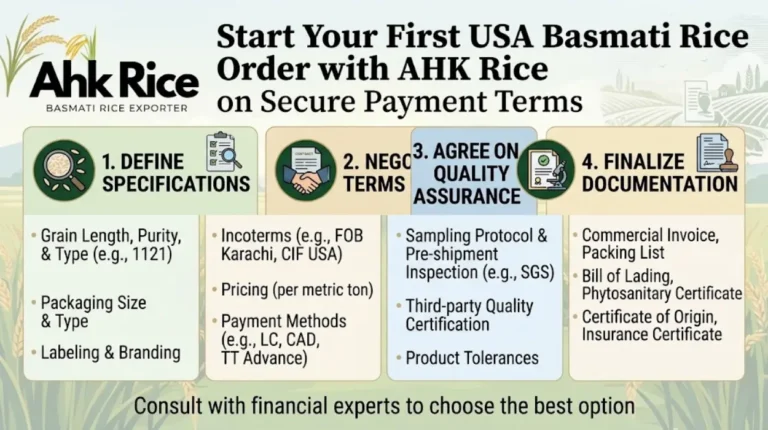
- Verify the required import documents for the destination country.
For bulk shipments, importers should also maintain batch identification and shipment inspection records. These records connect the purchased product with its processing and export history.
What Are the Practical Uses of Pakistan’s Basmati GI?
Pakistan’s Basmati GI framework has practical applications in export verification, international retail, private labelling, wholesale procurement, and geographical product differentiation. It helps businesses communicate product origin and establish clearer purchasing requirements across international rice supply chains.
Common applications include:
- Retail packaging: Identifying Pakistani geographical origin on consumer rice bags.
- Private-label products: Supporting accurate origin claims for supermarket brands.
- Wholesale procurement: Establishing geographical identity in bulk purchasing contracts.
- Restaurant supply: Distinguishing Pakistani Basmati from other aromatic rice varieties.
- International distribution: Supporting product descriptions and origin-based marketing.
- Import verification: Comparing supplier declarations with geographical specifications and supporting documents.
For Indonesian importers, geographical identification is particularly relevant when evaluating Pakistani Basmati against blended or incorrectly labelled rice. Importers should combine origin verification with laboratory testing and supplier traceability. The related buying considerations are explained in how Pakistan’s Basmati GI helps Indonesian importers identify blended or mislabeled rice.
Frequently Asked Questions About Pakistan’s Basmati GI Tag
What does the Basmati GI tag mean in Pakistan?
The Basmati Geographical Indication identifies rice associated with specified Pakistani production areas and defined product characteristics. It provides a legal framework for protecting geographical identity and preventing misleading origin claims.
Which Pakistani regions produce GI-specified Basmati?
The geographical specification identifies selected districts in Punjab, Sindh, Khyber Pakhtunkhwa, Balochistan, and Azad Jammu and Kashmir. Important production districts include Gujranwala, Hafizabad, Sheikhupura, Sialkot, and Narowal.
Does Pakistan have a GI law for Basmati rice?
Yes. Pakistan introduced the Geographical Indications (Registration and Protection) Act, 2020. Basmati rice appears in its schedule of prospective geographical indications.
Is Pakistani Basmati registered as a PGI in the European Union?
Pakistan submitted a PGI application for Basmati under reference PGI-PK-02990. The European Commission published the application in 2024 for the opposition process. Publication does not mean final registration.
Which Pakistani Basmati varieties are available for export?
Major commercial varieties include 1121, Super Kernel, and 1509. Exporters supply these varieties in White, Steam, Golden Sella, Creamy Sella, Brown, and broken grades, depending on availability and product specifications.