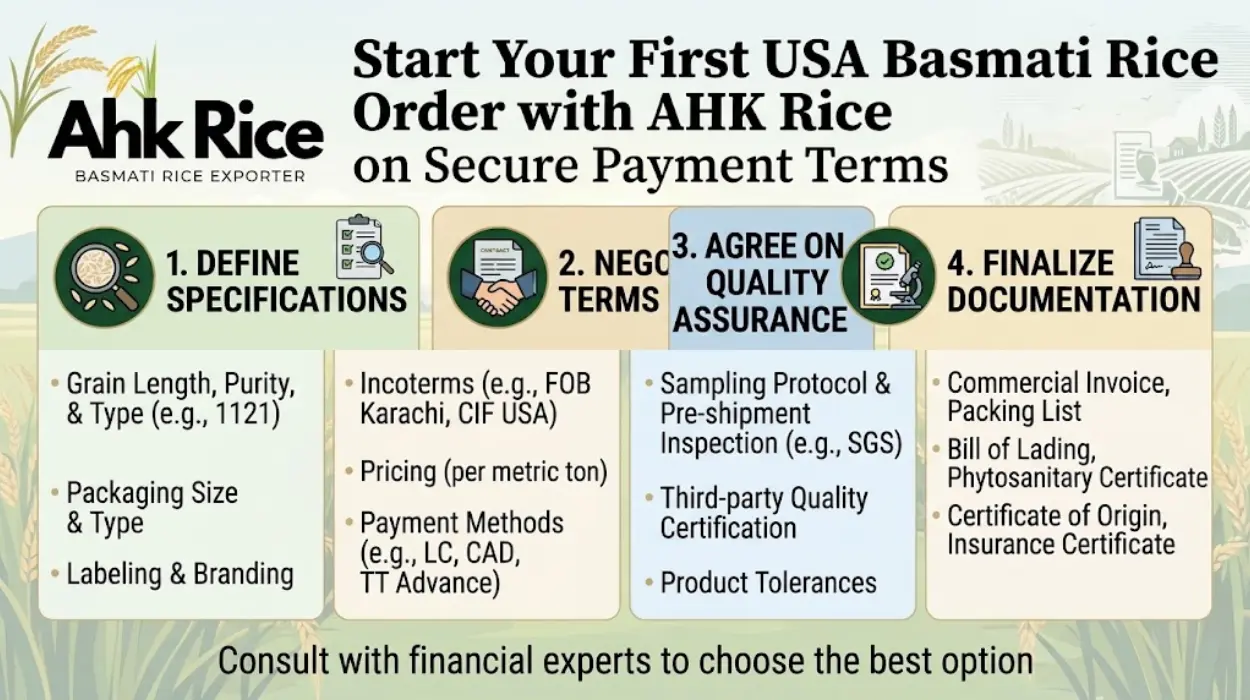
Start Your First USA Basmati Rice Order with AHK Rice on Secure Payment Terms
Starting your first Pakistani Basmati rice import into the United States requires clear product specifications, verified payment terms, compliant documentation, and a realistic shipping schedule. For first-time buyers, the safest approach is to agree on the specification, verify the exporter, establish a documented payment method, and approve the shipment terms before transferring funds. Understanding payment terms used when importing Basmati rice from Pakistan helps buyers prepare for negotiations, although the final agreement must reflect the selected transaction and bank requirements.
AHK Rice supplies Pakistani Basmati rice to international buyers, including importers seeking consistent grain specifications, customized packaging, and coordinated export documentation. A first order should begin with a written quotation and a clear agreement covering grade, quantity, inspection, payment milestones, shipment timing, and responsibility for import clearance.
What is the best solution for securing your first USA Basmati rice order?
The best solution is a documented purchase agreement supported by a verified exporter, an agreed rice specification, and a payment method suited to your risk tolerance. First-time USA importers should confirm bank procedures, shipping responsibilities, and required compliance documents before authorizing payment.
A secure transaction starts with a purchase specification rather than a price alone. Buyers should identify the rice variety, processing type, average grain length, broken percentage, moisture limit, crop year, packaging format, and destination port. These details establish the standard against which the shipment can be assessed.
For example, a distributor purchasing 1121 Golden Sella for ethnic grocery stores needs a different specification from a foodservice importer purchasing 1509 Basmati for high-volume catering. The written contract should state whether the quoted price is FOB Karachi or CIF a named US port, along with the applicable Incoterms rules.
Payment arrangements should match the buyer’s experience and the supplier’s requirements. An irrevocable letter of credit at sight can provide a documentary payment structure when the credit terms are carefully drafted and the required documents comply. Telegraphic transfer, or TT, may be used for advance payments under an agreed contract. Cash against documents, or CAD, depends on the documentary collection arrangement and does not provide the same payment guarantee as a letter of credit.
First-time importers should compare these options before committing. Read the detailed guide to LC at sight vs TT advance vs CAD for USA rice importers to understand how the mechanisms differ, including their banking costs, document requirements, and risk allocation.
Why should USA importers choose AHK Rice?
AHK Rice offers a direct sourcing route for Pakistani Basmati buyers who need defined product specifications, coordinated processing, export packing, and shipment documentation. Importers should evaluate the quotation, sample quality, compliance evidence, and contractual terms before selecting a supplier.
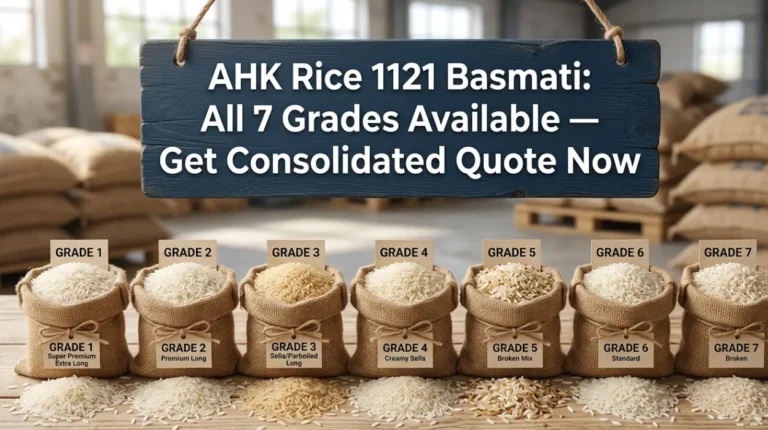
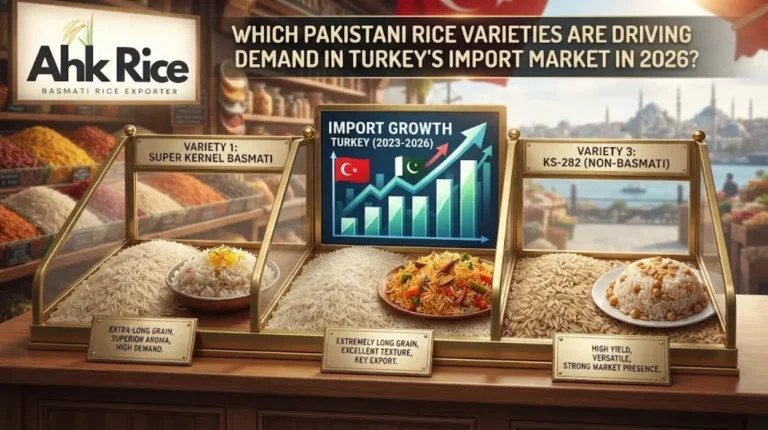
Through the AHK Rice Basmati rice export service, buyers can discuss varieties such as 1121, Super Kernel, and 1509 Basmati rice according to their distribution needs. The appropriate selection depends on grain appearance, aroma, cooking performance, price positioning, and customer expectations.
1121 Basmati suits buyers targeting premium long-grain presentation and aromatic cooked rice. Super Kernel can serve retailers and distributors seeking traditional Pakistani Basmati characteristics. The 1509 variety can support buyers looking for an alternative balance between grain length, yield characteristics, and purchase cost. Actual specifications must be confirmed for each offered lot rather than assumed from the variety name.
AHK Rice can coordinate discussions covering processing, grading, packaging, and export arrangements. Buyers should request the available specification sheet, proposed packing details, relevant certificates, and a draft set of shipping documents before approving the order. Any laboratory report, certification, or inspection service should be confirmed for the particular shipment.
The commercial advantage of a documented supplier relationship is consistency in decision-making. When the buyer approves the product specification and payment conditions before production or dispatch, both parties have a clearer reference for resolving discrepancies and planning repeat orders.
Which payment method is suitable for a first-time USA importer?
An irrevocable letter of credit at sight can suit buyers who require a bank-managed documentary payment mechanism. TT advance can be simpler but increases advance-payment exposure, while CAD relies on collection instructions and does not guarantee that the buyer will receive conforming goods.
The right method depends on transaction value, bank charges, supplier history, document requirements, and the parties’ negotiating positions.
| Payment method | How it works | Main consideration |
|---|---|---|
| Irrevocable LC at sight | The issuing bank undertakes to pay against a complying presentation under the credit. | Documentary discrepancies can delay payment; bank fees and credit limits apply. |
| TT advance | The buyer transfers funds before the agreed shipment or production milestone. | The buyer has greater exposure before shipment. |
| Partial advance and balance before dispatch | The buyer pays in agreed stages under the contract. | Milestones and evidence required for each payment must be explicit. |
| CAD documentary collection | Banks handle documents according to collection instructions, usually releasing them against payment. | Banks generally do not guarantee payment or product quality. |
For an LC transaction, the buyer should have its bank review the draft credit before issuance. The credit must identify the beneficiary, amount, expiry, presentation period, required documents, shipment deadline, and applicable rules. Documentary requirements should be achievable and consistent with the sales contract.
For TT payments, buyers should independently verify the supplier’s legal identity and banking instructions. Confirm any change to bank details through a separate, trusted communication channel. The contract should explain what happens if production, inspection, or shipment misses the agreed deadline.
CAD may be suitable when the parties understand the collection process and accept its limitations. Possession of shipping documents can affect cargo release, but documentary control is not the same as a bank payment guarantee or independent proof of rice quality.
No payment method removes every risk. The most defensible arrangement combines verified counterparties, precise contract terms, agreed inspection procedures, authentic documents, and a clear process for handling disputes.
What shipping time should USA buyers expect after placing an order?
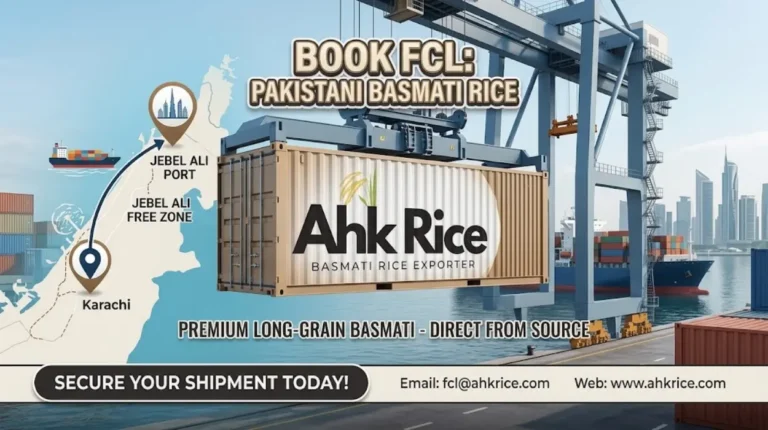
Shipping time depends on production readiness, inspection, port schedules, vessel availability, and the destination port. As a planning estimate, allow approximately 30–50 days for ocean transit from Pakistan to major US ports, then add preparation, documentation, and customs clearance time.
The following figures are indicative planning ranges, not confirmed transit schedules or guaranteed delivery dates. Buyers should obtain a shipment-specific schedule from the exporter and freight forwarder before finalizing the purchase contract.
| Destination market | Indicative ocean transit from Pakistan | Main planning considerations |
|---|---|---|
| USA West Coast, including Los Angeles | 30–40 days | Vessel routing, transshipment, port congestion, and customs processing |
| USA East Coast, including New York and New Jersey | 35–50 days | Routing, transshipment, vessel schedules, and port handling |
| USA Gulf Coast, including Houston | 30–45 days | Carrier route, sailing frequency, terminal availability, and clearance |
| UAE, including Jebel Ali | 5–10 days | Sailing schedule, container availability, and destination handling |
| Saudi Arabia, including Dammam | 7–15 days | Vessel routing, port schedules, and import clearance |
| United Kingdom, including Felixstowe | 20–30 days | Routing, transshipment, port congestion, and customs clearance |
These ranges represent approximate ocean transit, not the full order-to-delivery period. Production, packing, inspection, export clearance, vessel waiting time, discharge, customs examination, and inland transportation can extend the schedule.
For a first USA order, buyers should plan backward from the required warehouse delivery date. For example, a retailer preparing for a seasonal promotion should allow time for sample approval, production, shipping, customs clearance, and domestic transportation rather than relying solely on the vessel’s estimated arrival date.
Before making a payment, obtain the proposed shipment window, port of loading, destination port, container plan, and responsibility for freight and insurance in writing.
What does a Basmati rice sample cost, and how does approval work?
A commercial sample allows the buyer to assess grain appearance, aroma, cooking performance, and suitability for the target market before committing to a full order. Sample costs depend on quantity, courier destination, packaging, testing, and any applicable export or import requirements.
AHK Rice buyers should confirm the sample arrangement in writing before dispatch. A sample is a quality-evaluation step, not a substitute for the final commercial specification or shipment inspection.
The sample-to-order process should follow these steps:
- Define the requirement. Specify the variety, processing type, target grain length, broken percentage, moisture limit, intended use, and preferred packaging.
- Request a sample quotation. Confirm the sample quantity, preparation charges if any, courier charges, payment method, dispatch time, and the party responsible for import charges.
- Arrange dispatch. The exporter prepares the agreed sample and shares the available courier details and applicable documentation. The buyer should confirm whether the destination’s import rules permit the sample shipment.
- Conduct quality checks. Assess raw grain uniformity, broken grains, aroma, cooking time, cooked elongation, texture, and suitability for the intended retail or foodservice application.
- Approve the specification. Record the accepted variety and quality parameters in writing. Where necessary, request a laboratory analysis or independent inspection against agreed criteria.
- Confirm the commercial order. Agree on quantity, packaging, price, Incoterm, payment terms, production schedule, inspection arrangements, and shipping documents before authorizing the transaction.
- Approve pre-shipment evidence. Review the agreed inspection results and available documents before the relevant payment milestone or shipment release.
How much should buyers budget for samples?
There is no universal sample fee. As an illustrative budgeting example, a small parcel weighing 1–5 kg might incur a courier charge of approximately US$50–US$150, depending on the service, destination, and shipment weight. This is a planning example, not a confirmed AHK Rice rate or offer.
Additional charges may apply for sample preparation, laboratory testing, phytosanitary documentation where required, customs processing, and other destination-specific requirements. Some charges may not apply to every sample, so buyers should obtain an itemized quotation before payment.
AHK Rice should confirm the actual sample quantity available, courier cost, dispatch timing, and documentation for the destination. Buyers should also establish whether the sample charge is refundable or creditable against a subsequent commercial order; this should never be assumed without written confirmation.
What determines the price of a first USA Basmati rice order?
The final import cost depends on rice variety, grade, processing, order volume, packaging, payment structure, freight, insurance, destination charges, and applicable import duties. Buyers should compare quotations on the same specification and delivery basis rather than choosing the lowest headline price.
A useful quotation identifies the commercial product and the costs included in the offer. An FOB quotation generally covers the seller’s responsibilities up to loading the goods aboard the vessel at the named port, subject to the agreed Incoterms rule. A CIF quotation includes cost, insurance, and freight to the named destination port, but the buyer remains responsible for import clearance and other obligations allocated under CIF.
The main cost factors include:
- Rice variety and grade: 1121, Super Kernel, and 1509 differ in grain characteristics, processing options, and market positioning.
- Processing method: Raw, Steam, Golden Sella, and other agreed processing types can have different production costs.
- Quality specification: Grain length, broken percentage, moisture, foreign matter, and inspection requirements affect the quotation.
- Order volume: Quantity influences production planning, container utilization, and freight allocation.
- Packaging: Retail bags, private-label artwork, foodservice sacks, and bulk packaging require different materials and preparation.
- Payment terms: LC issuance, advising, confirmation where applicable, amendments, and other banking services can add costs. TT and CAD also carry transaction and handling charges.
- Logistics: Freight, insurance, port handling, demurrage, detention, and inland delivery depend on the route and contract.
- US import compliance: Applicable duties, customs brokerage, inspections, testing, and other regulatory costs should be verified for the specific product and entry.
For example, a buyer comparing 25 kg retail-ready bags with plain 50 kg foodservice sacks should request separate quotations. Packaging material, printing, bag specifications, and order quantity can change the landed cost.
The buyer should also distinguish the supplier’s export price from the total landed cost. Customs duties and other import charges depend on the correct product classification, origin, applicable US trade measures, and entry date. Confirm the current treatment with a qualified customs broker rather than relying on an outdated online estimate.
What documents should be confirmed before payment and shipment?
The buyer should agree on the required commercial, transport, origin, and regulatory documents before the payment instrument is issued. Document requirements depend on the shipment, the selected payment method, US import rules, and the terms of the sales contract.
The document checklist may include:
- Pro forma invoice and signed purchase contract.
- Commercial invoice and packing list.
- Ocean bill of lading or other applicable transport document.
- Certificate of Origin, when required or agreed.
- Phytosanitary certificate, when applicable to the shipment.
- Certificate of Analysis or laboratory results, if specified.
- Inspection certificate, where contractually required.
- Insurance evidence when the seller is responsible for arranging cover.
- Food-facility and shipment-related information required under applicable US rules.
US food imports can be subject to FDA requirements, including facility registration where applicable and Prior Notice for food shipments. The Foreign Supplier Verification Program may also impose obligations on the US importer, subject to the applicable rules and exemptions. A supplier’s export documentation does not replace the importer’s own compliance responsibilities.
For California-bound shipments, buyers should separately assess California Proposition 65 obligations with qualified compliance advice. A supplier should not promise that a product is universally “Prop 65 compliant” without appropriate evidence and a review of the specific product, exposure, and applicable legal requirements.
Before funds are released, the buyer should verify the exporter, beneficiary bank details, contract, and documentary requirements. Under an LC, the documents must meet the credit’s conditions. Under TT, payment milestones should match the written agreement. Under CAD, buyers should understand precisely when documents are released and what protection the collection arrangement does and does not provide.
How can a USA importer start an order with AHK Rice?
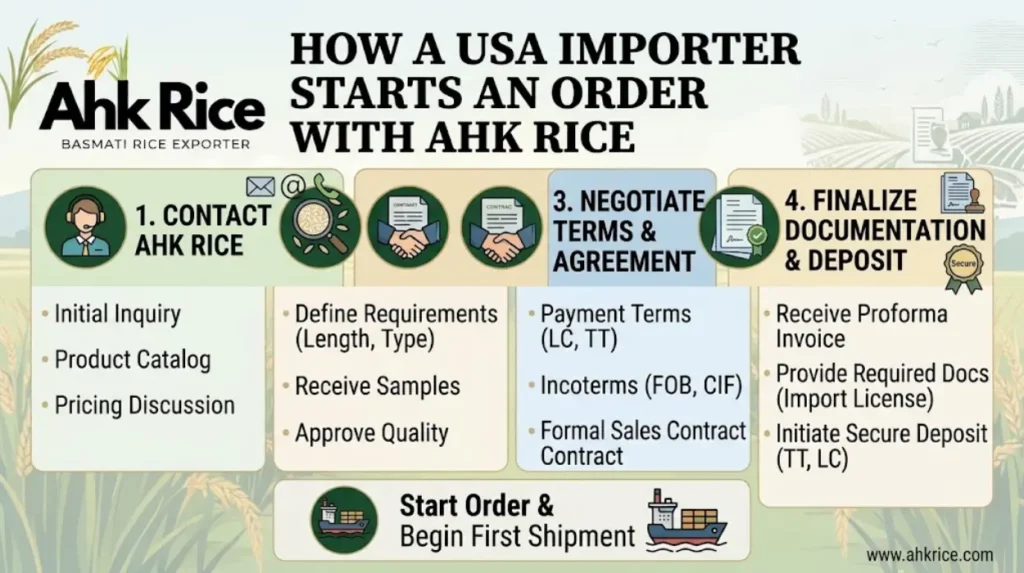
Start by submitting a written product requirement, destination, quantity, packaging preference, and proposed payment method. Request a sample quotation and commercial offer, evaluate the documentation, and approve the specification and contract before committing funds or authorizing shipment.
A practical first-order checklist helps prevent avoidable delays.
Step 1: Define the product. Select the variety and processing type, specify the grade, and identify the intended market channel.
Step 2: Confirm the quantity and packing. State the required net weight per bag, packaging material, private-label requirements, and estimated order volume.
Step 3: Request the quotation. Ask for the currency, validity period, Incoterm, named port, production lead time, payment schedule, and separately identified charges.
Step 4: Evaluate the sample. Approve the sample against the intended specification and document any testing or inspection requirements.
Step 5: Verify the transaction. Confirm the exporter and bank details independently. Have the relevant bank review the proposed LC if that method is selected.
Step 6: Approve compliance and shipping documents. Establish which party will supply each document and which party will handle US entry requirements.
Step 7: Finalize the purchase contract. Record the quality standard, inspection procedure, shipment window, payment milestones, remedies for discrepancies, and dispute-resolution process.
AHK Rice can discuss product sourcing, grading, packaging, and export coordination for the proposed order. The buyer should evaluate the final quotation and supporting evidence against its commercial requirements before proceeding. A clear contract gives both parties a shared reference for quality, payment, shipment, and documentation.
The supplied prompt does not include the actual URLs for the TOFU and MOFU articles. Replace the two corresponding article links with their published URLs before publishing. The three-link limit and the additional request to link the MOFU article conflict: linking both educational articles, the service page, and the quote page requires four internal links. To keep exactly three, combine the educational-link requirement by linking only the MOFU article in the opening and omit the separate TOFU link. Finish the published article with the quote CTA: Request a tailored Basmati rice export quotation from AHK Rice at AHK Rice Request a Quote.
Frequently Asked Questions
What is the safest payment method for a first USA Basmati rice order?
An irrevocable LC at sight can provide a structured documentary payment process.
The issuing bank pays against a presentation that complies with the credit terms.
The buyer must ensure the credit requirements are practical and clearly written.
Bank charges, credit approval, and documentary discrepancies can affect the transaction.
Discuss the proposed credit with your bank before issuing it.
How long does Pakistani Basmati rice take to reach the USA?
Ocean transit to major US ports can take approximately 30–50 days.
Actual transit depends on the port, carrier, routing, and vessel schedule.
Production and export documentation can add time before departure.
Customs clearance and inland delivery extend the total order timeline.
Obtain a shipment-specific schedule before confirming your purchase.
Can I request a Basmati rice sample before placing an order?
Yes, buyers can request a sample quotation before making a commercial commitment.
The sample should match the intended variety and processing type.
Courier charges depend on the destination, weight, and service selected.
Testing and applicable documentation may create additional costs.
Confirm the complete sample cost and dispatch arrangements in writing.
What documents are required to import Basmati rice into the USA?
Common commercial documents include the invoice, packing list, and bill of lading.
A Certificate of Origin or phytosanitary certificate may be required or agreed.
FDA requirements can include Prior Notice and applicable facility registration.
The US importer must assess its FSVP and other compliance responsibilities.
Confirm shipment-specific requirements with your customs broker before dispatch.
What factors determine the final price of imported Basmati rice?
Rice variety, grade, processing method, and packaging affect the export price.
Order quantity and payment terms influence the overall transaction cost.
Freight, insurance, port charges, and customs-related expenses affect landed cost.
FOB and CIF quotations allocate costs and responsibilities differently.
Compare written quotations using identical specifications and delivery terms.