Why Is Import Documentation Important for Northern Ireland Rice Buyers?
Import documentation proves the rice identity, origin, classification, compliance, and shipment details needed for customs and food controls. Here is why: Northern Ireland applies specific UK and EU controls depending on the shipment route and goods status.
Rice buyers need accurate documents before dispatch. A commercial invoice identifies the transaction. A packing list identifies the cargo. A bill of lading records transport. A certificate of analysis records tested quality. Customs declarations connect these details with the correct commodity code.
Documentation also supports food safety controls. Northern Ireland follows EU maximum residue levels for many foods. Imported rice therefore requires suitable compliance evidence for applicable pesticide and contamination requirements.
What Is Import Documentation for Northern Ireland Rice Buyers?
Import documentation is the documented evidence that identifies rice, confirms its commercial details, supports customs classification, and demonstrates compliance with applicable Northern Ireland controls.
Import documentation covers several connected records. Each record answers a different question about the shipment.
Which documents identify the rice shipment?
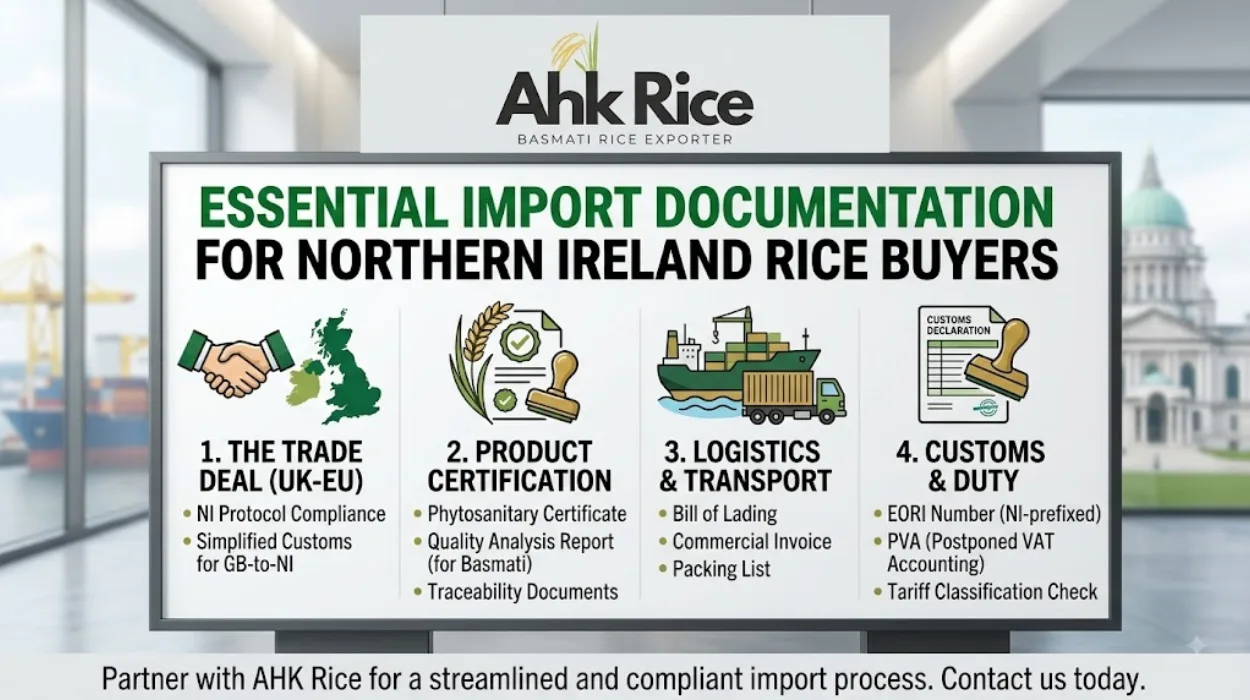
A commercial invoice identifies the seller, buyer, product description, quantity, price, currency, origin, and trade terms.
A packing list identifies the number of bags, net weight, gross weight, pallet details, and package configuration.
A bill of lading records the carrier, shipment route, cargo quantity, loading information, and consignee.
A certificate of origin identifies the country where the rice originates. Pakistani Basmati rice therefore requires Pakistan to appear as the relevant origin.
A certificate of analysis records laboratory test results. Typical rice tests include moisture, broken grains, foreign matter, grain characteristics, pesticide residues, and microbiological parameters.
A phytosanitary certificate concerns plant-health controls. The requirement depends on the specific commodity and applicable plant-health rules. DAERA states that regulated plant products entering Northern Ireland from third countries can require phytosanitary certification.
These documents create the documentary identity of the consignment. The next step is understanding how customs uses that identity.
How Does Import Documentation Work During Rice Clearance?
Documentation moves through a defined sequence: classify the rice, prepare the declaration, submit supporting documents, complete applicable controls, and obtain customs release.
How does commodity classification affect clearance?
Rice falls under heading 1006 when it meets the relevant classification descriptions. HMRC distinguishes paddy rice, husked rice, semi-milled rice, wholly milled rice, broken rice, and parboiled rice.
The exact commodity code matters because customs measures depend on classification. Different rice forms therefore require different tariff checks.
Northern Ireland importers must use the appropriate Northern Ireland Online Tariff. The applicable controls also depend on whether goods enter from a third country or move from Great Britain.
How does the customs declaration use these documents?
The Customs Declaration Service connects the commodity code with duties, taxes, documentary requirements, quantities, and additional information.
HMRC states that certain documentary requirements are driven by the commodity code. Missing required document codes can cause a customs declaration to fail validation.
A Northern Ireland shipment from Pakistan therefore needs consistent information across the invoice, packing list, transport document, certificate, and customs declaration.
Documentation works as one connected data system rather than as separate paperwork. The next question concerns the specific information buyers should verify.
What Are the Key Components of a Rice Import Document Set?
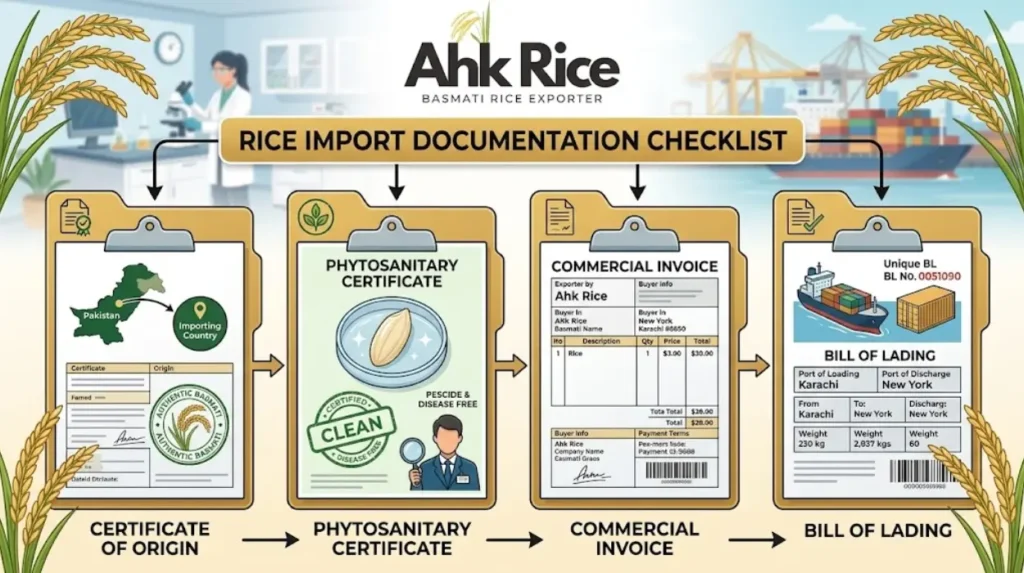
A complete rice document set connects product identity, quantity, origin, quality, transport, customs classification, and applicable regulatory controls into one consistent shipment record.
What commercial information should match?
Commercial documents should use the same product description, quantity, package count, origin, and buyer information.
For example, an invoice showing 25 metric tonnes must align with the packing list and transport document. A mismatch creates an avoidable verification issue.
What quality information should match?
Quality documents should identify the rice grade and relevant test parameters.
For Pakistani Basmati rice, examples include 1121, Super Kernel, and 1509. Processing forms include white rice, parboiled rice, and other applicable preparations.
The certificate of analysis should identify the tested lot. The lot reference should connect the laboratory result with the physical shipment.
What regulatory information requires verification?
Regulatory requirements depend on the rice classification, origin, route, and applicable control measure.
Northern Ireland maintains specific controls for certain high-risk food products of non-animal origin. These controls address risks such as aflatoxins, pesticides, salmonella, and other contaminants.
Rice originating from China also has specific regulatory treatment under Northern Ireland food controls. Buyers sourcing Pakistani rice must therefore distinguish Pakistan-origin consignments from China-origin consignments.
Accurate documents establish the shipment’s identity and regulatory pathway. The benefits become clearer when clearance, food safety, and traceability are considered together.
Why Do Northern Ireland Rice Buyers Need Accurate Documentation?
Accurate documentation reduces declaration errors, supports regulatory checks, establishes traceability, and helps customs authorities determine the correct treatment of each rice consignment.
How does documentation support customs clearance?
Customs officers use declaration information and supporting documents to establish what enters Northern Ireland.
The correct commodity code identifies applicable tariff measures and documentary conditions. HMRC states that the wrong tariff selection can lead to incorrect revenue assumptions and omitted documentary requirements.
How does documentation support food safety?
Food documentation provides evidence about origin, processing, testing, and compliance.
Pesticide residue limits apply to food marketed in Northern Ireland. EU maximum residue levels apply to food imported into Northern Ireland, subject to specific arrangements such as the Northern Ireland Retail Movement Scheme.
How does documentation support traceability?
Traceability connects the final shipment with its supplier, lot, production information, testing, and transport records.
A lot number on a certificate of analysis can connect laboratory results with specific bags or pallets. This relationship supports investigation when a food-safety issue occurs.
Documentation therefore protects the integrity of the supply chain. The same system applies across several practical rice-import scenarios.
Where Do Northern Ireland Buyers Use Rice Import Documentation?
Buyers use import documentation for wholesale purchasing, retail distribution, foodservice supply, customs clearance, regulatory verification, and shipment traceability.
How is documentation used for wholesale rice?
Wholesale buyers use invoices, packing lists, certificates, and transport documents to verify bulk purchases.
A 20-tonne shipment requires clear quantity and packaging records. The documents must identify the rice grade and shipment lot consistently.
How is documentation used for retail rice?
Retail buyers require stronger product identification because packaged rice reaches consumers.
Product descriptions, origin information, lot references, and applicable food information must remain consistent throughout the supply chain.
How is documentation used for foodservice rice?
Hotels, restaurants, caterers, and distributors use documentation to verify supply specifications.
A buyer purchasing long-grain Basmati rice can compare the certificate of analysis with the agreed specification before accepting the shipment.
Documentation therefore supports commercial verification as well as border procedures. The main risks appear when buyers treat paperwork as an administrative afterthought.
What Common Documentation Problems Affect Rice Imports?
The main problems are incorrect commodity codes, inconsistent quantities, missing certificates, mismatched lot references, incomplete declarations, and documents that do not match the physical shipment.
What happens when the commodity code is wrong?
An incorrect commodity code can produce the wrong tariff treatment or omit required documentary controls.
HMRC specifically states that the commodity code affects customs declaration requirements and associated control measures.
What happens when documents contain different quantities?
A mismatch creates a verification problem.
For example, an invoice showing 1,000 bags while the packing list shows 1,020 bags requires clarification before the records can reliably represent the shipment.
What happens when a required certificate is missing?
A missing document can delay clearance or prevent a declaration from satisfying a documentary condition.
HMRC explains that required document codes must be declared when applicable. Failure to meet those requirements can result in CDS rejection.
Is every rice shipment subject to the same documents?
No. Documentation depends on classification, origin, route, risk status, and applicable controls.
Northern Ireland imports from the rest of the world can face both UK and EU import controls under the relevant declaration pathway.
The document set must therefore be determined from the actual shipment rather than copied from another consignment.
What Should Northern Ireland Rice Buyers Check Before Shipment?
Buyers should verify the rice classification, origin, commercial documents, lot references, certificates, quantities, packaging details, and applicable Northern Ireland tariff controls before dispatch.
What should buyers verify first?
- Confirm the rice form. Identify paddy, husked, milled, broken, or parboiled rice.
- Confirm the commodity code. Check the applicable Northern Ireland Online Tariff.
- Confirm the country of origin. Match the origin across commercial and supporting documents.
- Confirm the shipment quantity. Match metric tonnes, bags, pallets, net weight, and gross weight.
- Confirm the quality records. Match the certificate of analysis with the shipment lot.
- Confirm applicable controls. Check commodity-specific documentary requirements and food controls.
- Confirm transport details. Match the bill of lading with the invoice and packing list.
This verification sequence creates a consistent documentary chain before the cargo reaches the border. Buyers can then examine how export paperwork supports the wider clearance process.
How Does Export Documentation Support Smooth Rice Shipment Clearance?
Export documents support clearance by giving customs, food authorities, carriers, and buyers consistent evidence about the shipment, product, origin, quantity, quality, and regulatory status.
A structured export document set connects the exporter and importer before the shipment arrives.
The commercial invoice establishes the transaction. The packing list establishes cargo configuration. The bill of lading establishes transport information. Certificates establish origin, quality, or regulatory compliance where required.
The commodity code connects the product to tariff measures. HMRC guidance states that the correct tariff must be selected according to the declaration location and applicable Northern Ireland status.
For a deeper explanation of this document-to-clearance relationship, the most relevant next resource is how export documents support smooth rice shipment clearance.
Documentation is therefore a control mechanism, not simply paperwork. Northern Ireland rice buyers use it to connect commercial specifications with customs and food-safety requirements.
Frequently Asked Questions
Why is import documentation important for Northern Ireland rice buyers?
Import documentation verifies the rice’s origin, quantity, classification, quality, transport details, and regulatory status. Accurate records support customs declarations and help prevent clearance problems.
What documents are commonly required for rice imports?
Common documents include a commercial invoice, packing list, bill of lading, certificate of origin, certificate of analysis, and customs declaration. Additional certificates depend on the rice and applicable controls.
What commodity code is used for rice?
Rice falls under HS heading 1006. The precise commodity code depends on the product form, such as paddy, husked, milled, broken, or parboiled rice.
Does Pakistani rice require a certificate of origin?
A certificate of origin identifies where the rice was produced. For Pakistani rice, the document establishes Pakistan as the country of origin and supports customs and commercial verification.
Why is a certificate of analysis important?
A certificate of analysis provides laboratory results for defined quality and safety parameters. It can record moisture, broken grains, foreign matter, pesticide residues, and microbiological results, depending on the agreed specification.
Does every rice shipment require the same documents?
No. Requirements depend on the rice classification, country of origin, shipment route, and applicable regulatory controls. Buyers should verify the requirements for each specific consignment.
Why must the invoice and packing list match?
Matching documents establish consistent information about the product, quantity, packaging, and shipment. Differences such as 1,000 bags on the invoice and 1,020 bags on the packing list require clarification.