Cleaning, Dehusking, Whitening, Polishing, Sortex and Grading: Inside a Basmati Rice Mill
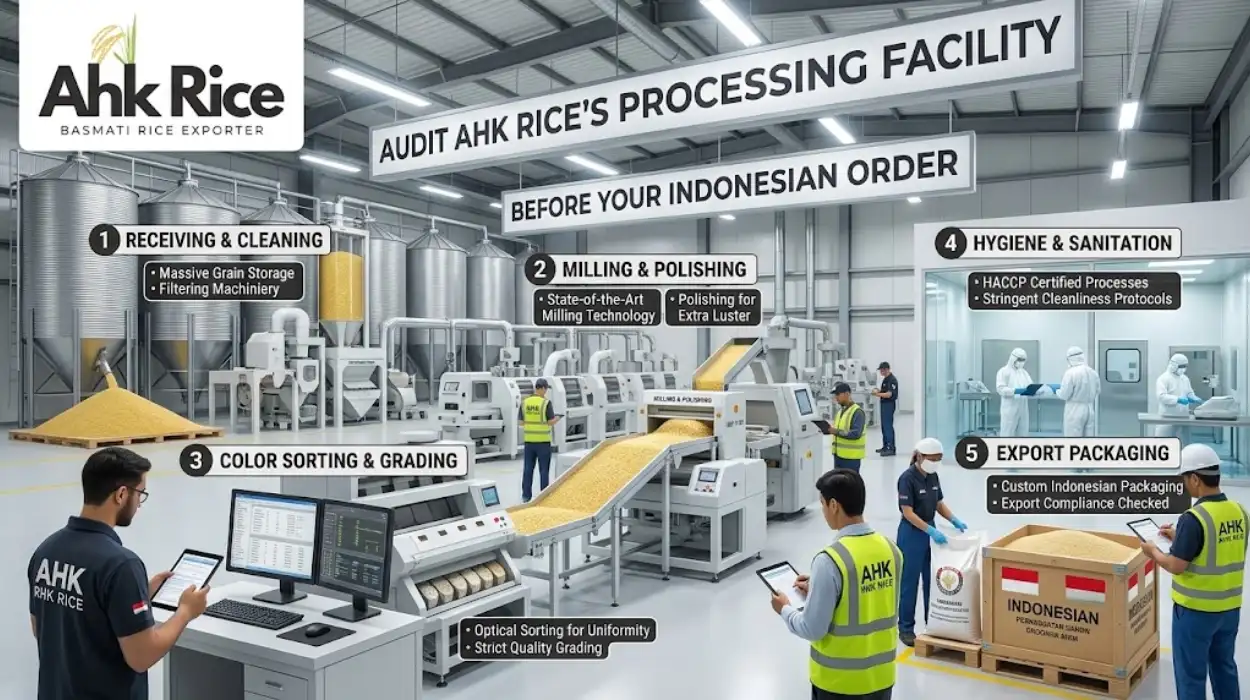
The quality of export-ready Basmati rice depends on the complete milling sequence, not a single machine. Cleaning removes field contaminants, dehusking separates the husk, whitening removes bran, polishing improves surface appearance, Sortex identifies defective grains, and grading separates rice by length and quality. Each operation serves a different purpose, and the best milling configuration combines them according to the required grain variety, destination market and buyer specification.
Understanding these operations helps importers evaluate processing quality before selecting a supplier. A useful starting point is this guide to Pakistanasmati rice varieties and their characteristics, which explains the grain characteristics that influence processing decisions. For commercial buyers, the next consideration is how a mill converts harvested paddy into consistent export-grade products through controlled machinery, inspection and quality management.
An export-oriented mill processes varieties such as 1121, Super Kernel, and 1509 Basmati rice according to their physical characteristics. Grain length, moisture, broken percentage, whiteness, purity and cooking performance determine the processing settings. A mill that applies identical settings to every variety risks unnecessary breakage, uneven appearance and inconsistent finished products.
What are the main stages inside a Basmati rice mill?
A Basmati rice mill uses six interconnected operations to convert harvested paddy into export-ready grain. Each stage removes a different type of impurity, protects grain integrity or improves visual consistency. The sequence determines the finished rice specification and commercial grade.
The six main processing operations are:
- Cleaning: Removes dust, stones, straw, soil and other foreign materials.
- Dehusking: Separates the outer husk from the edible rice kernel.
- Whitening: Removes bran layers from brown rice to produce white rice.
- Polishing: Improves surface finish and removes remaining loose bran particles.
- Sortex: Uses optical technology to identify and reject discoloured or defective grains.
- Grading: Separates grains according to length, thickness, broken percentage and other specifications.
These operations require different machines and quality checks. Cleaning equipment protects downstream machinery from stones and metal. Rubber-roll huskers separate the husk while reducing kernel damage. Whitening machines control bran removal, while polishing equipment creates the required surface appearance.
Sortex machines use optical sensors and high-speed air ejectors to remove unwanted grains. Grading machines then separate the finished rice into commercial categories. The resulting product receives a final inspection before packaging.
How does the cleaning process prepare paddy for milling?
Cleaning prepares paddy by removing foreign materials before mechanical processing begins. Aspirators, vibrating screens, magnetic separators and destoners protect the milling line, reduce contamination risks and prevent unnecessary machine wear during subsequent operations.
Paddy is harvested with different contaminants depending on field conditions, harvesting equipment and transportation. Common contaminants include:
- Soil particles and dust.
- Stones and small pebbles.
- Straw and rice husk.
- Weed seeds.
- Metal fragments.
- Undersized and immature grains.
A pre-cleaner uses vibrating screens to separate materials according to size. An aspirator creates controlled airflow that removes lighter particles such as dust and straw. A destoner separates heavier foreign materials according to differences in density and aerodynamic behaviour. Magnetic separators capture ferrous metal particles.
Example: A shipment of Punjab-origin paddy containing stones and straw requires effective pre-cleaning before entering the husking section. Stones can damage rubber rolls, while excessive dust affects machine performance and workplace hygiene.
Cleaning quality also affects food safety. Removing physical contaminants at the beginning reduces the risk of foreign materials reaching the finished product.
How does dehusking separate rice husk from the grain?
Dehusking removes the inedible outer husk while preserving the edible rice kernel. Rubber-roll huskers use controlled pressure and differential roller speeds to separate husk from paddy, producing brown rice for further milling and processing.
Paddy consists of an outer husk, bran layers, germ and starchy endosperm. Dehusking removes the outer protective husk without intentionally removing the bran.
The main equipment includes:
- Rubber-roll huskers.
- Paddy separators.
- Husk aspiration systems.
- Grain transfer conveyors.
Rubber-roll huskers use two rollers rotating at different speeds. The difference in rotational speed creates friction that separates the husk from the kernel. The husk is collected separately, while brown rice proceeds to the next operation.
A paddy separator divides unhusked grains from brown rice. Unhusked paddy returns to the husker for another pass. This circulation reduces unnecessary pressure on already dehusked kernels.
The objective is a high husking efficiency with minimum broken grain. Excessive roller pressure, worn rubber surfaces and incorrect feed rates increase kernel damage.
For long-grain Basmati, this stage requires particular attention because broken grains reduce the value of premium whole-grain specifications.
What is the difference between whitening and polishing?
Whitening removes the bran layers surrounding brown rice, whereas polishing improves the appearance and surface finish of already whitened grains. Both operations influence colour, texture and commercial presentation, but excessive processing reduces milling recovery and increases grain breakage.
Whitening
Brown rice contains bran layers rich in fibre, oil and natural pigments. Whitening machines remove these layers through controlled abrasion or friction.
Common whitening systems include:
- Abrasive whiteners.
- Friction whiteners.
- Multi-stage whitening machines.
Abrasive whiteners remove bran through contact with an abrasive surface. Friction whiteners use pressure between rice kernels and machine components. Multi-stage systems distribute bran removal across several operations.
The required whitening level depends on the buyer’s specification. Excessive whitening reduces grain weight and increases broken percentage.
Polishing
Polishing follows whitening and improves the external appearance of rice. A silky polisher uses controlled friction, airflow and surface treatment to remove loose bran particles and produce a smoother finish.
Some mills use single polishing, while others use double polishing to achieve a more uniform appearance.
| Attribute | Whitening | Polishing |
|---|---|---|
| Main purpose | Remove bran layers | Improve surface finish |
| Input material | Brown rice | Whitened rice |
| Main equipment | Abrasive or friction whitener | Silky or friction polisher |
| Appearance | White grain | Smoother, cleaner surface |
| Processing intensity | Higher bran removal | Controlled surface finishing |
| Main quality risk | Excessive grain removal | Excessive friction and breakage |
| Commercial value | Determines whiteness level | Improves presentation consistency |
For example, premium retail Basmati requires consistent whiteness and a clean surface. Restaurant and institutional buyers also evaluate cooking performance, grain integrity and cost rather than appearance alone.
How does Sortex technology improve Basmati rice quality?
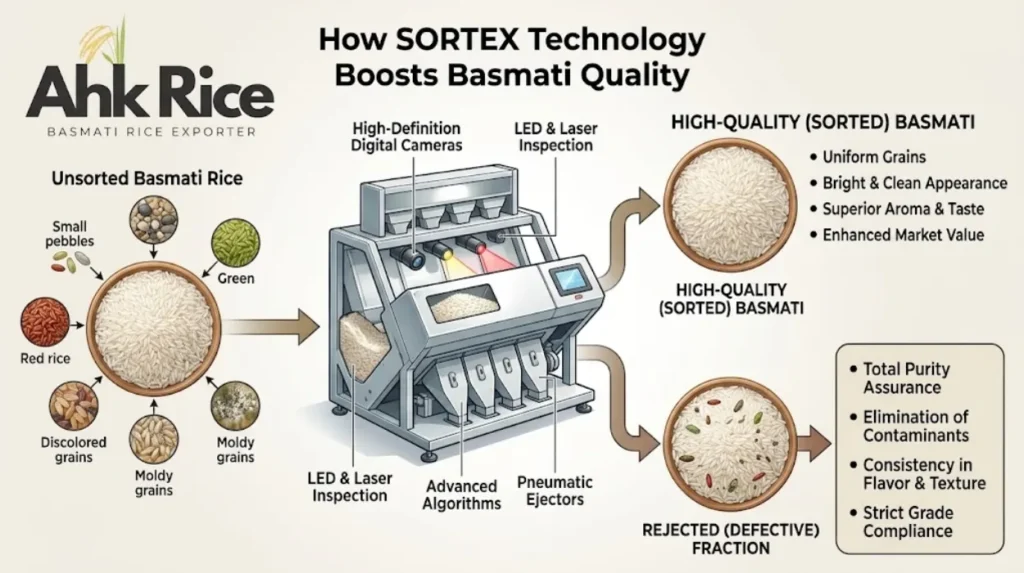
Sortex is an optical colour-sorting system that detects unwanted grains through cameras and sensors. It identifies colour differences, discoloured kernels and selected defects, then removes rejected material through precisely timed air jets to improve finished-product purity.
Sortex technology uses cameras, lighting systems, image-processing software and pneumatic ejectors. Rice passes through dedicated channels at controlled speeds. Cameras examine individual grains and identify differences from the accepted colour profile.
The machine can reject:
- Yellow and discoloured grains.
- Black and damaged kernels.
- Foreign-coloured rice.
- Certain immature and defective grains.
- Selected foreign materials detectable by the installed optical system.
A single Sortex pass removes detectable defects at one processing stage. Double Sortex processing provides another inspection opportunity and improves sorting consistency when the incoming material contains higher defect levels or the buyer specifies tighter purity requirements.
However, optical sorting does not replace laboratory testing. It cannot independently verify pesticide residues, heavy metals, moisture content or microbiological safety.
An export buyer should therefore assess Sortex performance alongside broken percentage, foreign matter, grain length, moisture and laboratory test results.
What is rice grading and why does it matter for export orders?
Rice grading classifies finished grains according to measurable physical and commercial characteristics. Length, thickness, broken percentage, foreign matter and colour consistency determine whether a batch meets a particular export specification, retail requirement or institutional purchasing standard.
Grading machines use screens, indent cylinders and length separators to divide rice into different categories.
The principal grading criteria include:
- Grain length: Measures the physical length of individual rice kernels.
- Broken percentage: Measures the proportion of kernels that fall below the agreed whole-grain specification.
- Thickness: Separates grains according to width and physical dimensions.
- Foreign matter: Measures unwanted non-rice materials.
- Head rice recovery: Measures the proportion of whole kernels recovered after milling.
Consider three Pakistani Basmati varieties:
- 1121 Basmati: Premium extra-long grain, commonly associated with raw grain lengths around 8.0–8.3 mm.
- Super Kernel Basmati: Traditional aromatic Basmati with raw grain lengths around 7.0–7.5 mm.
- 1509 Basmati: Extra-long grain variety with raw grain lengths commonly around 8.1–8.4 mm, depending on the specification.
These measurements are product targets, not universal limits for every crop or shipment.
A buyer ordering 1121 Basmati with a maximum 2% broken specification requires a different grading target from a buyer purchasing a commercial grade with a higher permitted broken percentage.
How do different Basmati milling approaches compare?
Single-stage and multi-stage milling configurations serve different quality objectives. Basic processing supports economical commercial grades, while integrated cleaning, controlled whitening, double polishing, optical sorting and precise grading support demanding premium export specifications.
The main approaches include:
Basic milling
Basic milling combines cleaning, dehusking and whitening with limited finishing and sorting. It suits buyers purchasing less demanding commercial grades where price and basic physical quality take priority.
Its main limitation is reduced control over appearance and defect removal compared with advanced processing lines.
Standard export milling
Standard export milling adds controlled polishing, mechanical grading and optical sorting. It provides improved grain consistency and better control over broken percentage.
This approach suits wholesalers, foodservice distributors and importers supplying established retail channels.
Premium export milling
Premium processing combines multiple cleaning stages, carefully controlled dehusking, multi-stage whitening, polishing, optical sorting and detailed grading. It also includes batch inspection and laboratory testing.
This configuration suits importers requiring consistent specifications, private-label packaging and premium retail presentation.
Processing comparison
| Processing attribute | Basic mill | Standard export mill | Premium export mill |
|---|---|---|---|
| Cleaning | Basic screens | Multi-stage cleaning | Multi-stage cleaning and separation |
| Dehusking | Standard husker | Controlled husking | Controlled husking and separation |
| Whitening | Single-stage | Controlled multi-stage | Precision multi-stage |
| Polishing | Limited | Single or double | Double or specified finish |
| Sortex | Limited or absent | Optical sorting | Multi-pass optical sorting |
| Grading | Basic screens | Length and broken grading | Detailed specification grading |
| Quality inspection | Basic visual checks | Batch inspection | Batch and laboratory verification |
The premium configuration delivers greater process control, but the equipment alone does not guarantee quality. Operator skill, maintenance, raw paddy condition and inspection procedures remain essential.
Which Basmati milling method works best for different buyers?
The best milling method depends on the buyer’s intended market, retail positioning, cooking requirements and contractual specifications. Premium retailers prioritise appearance and grain consistency, while bulk distributors balance whole-grain recovery, processing cost and reliable supply.
Different markets place different emphasis on grain appearance, cooking characteristics and commercial price.
Indonesia market requirements
Indonesia offers opportunities for imported rice across retail, wholesale and foodservice distribution. Buyers selecting Pakistani Basmati should evaluate grain consistency, cooking performance, packaging requirements and landed cost.
Long-grain 1121 and aromatic Super Kernel serve premium Basmati positioning. The 1509 variety provides another long-grain option for buyers evaluating yield, availability and price.
A suitable processing specification includes:
- Effective cleaning and destoning.
- Controlled dehusking.
- Consistent whitening.
- Appropriate polishing.
- Optical sorting for visible defects.
- Grading against the agreed grain-length and broken specifications.
Indonesian importers should also confirm applicable import permits, food requirements, labelling and documentation before shipment.
Middle East market requirements
The UAE and Saudi Arabia have established demand for Pakistani Basmati across ethnic grocery retail, wholesale distribution, catering and institutional foodservice.
1121 Steam and Golden Sella are relevant choices for buyers seeking long grains and distinct cooking performance. Super Kernel appeals to buyers prioritising traditional Basmati aroma and flavour.
Golden Sella processing involves parboiling before milling. The treatment changes grain characteristics and supports firm cooked grains suitable for bulk catering and foodservice applications.
Middle Eastern buyers often specify 5 kg, 10 kg, 25 kg and 50 kg packaging depending on the distribution channel.
Indicative FOB price comparison
The following September 2026 market benchmarks illustrate the price positioning of selected Pakistani varieties. They are supplier-published indicative prices, not confirmed AHK Rice quotations or destination-specific landed prices. Direct Mill+1
| Variety and grade | FOB Karachi price per MT |
|---|---|
| 1121 White Basmati, premium | US$1,165–1,205 |
| 1121 Sella Basmati, premium | US$1,135–1,175 |
| 1121 Steam Basmati, premium | US$1,160–1,200 |
| Super Kernel Basmati, premium | US$1,165–1,205 |
| 1509 Basmati | Obtain current grade-specific quotation |
Actual prices depend on crop year, grain length, broken percentage, moisture, processing type, packing, order quantity and shipment terms. Buyers should compare equivalent specifications rather than choosing the lowest headline price.
Shelf-life comparison
Properly milled and packaged white Basmati commonly carries a commercial shelf-life specification of approximately 18–24 months, subject to manufacturer validation and storage conditions. The actual declared shelf life must follow the product specification and applicable destination requirements.
| Processing type | Typical planning shelf life | Main consideration |
|---|---|---|
| White Basmati | 18–24 months | Moisture and packaging integrity |
| Steam Basmati | 18–24 months | Controlled moisture and storage |
| Golden Sella Basmati | 18–24 months | Parboiling quality and moisture |
| Super Kernel White | 18–24 months | Aroma preservation and storage |
| 1509 White/Sella | 18–24 months | Packaging and warehouse conditions |
These are planning ranges, not guaranteed shelf-life declarations. Temperature, humidity, packaging barriers, warehouse hygiene and infestation control influence actual product stability.
What are the advantages and disadvantages of advanced rice milling?
Advanced milling improves grain purity, appearance and specification control, but it increases equipment, maintenance and operating costs. Buyers should evaluate the improvement in finished-product quality against processing expenses and the commercial requirements of their target market.
Advantages
- Improved physical purity: Cleaning and Sortex reduce foreign matter and visible grain defects.
- Better grain consistency: Grading separates different grain lengths and broken fractions.
- Improved presentation: Controlled whitening and polishing create a more uniform retail appearance.
- Higher specification control: Multi-stage processing allows mills to target buyer-specific requirements.
- Better shipment consistency: Batch inspection helps maintain agreed specifications across export orders.
Disadvantages
- Higher operating costs: Advanced machinery increases electricity, maintenance and labour expenses.
- Potential grain breakage: Excessive pressure during whitening and polishing damages kernels.
- Processing losses: Bran removal and rejected grains reduce finished-rice recovery.
- Maintenance requirements: Optical sorters require clean sensors, calibrated cameras and properly maintained ejectors.
- Operator dependency: Incorrect machine settings produce inconsistent output despite advanced equipment.
For example, a premium 1121 order with a maximum 2% broken specification benefits from controlled milling and detailed grading. However, a buyer purchasing a less demanding commercial grade does not necessarily need the same processing intensity.
What factors should importers consider when selecting a Basmati rice mill?
Importers should evaluate machinery, processing controls, product specifications, inspection procedures and shipment traceability together. A facility audit should establish whether the mill consistently produces the contracted variety, grain length, moisture, broken percentage and packaging quality.
Five factors provide a practical purchasing framework:
| Decision factor | What to evaluate | Why it matters |
|---|---|---|
| Machinery | Cleaning, husking, whitening, polishing and Sortex equipment | Confirms processing capability |
| Grain specifications | Length, moisture, broken percentage and purity | Establishes product conformity |
| Quality assurance | Sampling, laboratory testing and batch records | Supports consistent quality |
| Storage and packaging | Warehouse hygiene, moisture protection and bag specifications | Protects finished rice |
| Export capability | Documentation, traceability and shipment inspection | Supports destination compliance |
An importer should also request a production sample before approving a bulk order. The sample should represent the actual commercial grade rather than a specially selected demonstration batch.
For a complete assessment, buyers can evaluate AHK Rice’s Basmati rice export and supply services, including its processing, custom packaging and export coordination capabilities.
How can buyers audit a Basmati rice processing facility before ordering?
A processing facility audit verifies whether the supplier’s equipment, operating procedures and quality records support the buyer’s purchase specification. Physical inspection, sample testing, batch traceability and document verification provide stronger evidence than machinery photographs or marketing claims alone.
An effective audit should cover six areas:
- Raw material inspection: Check paddy sourcing, variety identification, crop year and incoming moisture.
- Production inspection: Observe cleaning, dehusking, whitening, polishing, Sortex and grading operations.
- Quality records: Review moisture measurements, broken percentages, grain-length reports and inspection records.
- Laboratory verification: Examine relevant pesticide residue, heavy metal and food-safety test reports.
- Packaging inspection: Verify bag weights, stitching, labelling, batch identification and storage conditions.
- Shipment verification: Match approved samples, certificates and packing specifications with the final commercial shipment.
For Indonesian buyers, the audit should also examine the supplier’s ability to prepare the required export documentation and meet applicable Indonesian import requirements.
A decision-focused next step is to review the planned article Audit AHK Rice’s Processing Facility Before Your Indonesian Order. It should guide buyers through the facility inspection, quality verification and supplier approval process.
The Basmati rice milling process combines cleaning, dehusking, whitening, polishing, Sortex and grading to produce consistent export-quality rice. Each operation contributes to grain purity, appearance, physical integrity and commercial classification. The right processing configuration depends on variety, buyer requirements and destination market.
For importers in Indonesia and the Middle East, evaluating machinery alone is insufficient. Processing controls, laboratory results, sample approval, packaging and shipment traceability establish whether a supplier can meet an agreed specification. A systematic facility audit helps buyers reduce quality risks and make more informed sourcing decisions.
Frequently asked questions
What is the difference between rice cleaning and grading?
Cleaning removes foreign materials such as stones, dust and straw. Grading separates processed rice according to grain length, thickness and broken percentage. Both operations improve finished-product consistency.
Does double Sortex improve Basmati rice quality?
Double Sortex provides additional optical sorting opportunities and removes more detectable defective grains. Its effectiveness depends on incoming rice quality, machine calibration and the buyer’s rejection specifications.
Does polishing affect Basmati rice cooking quality?
Polishing mainly improves surface appearance by removing loose bran particles. Excessive polishing increases breakage and milling losses, so controlled settings help preserve grain integrity.
Which Basmati variety requires careful grading?
1121, Super Kernel and 1509 all require variety-specific grading. Their grain lengths and physical characteristics differ, so mills must adjust grading settings to match the agreed product specification.
What should Indonesian importers check before buying Pakistani Basmati?
Indonesian importers should verify grain variety, origin, moisture, broken percentage, packaging, laboratory reports, sample consistency and export documentation. They should also confirm current Indonesian import and food-labelling requirements.