Audit AHK Rice’s Processing Facility Before Your Indonesian Order
Indonesian rice importers need more than an attractive quotation before committing to Pakistani Basmati rice. They need evidence of processing capability, consistent grading, documented quality controls and a shipment that matches the approved sample. Understanding how Basmati rice is processed from paddy to export grain helps buyers identify the production stages that deserve attention during a supplier audit.
AHK Rice operates an integrated rice processing and export facility in Bucheki, Nankana Sahib, Punjab, Pakistan. Buyers can evaluate its sourcing, milling, cleaning, grading, colour sorting, packaging and export preparation before confirming a commercial order.
What is the best solution for verifying a Basmati rice processing facility?
The best solution is a documented facility audit supported by processing evidence, product specifications, sample evaluation and independent inspection. Buyers should verify each production stage, compare the finished grain against agreed tolerances and confirm that the exporter can reproduce the approved quality in bulk shipments.
A supplier’s product photographs and quotations do not establish manufacturing consistency. Indonesian importers should request evidence of actual processing operations, equipment availability, quality checkpoints and finished-product handling.
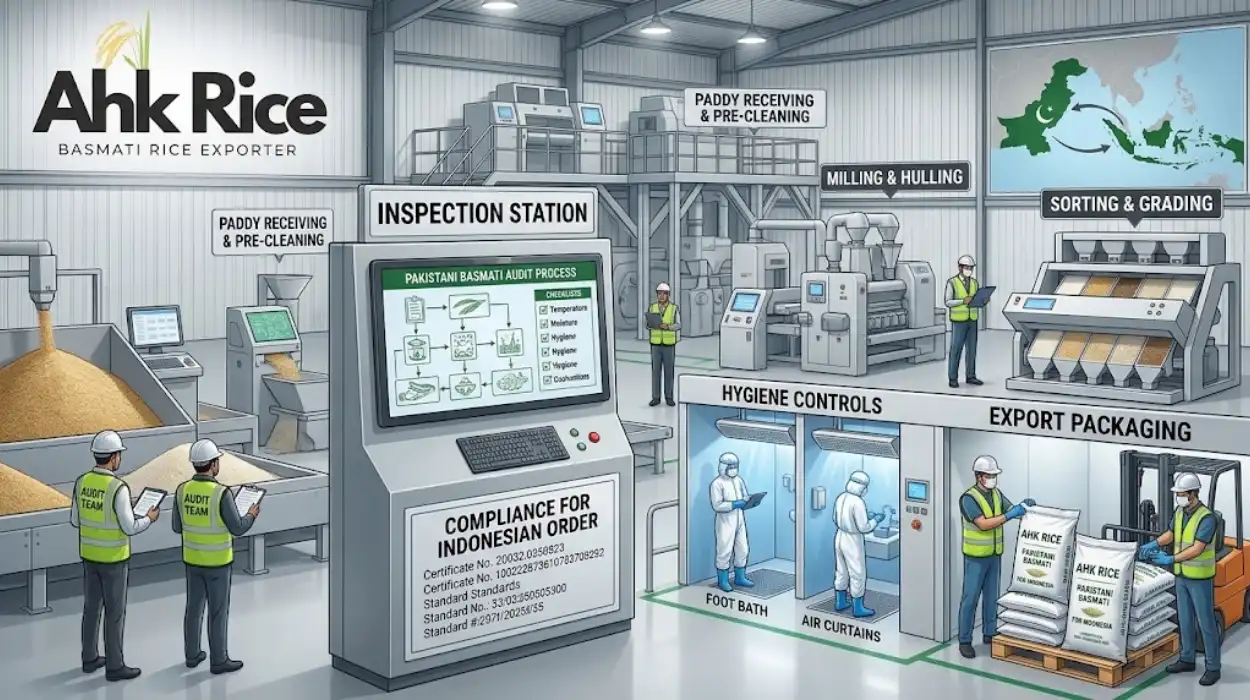
An effective audit should examine:
- Paddy sourcing: Confirm the rice variety, Punjab origin and available traceability records.
- Pre-cleaning: Check equipment used to remove stones, dust, straw and foreign material.
- Dehusking: Verify that husk separation produces clean brown rice.
- Whitening and polishing: Examine grain appearance, milling consistency and surface finish.
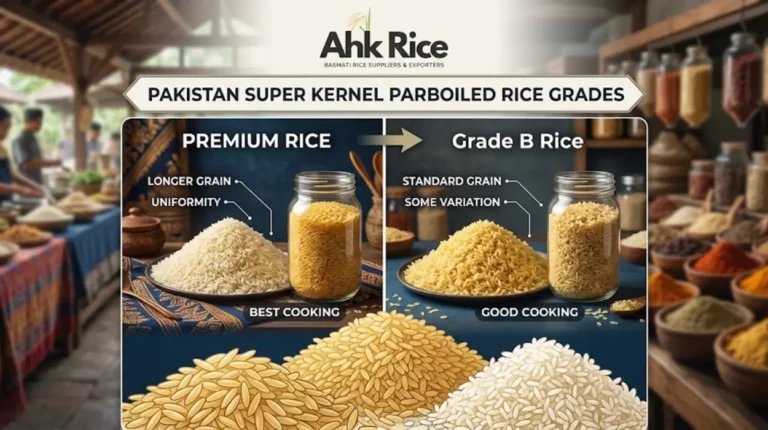
- Grading: Review length separation, broken percentages and grade specifications.
- Sortex processing: Inspect colour sorting for discoloured grains and unwanted foreign material.
- Packaging: Verify bag materials, weight accuracy, stitching and batch identification.
- Storage: Check moisture protection, warehouse cleanliness and finished-stock handling.
Buyers should also compare the mill’s processing sequence with the product-specific requirements in the Basmati milling and grading comparison guide. This helps distinguish equipment availability from actual quality-control performance.
Why choose AHK Rice for an Indonesian Basmati rice order?
AHK Rice provides an integrated sourcing, processing and export arrangement from Punjab, allowing Indonesian buyers to coordinate rice specifications, milling, grading, packaging, sampling and shipping through one supplier. This reduces communication gaps between separate processing and export intermediaries.
AHK Rice is a Pakistani Basmati rice exporter based in Punjab, supplying 1121, Super Kernel and 1509 varieties to international buyers across 15+ countries.
Through its Pakistani Basmati rice export and supply services, AHK Rice coordinates the major stages between paddy procurement and container loading.
The available processing capabilities include:
- Paddy procurement from Punjab’s rice-growing regions.
- Industrial pre-cleaning and dehusking.
- Whitening and polishing according to the selected grade.
- Length grading and broken-grain separation.
- Colour sorting through Sortex equipment.
- Customised retail and bulk packaging.
- Export documentation and shipment coordination.
The appropriate variety depends on the Indonesian buyer’s distribution channel.
1121 Basmati: Suitable for premium retail, specialty rice distributors and restaurants seeking extra-long cooked grains and aromatic performance.
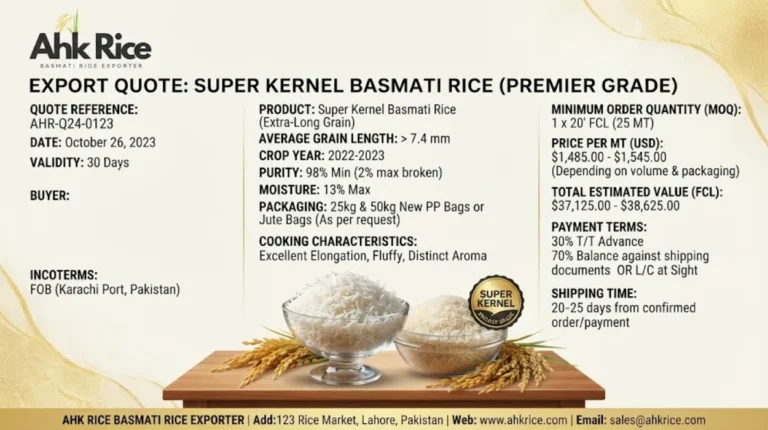
Super Kernel Basmati: Appropriate for ethnic grocery wholesalers and buyers prioritising traditional Pakistani Basmati aroma, slender grains and competitive positioning.
1509 Basmati: A practical option for buyers evaluating yield efficiency, bulk distribution and competitive purchasing costs.
AHK Rice can discuss product specifications and processing requirements before production. Buyers should confirm the actual available grade, crop year, moisture level and broken percentage in the commercial specification.
What results can Indonesian buyers expect from a facility audit?
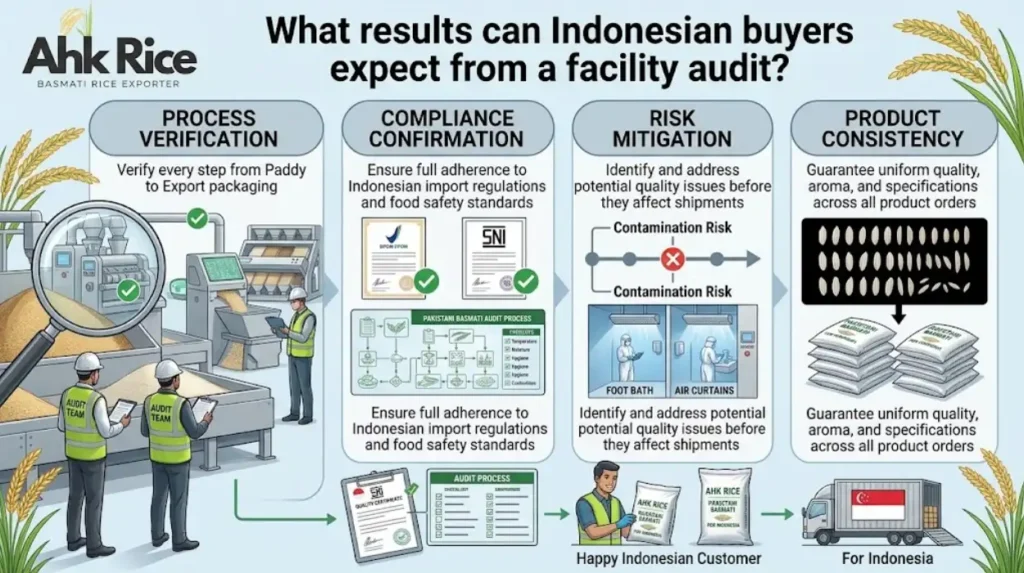
A completed audit provides a clearer basis for approving a supplier, selecting a rice grade and establishing measurable shipment requirements. It also creates a documented reference against which pre-shipment inspection and delivered cargo can be evaluated.
The most important outcome is specification consistency.
For example, an Indonesian distributor ordering Super Kernel Basmati can establish requirements for grain length, moisture, broken percentage, aroma, colour and packaging before approving production.
A practical quality-control checklist includes:
| Inspection parameter | What buyers should verify |
|---|---|
| Rice variety | 1121, Super Kernel or 1509 |
| Grain length | Agreed raw-grain specification |
| Moisture | Contractual maximum |
| Broken percentage | Agreed grade tolerance |
| Purity | Foreign material and varietal consistency |
| Colour | Uniformity and discoloured grain control |
| Aroma | Characteristic Basmati fragrance |
| Packaging | Material, weight and labelling |
Buyers should request a representative production sample rather than relying exclusively on showroom samples. A third-party inspection can independently assess the finished lot before container loading.
AHK Rice also offers third-party inspection arrangements, including SGS inspection, with independent inspection charges payable by the buyer.
The final inspection report, approved sample and contractual specification should refer to the same product grade and production lot.
How does the sample approval process work, and what does it cost?
The sample process starts with product selection, followed by specification confirmation, sample preparation, courier dispatch and buyer evaluation. AHK Rice offers up to 20 kg of rice samples without a product charge, while the buyer covers courier and applicable phytosanitary certification costs.
Indonesian buyers can follow this process before placing a bulk order.
Step 1: Submit the sample request.
Specify the required variety, processing type, grain grade, intended application and destination in Indonesia. Identify whether the requirement is for 1121, Super Kernel or 1509.
Step 2: Confirm the sample specification.
Agree on grain length, moisture, broken percentage, appearance and packaging. Request the available technical specification and relevant quality documentation.
Step 3: Arrange sample preparation.
AHK Rice prepares the requested rice sample. Up to 20 kg is available free of product charges, subject to confirmation of the selected grade.
Step 4: Arrange courier and phytosanitary costs.
The buyer pays international courier charges and applicable phytosanitary certification costs. The buyer can also provide an existing courier account. Exact costs depend on destination, sample weight, courier service and applicable certification requirements.
Step 5: Receive and evaluate the sample.
AHK Rice indicates sample dispatch through DHL or the buyer’s nominated courier within approximately 3–5 days after inquiry. The buyer should conduct cooking, aroma, grain elongation and appearance tests.
Step 6: Approve the commercial sample.
Once approved, the sample specification becomes the reference for bulk production. If the buyer completes an order, AHK Rice states that sample-related charges can be waived in the final export quotation, subject to agreed terms.
This process gives Indonesian importers an opportunity to evaluate product suitability before committing to a container.
How much does an Indonesian Basmati rice order cost?
The final purchase price depends on rice variety, crop year, processing grade, quantity, packaging, inspection requirements, freight, insurance and delivery terms. A reliable quotation must separate the rice price from destination-specific logistics and compliance expenses.
AHK Rice prepares quotations according to the buyer’s actual specification rather than applying one price to every Basmati grade.
The main cost factors include:
- Variety: 1121, Super Kernel and 1509 have different market positioning.
- Processing: Steam, Golden Sella and other agreed processing options affect production costs.
- Quality: Grain length, broken percentage, moisture and purity influence grade pricing.
- Packaging: Retail bags, private-label packaging and 25 kg or 50 kg bulk bags have different requirements.
- Quantity: Full-container orders and recurring contracts influence commercial pricing.
- Inspection: Independent inspection and laboratory testing may involve additional charges.
- Freight: Container availability, carrier, route and destination port determine shipping costs.
For planning purposes, published freight estimates indicate approximately 14–26 days of port-to-port ocean transit from Karachi to Jakarta, depending on the carrier and service. Surabaya and other Indonesian destinations require separate routing confirmation. These are indicative estimates, not guaranteed sailing schedules.
Total delivery time also includes factory preparation, inland transport, port handling, customs clearance and destination delivery.
Indonesian importers should obtain confirmation of current rice import permissions, applicable quota or approval requirements and phytosanitary conditions before production and shipment. Import eligibility must be established by the buyer and relevant Indonesian authorities.
How can Indonesian buyers start a facility audit and place an order?
Start by requesting the facility information, product specification, sample and inspection arrangements. Once the buyer approves the sample and confirms Indonesian import eligibility, both parties can finalise the commercial contract, payment terms, packaging and shipment schedule.
AHK Rice recommends a specification-led purchasing process.
- Submit the required variety and destination details.
- Request processing information and available facility audit arrangements.
- Review the technical specification and quality-control documents.
- Arrange a physical or remote facility inspection.
- Request samples and complete cooking evaluations.
- Approve the commercial sample and contractual tolerances.
- Confirm the Indonesian import requirements and shipping documents.
- Finalise quantity, price, payment terms and delivery arrangements.
- Arrange pre-shipment inspection and container loading.
Buyers should confirm the commercial invoice, packing list, bill of lading, certificate of origin and phytosanitary documentation according to the applicable Indonesian import requirements. Pakistan’s Department of Plant Protection handles export phytosanitary certification in accordance with destination-country requirements.
A documented audit, approved sample and agreed inspection standard provide a stronger purchasing foundation than selecting an exporter on price alone.
Indonesian importers, distributors and wholesale buyers can request a customised Basmati rice export quotation from AHK Rice to discuss specifications, sampling, facility inspection and container shipments.
Frequently Asked Questions
Can Indonesian buyers audit AHK Rice’s processing facility?
Yes. Buyers can request information about AHK Rice’s processing facility in Bucheki, Nankana Sahib, Punjab. Audit arrangements should be confirmed before scheduling. The review can cover sourcing, cleaning, milling, grading, Sortex and packaging. Buyers can also request relevant quality documentation. Physical or remote inspection arrangements depend on mutual agreement.
2. Which Basmati varieties does AHK Rice supply to Indonesia?
AHK Rice supplies Pakistani 1121, Super Kernel and 1509 Basmati varieties. Each variety serves different retail, wholesale and foodservice requirements. Buyers can specify Steam, Golden Sella or other available processing grades. Final availability depends on crop and production schedules. Commercial samples help confirm suitability before ordering.
Are AHK Rice samples free for Indonesian importers?
AHK Rice offers up to 20 kg of rice samples without product charges. Buyers pay applicable international courier and phytosanitary certification costs. DHL or a buyer’s nominated courier can be arranged. Sample dispatch is indicated within approximately 3–5 days after inquiry. Applicable sample charges may be waived in the final order quotation under agreed terms.
How long does shipping take from Pakistan to Indonesia?
Indicative ocean transit from Karachi to Jakarta is approximately 14–26 days, depending on the shipping service. Surabaya and other destinations require separate estimates. Port congestion and transshipment can affect arrival schedules. Customs clearance and inland delivery add further time. Buyers should confirm the vessel schedule before finalising delivery commitments.
Can buyers arrange third-party rice inspection before shipment?
Yes. AHK Rice offers third-party inspection arrangements, including SGS inspection. Buyers can establish inspection parameters before production and loading. The independent inspection charges are payable by the buyer. Inspection should compare the finished lot with the approved commercial sample and contractual specification. The final inspection report provides additional evidence for shipment acceptance.