FOB Karachi vs CIF Jakarta and Surabaya: Basmati Rice Cost Breakdown
FOB Karachi works best for Indonesian buyers that already control freight, while CIF Jakarta or CIF Surabaya works better when the buyer wants one coordinated quotation covering rice, ocean freight, and insurance to the destination port. The right choice depends on shipment size, freight access, destination, and required landed-cost control.
For a broader understanding of how Pakistani Basmati reaches Indonesia, buyers can first review this guide to importing Pakistani Basmati rice into Indonesia before comparing commercial terms.
What are the available solutions for buying Pakistani Basmati rice?
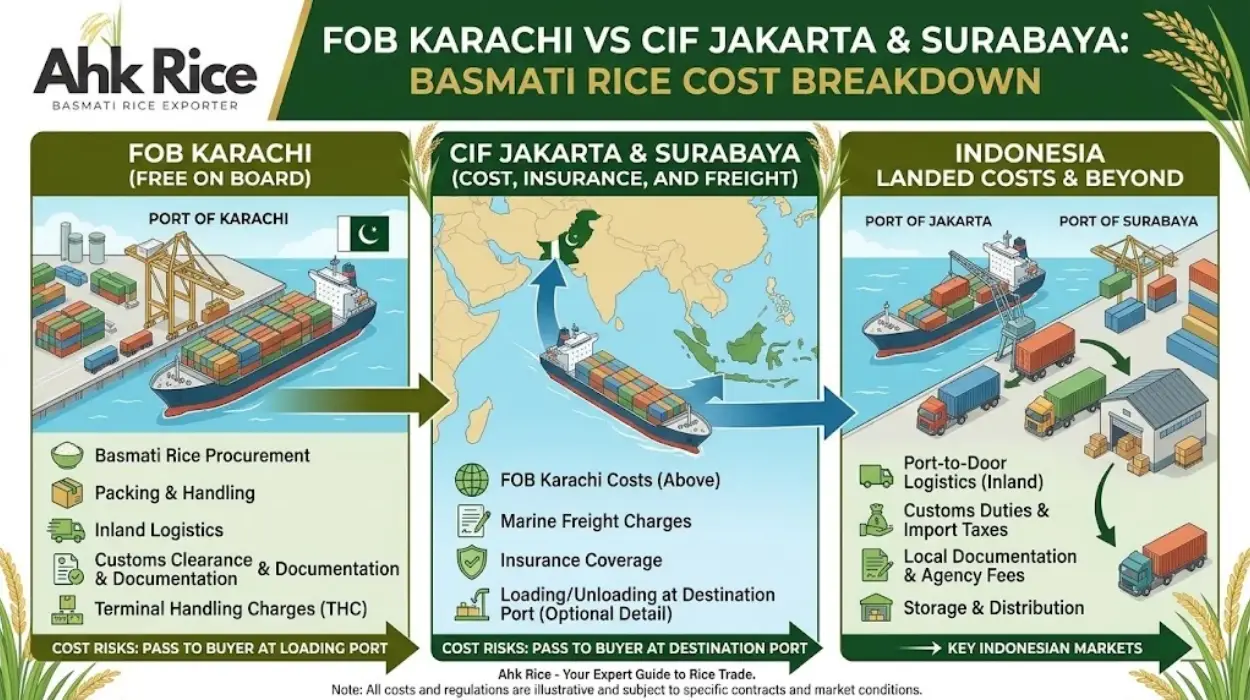
Indonesian buyers have three practical cost structures: FOB Karachi, CIF Jakarta, and CIF Surabaya. FOB separates ocean freight from rice procurement, while CIF combines rice, freight, and insurance to the named Indonesian port.
FOB means Free On Board. Under FOB Karachi, the exporter prepares the rice, completes export clearance, and loads the shipment onto the vessel nominated for the contract. The importer arranges the main ocean freight and normally controls the freight booking.
CIF means Cost, Insurance and Freight. Under CIF Jakarta, the exporter arranges the ocean freight and marine insurance to the named Jakarta destination port. CIF Surabaya follows the same structure but uses Surabaya as the named destination.
Neither FOB nor CIF represents the complete Indonesian landed cost. Import duties, taxes, customs clearance, destination handling, inland transportation, inspection charges, and other applicable local costs remain outside the basic CIF price.
The three approaches therefore solve different procurement problems. FOB gives more control over freight. CIF simplifies supplier coordination. The important comparison is not simply the quoted price per metric ton but the total cost structure behind each quotation.
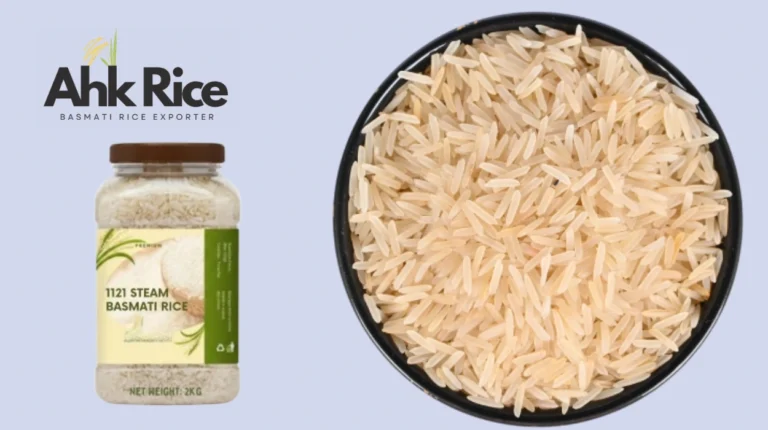
For AHK Rice, the commercial specification can include 1121, Super Kernel, and 1509 varieties, with White, Steam, and Sella processing options. Grade, grain length, broken percentage, moisture, packaging, quantity, and destination all influence the quotation.
How do FOB Karachi, CIF Jakarta, and CIF Surabaya compare?
FOB Karachi normally provides the strongest freight-control option, while CIF provides simpler budgeting. Jakarta and Surabaya use the same basic CIF structure, but destination routing, freight, port handling, and inland distribution change the final economic result.
| Specification attribute | FOB Karachi | CIF Jakarta | CIF Surabaya |
|---|---|---|---|
| Rice price | Exporter product price | Product plus freight and insurance | Product plus freight and insurance |
| Ocean freight | Buyer arranges | Exporter arranges | Exporter arranges |
| Marine insurance | Buyer arranges | Included in agreed CIF | Included in agreed CIF |
| Destination | Karachi loading point | Jakarta destination port | Surabaya destination port |
| Freight control | High | Lower | Lower |
| Budget simplicity | Moderate | High | High |
| Best commercial use | Experienced importers | Jakarta-focused distribution | East Java-focused distribution |
The biggest distinction is responsibility. FOB transfers main freight planning to the importer. CIF transfers freight coordination to the exporter.
FOB also gives a buyer more freedom to use an existing freight contract. A distributor importing multiple commodities may already have negotiated container rates with a carrier or freight forwarder. In that situation, FOB can create a stronger purchasing position.
CIF is useful when the importer wants a supplier to coordinate the shipment. The buyer can compare a product-and-freight quotation against another supplier without separately sourcing ocean freight.
The destination port also matters. Jakarta is a logical choice for buyers distributing around western Indonesia and Java. Surabaya can be more efficient for buyers concentrated in East Java and nearby distribution networks. AHK Rice identifies both Jakarta and Surabaya as primary Indonesian shipment destinations.
What is the price difference between FOB and CIF Basmati rice?
A current AHK Rice Indonesia reference lists 1121 Basmati from about US$1,100 per MT FOB Karachi. CIF pricing is higher because freight and insurance are added, so buyers should compare FOB and CIF using the same grade, quantity, packaging, and shipment specification.
The US$1,100 per MT figure is an indicative starting reference for 1121 Basmati FOB Karachi, not a guaranteed CIF Jakarta or CIF Surabaya quotation. Final pricing changes with volume, packaging, season, product specification, freight, and destination.
For example, a 100 MT order at US$1,100 per MT represents US$110,000 for the rice component before ocean freight, insurance, destination charges, import costs, and inland delivery.
A simplified comparison looks like this:
| Cost component | FOB Karachi | CIF Jakarta/Surabaya |
|---|---|---|
| Rice reference | US$1,100/MT | US$1,100/MT base |
| Ocean freight | Added separately | Included |
| Marine insurance | Added separately | Included |
| Destination charges | Separate | Separate |
| Import taxes/duties | Separate | Separate |
| Inland delivery | Separate | Separate |
| Final landed cost | Buyer calculates | Buyer calculates |
This distinction prevents one of the most common procurement errors: comparing a US$1,100 FOB quotation directly with a higher CIF quotation and assuming the FOB supplier is automatically cheaper.
The correct comparison adds the buyer’s actual freight and insurance cost to FOB. The CIF quotation already includes those elements up to the named destination port.
For example, if an importer can obtain competitive freight through an existing logistics contract, FOB can produce a lower landed cost. If independent freight costs are high or freight management creates administrative work, CIF can produce a better overall procurement result.
How do Jakarta and Surabaya costs differ?
Jakarta and Surabaya should be evaluated according to the buyer’s distribution network rather than by port name alone. Freight, vessel routing, transshipment, port charges, inland delivery, and final warehouse location determine which destination produces the lower total cost.
Jakarta is particularly relevant for importers serving western Indonesia and major Java distribution channels. Surabaya provides a strong destination option for East Java buyers and businesses distributing from the eastern side of Java.
Sea transit planning from Karachi to Indonesia is commonly presented around 14–21 days for Jakarta or Surabaya on AHK Rice’s Indonesia export material, although other published planning ranges extend longer depending on routing and port conditions.
The important point is that ocean transit is not the same as total procurement lead time. Production, packing, documentation, vessel scheduling, customs clearance, port handling, and inland delivery must be added.
A buyer with a warehouse near Jakarta should calculate the complete Jakarta route. A buyer serving East Java should calculate the complete Surabaya route. Choosing the nearest major port based only on ocean freight can produce the wrong result when inland transportation is considered.
Which Basmati grades work best for different Indonesian markets?
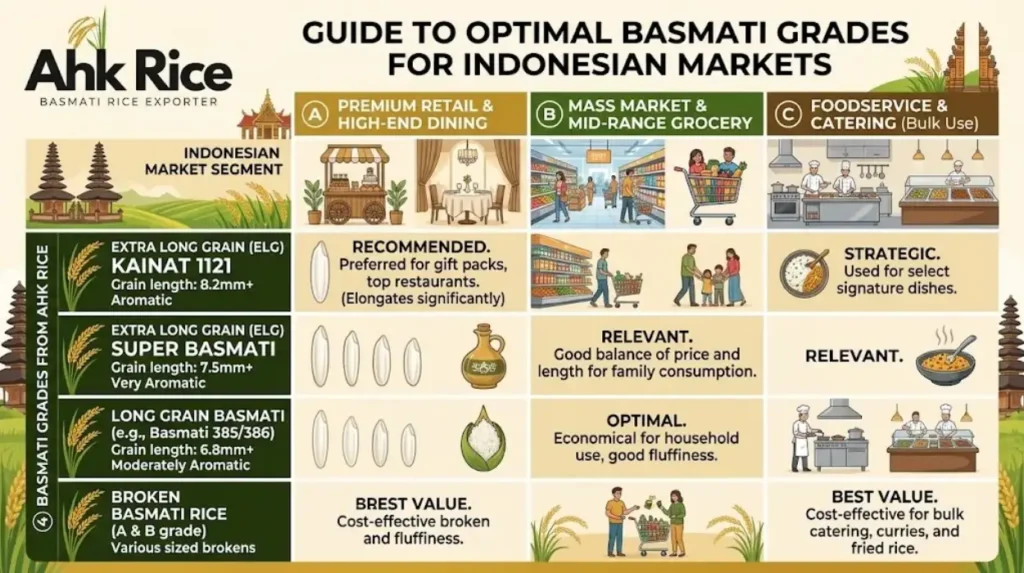
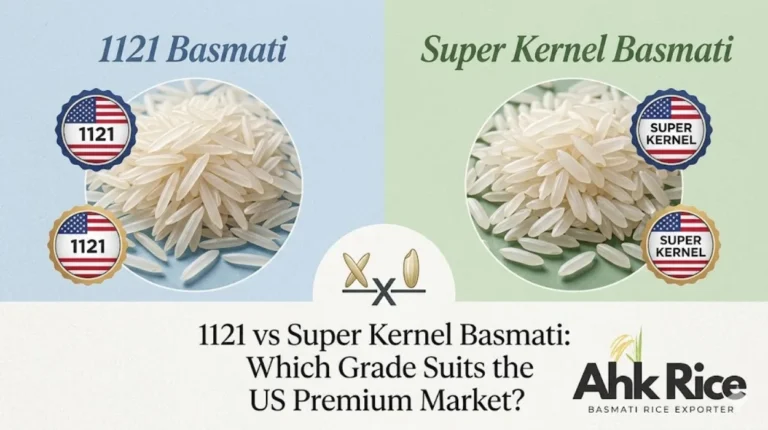
1121 suits premium retail and foodservice buyers seeking long grain, aroma, and presentation, while 1509 provides a cost-focused alternative. Super Kernel targets buyers prioritising premium Pakistani Basmati characteristics and consistent commercial specifications.
1121 is commonly positioned as a premium Basmati option because of its long grain and aromatic cooking profile. Steam and Sella processing create different cooking and handling characteristics, so the buyer should specify processing rather than requesting only “1121 Basmati.”
Super Kernel occupies another premium position. It is associated with Pakistani Basmati from Punjab and can suit retail, restaurant, and distributor programs where aroma, grain appearance, and consistent specification are important.
1509 provides a different commercial proposition. Its shorter maturity cycle and strong yield characteristics make it useful when buyers prioritise supply efficiency and competitive pricing.
For a foodservice distributor, 1509 Steam or Sella can provide a practical balance between cooking performance and cost. For premium retail, 1121 White or Steam can provide stronger grain presentation. For long-storage distribution programs, Sella processing deserves specific evaluation because parboiling changes grain structure and storage behaviour.
The specification should therefore start with the intended market rather than the supplier’s available stock.
How does shelf life compare between Basmati options?
Shelf life depends on processing, moisture, packaging, warehouse conditions, pest control, and stock rotation. Properly processed Basmati can support long commercial storage, while Sella products provide stronger kernel stability for selected distribution programs.
There is no single shelf-life number that applies to every Basmati shipment. The commercial storage period depends on moisture control, packaging integrity, warehouse humidity, temperature, pest management, and product processing.
A practical planning range for properly stored commercial rice is often 12–24 months, with the actual specification and storage environment determining stock performance. AHK Rice’s Indonesia material also distinguishes between product grades and storage requirements rather than assigning one universal shelf-life figure.
| Product approach | Typical market position | Storage planning |
|---|---|---|
| 1121 White | Premium retail/foodservice | Strong with controlled storage |
| 1121 Steam | Premium and high-volume use | Strong with controlled moisture |
| 1121 Sella | Long holding and foodservice | Strong kernel stability |
| 1509 Steam | Cost-conscious bulk programs | Suitable for planned stock rotation |
| Super Kernel | Premium Pakistani Basmati | Depends strongly on packaging and storage |
Buyers planning 6–12 months of inventory should define warehouse conditions before selecting the grade. A premium rice specification stored in poor humidity conditions does not retain its commercial advantage.
Which method works best for different cases?
FOB is strongest for experienced importers with freight contracts, while CIF is stronger for buyers seeking simpler procurement. Jakarta suits western and central Java distribution, while Surabaya often fits East Java-focused supply chains.
| Buyer situation | Preferred option | Reason |
|---|---|---|
| Existing freight contract | FOB Karachi | Buyer controls ocean freight |
| New Indonesian importer | CIF Jakarta or Surabaya | Simpler shipping coordination |
| Jakarta warehouse network | CIF Jakarta | Destination aligns with distribution |
| East Java distribution | CIF Surabaya | Reduces unnecessary inland movement |
| Large repeat importer | FOB Karachi | Greater freight negotiation control |
The best method is therefore determined by the buyer’s operating model. A large importer with established logistics capability can gain more from FOB.
A smaller distributor may prefer CIF because one supplier coordinates the principal shipping elements. This reduces the number of separate commercial inputs needed for initial budgeting.
The same principle applies to port selection. The correct destination is the one that produces the strongest total landed-cost position after inland transportation and local charges are included.
What are the pros and cons of FOB versus CIF?
FOB provides greater freight control but requires stronger logistics management. CIF simplifies purchasing and budgeting but gives the buyer less direct control over the freight arrangement and requires careful review of the included destination terms.
FOB’s main advantage is control. Buyers can select their freight forwarder, negotiate shipping rates, choose carriers, and manage vessel schedules according to their own logistics strategy.
Its disadvantage is administrative responsibility. The importer must obtain freight and insurance costs before knowing the complete landed price.
CIF’s main advantage is simplicity. The supplier coordinates ocean freight and insurance to the named destination port. This gives the buyer a clearer product-plus-shipping quotation.
Its disadvantage is reduced freight control. Buyers should inspect the CIF quotation carefully and confirm the exact destination port, freight validity, insurance coverage, shipment schedule, and excluded destination charges.
For example, a distributor with a strong freight contract may save money with FOB. A buyer placing a first container order without established shipping relationships may gain more operational value from CIF.
What decision factors should Indonesian buyers use before ordering?
The strongest procurement decision compares identical specifications across FOB and CIF quotations, then calculates landed cost, stock requirements, destination logistics, quality controls, and supplier execution before selecting the commercial term.
A five-step decision framework provides a practical way to compare offers:
| Decision factor | Question to ask | Preferred evaluation |
|---|---|---|
| Product specification | Are grade, processing, moisture and broken limits identical? | Compare like-for-like |
| Freight | Can the buyer obtain better freight independently? | Choose FOB when control adds value |
| Destination | Which port reduces total inland cost? | Jakarta or Surabaya by warehouse location |
| Inventory | How long must the rice remain in stock? | Match processing and storage plan |
| Risk control | Who coordinates freight, documents and insurance? | Choose the structure matching internal capability |
This framework prevents buyers from selecting a quotation based only on the headline US$/MT figure.
The product specification must remain identical during the comparison. A 1121 Steam quotation should not be compared against 1121 White or 1509 simply because the price is lower.
Packaging must also remain consistent. A 50 kg bulk bag and a private-label retail pack have different material, printing, labour, and production requirements.
Inspection requirements should also be included. Third-party inspection, laboratory testing, phytosanitary documentation, and other shipment-specific requirements can alter the final commercial calculation.
What is the practical solution for comparing AHK Rice quotations?
The most reliable approach is to request comparable FOB Karachi and CIF Jakarta or Surabaya quotations using one fixed specification, quantity, packaging format, destination, and inspection requirement, then calculate the complete landed cost.
AHK Rice’s Indonesia supply information states that quotations depend on variety, processing grade, quality specifications, quantity, packaging, freight, inspection, and destination. This makes a specification-based quotation more useful than a generic price list.
For example, an importer can submit:
- 1121 Steam or Sella
- Required broken percentage
- Required moisture specification
- Total metric tons
- 25 kg, 50 kg, or custom packaging
- Jakarta or Surabaya destination
- FOB or CIF requirement
- Inspection requirement
- Required shipment schedule
- Payment preference
The supplier can then calculate the commercial offer against the actual order structure.
The same process applies when comparing 1121, Super Kernel, and 1509. Product selection should follow the buyer’s market position, while Incoterm selection should follow the buyer’s logistics capability.
A properly structured quotation also reduces disputes because the commercial specification becomes the reference point for production, inspection, packing, documentation, and shipment.
FOB Karachi and CIF Jakarta or Surabaya are not competing prices for the same cost boundary. They are different procurement structures. FOB gives the importer greater freight control, while CIF provides simpler shipping coordination.
The strongest purchasing decision comes from comparing identical rice specifications and calculating the complete landed cost. For Indonesian buyers, destination choice must also reflect the warehouse location and distribution network. Jakarta and Surabaya should therefore be evaluated as separate logistics routes rather than treated as interchangeable ports.
AHK Rice can structure quotations around 1121, Super Kernel, and 1509 requirements, including processing, packaging, destination, and shipment terms. The buyer’s objective should be a transparent specification-to-landed-cost comparison rather than the lowest headline FOB or CIF figure.
Frequently Asked Questions
Is FOB Karachi cheaper than CIF Jakarta?
FOB is not automatically cheaper. FOB excludes main ocean freight and insurance, while CIF includes those costs to the named destination port. Compare the complete landed cost before choosing.
What is the indicative price of Pakistani 1121 Basmati for Indonesia?
AHK Rice publishes an indicative starting reference of about US$1,100 per MT FOB Karachi for 1121 Basmati shipments to Indonesia. The final quotation changes according to grade, quantity, packaging, season, and specification.
What is the difference between CIF Jakarta and CIF Surabaya?
The commercial structure is the same, but freight routing, destination charges, port handling, and inland transportation differ. The better option depends on the buyer’s warehouse and distribution network.
Which Basmati rice is best for Indonesian distributors?
1121 suits premium retail and foodservice programs, Super Kernel suits premium Pakistani Basmati positioning, and 1509 suits buyers prioritising supply efficiency and competitive pricing.
How long does Pakistani Basmati take to reach Indonesia?
Planning estimates commonly place sea transit from Karachi to Jakarta or Surabaya around 14–21 days, with additional time required for production, documentation, vessel scheduling, customs, and inland delivery.
Does CIF include Indonesian import duty and taxes?
No. CIF generally covers the agreed product, ocean freight, and marine insurance to the named destination port. Import duties, taxes, customs clearance, destination handling, and inland transportation remain separate unless specifically included under another contractual arrangement.
Should an importer choose FOB or CIF for a first order?
CIF is often easier for a first shipment when the importer lacks an established freight arrangement. FOB becomes more attractive when the buyer has freight contracts, experienced logistics staff, or strong control over shipping costs.